
Aluminized Steel Supplier Evidence: Plant, Lab, Stock & Export
Aluminized Steel Supplier Evidence: Plant, Lab, Stock & Export
A supplier's plant size, headcount and export count are easy to publish and difficult to check. For an aluminized steel buyer working between evaluation and execution, the useful question is not whether a supplier lists these numbers, but whether each number can be traced to something the buyer can inspect, test or write into a purchase order.
This article examines the evidence behind aluminized steel supply at Dalian Mesco Steel Co., Ltd. (MESCO): a 40,000 m² facility, approximately 120 staff, five R&D engineers, key performance indicators verified in the company's laboratory, tens of thousands of tons of standard-specification stock and a 3–7 working-day delivery window for stocked material. Each item is connected to the ASTM A463 Type 1 and Type 2 product envelope it supports — 0.37–3.0 mm thickness, 600–1500 mm width, and AS80 through AS300 g/m² coating weights — and to the limitation a buyer should confirm before the order is locked.
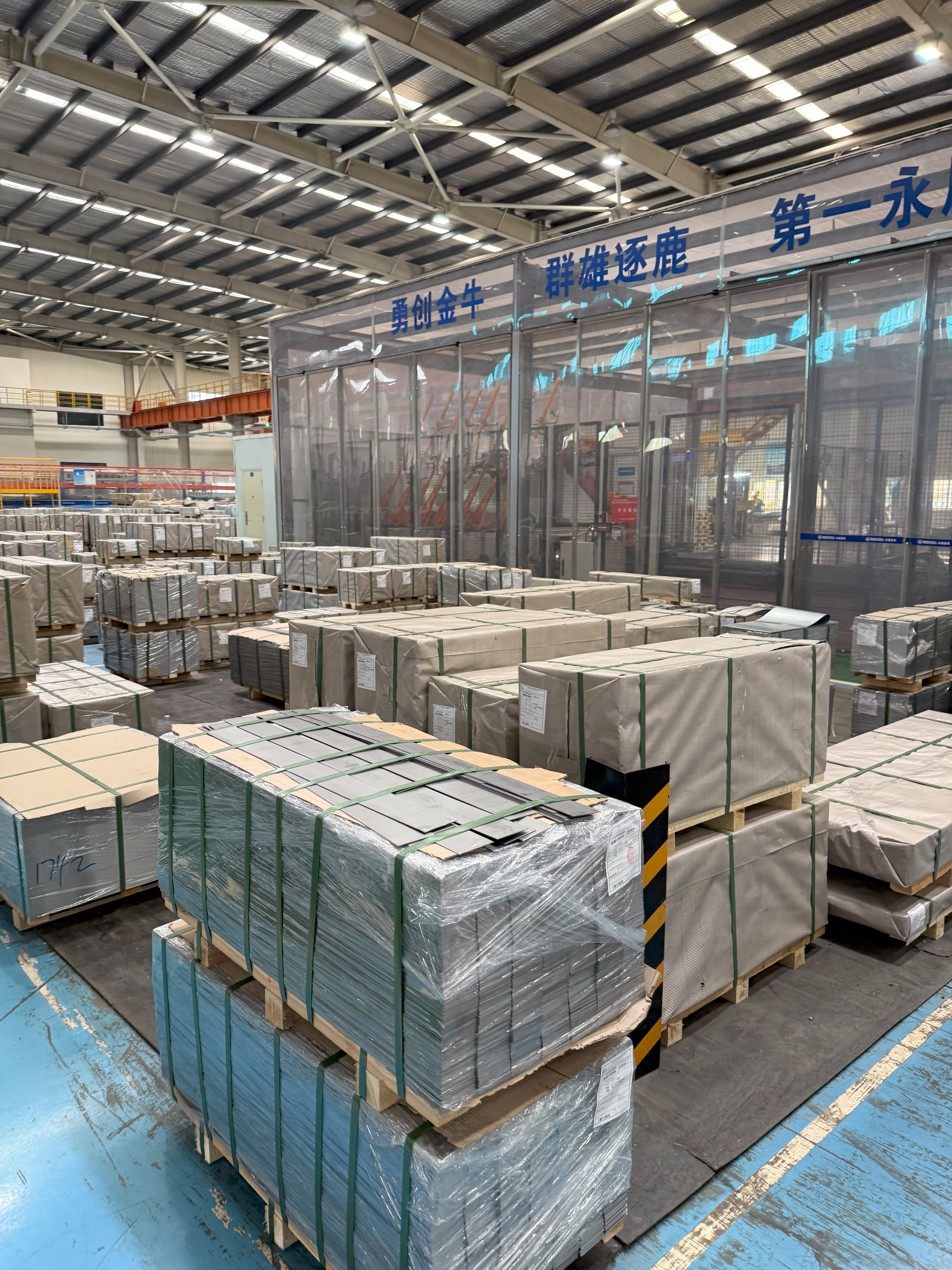
Standard-specification steel held in stock at the MESCO facility in Dalian, Liaoning Province.
Why Supplier Evidence, Not Supplier Claims, Decides the Order
Aluminized steel is specified by standard. ASTM A463 defines two coating types and a set of coating weight classes, so the material a buyer wants is rarely ambiguous on paper. What remains uncertain at the evaluation and execution stage is whether a given supplier can reproduce that specification on the coil, sheet, strip or plate the buyer actually needs — repeatedly, without the buyer inspecting every shipment personally.
Supplier claims and supplier evidence answer different questions. A floor area answers whether a supplier can physically handle the buyer's coil sizes. A laboratory answers whether the supplier can tell the buyer what the material is. A stock figure answers whether the supplier can ship before a production line stops. An export record answers whether the supplier has completed the documentation and logistics before. None of these four answers proves coating adhesion on a specific coil, and none replaces a mill test certificate — but together they define what a buyer can audit before the first order rather than after the third.
That is the framework used below: four categories of evidence, each paired with the specific check a buyer can request, and each accompanied by a plain statement of what it does not establish.
The Plant Record: 40,000 m² in Dalian
Dalian Mesco Steel Co., Ltd. was founded in 2007 and is based in the Dalian Economic and Technological Development Zone, Liaoning Province, China. The company operates a 40,000 m² facility with approximately 120 employees, and states that it owns six subsidiaries covering steel, UV coatings, robotic automation, modular housing and construction machinery.
For an aluminized steel buyer, the plant figure matters for one practical reason: coil handling. Aluminized steel coil, sheet, plate and strip are bulky, edge-sensitive products. Storage area, crane capacity and cut-to-length or slitting equipment determine whether a supplier can hold mixed specifications without damaging outer wraps, and whether a modest order can be assembled from stock rather than scheduled as a fresh production run.
The 120-employee figure is informative in the opposite direction. It describes a focused operation rather than a very large integrated mill, which is consistent with a supplier built around stocking, specification matching and export coordination rather than around commodity tonnage. Buyers who need one high-volume grade at the lowest achievable cost should test that assumption directly; buyers assembling several coating classes and sizes from a single source are closer to the profile this footprint supports.
What the plant record does not state is line-level aluminized capacity: the number of coating lines, the tonnage each can produce, or the maximum coil weight handled. Those figures belong in a capability questionnaire and should be requested in writing, because floor area and throughput are not interchangeable measures.
The Lab Record: Five Engineers and Tested KPIs
MESCO states that key performance indicators are tested and verified in laboratories, from chemical composition to mechanical properties, and that it employs five R&D engineers.
This is the most consequential of the four evidence categories, because it is the one that turns a specification into a document. ASTM A463 controls the coating type and coating weight of aluminum-coated sheet; the base metal beneath that coating is controlled by chemical composition and mechanical properties. A supplier that measures both can tell a buyer, before shipment, whether the coil in the warehouse is the material described in the purchase order.
The verification question is therefore not whether a laboratory exists, but what it is used for. A buyer should ask which KPIs are tested on every lot and which are tested only on request; whether results are reported per heat or per coil; and whether reports are issued from an in-house laboratory or supported by an accredited third party. These two arrangements provide different levels of assurance, and a purchase order should state which one it requires rather than leave the answer to interpretation.
Five R&D engineers is a deliberately modest team, and that has a planning implication. Standard grades and standard coating classes are typically handled through established procedures, while genuinely new requirements — an unusual base-metal grade, a non-standard width, or a coating class near the top of the published range — need to be raised early enough for the engineering response to fit the project schedule. Buyers planning a first trial order should build that conversation into the timeline rather than into the final week.
The Stock Record: Tens of Thousands of Tons and 3–7 Working Days
MESCO states that it maintains tens of thousands of tons of stock for standard specifications, enabling delivery within 3–7 working days.
For a buyer in the execution stage, stock is the evidence category that protects a production schedule — and it is also the category most often misread. Stocked volume describes finished material already sitting in a warehouse. It does not describe production capacity, and the two are not interchangeable. A supplier holding large stock of common sizes can ship quickly and cannot necessarily produce an unusual coating class quickly. Conversely, a supplier with strong line capacity may still quote several weeks for a grade it does not hold.
The 3–7 working-day window should therefore be read as a statement about stocked standard material, not as a universal lead time. Three points are worth writing into the order: whether the clock starts at order confirmation, at deposit or at credit approval; which port or warehouse the material ships from; and whether the quoted size and coating class are confirmed as stock at the time of quotation rather than assumed to be. A buyer who resolves those three points converts a marketing sentence into a delivery term.
The Product Envelope: ASTM A463 Type 1 and Type 2
The aluminized steel MESCO supplies is quoted against ASTM A463 in Type 1 and Type 2, across 0.37–3.0 mm thickness and 600–1500 mm width, with coating weights from AS80 to AS300 g/m².
Under ASTM A463, Type 1 is an aluminum-silicon alloy coating intended for heat resistance, with a service capability up to 677 °C; Type 2 is a commercially pure aluminum coating intended for atmospheric corrosion resistance. The distinction is not stylistic. It determines which coating type suits a given thermal or corrosive environment, and it belongs on the purchase order explicitly rather than being inferred from a product title such as aluminum silicon coated steel or hot-dip aluminized steel.
The dimensional envelope is broad in a specific way. At 0.37 mm the material sits in light-gauge territory, where handling, flatness and coating continuity matter more than stiffness. At 3.0 mm it moves into heavier component work, including high-temperature parts. Widths from 600 mm to 1500 mm span narrow strip through full-width sheet, which is why processing capability — slitting, cut-to-length and edge treatment — matters as much as the coil itself when a buyer evaluates a supplier rather than a grade.
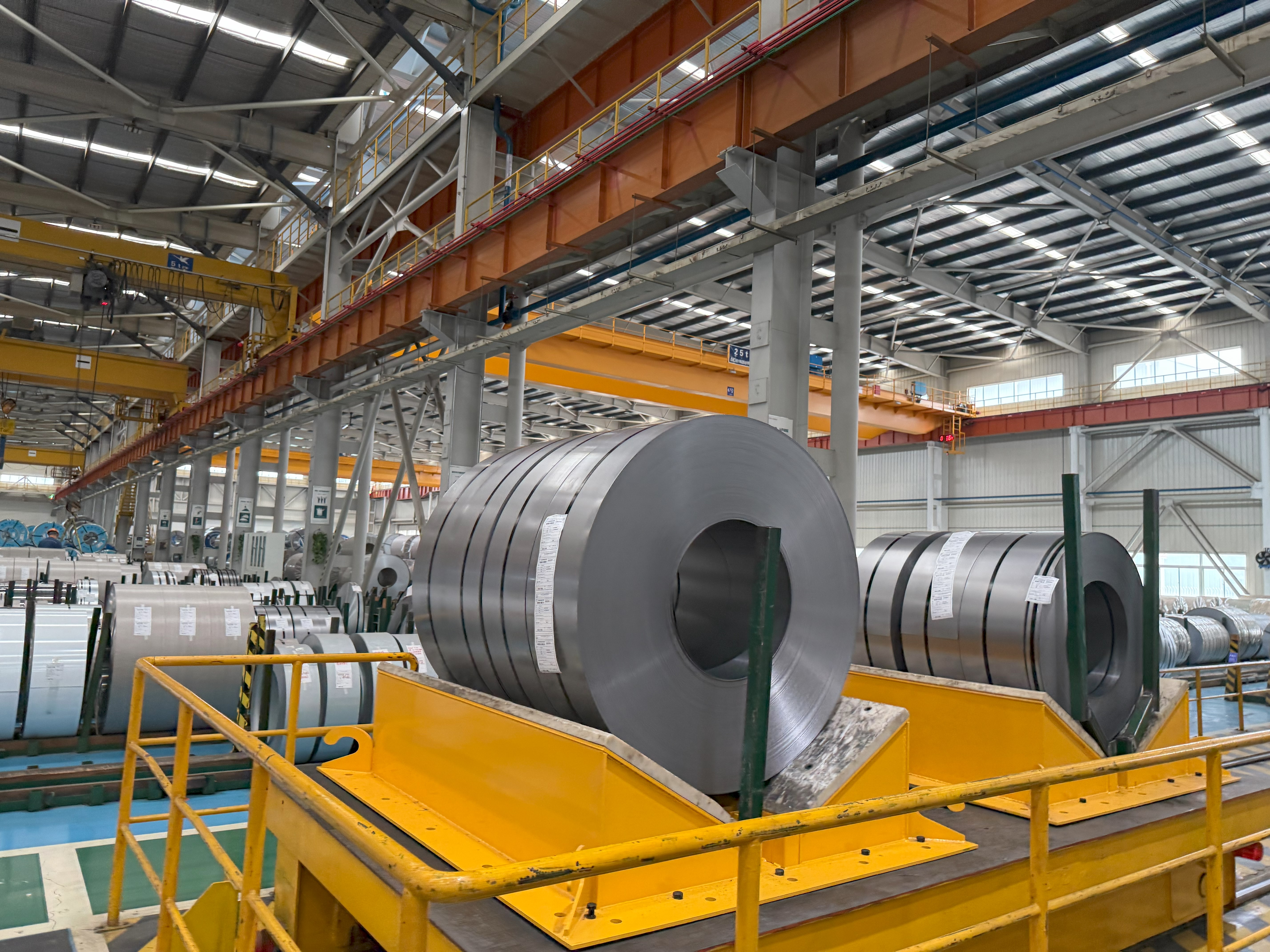
Coated steel supply covering coil, sheet, strip and plate formats from a single stocking point.
| ASTM A463 coating class | Coating weight (g/m²) | Confirm before ordering |
|---|---|---|
| AS80 | 80 | Base-metal grade and mechanical properties for the intended forming operation |
| AS120 | 120 | That the class matches the heat-exposure assumption behind the part design |
| AS240 | 240 | Coating-mass test method and sampling frequency |
| AS275 | 275 | Whether the exact size and class are held as stock or made to order |
| AS300 | 300 | Production lead time and wrap/edge protection for the heavier coating |
Coating classes published in the MESCO aluminized steel range. Each row is a confirmation point for the buyer, not a performance rating.
One comparison point follows from the table. A quoted AS designation should be confirmed in writing as total coating on both surfaces, because the basis affects how two quotations for apparently identical material are compared. Two suppliers can both write "AS240" and describe different quantities of deposited coating if the basis is left unstated.
What Coating Weight Actually Decides
Within a given type, coating weight is the main variable the buyer controls. The aluminum-silicon layer is the part that resists oxidation and reflects heat; a heavier coating generally means more of that layer is available before the base metal becomes exposed, which is why heavier classes are usually associated with longer service in demanding conditions.
Two cautions follow. First, heavier is not automatically better for every application: a thicker coating changes forming behaviour and surface condition, and a part designed around AS120 should not be switched to AS300 without checking how it forms. Second, coating weight is a mass per unit area, so it has to be verified by a stated method at a stated sampling frequency. A certificate that names the class without a measured value is a description, not a test result.
This is where the laboratory evidence and the product envelope meet. The value of five engineers testing chemical and mechanical properties is not the existence of a testing room; it is that a declared coating class and a declared base metal can be checked against the delivered coil with a document the buyer can file.
Application Fit: Where Aluminized Steel Earns Its Place
Type 1 heat-resistant aluminized steel is normally considered where a part sees elevated temperature in service and where a heat-reflective steel material can stand in for a more costly alloy in the same position. Exhaust components, furnace and oven internals, heat exchangers and water-heater parts are long-standing examples of that pattern. Type 2 is the atmospheric-corrosion choice, used where the dominant risk is moisture and weathering rather than temperature.
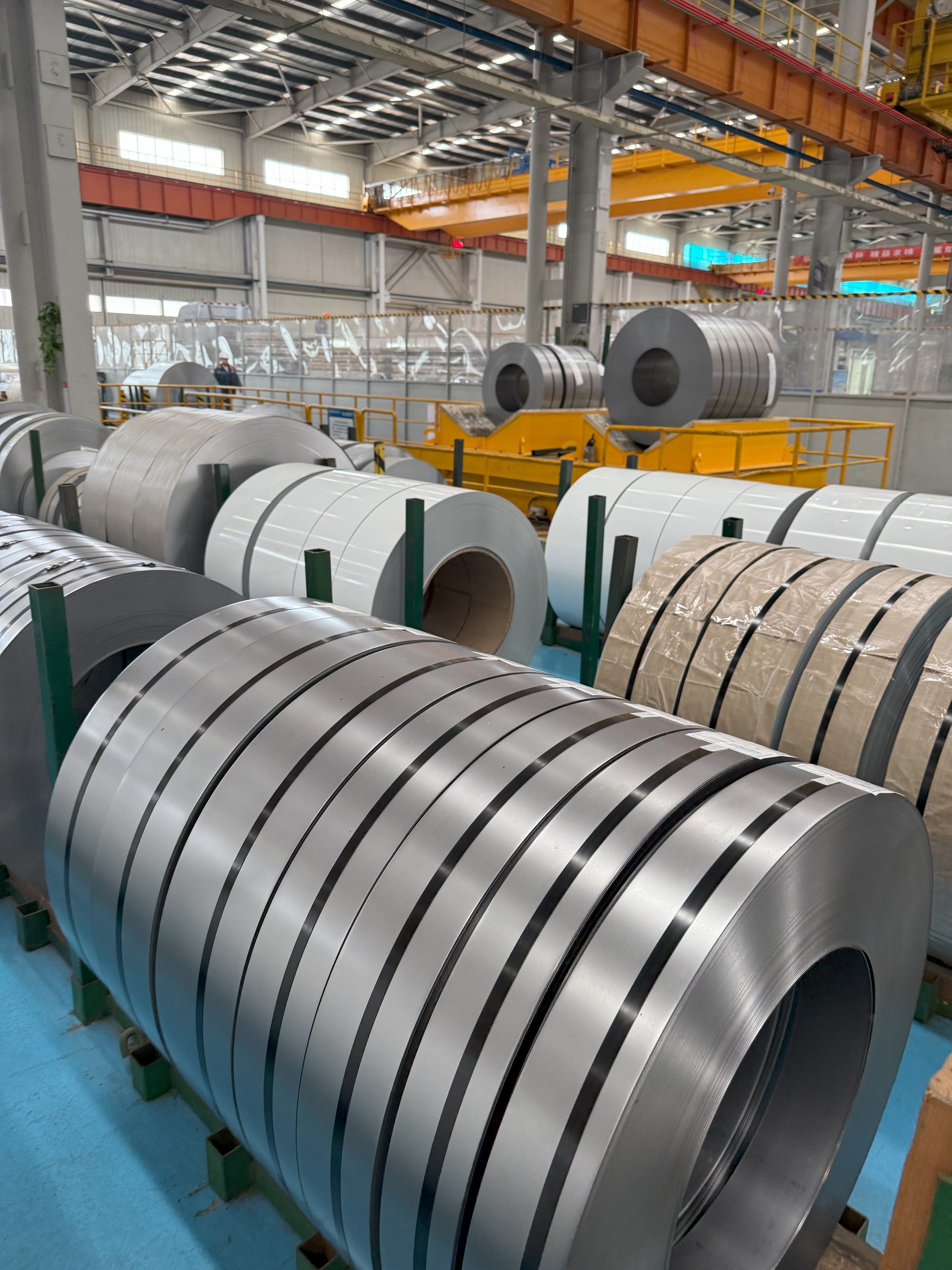
Processing equipment inside the MESCO plant in Dalian; the coated product envelope is quoted separately by type and coating class.
These are application patterns, not guarantees for a specific design. The fit boundary is the actual thermal and corrosive profile of the component. A part running near the upper end of the Type 1 range leaves little margin for a mis-specified coating class, and a part exposed to a corrosive environment outside the assumed conditions needs its own evaluation rather than a default upgrade in coating weight.
It is equally useful to name where aluminized steel is not the answer. Where a component faces sustained wet, acidic or chloride-rich exposure, an austenitic stainless grade is generally the more appropriate choice, and the same applies where a part needs corrosion resistance across a wide range of media rather than heat reflection. In those cases the aluminized option is not a cheaper equivalent and should not be presented as one; the comparison only holds inside the temperature and atmospheric range the coating was designed for.
The Export Record: 100+ Markets, 700+ Clients
MESCO states exports to more than 100 countries and regions and more than 700 clients, including 9 Fortune Global 500 companies, with an export ratio of 70%. Named markets include South Korea, Thailand, the Philippines, the United Arab Emirates, Saudi Arabia, Indonesia, Turkey, Brazil, Pakistan, Malaysia, Peru, India, Mexico, Russia, Singapore, Bangladesh, Nigeria, Chile and South Africa.
For a buyer, the value of that record is procedural rather than metallurgical. Repeated export shipments mean the supplier has handled certificates of origin, sea-freight packing, customs documentation and multi-market delivery schedules before. For a first-time importer, that lowers the probability that a technically correct coil arrives with an incorrect document set — a failure mode that costs more schedule time than a small coating deviation.
What the record does not establish is that the buyer's specific grade, width and coating class have been shipped to the buyer's market. Aggregate client counts are not a reference list, and they should not be treated as one. A buyer should ask for contacts or order patterns in the same product family and same application type, and should treat that request as a normal part of supplier qualification rather than as a challenge to the supplier's credibility.
What Supplier Evidence Does Not Prove
The published capability description does not include aluminized line capacity in tons, price levels, a certification list, third-party audit results, or a verified market ranking. Buyers who need those items should request them and expect a documented answer rather than a verbal assurance.
The distinction matters because a strong evidence set can create a false sense of completeness. A 40,000 m² plant, a laboratory and a large stock position describe a supplier's ability to hold, measure and ship material. They do not describe the material in the buyer's specific order. Only a mill test certificate, a dimensional inspection and, where relevant, a pre-shipment inspection do that — and those documents should be requested as standard on a first order rather than as an escalation.
A Buyer's Verification Sequence
For an evaluation moving into execution, the eight checks below convert the four evidence categories into order documents.
- Written specification. State the ASTM A463 type (1 or 2), the coating class from AS80 to AS300, thickness in millimetres and width in millimetres. Do not leave the type to be inferred from a product title.
- Base-metal confirmation. Ask which grade sits beneath the coating and which mechanical properties are expected from it.
- Coating-mass verification. Ask which test method and sampling frequency will be used, and how the result is shown on the certificate.
- Stock confirmation. Ask whether the exact size and class are held as stock; if not, ask for the production lead time rather than assuming the stocked-material window applies.
- Delivery clock definition. Confirm whether the 3–7 working-day window starts at order confirmation, deposit or credit approval, and which port of loading applies.
- Packing and edge protection. Heavier coatings and thinner gauges are both vulnerable in transit; specify wrap, edge protection and coil weight limits.
- Documentation set. Confirm certificates of origin, inspection certificates and any market-specific documentation required at destination.
- Pre-shipment inspection. On a first order, a third-party inspection before shipment is the most direct test of whether the evidence set matches the delivered material.
Market Context and Outlook
Zion Market Research, a commercial research publisher, estimated the global aluminized steel sheet market at USD 13.43 billion in 2024. The figure is a commercial estimate covering the sheet segment and should be read as a scale indicator, not as a forecast of any individual supplier's position or of the growth available to a particular buyer.
What that scale implies for a buyer is narrower than it first appears. In a large category with many available sources, availability is rarely the binding constraint; repeatability is. The parts of a supplier's evidence set that address repeatability — laboratory verification of declared properties, stock depth by specification, and a delivery window that is defined rather than implied — are therefore the parts worth the most attention during evaluation.
The forward-looking read is conditional rather than promotional. If a project's thermal profile sits near the upper limit of Type 1 service capability, coating class selection becomes the decisive variable and the supplier's ability to verify it becomes the decisive evidence. If a project's exposure is atmospheric, Type 2 and coating availability dominate. In both cases the evaluation procedure is the same; only the binding constraint changes.
Conclusion
Aluminized steel supply can be evaluated as a chain of verifiable statements rather than as a set of claims. At MESCO, that chain runs from a 40,000 m² facility and roughly 120 staff, through laboratory verification of chemical and mechanical properties by five R&D engineers, to tens of thousands of tons of standard stock with a 3–7 working-day delivery window, and out to more than 100 export markets and 700+ clients across an ASTM A463 Type 1 and Type 2 envelope of 0.37–3.0 mm thickness, 600–1500 mm width and AS80 to AS300 g/m² coating weights.
Each link answers a different question, and none of them answers the last one: whether the coil delivered matches the coil ordered. That answer comes from a mill test certificate, a dimensional check and, on a first order, an inspection before shipment. Treating the plant, lab, stock and export figures as the start of a verification sequence — rather than as the conclusion of one — is what separates a supplier evaluation from a brochure reading.
The full product range and specification set are collected in the MESCO STEEL catalogue (PDF), and specification questions can be directed to mesco@mescogroup.com.cn.
FAQ
How can a buyer verify aluminized steel coating weight before shipment?
Ask for the coating-mass test method, the sampling frequency and the measured value on the certificate, not only the class name. Confirm whether the quoted AS designation is stated as total coating on both surfaces, so that quotations from different suppliers are compared on the same basis. On a first order, a pre-shipment inspection adds an independent check on the delivered coil.
What is the practical difference between ASTM A463 Type 1 and Type 2 when evaluating a supplier?
Type 1 uses an aluminum-silicon alloy coating intended for heat resistance, with a service capability up to 677 °C under ASTM A463. Type 2 uses commercially pure aluminum for atmospheric corrosion resistance. For evaluation, the difference determines which base-metal and coating combination the supplier must be able to test and document, and the type should be written explicitly on the purchase order.
Does the 3–7 working-day delivery window apply to non-standard sizes and custom coating classes?
The stated window applies to standard specifications held in stock, which the company describes as tens of thousands of tons. Non-standard thickness, non-standard width or a coating class not held as stock should be quoted separately with its own production lead time. Buyers should also confirm whether the clock starts at order confirmation, deposit or credit approval.
What does an export record of 100+ markets and 700+ clients tell a buyer?
It indicates repeated handling of export documentation, sea-freight packing and multi-market delivery schedules, which reduces procedural risk on a first order. It does not confirm that the buyer's specific grade, width and coating class have been shipped to that buyer's market, so a request for references in the same product family remains a reasonable part of qualification.
Which thickness, width and coating weight range is quoted for aluminized steel?
The MESCO aluminized steel range is quoted against ASTM A463 in Type 1 and Type 2, from 0.37 mm to 3.0 mm in thickness, 600 mm to 1500 mm in width, and from AS80 to AS300 g/m² in coating weight. Buyers should confirm that the exact combination required is available as stock or as a made-to-order item before fixing a project schedule.
Have Questions or Need More Details?
Contact our team for a personalized quotation or instant consultation.
Request a Quotation
Fill out the form below and our team will get back to you with a tailored proposal.
WhatsApp Direct Chat
Prefer to chat in real-time? Message us on WhatsApp for instant assistance & quick answers.
- Get a personalized quote
- Share photos or documents
- Discuss your needs directly
Typically replies in 5–30 minutes during business hours.