
Aluminum Bioclimatic Pergolas: A Buyer's Discovery Guide
Aluminum Bioclimatic Pergolas: A Buyer's Discovery Guide
An aluminum bioclimatic pergola is a motorized outdoor roof structure built from aluminum profiles, in which adjustable louvers rotate to control sunlight, shade, ventilation and rain protection. It belongs to the wider category of outdoor living solutions within construction and decoration, and it is increasingly specified as part of a building's exterior rather than bought as garden furniture. For buyers in the discovery stage, the useful questions are not about slogans but about structure: what the roof does in rain, how the motor is protected, what the load ratings mean, and what a supplier must be able to document before a project can be specified.
Why Outdoor Space Is Being Re-Engineered, Not Just Decorated
Outdoor areas on residential and commercial properties have traditionally been furnished rather than built. A wooden pergola, a fabric awning or a fixed metal canopy is added to a terrace, and the space is used when the weather allows. The limitation is structural, not decorative: a fixed roof cannot respond to changing sun angles or sudden rain, and a fabric awning cannot stay deployed in strong wind.
The result is predictable. Owners of villas, courtyards and poolside decks lose usable hours; restaurants and hotels lose terrace seating capacity; landscapers deliver spaces that look complete but perform seasonally. Buyers increasingly ask for a roof that can be adjusted hour by hour and used across seasons — the requirement that motorized louvered, or bioclimatic, pergolas were developed to answer.
This is also why pergolas now appear in project scopes alongside fences, gates and screens. They are part of a coordinated exterior rather than an isolated purchase, which changes how they are sourced and evaluated.
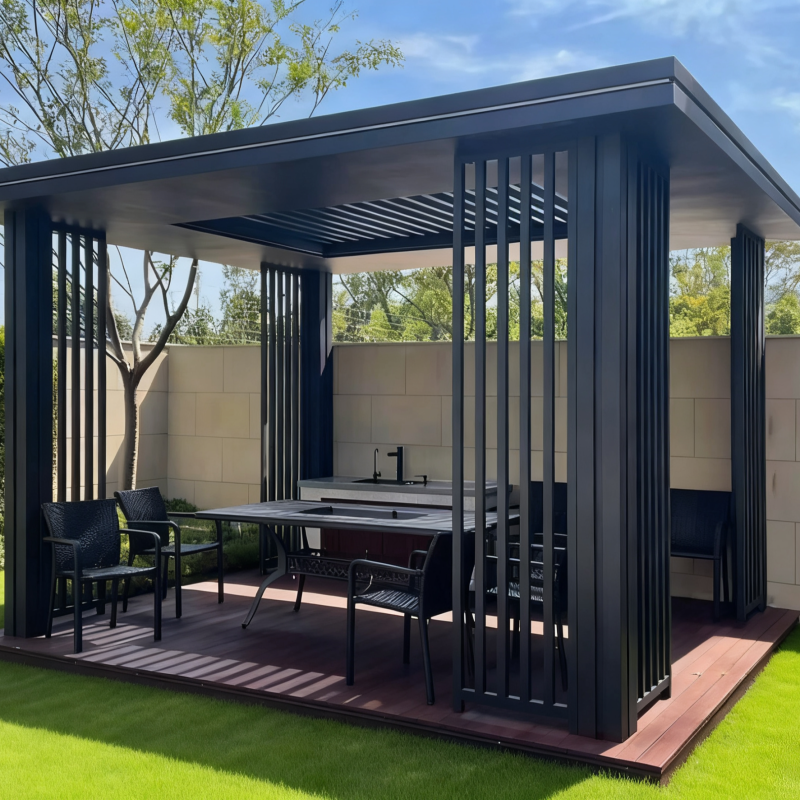
An all-season aluminum louvered pergola: the roof structure, not the furniture, determines how many hours a year the space can be used.
What an Aluminum Bioclimatic Pergola Actually Is
The word "bioclimatic" describes function, not certification. A bioclimatic pergola modifies the microclimate beneath its roof by changing the geometry of that roof. In an aluminum version, the roof surface is made of horizontal aluminum louvers rather than a solid panel or fabric sheet. When the louvers rotate, the roof moves between three states: open for ventilation and sky view, partially angled for shade with airflow, and fully closed for rain protection.
Structurally, the product category is defined by four things: an aluminum frame and louver system, a rotation mechanism (motorized or manual), an integrated water management design, and a mounting method — typically wall-mounted or free-standing, with multi-zone layouts and special cuts or angles for irregular spaces. Aluminum alloy is the primary material of the pergola on this platform, with 6063-T5 aluminum alloy used as the standard specification for aluminum products.
Henan Junsu Technology Co., Ltd., trading as Junsu Outdoor, is an outdoor courtyard product supplier based in Zhengzhou, Henan Province, China, established in 2001 with more than 25 years of experience in metal courtyard product manufacturing and international trade. Its aluminum bioclimatic pergola is offered as a custom-made product with model configurations 147, 163, 175 and 220, available in wall-mounted, free-standing and multi-zone formats with special cuts and angles.
How the Structure Works: Louvers, Motors and Drainage
The engineering question buyers ask first is usually about rain. A louvered roof is not a solid slab, so waterproofing depends on how the closed position and the drainage path are designed.
In Junsu Outdoor's aluminum louvered pergola, the louvers rotate through a 0–90° motorized range. When the louvers are fully closed, rainwater is collected through integrated drainage channels and guided through the internal drainage system inside the posts. This is the mechanism that allows the structure to be described as a waterproof pergola rather than only a shade structure. It also explains why installation matters: the internal drainage path only performs as designed when the frame is level, correctly anchored and connected to adequate site drainage.
The operating mode is automatic louver adjustment for sun, shade, ventilation and rain protection. Control can be manual switch, wireless remote, mobile app, automatic weather sensing or timed switching, depending on configuration. Optional equipment integrates at the factory or on site, including LED ambient lighting, motorized retractable zip screens, cooling mist fans, outdoor heaters, waterproof audio speakers, and rain or wind sensors.
For the electrical side, the motor and control components are installed with outdoor protection requirements in mind, and the working condition is specified as outdoor installation resistant to high humidity and dust across a wide temperature range of -35℃ to 65℃, with IP66 waterproof and dustproof protection. Two practical boundaries apply: electrical components must not remain submerged in standing water, and the power supply location, drainage conditions, cable routing and installation surface should be confirmed before installation.
Material and finish choices follow the same logic. Aluminum alloy construction is corrosion-free, and premium fluorocarbon and wood-grain transfer finishes are described by the manufacturer as UV, salt spray and rain resistant, supporting long-term color stability. Standardized certification covers the production system: ISO 9001 quality system certification and CE EU product safety certification.
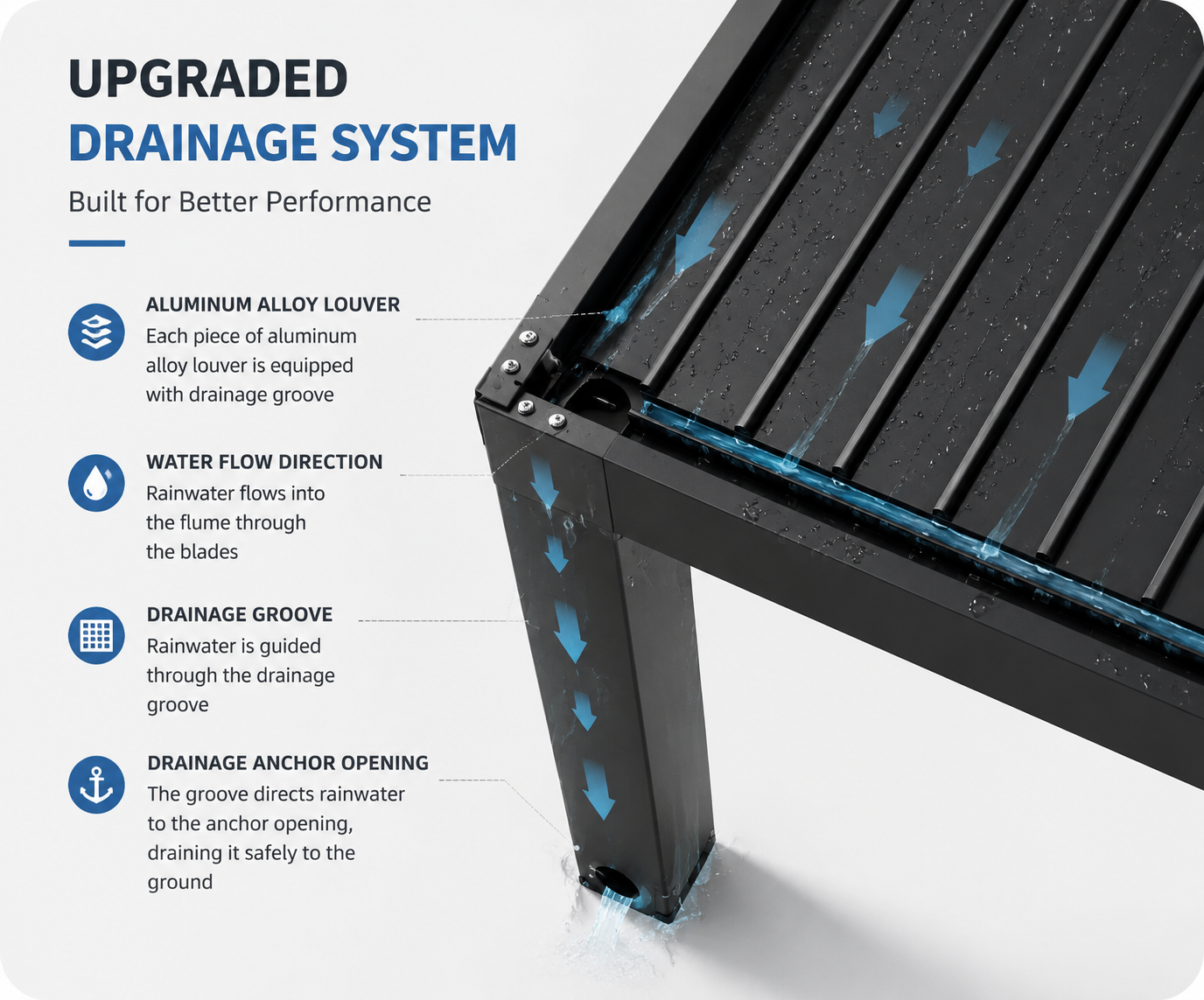
Louvered pergola drainage diagram: closed louvers channel rainwater into internal post drainage rather than off the roof edge.
Where These Structures Are Used
The application profile of aluminum bioclimatic pergolas is broader than residential gardens, which is why they sit in construction and decoration rather than in garden furniture. The product is intended for the garden decoration and outdoor landscaping industry and is designed for garden, courtyard, villa, beach and camping scenarios, with commercial space and public construction as typical applications.
Recurring project types include villa residential renovation, commercial plaza landscaping, community courtyard reconstruction, scenic area outdoor supporting works, and high-end real estate supporting facilities. In practice this covers poolside and patio roofs where sun exposure is intense, restaurant and hotel terraces where covered seating capacity has direct commercial value, and courtyard layouts where a freestanding louvered roof defines an outdoor room without blocking airflow.
Documented reference markets for this supply base are the United States, Belgium, Canada, Germany, France, the United Kingdom, Singapore and Switzerland, with roughly 90% of production exported and major markets including the EU, USA, France, Germany, Canada and Australia.
What the Market Data Shows — and Where It Gets Blurry
Independent market research places the global aluminum pergola market at USD 3.8 billion in 2025, projected to reach USD 7.1 billion by 2034 (Dataintelo, Aluminum Pergola Market Research Report 2034). Within that, North America leads demand with a 34.2% market share in 2025 according to the same source.
The motorized and bioclimatic sub-segment is tracked separately by Fortune Business Insights, which expects the global bioclimatic pergola market to grow from USD 600.87 million in 2026 to USD 1,049.46 million by 2034, a CAGR of 7.22%.
On the supply side, the commercial-grade segment includes established specialists such as StruXure, identified in industry analysis as a major American manufacturer of commercial-grade motorized louvered pergola systems. For buyers, the practical takeaway is that the category spans commercial-grade engineered systems and lower-specification shade products that borrow similar terminology, so specification documents matter more than category labels.
Aluminum Louvered Systems Compared with Traditional Shade Solutions
Comparing a motorized louvered pergola with traditional options is not a question of which material is universally better. It is a question of which performance profile fits the site, the usage pattern and the maintenance budget.
| Evaluation criterion | Aluminum louvered / bioclimatic pergola | Wooden pergola | Retractable fabric awning | Fixed steel or aluminum canopy |
|---|---|---|---|---|
| Rain protection | Full coverage when louvers are closed and internal drainage is correctly installed | None; open slats or beams are not sealed | Provides cover when deployed; must be retracted in strong wind | Full cover, but fixed |
| Adjustability | Motorized 0–90° louver rotation, with optional weather sensing | None | Extend and retract only | None |
| Corrosion behaviour | Aluminum alloy construction described as rust-free; finishes specified for UV and salt spray exposure | Untreated wood degrades in humid and coastal conditions; requires sealing | Fabric and mechanism degrade with UV and rain exposure | Steel variants require coating maintenance |
| Maintenance profile | Manufacturer states zero annual anti-corrosion work, with regular light cleaning | Periodic staining, sealing and rot repair | Fabric cleaning and periodic replacement | Repainting or rust treatment |
| Upfront cost | Higher: manufacturer comparison notes place initial purchase cost 15%–25% above traditional materials | Lower | Moderate | Lower |
| Long-term cost basis | Manufacturer comparison notes cite a 3–6 times longer replacement cycle, roughly 90% less maintenance workload, and 70%–80% lower overall cost within 20 years | Recurring annual maintenance | Repeated fabric replacement | Recurring coating maintenance |
Note: cost, maintenance and lifespan figures in the table above are comparison notes published by the manufacturer (Junsu Outdoor) and describe aluminum versus wrought iron, solid wood and brick alternatives. Buyers should validate them against their own maintenance costs, labour rates and project lifespan.
What Buyers Should Verify Before Specifying a Pergola
At the research stage, the most useful output of a supplier conversation is a specification sheet that can be compared across vendors. The following points are the ones that separate a definable product from a generic listing.
- Material and temper. Which aluminum alloy and temper is used? 6063-T5 aluminum alloy is the stated standard for aluminum products from this supplier.
- Louver mechanism. What is the rotation range, is it motorized or manual, and is the motor silent in operation for residential use?
- Water management. How is rainwater collected when the roof is closed, and where does it discharge? Internal post drainage is the mechanism used in this product family.
- Load ratings and their basis. Snow load up to 100 lbs/sq ft and wind load up to 190 mph are stated for the specified configuration; confirm the anchoring and installation assumptions behind those figures.
- Electrical protection. What is the protection rating of the motor and control enclosure, and what are the requirements for cable routing and drainage at the power supply point?
- Accessory integration. Which items — LED lighting, zip screens, fans, heaters, misting, speakers, rain and wind sensors — are factory-integrated versus site-installed?
- Documentation package. Are technical drawings, design optimization, installation drawings, customized logos, private labels and packaging available? Customization can be supported from CAD drawings, architectural plans, sketches, photos, dimensions and samples.
- Certification and standards. CE EU product safety certification and ISO 9001 quality system certification apply to this supplier. For the EU market, EN 13561:2015 is the European standard covering performance and safety requirements for external blinds and awnings, including pergola awnings; it is a standard reference, not a brand certification.
- Customs and classification. Tariff treatment is product-specific. As a documented example, aluminum fence panel kits from China are classified under HTSUS 7610.90.0080 with a duty rate of 5.7% (U.S. Customs and Border Protection ruling); confirm classification for the exact product and destination with a customs broker.
- After-sales route. Spare parts, technical support and installation guidance should be defined before the order, not after delivery.
The Supplier Side: What a Full-Scope Outdoor Manufacturer Brings
For project buyers, the practical advantage of sourcing a pergola from a manufacturer that also produces fences, gates and screens is dimensional and visual consistency rather than convenience alone. Henan Junsu Technology Co., Ltd. operates a 30,000 m² manufacturing facility with approximately 120 staff, covering the full production process from metal processing, cutting and welding to assembly, quality inspection and packaging, with an annual production capacity of approximately 36,000 sets of outdoor courtyard products.
Its product scope covers custom gates, fences, screens, railings, stair handrails, pavilions and pergolas for outdoor courtyard projects, with main products including outdoor gazebos, aluminum fences and automatic driveway gates. An R&D team of 10 engineers and technicians supports OEM/ODM customization, and quality control is implemented across raw material inspection, manufacturing, assembly, functional checks, pre-shipment inspection and packaging inspection, with 100% inspection before delivery and third-party sampling inspection of raw materials and finished goods.
Because profiles, color codes and finishing processes are shared across pergolas, fences and gates from a single factory, coordinated outdoor systems avoid the color mismatch that commonly appears when these items are purchased separately from different vendors. Coordination is a genuine procurement criterion in villa and residential renovation projects, where the pergola, boundary fence and driveway gate are all visible in the same view.
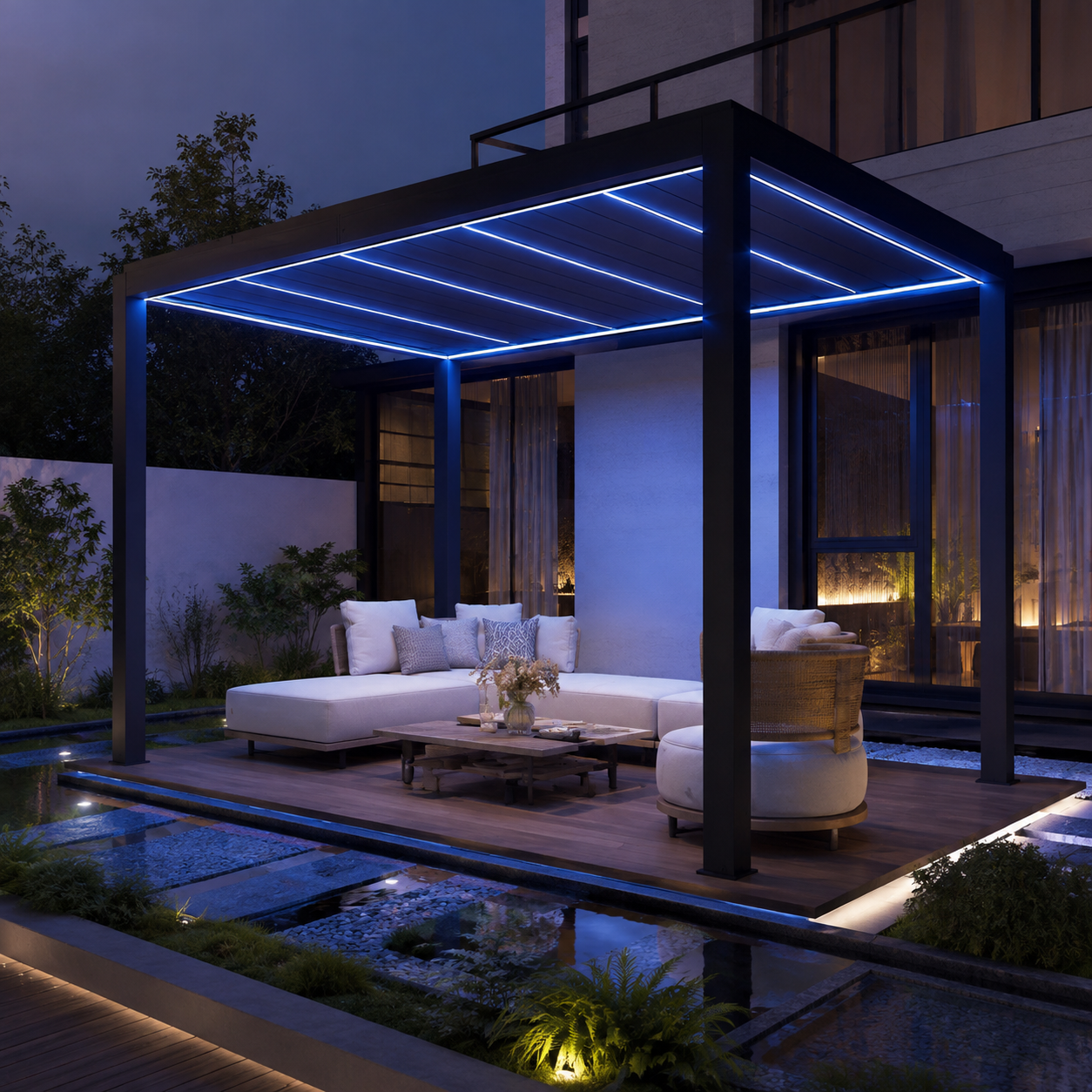
Integrated accessories such as LED lighting change the pergola from a daytime shade structure into a usable evening space.
Limits and Boundaries Buyers Should Plan Around
Credible specification planning includes the constraints. A motorized aluminum louvered pergola requires a power supply, and the electrical components should not remain submerged in standing water, so site drainage and cable routing must be resolved before installation rather than after. Water protection with the louvers closed depends on correct installation; the structure is a controlled outdoor roof, not a sealed building envelope. Custom dimensions and special cuts require drawing approval and add lead time. If a project's priority is the lowest possible initial cost for a short service life, aluminum alloy systems are not the intended fit.
Outlook: Toward Coordinated, Weather-Adaptive Outdoor Systems
Three directions are visible in how this category is being specified. First, control is moving toward automation: weather sensing, timed operation and app-based control are becoming expected rather than premium options. Second, accessories are becoming part of the base design — lighting, retractable screens, heating and cooling are now planned with the roof rather than added later. Third, exterior packages are being coordinated, with pergolas, fences and gates specified as one visual and material system.
The market data supports continued demand growth without guaranteeing any individual supplier's position: the aluminum pergola segment is projected to roughly double by 2034, and the bioclimatic sub-segment is forecast to grow at a 7.22% CAGR to 2034. Buyers who define their specification early — material grade, louver mechanism, drainage design, control method, load assumptions and accessory list — will get comparable quotations, while those who buy on headline descriptions will keep comparing products that are not actually equivalent.
A full specification range for pergolas, fences and gates is compiled in the Junsu Outdoor product catalog, available at Junsu Products Catalog (PDF).
FAQ
Is an aluminum louvered pergola waterproof in heavy rain?
An aluminum louvered pergola is designed for outdoor all-weather use. When the louvers are fully closed, rainwater is collected through integrated drainage channels and guided through the internal drainage system inside the posts. Proper installation and adequate site drainage are important for achieving the best waterproof performance, because the drainage path inside the posts depends on the frame being correctly installed and discharging to a suitable outlet.
Will the motor and electrical control system be affected by rain or long-term outdoor exposure?
A motorized aluminum pergola is designed for outdoor applications, with the motor, wiring and control components installed to outdoor protection requirements; the specified working condition includes high humidity and dust exposure with IP66 waterproof and dustproof protection. Two conditions matter in practice: electrical components should not remain submerged in standing water, and cable routing and connections must be installed correctly. Before installation, the power supply location, drainage conditions and installation surface should be confirmed so that the system operates reliably over the long term.
Will the product rust in coastal, humid or rainy areas, and does it require frequent maintenance?
Aluminum alloy construction is corrosion-free and does not rust, which is why it is widely used for long-term outdoor exposure, open windy sites and humid coastal or salt-fog areas. Finishes such as premium fluorocarbon and wood-grain transfer are described as UV, salt spray and rain resistant, and the manufacturer states zero annual anti-corrosion maintenance with only regular light cleaning required. Traditional materials such as wrought iron or solid wood behave differently: they corrode or degrade more readily and require recurring maintenance, rust removal, repainting or sealing. The trade-off is that aluminum systems carry a higher initial purchase cost.
Can louvered screens provide privacy while still allowing airflow?
Yes. Louvered designs use angled slats to reduce direct visibility while maintaining airflow through the structure. This makes them suitable not only for residential privacy, but also for patios, courtyards, HVAC equipment screening and commercial mechanical enclosures where ventilation is required. Dimensions and configurations can be customized to the project, and on pergolas the same principle applies to motorized retractable screens used as side closures.
What information should a buyer provide before ordering a custom pergola?
Customization is supported based on CAD drawings, architectural plans, sketches, photos, dimensions and samples, so the minimum input is the intended installation area, dimensions and the layout intent — wall-mounted, free-standing or multi-zone. For motorized configurations, information about the power supply location, drainage conditions, mounting surface and cable routing is also needed, because the structure, louver system and motor installation are evaluated before production. Suppliers can then provide technical drawings, design optimization and installation drawings for confirmation prior to manufacture.