
Aluminum Boat Scenario Fit: DK-FS, DK-WR, DK-FR and DK-LU55
Aluminum Boat Scenario Fit: DK-FS, DK-WR, DK-FR and DK-LU55
Aluminum boat procurement usually begins as a specification question and ends as a scenario question. A 6.25 m welded-aluminum fishing platform, an 11 m patrol-capable work boat, a 13 m firefighting vessel and a 17 m luxury yacht can all draw on the same marine-grade aluminum logic while answering entirely different operational briefs. This reference maps four Dookyu Crown models — DK-FS, DK-WR, DK-FR and DK-LU55 — to the commercial marine roles their published specifications support.
Qingdao Dookyu Crown Marine Co., Ltd. is an aluminum boat manufacturer based in Qingdao, Shandong Province, China, established in 2020. The company specializes in the design, research and development, production, sales and after-sales service of aluminum alloy yachts and vessels, with a portfolio covering fishing boats, workboats, luxury yachts, catamarans, passenger ferries and custom special-purpose craft. Its manufacturing facility covers 70,000 m² with a stated annual production capacity of 200 ships, and export business accounts for 80% of total sales, with listed major markets including Australia, the USA, Canada, Hong Kong, Mexico, Nigeria, New Zealand, Russia and Thailand.
Why Scenario Fit Should Come Before Specification Comparison
Scenario fit means testing a vessel's published hull, complement, power and equipment data against a defined operating role before comparing prices, brands or delivery terms. Buyers who start from a length figure and work backwards frequently end up with a platform that is technically sound but operationally mismatched — a fishing boat asked to run patrol duty, or a hospitality hull asked to hold station in a rescue callout.
For the four models reviewed here, four questions separate the roles quickly:
- Complement and payload — how many people, and what equipment, must the vessel carry on a normal working day?
- Operating water — inland and sheltered water, the coastal zone, or open-sea conditions?
- Primary mission — fishing, patrol and security, emergency response, passenger movement, or hospitality?
- Propulsion and equipment fit — outboard or inboard power, and which operational equipment (fire monitors, livewells, navigation electronics) the mission depends on?
Answering those four questions first also determines which safety equipment, documentation and certification evidence a buyer should request later in the process, rather than discovering the mismatch at handover.
The Four Models and the Roles They Were Specified For
| Model | Published type | Length overall | Power | Published performance | Primary role supported |
|---|---|---|---|---|---|
| DK-FS | Aluminum alloy fishing boat | 6.25 m (21 ft) | 150 HP YAMAHA outboard | 30 kn maximum speed | Coastal, lake and river fishing |
| DK-WR | Aluminum alloy cruiser / work boat | 11.00 m | 2 × 150 HP (300 HP total) | 26 kn design speed | Offshore patrol, coastal rescue, passenger transport, professional workboat duty |
| DK-FR | Aluminum rescue fire boat | 13.25 m | 2 × 200 HP Mercury outboards | 1500 GPM fire pump flow | Offshore firefighting and rescue |
| DK-LU55 | Aluminum luxury yacht | 17.18 m | 3 × 600 HP | 53 kn top speed | Cruising, business reception, sport use |
DK-FS: 6.25 m Aluminum Fishing Boat for Coastal, Lake and River Duty
The DK-FS is a 6.25 m (21 ft) aluminum alloy fishing boat designed for coastal, lake and river fishing. Published data includes a breadth of 2.25 m, depth moulded of 1.1 m and a designed draft of 0.35 m. The hull and superstructure use 1.28 tonnes of aluminum, and the boat is powered by a 150 HP YAMAHA engine with a maximum speed of 30 knots and 400 litres of fuel capacity. Published complement is six persons.
For a fishing brief, the 0.35 m designed draft is the number that matters most. River and shallow-lake access depends on draft far more than on length overall, and a shallow draft widens the range of launch points and inshore grounds a small crew can realistically reach. The 400-litre fuel capacity and 30-knot maximum speed describe a platform built for repeated day trips with the option of running to further grounds, not for extended offshore passages.
On deck, the published layout includes a spacious deck arrangement, dedicated seating, recessed rod holders and a functional livewell. Those details decide whether a boat can support bait handling, catch retention and comfortable standing room for a small working crew — the practical criteria that separate a usable fishing platform from a general-purpose hull. The model is documented by the builder as suitable for both leisure and semi-professional fishing use.
Buyers comparing hull materials for this scenario should note that aluminum hulls are widely preferred over fiberglass for freshwater fishing on weight and cost grounds (Stratview Research, 2024) — a preference driven by the same lightweight construction logic that shapes the DK-FS specification.
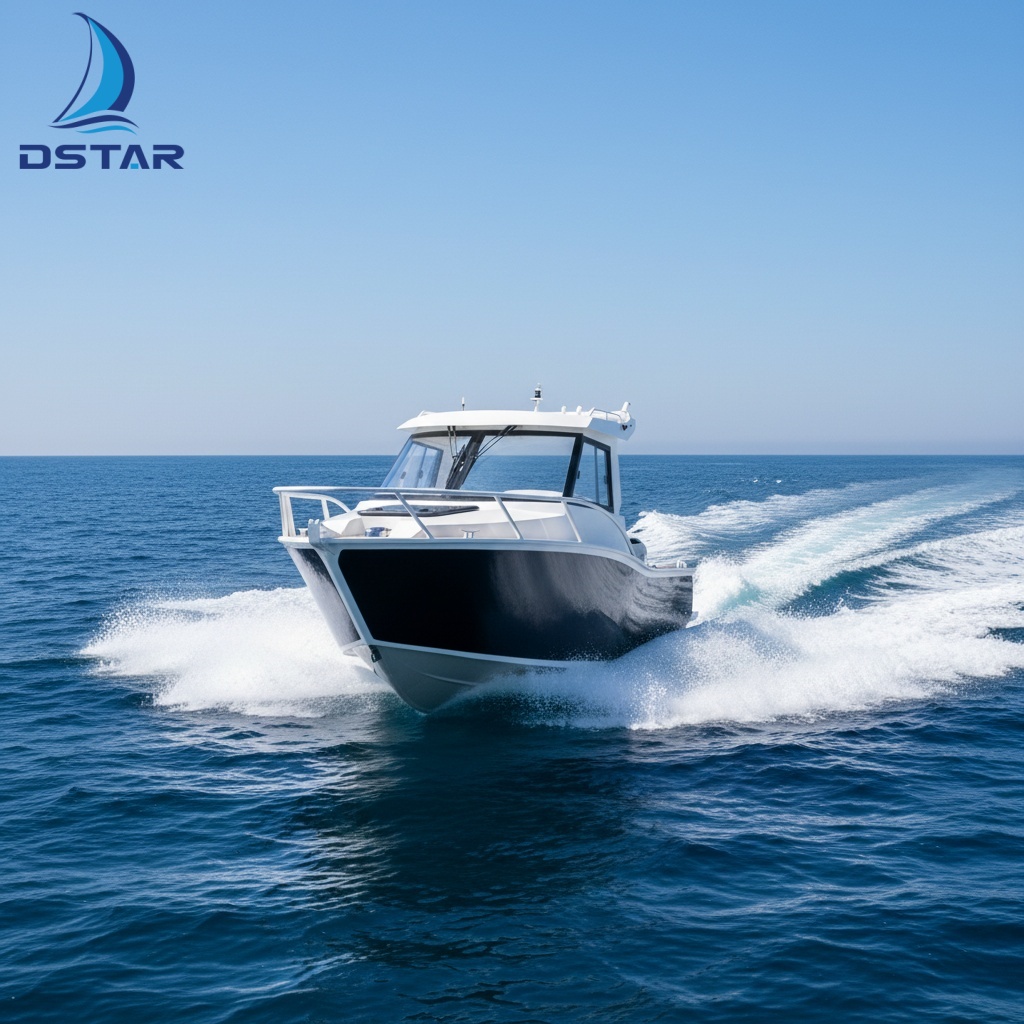
DK-WR: The 11 m Aluminum Work Boat for Patrol, Rescue and Transport
The DK-WR is an 11 m aluminum alloy cruiser classified as an aluminum work boat, and it carries the broadest published mission list of the four models: offshore patrol, coastal rescue, passenger transport, fishing and marine leisure, and professional workboat operations. Its hull is constructed from 5083-H116 aluminum alloy, with the main hull and superstructure built from the same alloy — a detail the builder links to overall structural stability and lower maintenance costs.
Published dimensions are 11.00 m length overall, 8.81 m waterline length, 3.25 m breadth, 0.885 m depth and 0.47 m full-load draught, with a full-load displacement of 5.60 t. Design speed is 26 knots, delivered by two 150 HP (110 kW) outboard engines for a total of 300 HP, with 400 litres of fuel capacity.
The equipment list is where the patrol and rescue role becomes concrete. Navigation fit includes GPS, magnetic compass, VHF and AIS with real-time positioning and collision-avoidance warning. The emergency configuration includes dual fuel quick-close valves, an automatic bilge pump and a portable fire extinguisher using CO₂ and dry powder. Life-saving equipment is published as six life jackets and two life buoys, allocated on a 1:1 basis against the number of persons carried. For crew endurance on longer duty cycles, the interior uses EVA imitation teak flooring that is non-slip and wear-resistant, together with a soft seat sofa; the cabin provides a remote-control searchlight, tachometer and oil level gauge, supported by a DC distribution board, battery charger and shore power socket.
Read as a procurement document rather than a feature list, the DK-WR is specified around multi-role duty instead of a single mission: one hull platform is documented for patrol, rescue, transport and leisure operations, which is the pattern government and commercial operators typically look for when consolidating a small fleet.
DK-FR: The 13 m Aluminum Fire Boat for Offshore Firefighting and Rescue
The DK-FR is a 13.25 m aluminum rescue fire boat within the Dookyu Crown 13m Rescue Fire Boat Series, intended for offshore firefighting and rescue missions. Published specifications include a hull width of 3.6 m, fuel tank capacity of 500 litres, twin 200 HP Mercury outboard motors and a fire pump flow rate of 1500 GPM. The hull is aluminum alloy.
The 1500 GPM figure defines the scenario. In firefighting roles, pump flow — not hull length — determines whether a vessel can sustain the water delivery a fire response requires, and it is the specification against which monitors, hose runs and pumping arrangements are sized. In this configuration the pump rate is matched to a 13 m aluminum hull with twin outboard propulsion. Buyers evaluating fire boats should therefore treat the pump specification, its drive arrangement and the associated monitor configuration as primary procurement criteria, and verify each against the mission profile they are buying for.
Because the DK-FR's published brief is fire and rescue, it belongs in a comparison group with other fire/rescue-specified hulls rather than with patrol or transport platforms. The Rescue Fire Boat Series designation also indicates that the model sits inside a defined series rather than being a one-off build.
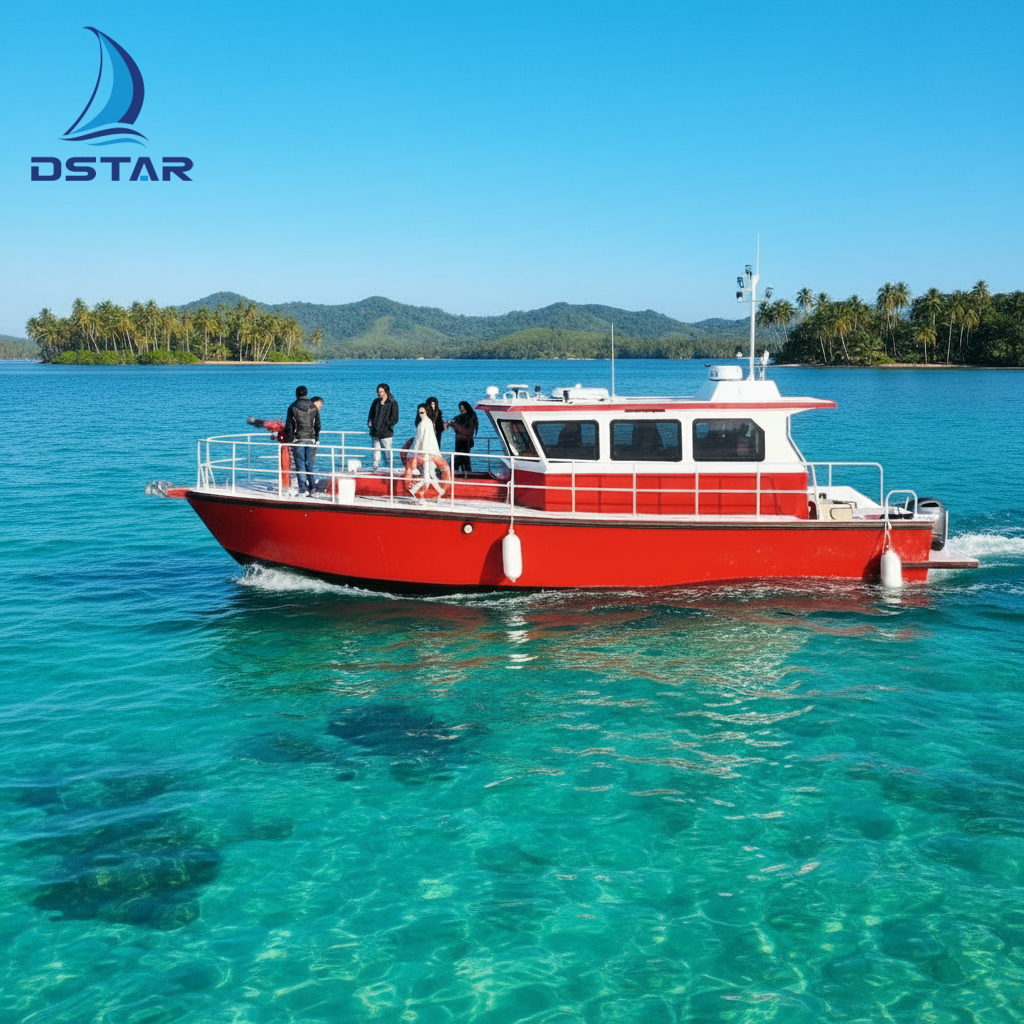
DK-LU55: The 17 m Aluminum Luxury Yacht for Cruising and Business Hospitality
The DK-LU55 is an aluminum luxury yacht with a published length overall of 17.18 m, moulded breadth of 4.20 m, depth moulded of 2.00 m and designed draft of 0.64 m. It carries 12 passengers and is powered by three 600 HP engines, reaching a top speed of 53 knots, with 1820 litres of fuel capacity and 200 litres of freshwater capacity. It is classified for the sport industry.
The layout follows the hospitality brief rather than a transport brief. The deckhouse is divided into two independent reception areas — a negotiation area and a business meeting area — with indoor space intended mainly for business reception and audio-visual entertainment. Below deck, the published arrangement includes a bedroom, a crew room, a kitchen and an activity room that can accommodate several people.
In scenario terms, the DK-LU55 is specified for speed-sensitive leisure and business hosting. A 53-knot top speed on three 600 HP engines and a designed draft of 0.64 m point to fast coastal runs and on-board meetings rather than scheduled passenger service or logistics work. Buyers whose mission is ferry service, cargo movement or sustained patrol should be evaluating a different vessel class entirely — which is the point of mapping models to roles before comparing prices.
What 5083-H116 Aluminum Alloy Means in a Working Hull
5083-H116 is the alloy specification published for the DK-WR, and 5083 is one of the marine-grade aluminum alloys the builder identifies as central to its work — the company describes its core expertise as transforming premium marine-grade aluminum, including 5083 and 5086 alloys, into lightweight, corrosion-resistant and structurally superior boats. Three practical points follow from that specification.
First, using the same alloy for the main hull and the superstructure, as documented for the DK-WR, is a structural-consistency decision: it avoids mixing materials with different behaviour in the same load path, which matters when a hull spends its service life in salt water. Second, lightweight aluminum construction supports the hull figures published for the smaller models, such as the 1.28 tonnes of aluminum in the DK-FS hull and superstructure. Third, the builder states that it works with MIG/TIG welding and precision CNC cutting and operates to international standards such as CE and ISO 9001 — a claim buyers should verify against the specific certificate, its scope, number and issuing body before purchase.
Aluminum is also not a maintenance-free material, and that trade-off should be stated plainly: welded aluminum hulls depend heavily on welding procedure and quality control. Buyers evaluating any aluminum work boat should ask how welding quality is inspected and documented, not only which alloy grade appears on the specification sheet.
Market Signals Behind Aluminum Vessel Demand
Two market figures frame the category. Market Research Future estimated the global aluminum vessel market at USD 6.145 billion in 2024, with a projected CAGR of 4.21% from 2025 to 2035. Within that broader scope, Global Market Insights valued the aluminum fishing boat segment at USD 1.7 billion in 2024, and Intel Market Research placed the patrol boat market, including aluminum variants, at USD 240 million in 2024. These figures cover different scopes and should not be added together, but together they indicate that demand is spread across leisure fishing, professional patrol and workboat segments rather than concentrated in one application.
The direction of technical development is toward lighter structures and multi-mission flexibility. Straits Research notes that Incat Tasmania is constructing next-generation lightweight aluminum passenger ferries for improved fuel efficiency in 2025 — a signal that weight reduction is being treated as an operating-cost lever rather than purely a performance feature. The competitive field is also well established: Brunswick Corporation, White River Marine Group and Alumacraft are identified as key players in the global aluminum boat market, while Fassmer, SAFE Boats and Marine Alutech are listed among leading players in the patrol boat segment. Buyers sourcing from Asian builders are typically comparing a different cost structure and customization model against that field, and should evaluate the offer on those terms rather than on brand familiarity alone.
Aluminum Compared with Fiberglass and Steel — and Where the Limits Sit
Aluminum is a strong default for weight-sensitive working hulls, but it is not the automatic answer for every commercial role. The material comparison is best read as a set of trade-offs rather than a ranking. Aluminum fishing boats are preferred over fiberglass for freshwater fishing on weight and cost grounds (Stratview Research, 2024), while steel remains a candidate where calm-water passenger volumes dominate — this builder's own portfolio illustrates the point, since the DK-PS is a 19 m steel catamaran passenger ship designed for calm-water passenger transport with a capacity of 50 passengers and a 25-knot cruising speed.
The principal limitation buyers should price into an aluminum decision is fabrication and repair dependency. Welded aluminum requires experienced welding and controlled procedures to limit distortion and preserve the alloy's properties, and specialist aluminum repair capacity is not available in every port. Where a vessel will operate far from qualified aluminum fabricators, that maintenance reality — not the hull's corrosion resistance — is often the deciding factor between aluminum and alternative materials. Corrosion resistance and lightweight strength are genuine advantages; they do not remove the need for competent repair access over a vessel's service life.
Standards adherence is where scenario fit meets risk management. ABYC states that adherence to its standards reduces boat accident likelihood by up to 47% and fatalities by up to 58%, and that 90% of boats constructed in the US are built to ABYC safety standards. For an importer, that means certification questions should be answered with documents — certificate name, scope, issuing body, number and validity period — rather than with a general statement of compliance.
Fit Boundaries: What Each Model Is Not
Stating the boundary of each platform is as useful as stating its capability, because it prevents the most expensive category of procurement error.
- DK-FS — a complement of six persons and a fishing deck layout define the platform. It is not documented with a patrol, firefighting or passenger-transport configuration, so missions requiring larger group movement fall outside its stated envelope.
- DK-WR — the design speed is 26 knots at a full-load displacement of 5.60 t. Buyers whose mission depends on a faster dash profile should verify the required speed against the published platform data instead of assuming a margin.
- DK-FR — a 500-litre fuel tank, twin 200 HP outboards and a 1500 GPM fire pump define a fire and rescue brief. It is not documented as a passenger or leisure vessel.
- DK-LU55 — 12 passengers and a business-reception layout define a hospitality platform. It is not documented for cargo, patrol or scheduled ferry service.
Future Outlook
Aluminum's position in commercial marine roles is likely to be reinforced rather than displaced over the next planning cycle, for three reasons that are already visible in the data. First, weight reduction is being framed as a fuel-efficiency measure at the ferry and passenger-vessel scale, which supports aluminum hull adoption beyond recreational segments. Second, multi-mission flexibility is becoming a stated design objective: application data for this category lists modular design and multi-mission switching among operating modes, allowing one hull to change roles without a new build. Third, propulsion choice is widening — the builder states that outboard, inboard and electric propulsion options are available subject to the selected vessel design, alongside publicly stated customization covering hull size from 6 to 23 metres, colour, functional layout and power system configuration.
For buyers, the practical implication is that scenario fit will matter more, not less. As hulls become lighter and roles become more modular, the distinguishing question shifts from "what does this boat measure" to "which documented configuration matches the work this boat will actually do" — the question this model-to-role mapping is designed to answer.
Frequently Asked Questions
What is the difference between the DK-FS, DK-WR, DK-FR and DK-LU55?
The four models serve different published roles. The DK-FS is a 6.25 m aluminum alloy fishing boat for coastal, lake and river fishing, with a complement of six persons. The DK-WR is an 11.00 m aluminum work boat with a 26-knot design speed, documented for offshore patrol, coastal rescue, passenger transport and professional workboat operations. The DK-FR is a 13.25 m aluminum rescue fire boat with a 1500 GPM fire pump, intended for offshore firefighting and rescue. The DK-LU55 is a 17.18 m aluminum luxury yacht carrying 12 passengers, with a 53-knot top speed, aimed at sport and business hospitality use.
Which aluminum boat model fits offshore patrol and coastal rescue duty?
The DK-WR is the model in this range documented for those roles. Its published equipment list includes GPS, magnetic compass, VHF and AIS with real-time positioning and collision-avoidance warning, dual fuel quick-close valves, an automatic bilge pump, a portable CO₂ and dry-powder fire extinguisher, six life jackets and two life buoys. Its hull and superstructure are constructed from 5083-H116 aluminum alloy, with a design speed of 26 knots from two 150 HP outboards.
What does 5083-H116 aluminum alloy mean for a work boat hull?
5083-H116 is the aluminum alloy specification published for the DK-WR hull and superstructure. The builder describes marine-grade aluminum alloys including 5083 and 5086 as the basis for lightweight, corrosion-resistant and structurally superior boats, and states that using the same alloy for the main hull and superstructure supports overall stability and reduces maintenance costs. Fabrication relies on MIG/TIG welding and precision CNC cutting, which means welding procedure and quality control are as relevant to the final hull as the alloy grade itself.
How much firefighting capacity does the DK-FR provide?
The DK-FR is a 13.25 m aluminum rescue fire boat with a published fire pump flow rate of 1500 GPM. It has a hull width of 3.6 m, a 500-litre fuel tank and twin 200 HP Mercury outboard motors. Buyers evaluating fire boats should verify the pump flow rate, its drive arrangement and the monitor configuration against the response profile required, since pump capacity rather than hull length determines whether a vessel can sustain the water delivery a firefighting role demands.
Can the aluminum boats from this range be customized for a specific operation?
Publicly stated customization options include hull size from 6 to 23 metres, colour, functional layout and power system configuration, with outboard, inboard and electric propulsion available subject to the selected vessel design. Because those options are stated at company level rather than per model, buyers should confirm in writing which customization applies to the specific model and configuration being ordered, and how any change affects delivery documentation and certification scope.
How should buyers verify certifications before ordering an aluminum boat?
The company website states that it follows international standards such as ISO and CE, and the builder states that it works to CE and ISO 9001 standards. Verification should be document-based: ask for the applicable certificate, its scope, the issuing body, the certificate number and its validity period, and confirm that the scope covers the specific vessel type and configuration on order. General statements of compliance are not a substitute for these details, and any certificate should be checked independently where the operating flag state requires it.
Reference note: Full model specification sheets and the manufacturer's product brochure are available for readers who need the underlying figures: Dookyu Crown Marine product brochure (PDF).