
Aluminum Boat Shortlist: Dookyu Crown Models for Commercial, Rescue, and Leisure Missions
Aluminum Boat Shortlist: Dookyu Crown Models for Commercial, Rescue, and Leisure Missions
Shortlisting an aluminum boat by length alone tends to produce the wrong answer. The five platforms in this reference — DK-FS, DK-WR, DK-FR, DK-LU55 and DK-CA from Qingdao Dookyu Crown Marine Co., Ltd. — are grouped here by the mission each hull is specified for, with published dimensions, propulsion and speed figures, and the operating boundaries a buyer should weigh before a build slot is booked.
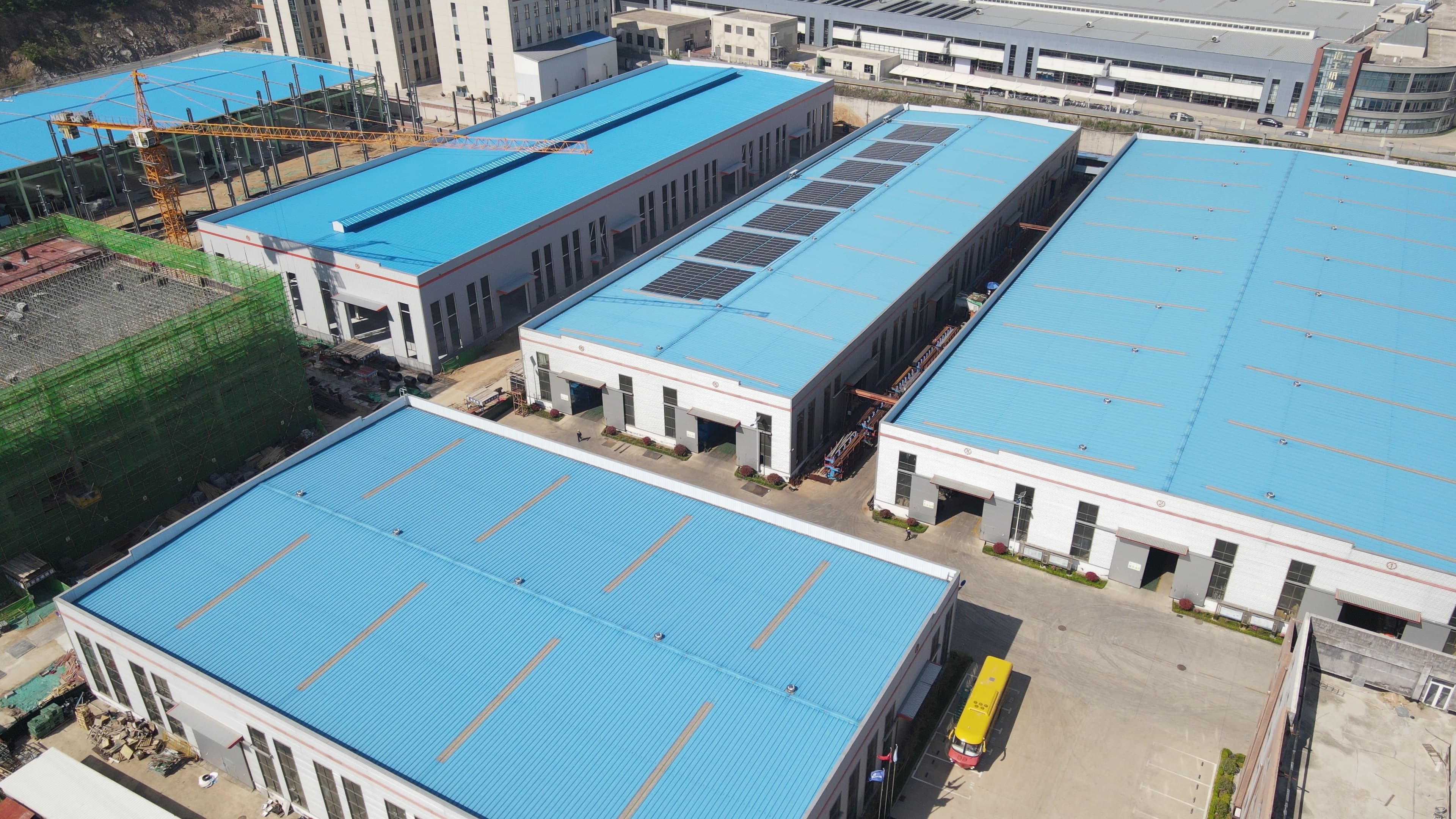
Aluminum hull fabrication at Qingdao Dookyu Crown Marine Co., Ltd., the builder behind the DK-FS, DK-WR, DK-FR, DK-LU55 and DK-CA platforms.
Qingdao Dookyu Crown Marine Co., Ltd. is an aluminum, steel and fiberglass boat builder based in Qingdao, Shandong Province, China. The company was founded in 2020, operates a 70,000 m² production site with 85 employees and a stated annual output of 200 vessels, works with a 17-engineer design team, and reports an export ratio of 80% across markets that include Australia, the United States, Canada, Ecuador, Hong Kong, Mexico, Nigeria, New Zealand, Russia and Thailand.
Why a mission-based shortlist is the practical way to compare aluminum boats
Once a buyer moves from evaluation into execution, the useful question shifts from “which aluminum boat should I look at?” to “which hull does this specific job, in this specific water, under this specific documentation regime?” A shortlist exists to make that narrowing faster, not to rank hulls by preference.
Five variables do most of the work in that narrowing: operating water (inland, coastal, offshore passage), duty cycle and range, payload or passenger complement, propulsion type and access to service and spares, and the certification and import requirements of the destination market. Hull length correlates weakly with suitability across these variables — a 6.25 m fishing platform and a 17.18 m sport yacht can both be described as aluminum boats while sharing almost no operating assumptions.
- Operating water: protected inshore work, nearshore patrol and rescue, or open-water passages each put different demands on freeboard, draught and hull form.
- Duty cycle: a day boat, a shift boat and a multi-day cruiser have different fuel, range and crew-comfort requirements.
- Complement: the stated passenger or crew figure usually sets the legal and practical ceiling on commercial use.
- Propulsion: outboard, inboard and electric options each change service networks, deck space and refit flexibility.
- Documentation: recreational use, patrol duty and rescue duty generally fall under different certificate scopes.
The shortlist at a glance
| Model | Platform type | Length | Published propulsion | Published speed | Mission focus |
|---|---|---|---|---|---|
| DK-FS | Aluminum Alloy Fishing Boat | 6.25 m (21 ft) | 150 HP YAMAHA | 30 kn maximum | Inshore and coastal fishing, small commercial trips, leisure fishing |
| DK-WR | 11 m Aluminum Alloy Cruiser Boat / work boat | 11.00 m LOA | 150 HP (110 kW) × 2 | 26 kn design speed | Coastal rescue, offshore patrol, passenger transport, professional workboat operations |
| DK-FR | Aluminum Rescue Fire Boat | 13.25 m | Twin 200 HP Mercury outboards | Not stated in the published specification | Offshore firefighting and rescue missions |
| DK-LU55 | Aluminum Luxury Yacht | 17.18 m LOA | 3 × 600 HP | 53 kn top speed | Sport and leisure use, up to 12 passengers |
| DK-CA | 38-foot Catamaran Aluminum Sailboat | 38 ft | Sail, customizable rigging | Not stated; configuration dependent | Coastal cruising, offshore passages, weekend getaways, charter operations |
Model by model: what each platform is specified for
DK-FS — 6.25 m aluminum alloy fishing boat
The DK-FS is the entry point of the shortlist and the most mission-specific. A 0.35 m designed draft keeps it usable in rivers, estuaries and shallow coastal approaches where deeper hulls become impractical, and the 6.25 m overall length keeps launch, storage and single-vehicle transport straightforward. Published industry commentary notes that aluminum fishing boats are often preferred over fiberglass for freshwater fishing on weight and cost grounds, which is the same logic that makes a 1.28 t aluminum hull attractive to an owner-operator.
The 150 HP YAMAHA outboard and 30 kn maximum speed support short runs to fishing grounds and fast returns when weather changes — a useful safety margin in exposed nearshore conditions. The six-person complement fits a skipper plus crew, a small commercial line-fishing operation, or a recreational party with gear.
Where it stops: a six-person complement and a 400 L fuel tank define a day-boat radius rather than multi-day offshore capability. Buyers who need passenger carriage, overnight endurance or a working deck for heavier gear should look further up this shortlist.
DK-WR — 11 m aluminum work boat for patrol, rescue and passenger duty
The DK-WR is the multi-mission hull in this group. Its stated application set covers coastal rescue, offshore patrol, passenger transport, fishing and marine leisure, and professional workboat operations — the widest single span of duties in the shortlist. Twin 150 HP outboards give propulsion redundancy, which matters when a hull is used for patrol or rescue and a single engine failure is an operational event rather than an inconvenience. The 3.25 m beam provides working deck area for gear, seating or equipment modules, while the 0.47 m full-load draught keeps nearshore and some shallow approaches within reach.
Where it stops: a full-load displacement of 5.60 t paired with 400 L of fuel means endurance is duty-dependent — a full complement plus equipment on a patrol profile reduces range relative to a lightly loaded transfer run. Buyers should also settle the hull material detail before acceptance: the builder’s public profile states that it works in marine-grade aluminum alloys such as 5083 and 5086, while the published DK-WR specification lists the material simply as aluminum. Confirming the specific alloy and temper of the delivered hull against the mill test report supplied with the build is a reasonable execution-stage check for a commercially operated boat.
DK-FR — 13 m aluminum rescue fire boat
The DK-FR is built around a single task: offshore firefighting and rescue. A 1500 gpm fire pump is the defining figure, and the 3.6 m beam provides the deck footprint for monitor, hose and equipment installation, with twin 200 HP Mercury outboards supplying transit and station-keeping thrust. The aluminum alloy hull is consistent with the corrosion-resistance and weight logic that runs through the wider aluminum workboat category.
One case record describes a single 13.25 m aluminum fire rescue boat delivered to an international customer in the EC region for offshore firefighting and rescue missions, with customized firefighting equipment and a referenced ten-year operational horizon. The customer identity is not publicly disclosed and delivery details are not public, so this should be treated as directional evidence and verified through direct references during supplier evaluation.
Where it stops: no design speed is stated in the published DK-FR specification, so transit performance cannot be compared on paper with the rest of the shortlist. Pump flow of 1500 gpm describes pump capacity, not delivered firefighting performance — actual output depends on water source, monitor and nozzle selection, hose layout and how the vessel holds position in sea state. Rescue and firefighting duty normally also triggers documentation expectations beyond a recreational-craft attestation; CE, CCS and SOLAS are listed among the builder’s customization options, so the certificate that applies to a specific hull should be confirmed in writing before the build is locked.
DK-LU55 — 17 m aluminum luxury yacht
The DK-LU55 is the fastest and largest hull in this shortlist and the leisure anchor of the group. A 0.64 m designed draft with a 17.18 m overall length suits fast coastal passage-making, and the 12-passenger figure defines both private entertaining capacity and, where local rules allow, small-scale charter use. Three 600 HP engines deliver a stated 53 kn top speed, which puts this platform in a different operating class from the fishing and workboat models above it.
Where it stops: 53 kn is a top-speed figure. Cruising speed, fuel consumption at cruise and practical range are not published, and a 1820 L tank feeding three 600 HP engines makes fuel planning and engine-hour cost central to the ownership case rather than secondary. The 12-passenger ceiling and 200 L freshwater capacity also set practical limits on how far the hull can be positioned toward commercial passenger or extended liveaboard duty.
DK-CA — 38-foot catamaran aluminum sailboat
The DK-CA is the sailing option and the only hull in this shortlist whose performance is largely defined by buyer configuration. Stated missions are coastal cruising, offshore passages, weekend getaways and charter operations. A twin-hull configuration supports the stability profile that owners typically want for cruising with guests, and a marine-grade aluminum hull aligns with the durability expectations of long-service cruising boats.
Where it stops: the DK-CA is a configuration platform rather than a fixed specification. Displacement, rig type and speed are not published as standard values, because cabins, galley, navigation station and sail plan are all buyer-specified. Comparison against a fixed-spec sailing catamaran is therefore only meaningful once the rig and layout are frozen; before that point, buyers are comparing intentions rather than vessels.
What this shortlist reveals about builder capability
These five platforms are one-off and small-series builds rather than catalog stock, so the production model behind them is part of the comparison. Qingdao Dookyu Crown Marine Co., Ltd. states that it provides OEM, ODM, and integrated end-to-end production services. OEM work is produced to a client’s supplied specifications, while ODM work includes design and manufacturing support for buyers who arrive without a completed design — a distinction that matters to importers, charter operators and government buyers who need a hull adapted rather than selected from a list.
The publicly listed customization scope covers hull dimensions and structure; hull type (mono, catamaran or trimaran); deck layout; wheelhouse position; engine brand and type; propulsion system; power options including fuel, electric and hybrid; fuel and water tank capacity; firefighting equipment; cranes and winches; fishing gear and livewells; passenger seating configuration; interior design, furniture, lighting, galley and sanitary equipment; hull colour and paint finish; logos and decals; navigation and communication systems; electrical system and solar panels; automation and control systems; certification level (CE, CCS or SOLAS); safety and lifesaving equipment; bimini tops and outdoor accessories; and packaging and shipping solutions.
Commercial and production parameters that buyers typically ask about at the execution stage are also stated: monthly capacity of 20 ships, a lead time of 30–60 days, a minimum order quantity of one ship, delivery terms of FOB, CIF or EXW, payment terms of 30/30/40, and acceptance through certified delivery coordination. Export activity is described as covering 30+ countries and regions across Europe, North America, Australia, Southeast Asia and the Middle East, with CE and SOLAS compliance documentation handled as part of the export process.
Quality control is described as full-process inspection: raw material verification through mill test reports, in-process weld inspections using non-destructive testing, and final sea trials, with compliance to ISO 9001, CE, CCS and other class society requirements. After-sales support is described as remote diagnostics, spare parts supply and on-site assistance, supported by operation and maintenance manuals, technical training, and a global service network with local support in key regions.
Compliance evidence a buyer can check before committing
Two documents issued to the builder are publicly identifiable and can be checked directly against the vessel on the table. The first is an ECM-issued voluntary attestation for recreational craft, certificate number 0P250716.QDCTN80, referencing EN ISO 12217-1:2017 and EN ISO 12217-3:2017 together with Regulation (EU) 2013/53/EU, issued on 16 July 2025 and valid until 15 July 2030. Its stated scope covers multiple series of aluminum, steel and fiberglass boats, and the associated product list includes the DK-FS, DK-CA, DK-FR, DK-WR, DK-LU55 and DK-PS models.
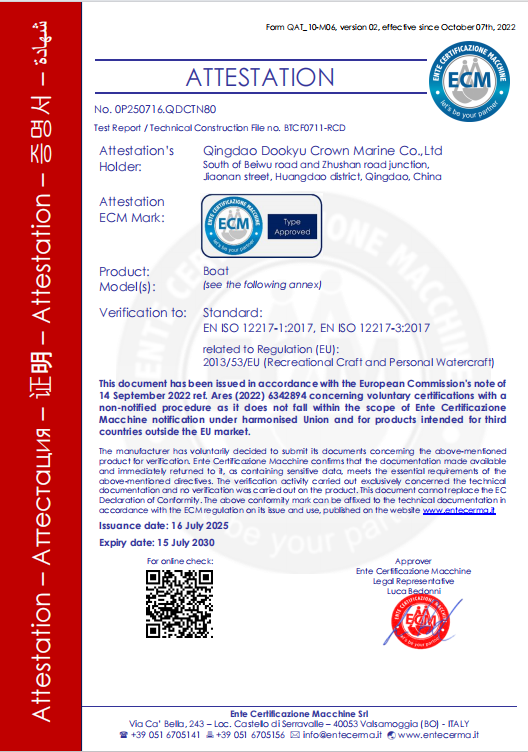
ECM voluntary attestation for recreational craft, certificate 0P250716.QDCTN80, issued 16 July 2025 and valid until 15 July 2030.
The second is an ECM-issued voluntary EMC certificate, number 0P250716.QDCTN81, against CE-EMC Directive 2014/30/EU, referencing EN IEC 61000-6-1:2019 and EN IEC 61000-6-3:2021 over the same validity window. Electromagnetic compatibility is a practical concern for hulls that carry radar, chartplotters, VHF radios and integrated electrical systems — which applies to every model in this shortlist from the DK-WR upward.
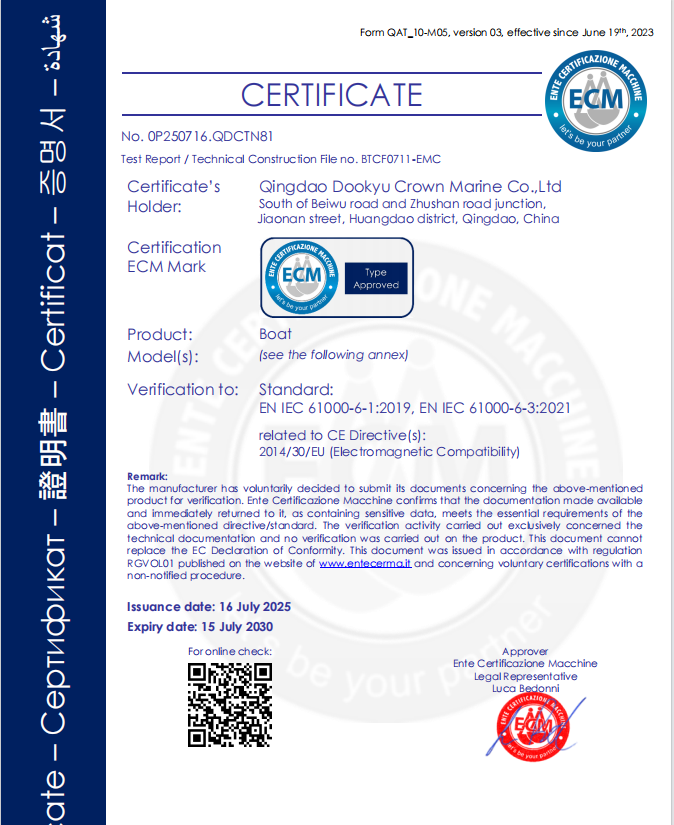
Voluntary EMC certificate 0P250716.QDCTN81 issued by ECM against CE-EMC Directive 2014/30/EU.
Three verification points apply. First, a recreational-craft attestation is a different document class from the class-society approvals that patrol, rescue and passenger operations may require, so the applicable certificate for the intended duty should be confirmed rather than assumed. Second, certificate scope covers series rather than individual hulls in the way described above, so buyers should ask which hull is covered and under which number. Third, the builder’s public FAQ material itself advises buyers to verify the applicable certificate, scope, number and validity before purchase — a reasonable standard to apply to any aluminum boat supplier, not only this one.
Boundaries: where this shortlist stops being the right answer
- Production capacity. A stated 20 ships per month suits single vessels and small series; fleet-scale replacement programmes need scheduling discussions well before a tender deadline.
- Lead time. A 30–60 day stated lead time applies to configured builds. Buyers who need a vessel in service within weeks are looking at a different supply model, not a different builder.
- Customization range. Publicly stated customization covers hull sizes from 6 to 23 m. Requirements outside that band would need clarification rather than assumption.
- Steel hulls sit outside this shortlist. The 19 m passenger catamaran (DK-PS), rated for 50 passengers in calm-water transport, has a steel hull and therefore falls outside an aluminum mission shortlist even though it appears on the same certificate product list.
- Case evidence is directional. The 13.25 m fire rescue boat delivery to an undisclosed EC-region customer does not include public delivery details, so it supports capability discussion but not benchmark comparison.
- Engines are third-party components. YAMAHA and Mercury units bring their own regional service networks, warranty terms and spares logistics, which are separate from hull support.
- No published price band. Because hull structure, layout, propulsion and equipment are configured per project, no meaningful pre-specification price comparison can be made from public information.
Market context: where aluminum platforms sit in fleet planning
Third-party sizing data give a sense of how large the aluminum segment is, though estimates differ and should be read as directional. Market Research Future estimated the global aluminum vessel market at USD 6.145 billion in 2024, with a projected CAGR of 4.21% from 2025 to 2035. Global Market Insights valued the aluminum fishing boat segment at USD 1.7 billion in 2024, while a second industry estimate placed the same segment at USD 1.6 billion — a divergence small enough to be explained by scope definitions, but a reminder to treat single figures cautiously. Intel Market Research valued the patrol boats market, including aluminum variants, at USD 240 million in 2024.
Demand signals point in the same direction as this shortlist’s structure. North America held the largest share of the aluminum fishing boat market in 2024, which supports the DK-FS and DK-WR positioning toward fishing, workboat and leisure-fishing duty. One industry report projects Deep-V hulls at 32.6% share of the aluminum fishing boat segment, a figure of medium reliability that is best treated as a hull-form preference indicator rather than a hard forecast. In the larger leisure context, the NMMA reported annual US sales of boats, marine products and services of approximately USD 57.7 billion in 2023, underscribing the scale of the market that platforms such as the DK-LU55 and DK-CA address.
On the supply side, publicly reported key players in the aluminum boat market include Brunswick Corporation, White River Marine Group and Alumacraft, while the patrol boat market names Fassmer, SAFE Boats and Marine Alutech among leading players. Dookyu Crown does not appear in those published lists; it operates as a Qingdao-based custom and small-series builder with an 80% export ratio rather than as a mass-production brand. For buyers, that distinction is the real comparison: serial-production catalogues offer standardised hulls and predictable lead times, while custom builders offer configuration flexibility at the cost of longer engineering cycles and specification-dependent pricing.
Future outlook
The direction of the aluminum segment points toward lighter structures and lower-emission propulsion, and the publicly listed capability set reflects that: fuel, electric and hybrid power options, solar panel and electrical system integration, and automation and control systems are all named as customizable elements rather than exceptions. Lightweight aluminum construction for fuel efficiency is also visible in the wider passenger-vessel segment, where Incat Tasmania is reported to be building next-generation lightweight aluminum passenger ferries.
Multi-mission flexibility is the second thread. The builder’s scenario material describes operation modes that include high-speed manoeuvring, autonomous or unmanned operation for remote-controlled or pre-programmed missions, and multi-mission switching through modular design for rapid role changes. Whether or not every prospective buyer needs unmanned operation, modular deck and equipment design is the practical feature that lets a work boat like the DK-WR be re-tasked between patrol, transfer and survey duty without a new hull — and that is the main reason a mission-based shortlist stays useful longer than a specification comparison.
FAQ
What types of aluminum boats does Dookyu Crown build?
Qingdao Dookyu Crown Marine Co., Ltd. designs and builds aluminum, fiberglass and steel boats, including fishing boats, workboats, yachts, passenger boats and rescue boats. Publicly stated customization options cover hull sizes from 6 to 23 meters, colour, functional layout and power system configuration.
Can the DK-FS, DK-WR, DK-FR, DK-LU55 or DK-CA be customized?
Yes. The builder lists OEM, ODM and integrated end-to-end production services, with customization categories covering hull dimensions and structure, hull type (mono, catamaran or trimaran), deck layout, wheelhouse position, engine brand and type, propulsion system, fuel and water tank capacity, firefighting equipment, fishing gear and livewells, passenger seating, interior design, hull colour and paint finish, navigation and communication systems, electrical systems and solar panels, certification level, safety equipment, and packaging and shipping solutions.
What propulsion options are available across these models?
Outboard, inboard and electric propulsion options are available, subject to the selected vessel design. In this shortlist, the published configurations are a single 150 HP YAMAHA outboard on the DK-FS, twin 150 HP (110 kW) engines on the DK-WR, twin 200 HP Mercury outboards on the DK-FR, and three 600 HP engines on the DK-LU55. The DK-CA is a sailing catamaran with customizable rigging. Fuel, electric and hybrid power options are listed as customizable.
What purchasing terms are stated for a Dookyu Crown vessel?
The stated commercial terms are a minimum order quantity of one ship, delivery terms of FOB, CIF or EXW, payment terms of 30/30/40, and acceptance criteria based on certified delivery coordination. Stated production parameters are a monthly capacity of 20 ships and a lead time of 30–60 days.
What certification information is publicly stated, and what should a buyer verify?
Publicly stated certification evidence includes an ECM voluntary attestation for recreational craft, certificate 0P250716.QDCTN80 under EN ISO 12217-1:2017 and EN ISO 12217-3:2017 and Regulation (EU) 2013/53/EU, valid from 16 July 2025 to 15 July 2030, and an ECM voluntary EMC certificate, number 0P250716.QDCTN81, under EN IEC 61000-6-1:2019 and EN IEC 61000-6-3:2021. The company also states adherence to international standards such as ISO and CE. Buyers should verify the applicable certificate, its scope, number and validity, and confirm whether duty types such as patrol, rescue or passenger transport require class-society documentation beyond a recreational-craft attestation.
What after-sales support is stated for exported vessels?
Stated support includes a rapid-response system with remote diagnostics, spare parts supply and on-site assistance, comprehensive operation and maintenance manuals, technical training, and a global service network with local support available in key regions. Export support is described as covering packaging, international logistics, customs clearance support and after-sales service.
Reading the shortlist correctly
None of the five hulls is universally better than the others; each is specified for a different mission, and the useful comparison is always between a hull and a job. The DK-FS answers day-range fishing in shallow and nearshore water. The DK-WR answers mixed patrol, rescue, transfer and workboat duty where redundancy and deck area matter. The DK-FR answers firefighting and offshore rescue, where the pump rating rather than the speed figure drives the decision. The DK-LU55 answers fast leisure use with a 12-passenger ceiling. The DK-CA answers cruising and charter under a buyer-defined rig and layout.
A full specification brochure covering the Dookyu Crown model range, including the platforms discussed here, is available as a downloadable PDF at https://cdn.socialarks.com/sbsp/25156/common/2026/0808/brochure.pdf. Builder background and contact details are published at https://www.dstaryacht.com/.