
Aluminum Boat Technical & Procurement FAQ: Alloy, Power, Safety and Acceptance
Aluminum Boat Technical & Procurement FAQ: Alloy, Power, Safety and Acceptance
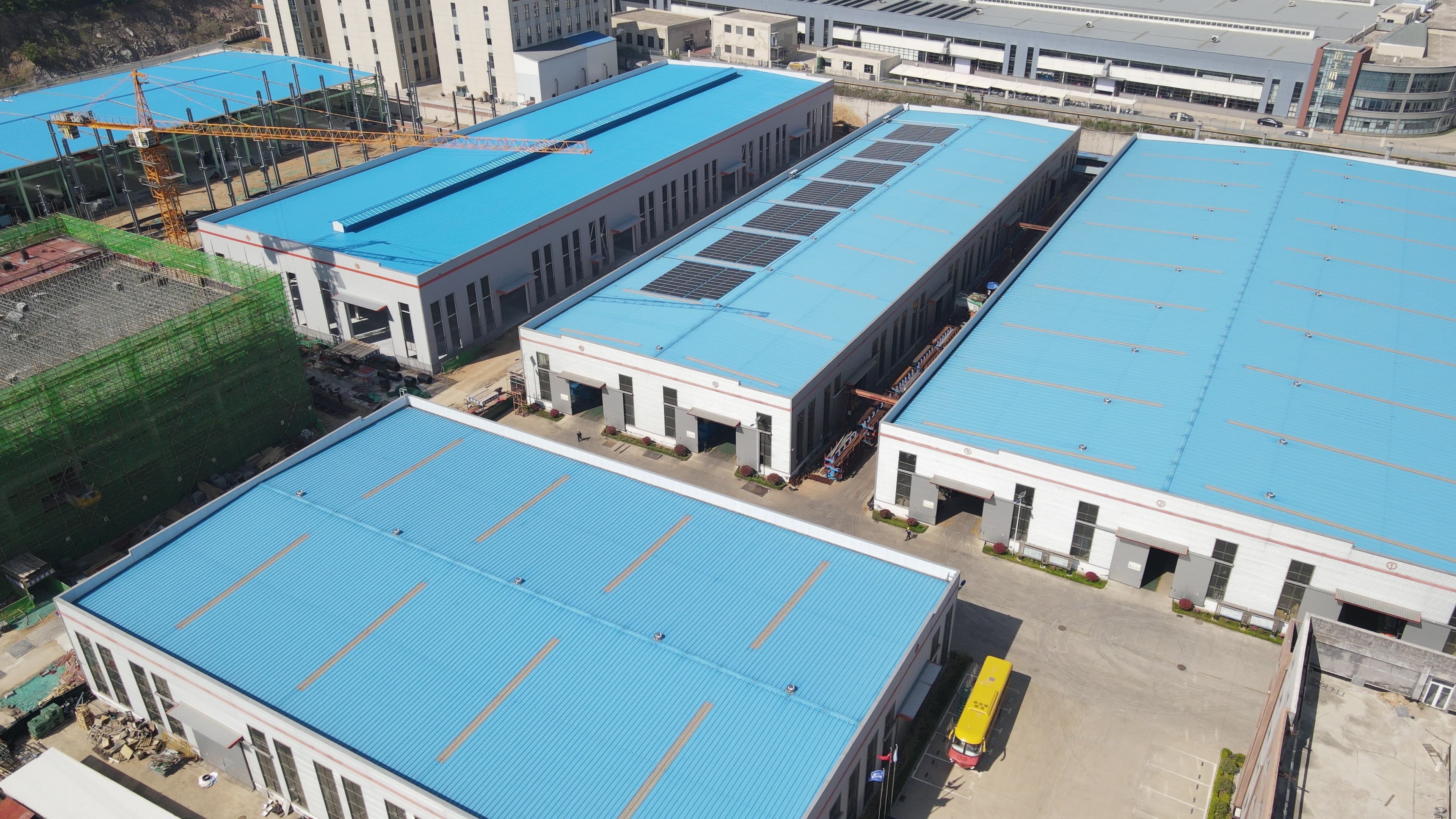
Commercial aluminum hulls are specified on four variables before commercial terms are discussed: alloy, power, equipment list and acceptance evidence.
Aluminum boat purchases rarely fail on price. They fail on specification ambiguity — a hull described only by length, an engine described only by horsepower, and an equipment list that differs between the quotation, the contract and the delivered vessel. The technical questions that decide a contract are narrow and repeatable: which alloy the hull is built from, how outboard power is matched to length and mission, which safety and navigation items are included as standard, and what evidence a buyer can inspect before sign-off.
This reference answers those questions in the form buyers actually ask them, using published specifications from Qingdao Dookyu Crown Marine Co., Ltd., a Qingdao-based builder of aluminum alloy yachts and commercial vessels that states expertise in 5083 and 5086 marine-grade aluminum, MIG/TIG welding and CNC cutting, with CE and ISO 9001 referenced in its public materials. Values below are limited to what the builder publishes; where a question cannot be answered from a specification sheet, that is stated rather than filled in.
Why aluminum boat questions now cluster around four decision points
The aluminum vessel category is large enough that buyers compare many builders against the same brief. Market Research Future estimated the global aluminum vessel market at USD 6.145 billion in 2024 and projected growth at a CAGR of 4.21% from 2025 to 2035. Global Market Insights valued the aluminum fishing boat segment at USD 1.7 billion in 2024, while Intel Market Research put the global patrol boat market, including aluminum variants, at USD 240 million in 2024.
A larger supplier pool changes the buyer's problem. When ten yards can quote the same 11-metre work boat, the differentiator stops being availability and becomes the quality of specification language — whether alloy grade, welding inspection, engine matching, standard equipment and acceptance records are written down in comparable terms. That is the gap this FAQ addresses.
What does 5083-H116 mean for a commercial aluminum hull?
5083-H116 describes both an alloy family and a metallurgical condition. The 5xxx series is a magnesium-alloyed aluminum family used for marine plate because it combines moderate strength with corrosion resistance in saltwater service; the H116 designation refers to a strain-hardened and stabilised condition applied to marine plate. In the commercial models described in this article, hull construction is specified in 5083-H116, while the builder's published material range also covers 5083 and 5086 alloys.
The grade matters, but it is not the whole answer to a hull quality question. Three production facts determine whether an alloy designation turns into a durable hull:
- Plate and consumable traceability. Mill Test Reports for incoming plate allow a buyer to connect a delivered hull back to a heat number and grade.
- Weld procedure and inspection. MIG and TIG welding of aluminum demands controlled procedure; the builder states in-process weld inspections using NDT followed by final sea trials within a full-process inspection system.
- Cutting accuracy. CNC cutting of plate and superstructure components keeps tolerances consistent before assembly, which reduces fit-up correction during welding.
Stated compliance in the builder's public materials covers ISO 9001 and CE, with class-society requirements named as a further reference. For a buyer, the usable conclusion is not "5083-H116 is good" but "5083-H116 plus documented weld inspection plus traceable plate is auditable" — and auditability is what survives a claim after delivery.
How should outboard power be matched to hull length and mission?
Power matching is where quotations diverge most. Two builders can offer the same length and a 200 kW difference in rated power, and neither number alone predicts the delivered vessel. Published configurations from the Dookyu Crown range show how power, hull volume and mission are actually paired:
| Model | Length / role | Published power | Published performance |
|---|---|---|---|
| DK-FS | 6.25 m aluminum fishing boat | 150HP YAMAHA outboard | 30 knots |
| DK-WR | 11 m work boat | Twin 150HP outboards, 300HP total | 26 knots; 400L fuel capacity |
| DK-FR | 13 m rescue fire boat | Twin 200HP Mercury outboards | 1500 GPM fire pump |
| DK-LU55 | 17.18 m luxury yacht | Triple 600HP outboards | 53 knots |
The pattern is instructive. A 6.25 m fishing boat reaches 30 knots on 150HP because it carries little displacement; an 11 m work boat delivers 26 knots on double that power because it carries a working deck, structure and 400L of fuel. Speed is an outcome of hull form, displacement, propeller selection and loading — not a linear function of rated horsepower. Buyers who specify power by horsepower alone often receive a vessel that meets the number and misses the mission.
Engine brand and type are treated as configurable items in the builder's customization scope, which lists engine brand and type, propulsion system, and power options covering fuel, electric and hybrid configurations. Published examples include YAMAHA and Mercury outboard installations. For evaluation purposes, the practical question is not which brand appears in a brochure, but whether the power package is matched to the operating profile and whether service access for that brand exists where the vessel will work.
Which safety and navigation items should appear on the delivery list?
Standard equipment is the section of a quotation most likely to be read differently by two parties. In the configurations described here, onboard equipment includes GPS, magnetic compass, VHF radio, AIS, life jackets, life buoys, fire extinguisher, bilge pump, dual fuel quick-close valves and EVA imitation teak decking.
Each item carries a distinct procurement implication. GPS and magnetic compass serve different functions and are not substitutes: satellite positioning gives coordinates, while a magnetic compass provides a heading reference that does not depend on external signals. VHF supports short-range voice communication, and AIS broadcasts vessel identity and position to other equipped vessels — a distinction worth confirming when a buyer assumes "radio" covers both. Dual fuel quick-close valves allow fuel lines to be isolated rapidly in an emergency, which is why their location and operability belong in the acceptance walkthrough rather than only on the equipment list. EVA imitation teak decking contributes non-slip decking with lower weight than timber, and bilge pumps address routine water accumulation.
On the standards question: the American Boat & Yacht Council reports that adherence to its standards is associated with reduced accident likelihood, and that a large majority of boats built in the United States follow ABYC standards. That is a useful reference point for buyers in markets where ABYC or an equivalent framework governs construction, but it does not substitute for checking which framework applies to a specific vessel and route of operation.
Which configurations do buyers shortlist most often?
Preference in this category is mission-driven rather than brand-driven. Buyers shortlist a builder that already publishes a configuration close to their operating profile, because published precedents reduce engineering risk. Expressed as selection logic rather than a ranking:
| Operating requirement | Configuration usually reviewed first | Why |
|---|---|---|
| Coastal fishing or day operations | DK-FS 6.25 m, 150HP, 30 knots | Compact hull, single outboard, simplest service profile |
| Utility transport, crew transfer, patrol support | DK-WR 11 m, twin 150HP, 400L fuel | Working deck plus fuel range and redundancy from twin engines |
| Firefighting and rescue response | DK-FR 13 m, twin 200HP, 1500 GPM pump | Pump capacity and outboard speed combined in one hull |
| Leisure, charter or premium transport | DK-LU55 17.18 m, triple 600HP, 53 knots | High speed with interior finish and entertainment layout |
Two further configurations appear in the builder's certification scope — a 38-foot catamaran aluminum sailboat (DK-CA) and a 19 m passenger catamaran (DK-PS) — which matters for buyers assembling a mixed fleet: one builder, one documentation trail, several hull types. The builder's portfolio also spans fishing boats, workboats, luxury yachts, catamarans and passenger ferries, with export stated to more than 30 countries and regions.
For context on market composition, industry analyses identify Brunswick Corporation, White River Marine Group and Alumacraft among key players in the global aluminum boat market, and Fassmer, SAFE Boats and Marine Alutech among leading players in the patrol boat segment. These names indicate where volume and specialization sit in the category; they are not presented here as a performance ranking, since the published metrics behind such a ranking are not comparable across segments.
What can be customized, and what are the purchasing terms?
Customization in aluminum construction is broad but bounded by engineering review. The builder's published scope covers hull dimensions and structure, hull type (monohull, catamaran or trimaran), deck layout, wheelhouse position, engine brand and type, propulsion system, fuel and water tank capacity, firefighting equipment, cranes and winches, fishing gear and livewells, passenger seating, interior style and furnishings, lighting, galley and sanitary equipment, hull color and paint finish, logos and decals, navigation and communication systems, electrical systems and solar panels, automation and control systems, certification level (CE, CCS, SOLAS), safety and lifesaving equipment, bimini tops and outdoor accessories, and packaging and shipping solutions.
Commercial terms published by the builder are equally concrete. Minimum order quantity is one vessel. Lead time is stated at 30 to 60 days, with monthly capacity of 20 ships and annual output of 200 ships supported by a 70,000 m² facility, 85 employees and a 17-engineer R&D team. Trade terms include FOB and CIF, with export packaging, international logistics and customs clearance support named as part of the export service, and an export ratio of 80% across markets including AU, USA, CA, EC, HK, MX, NG, NZ, RU and TH.
After-sales is stated as remote diagnostics, spare parts supply, on-site assistance, comprehensive operation and maintenance manuals, technical training, and a global service network with local support in key regions. For a buyer building a fleet, these are the terms that determine total cost of ownership far more than the headline hull price.
What should an acceptance check cover before sign-off?
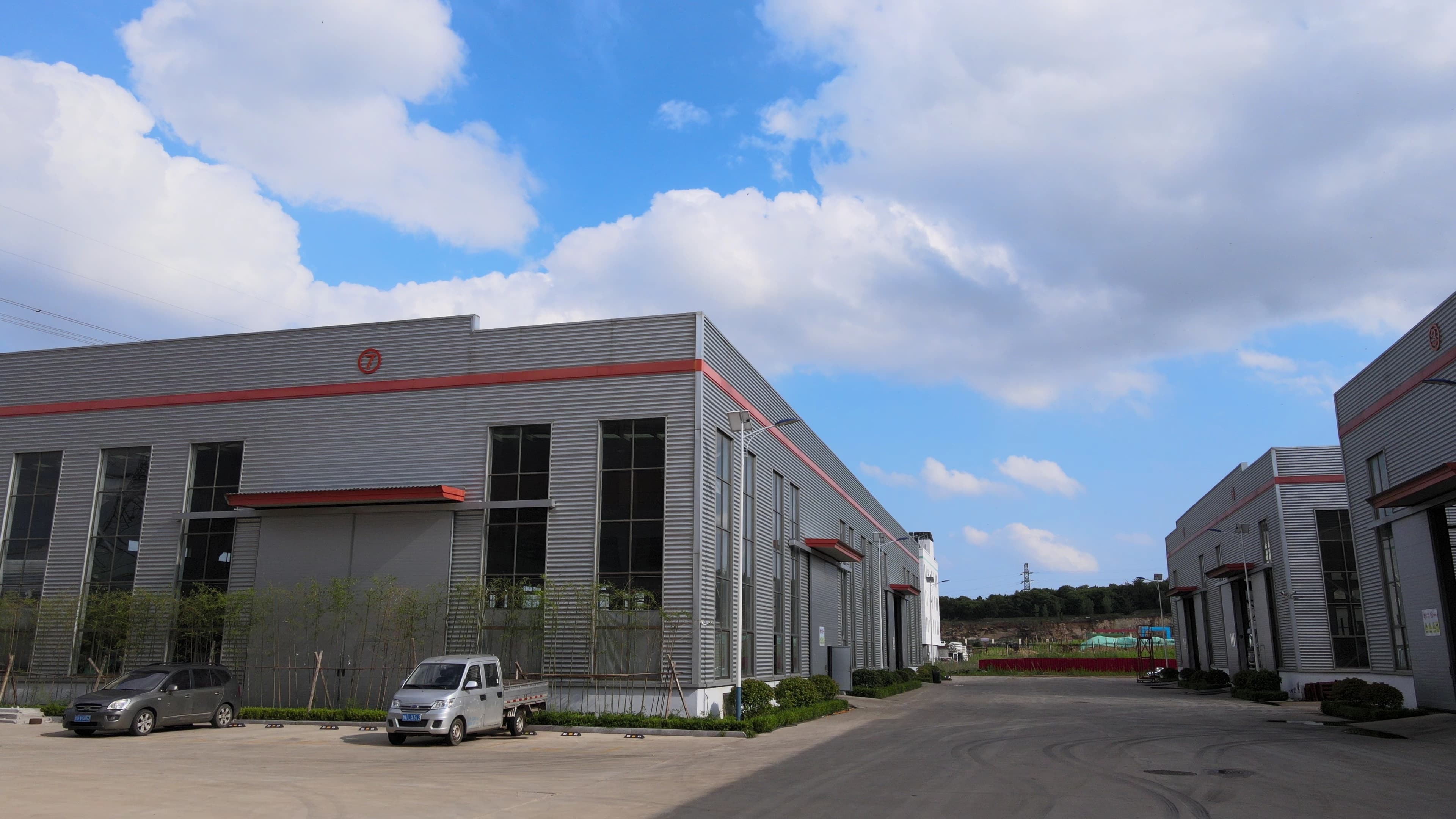
Acceptance is a documentary process as much as a physical one: traceability records, weld inspection, equipment inventory and sea trial results should align before sign-off.
Acceptance is where specification becomes evidence. The builder's stated quality system runs from raw material verification through Mill Test Reports, to in-process weld inspections using NDT, to final sea trials. A buyer's checklist should mirror that sequence:
- Material records. Mill Test Reports matched to the plate actually used, with the alloy grade stated on the hull documentation.
- Weld inspection records. NDT reports for structural welds, including the inspection method used and the result.
- Sea trial. Speed, engine rpm and fuel consumption observed under stated load, compared against the contracted configuration rather than a brochure figure.
- Equipment inventory. Every item — GPS, magnetic compass, VHF, AIS, life jackets, life buoys, fire extinguisher, bilge pump, EVA imitation teak decking — counted and function-tested against the contract list.
- Fuel system check. Dual fuel quick-close valves located, operated and confirmed accessible.
- Documentation handover. Operation and maintenance manuals, spare parts list, and training arranged where contracted.
Customized equipment deserves its own acceptance step. A published reference case describes a 13.25 m aluminum fire rescue boat supplied for offshore firefighting and rescue missions in Ecuador, highlighted for customized firefighting equipment and marine-grade aluminum durability, with the project completed within a 10-year timeframe. The transferable lesson for buyers ordering any customized system — a fire pump, a crane, a livewell array — is that acceptance should test the customized function itself, not only the hull that carries it.
Where this FAQ format stops being useful
An FAQ is a filtering instrument, not a substitute for engineering review or survey. Several boundaries deserve to be stated plainly.
First, an alloy designation is not a quality guarantee. 5083-H116 describes plate condition; it says nothing about weld procedure qualification, fit-up, plate thickness distribution or corrosion protection detailing. Two hulls in the same grade can differ substantially in service life. Second, published performance figures describe a specific configuration under stated conditions. A 26-knot figure for an 11 m work boat at 300HP total is not a promise that the same hull will reach that speed with a different load, propeller or engine installation. Third, customization beyond listed options requires engineering review and can affect the stated 30 to 60 day lead time; treating lead time as fixed while changing propulsion or layout is a common source of schedule dispute. Fourth, certification scope must be verified per model and per validity period rather than assumed from a builder-level statement. Finally, aluminum is a material choice with engineering consequences — weld quality control and galvanic isolation between dissimilar metals demand attention — so material selection should follow an operational profile, not precede it.
What is likely to change in aluminum boat procurement
Two signals are worth tracking. The first is weight-driven efficiency: Incat Tasmania is reported to be constructing next-generation lightweight aluminum passenger ferries aimed at improved fuel efficiency in 2025, a direction that tends to migrate from large commercial tonnage into smaller commercial hulls. The second is powertrain diversification — the builder's published customization scope already includes fuel, electric and hybrid power options, which shifts part of the evaluation from engine selection to systems integration and service capability.
Against a projected CAGR of 4.21% for the aluminum vessel market from 2025 to 2035, the practical effect for buyers is more comparable quotations rather than fewer. The evaluation advantage will sit with buyers who specify alloy, power matching, equipment list and acceptance evidence in the same language across every yard on the shortlist.
FAQ
Which aluminum alloy is used for the hulls described here?
Commercial hulls in this range are specified in 5083-H116, a strain-hardened and stabilised condition of the 5xxx marine aluminum family. The builder's published material range also covers 5083 and 5086 marine-grade alloys, processed with MIG/TIG welding and CNC cutting under a quality system referencing ISO 9001 and CE.
Can the engine brand and propulsion type be changed?
Yes. Engine brand and type, propulsion system, and power options covering fuel, electric and hybrid configurations are listed within the builder's customization scope. Published installations include YAMAHA outboards on the 6.25 m DK-FS and Mercury outboards on the 13 m DK-FR, subject to the selected vessel design.
Is navigation and safety equipment included as standard?
The configurations described include GPS, magnetic compass, VHF radio, AIS, life jackets, life buoys, fire extinguisher, bilge pump, dual fuel quick-close valves and EVA imitation teak decking. Buyers should confirm the exact list per vessel in the contract, since additional navigation, communication and lifesaving equipment can be specified under the customization scope.
What are the minimum order quantity and lead time?
Minimum order quantity is one vessel. Lead time is stated at 30 to 60 days, with monthly capacity of 20 ships and annual output of 200 ships. Custom propulsion, layout or equipment changes may affect that schedule and are subject to engineering review.
Which certifications apply, and how should a buyer verify them?
Published documentation includes an ECM Attestation for Recreational Craft, certificate number 0P250716.QDCTN80, issued 16 July 2025 and valid to 15 July 2030, referencing EN ISO 12217-1:2017, EN ISO 12217-3:2017 and Regulation (EU) 2013/53/EU, covering multiple series of aluminum, steel and fiberglass boats. A separate ECM Electromagnetic Compatibility certificate, number 0P250716.QDCTN81, references EN IEC 61000-6-1:2019 and EN IEC 61000-6-3:2021 over the same validity period. Verification means confirming that the specific model is inside the certificate scope and that the validity dates are current.
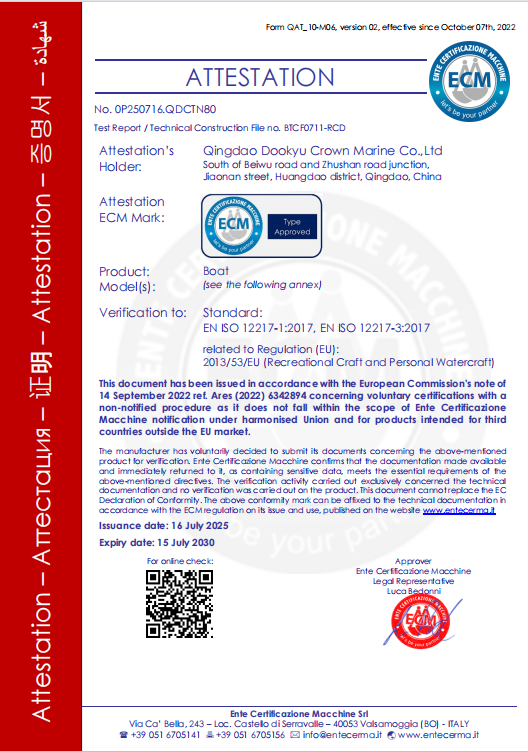
Certificate documentation should be checked for scope, certificate number and validity dates, not only for its existence.
What inspection evidence is produced during construction?
The stated quality-control process runs from raw material verification through Mill Test Reports, to in-process weld inspections using NDT, to final sea trials, within a full-process inspection system aligned with ISO 9001, CE and class-society requirements where applicable. Buyers can request these records as part of acceptance.
How is export handled, and what trade terms are available?
The builder states export packaging, international logistics, customs clearance support and after-sales service, with FOB and CIF trade terms and multilingual communication support. Export reaches more than 30 countries and regions, with a stated export ratio of 80% and markets including AU, USA, CA, EC, HK, MX, NG, NZ, RU and TH. Compliance documentation such as CE and SOLAS is described as available according to market entry requirements.
What after-sales support is provided?
Stated support covers remote diagnostics, spare parts supply, on-site assistance, comprehensive operation and maintenance manuals, technical training, and a global service network with local support available in key regions.
For buyers who want the underlying configuration and capability data behind these answers, the builder's brochure is available for download: Dookyu Crown marine brochure (PDF). Additional company information is published at dstaryacht.com.
Have Questions or Need More Details?
Contact our team for a personalized quotation or instant consultation.
Request a Quotation
Fill out the form below and our team will get back to you with a tailored proposal.
WhatsApp Direct Chat
Prefer to chat in real-time? Message us on WhatsApp for instant assistance & quick answers.
- Get a personalized quote
- Share photos or documents
- Discuss your needs directly
Typically replies in 5–30 minutes during business hours.