
Aluminum Frame Tent Compliance File: Fabric, Loads & Inspections
Aluminum Frame Tent Compliance File: Fabric, Loads & Inspections
Aluminum Frame Tent Compliance File: Fabric, Loads & Inspections
For an aluminum frame tent project, approval should be based on a coordinated set of documents—not on a product description or a single load figure. Before signing off, the buyer should be able to connect the fabric evidence, structural design basis, project-specific anchoring and foundation information, and inspection records to the tent being quoted. Together, these records form a practical compliance file for technical review, installation planning, and later reference.
Shoulder Tent is the brand name used by Shenzhen Shoulder Tent Co., Ltd., a manufacturer of prefabricated aluminum-frame tent structures for applications that include warehousing, sports, weddings, and events. Its supplied product information describes a clear-span design, high-strength aluminum profiles, modular bay expansion, double PVC waterproof and flame-retardant fabric, and stated wind and snow load capabilities. Those statements can help frame a quotation review, but they do not replace project-specific evidence or local approval.
Why one connected file matters
A compliance file is useful when it links design claims to identifiable project documents. If a quotation describes an Industrial Tent, Warehouse Tent, Sports Tent, Wedding Tent, Event Tent, or another Aluminum Frame Tent configuration, a buyer needs to know which design, fabric, anchoring arrangement, and inspection records apply to that specific scope. Without that link, documents can be technically relevant yet still fail to establish that the quoted configuration is the one that was reviewed.
The file also helps separate different questions that are often bundled together under the word “compliance.” Fabric fire-performance evidence addresses a material and a test method. Structural documentation explains the basis for the frame and stated loads. Anchoring and foundation details address how the structure is intended to connect to the site. Inspection records show what was checked during production or before dispatch. These are related parts of the review, but they are not interchangeable.
This distinction matters across temporary and semi-permanent uses. A Clear Span Tent used for storage has different project details from a Marquee Tent used for an event, even if both are described as a Large Tent. A buyer assessing a Temporary Warehouse Tent, aircraft hangar tent, workshop tent, pickleball tent, Padel Tent, tennis tent, or Outdoor Event Tent should therefore ask for evidence tied to the actual use, configuration, location, and installation approach—not rely on category labels alone.
1. Fabric: identify the material, test, and limits of the evidence
The first fabric question is not simply whether a cover is described as flame-retardant. It is what material was tested, which test report supports the claim, and whether the tested material corresponds to the fabric specified for the project. The name, construction, weight, color, and other identifiers should be consistent across the quotation, fabric specification, report, and final order documents wherever those details are provided.
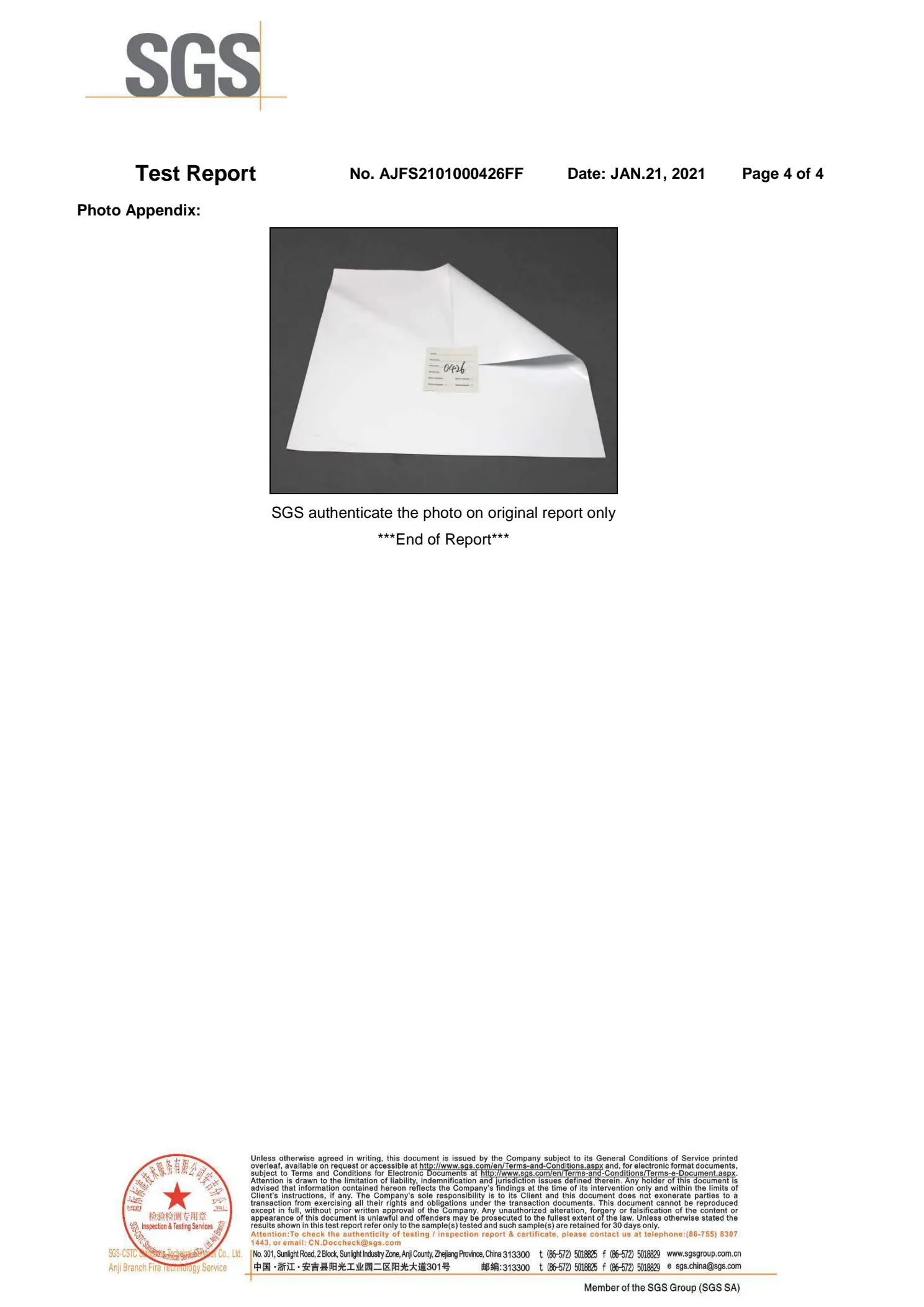
Shoulder Tent’s available compliance record is an SGS Test Report for 850gsm PVC Coating Material. The record identifies a single-layer white PVC coating material and references CAN/ULC-S109-14 Clause 4.4, Large-Flame Test. Its report number is AJFS2101000426FF, and the listed issue date is 2021-01-21. These details allow a buyer to identify what the provided report covers and to request a copy for review.
The scope is important. The record describes a particular PVC coating material; it should not be represented as a test of every fabric option, a complete double-layer tent cover, or the entire Aluminum Frame Tent assembly unless separate documentation establishes that broader scope. The product information also describes double PVC waterproof and flame-retardant fabric, but the buyer should confirm which report or other evidence applies to the precise cover construction quoted.
Fabric documents to request at quotation stage
- The fabric specification for the quoted cover, including the material description and any stated weight or construction details.
- The complete test report or an identifiable report copy, with issuer, report number, test method, tested specimen description, and result information visible.
- A written explanation of how the tested specimen matches the fabric option being quoted, including any differences between a single-layer material and the proposed cover assembly.
- Confirmation of which cover option and fabric documentation will be listed in the final order and supplied project file.
- Any additional fabric evidence required by the buyer’s destination, project owner, venue, or approval process, identified by the responsible party rather than assumed from a generic product description.
These requests help prevent a common documentation gap: a recognizable report is available, but the order does not clearly identify whether the tested material is the material that will be delivered. The report is evidence with a defined scope. Buyers should avoid expanding that scope by implication.
2. Frame and environmental loads: make the design basis explicit
Shoulder Tent’s product information states support for wind loads up to 120 km/h and snow loads up to 1.9 kN/m² in the documented product information. It also describes high-strength aluminum profiles, a clear-span column-free design, and modular 3m/5m bay expansion. These are useful starting points for a technical discussion, but a buyer should not treat either load value as a universal approval for every span, site, or installation.
A stated capability needs context before it can support a project decision. Ask the supplier to identify the configuration to which the load statement applies and to provide the available design documents for the quoted project. The buyer should be able to determine whether the proposed span, dimensions, bay arrangement, fabric, connections, and support conditions are represented in the submitted evidence. If a project has local engineering or permitting requirements, confirm who will review the documents and what additional information is needed.
For wind and snow, request the design basis and the relevant calculations or drawings available for the project. Ask the supplier to show how the quoted configuration relates to the stated values and to identify assumptions or exclusions in the documentation. A load number without its design context is difficult to evaluate, compare, or hand over to an engineer responsible for the site.
Aluminum profile information should be equally specific. The available materials describe high-strength aluminum profiles, while separate supplier product information identifies 6061/T6 for certain tent products. That alloy statement is not a substitute for a project’s structural documentation, and it should not be applied to a model or configuration unless the supplier confirms that it is relevant. Where alloy or profile characteristics are part of the approval basis, ask for the applicable specification and supporting records for the quoted structure.
Load-review questions for a quotation
- Which exact tent configuration and span does the stated wind and snow capability refer to?
- What drawings and calculations are available for the project dimensions and bay layout?
- Which assumptions, site conditions, or installation requirements accompany the submitted design information?
- How do the frame profiles, connections, and cover configuration shown in the documents correspond to the quoted package?
- Which documents are intended for the buyer’s engineer, project reviewer, or local approval process?
The purpose is not to make a supplier statement carry more weight than it can. It is to establish a traceable path from the stated capability to the project documents and then to the final supplied configuration. A number in a brochure may help identify a question; it does not answer every engineering question on its own.
3. Anchoring and foundations: request project-specific information
Anchoring is the link between the tent design and the installation site. A buyer should request an anchoring plan or relevant connection details for the project, together with a clear statement of what is included in the supplier’s scope and what must be designed, provided, or verified by another party. The available product information does not specify a universal anchoring system or foundation detail, so those items should not be inferred from the stated load values.
Ask the supplier to identify the proposed anchoring arrangement for the quoted project and to show how it relates to the frame layout and the submitted structural information. Request drawings or specifications for the relevant connection points, and ask what site information is needed before the arrangement can be confirmed. If the installation depends on a foundation or prepared surface, clarify who is responsible for its design and readiness, and which party verifies that it is suitable for the intended installation.
These are procurement questions, not a substitute for local engineering review. The buyer’s file should make responsibilities visible: what the tent supplier provides, what the installer supplies, what the site owner prepares, and which elements require review by the project’s qualified professionals or authorities. This is especially important where the project is a Commercial Tent, industrial storage tents, an aircraft hangar tent, or another structure whose use and site conditions require a formal project review.
4. Inspection records: define the checks and the handover
Shoulder Tent states that completed products undergo standardized engineering and quality inspections before leaving the factory. For procurement, that statement should lead to a request for the inspection records applicable to the order. The buyer should ask what is checked, how the inspected items are identified, and what documentation will be available before dispatch. The available information does not enumerate specific inspection steps or provide a sample inspection report, so those details should be confirmed rather than assumed.
A useful inspection record is connected to the order and the configuration being shipped. Ask the supplier to identify the inspection document, the date or production stage it represents, the items covered, and how any issues requiring correction are recorded and closed. Buyers can also agree in advance which documents must be received before dispatch and how the final package will identify the shipped configuration.
For an aluminum frame structure, the records requested may be organized around the buyer’s own acceptance plan: the approved drawings and configuration; the fabric identification and its evidence; the frame and connection details reviewed for the project; and the final inspection or release records supplied for the order. This is a document-control framework, not a claim that a particular inspection checklist or acceptance test is already part of every supplier’s standard package.
What a buyer can ask to receive before dispatch
- The final configuration or drawing reference used for production, with revisions identified.
- The fabric specification and the material report or other applicable evidence agreed for the order.
- The structural and load-related documents agreed for the project, with scope and assumptions identifiable.
- The anchoring and foundation information assigned to the supplier’s scope, plus a note identifying any items assigned to other parties.
- The completed engineering and quality inspection records applicable to the finished order, along with any agreed correction or release documentation.
- A consolidated index so that reviewers can see which documents are included, what each covers, and which project configuration it relates to.
5. Build the compliance file as a traceable sequence
One practical way to organize the review is to treat the file as a sequence from quotation to dispatch. Each stage should make the next one easier to verify.
| Stage | Buyer’s review question | Evidence to request or retain |
|---|---|---|
| Quotation definition | What exact tent, cover, dimensions, and configuration are being offered? | Quotation scope and the configuration or drawing reference used to describe the project. |
| Fabric review | Does the report cover the material option specified for this order? | Fabric specification and the applicable report, with its scope and test method identifiable. |
| Structural review | How does the project configuration relate to the stated wind and snow loads? | Available project drawings, calculations, design basis, and any stated assumptions. |
| Site interface | How will the structure be anchored, and who is responsible for the foundation? | Project-specific anchoring information, connection details, and a clear allocation of responsibilities. |
| Pre-dispatch review | What was inspected, and what records will accompany the order? | Applicable engineering and quality inspection records and the agreed document index. |
This table is a buyer’s review structure, not a claim that every listed document is automatically included with a quotation. Where a supplier cannot provide an item at the quotation stage, the buyer can record when it will be available, who is responsible for producing or reviewing it, and whether it is a condition for approval or dispatch.
What Shoulder Tent’s available evidence does—and does not—establish
The supplied information supports several specific statements: the Aluminum Frame Tent product information describes a clear-span column-free design, high-strength aluminum profiles, modular 3m/5m bay expansion, double PVC waterproof and flame-retardant fabric, and stated wind and snow load capabilities up to 120 km/h and 1.9 kN/m². A separate SGS report record identifies 850gsm PVC coating material, a single-layer white PVC coating scope, and CAN/ULC-S109-14 Clause 4.4 Large-Flame Test. Shoulder Tent also states that standardized engineering and quality inspections take place before products leave the factory.
Those points provide a basis for a focused quotation discussion. They do not, by themselves, establish that every fabric option has the same test evidence, that the cited material report covers a complete tent cover, that every project configuration has the same load capacity, or that a particular anchoring and foundation arrangement is approved for a buyer’s site. The documents should be checked for scope and correspondence to the order before they are used for sign-off.
This distinction is relevant whether the project is for storage, sports, events, weddings, exhibitions, or commercial use. Shoulder Tent’s supplied application information names event and exhibition organizers, wedding and banquet venue owners, sports organizations, logistics and warehousing companies, and hotel and resort operators. Application fit helps identify the intended use; it does not replace the design and installation review for a particular site.
What to request at quotation stage
To make the quotation review efficient, buyers can send the supplier a single document request organized around the project rather than asking for general claims. The request should name the intended use, configuration, relevant site information available to the buyer, and the documents required for review. It should also ask the supplier to identify any items that are not included or cannot be confirmed until additional project information is available.
- Configuration: Ask for the quoted tent layout and the identifying drawing or specification reference.
- Fabric: Request the exact cover specification and the test documentation that applies to that material and construction.
- Loads: Ask how the stated wind and snow capabilities relate to the offered project configuration, and request the available supporting design information.
- Anchoring and foundation: Request project-specific information and a written division of responsibility for the tent supplier, installer, and site-side work.
- Inspection: Ask which standardized engineering and quality inspection records will be provided and when they will be available.
- File control: Request a document index or equivalent method for connecting each record to the project, configuration, and order.
At evaluation stage, these questions help distinguish a general product description from a reviewable project submission. A complete answer does not mean that every local permit or engineering decision has already been resolved. It means the buyer can identify the evidence supplied, understand its scope, and see what remains for the project team to verify.
FAQ
What should be included in an Aluminum Frame Tent compliance file?
A practical file connects the quoted configuration to fabric evidence, structural and load-related documents, project-specific anchoring and foundation information, and applicable engineering and quality inspection records. Buyers should also retain a document index showing what each record covers.
Does the SGS report prove that the complete tent is fire compliant?
The available report record covers a single-layer white 850gsm PVC coating material and references CAN/ULC-S109-14 Clause 4.4, Large-Flame Test. That scope alone does not establish that every fabric option, the complete cover assembly, or the full tent structure has been tested or approved.
Can the stated 120 km/h wind and 1.9 kN/m² snow loads be used for any site?
No universal site approval follows from those product-level figures alone. The buyer should ask which configuration the figures apply to and request the available project design information, including relevant assumptions and installation conditions.
Why request anchoring and foundation documents before signing off?
Anchoring and foundation information connects the tent design to the installation site. Because the supplied product information does not define a universal anchoring or foundation arrangement, the buyer should request project-specific details and clarify which party is responsible for each part.
What inspection records should be requested before dispatch?
Ask for the standardized engineering and quality inspection records applicable to the order, and confirm what they cover, how they identify the inspected configuration, and whether any agreed corrections or release documents will be included. The specific record format and inspection scope should be confirmed with the supplier.
Conclusion
An Aluminum Frame Tent compliance file is strongest when it joins four evidence areas: fabric documentation with a clearly stated test scope; structural information that connects load claims to the quoted configuration; anchoring and foundation details assigned to the project and site; and inspection records tied to the order before dispatch. For buyers evaluating a Warehouse Tent, Industrial Tent, Sports Tent, Wedding Tent, Event Tent, or other large structure, the key procurement task is to request these items early and check that each one refers to the same project. That makes the quotation easier to review without treating a single certificate or load figure as a substitute for the complete project record.
Have Questions or Need More Details?
Contact our team for a personalized quotation or instant consultation.
Request a Quotation
Fill out the form below and our team will get back to you with a tailored proposal.
WhatsApp Direct Chat
Prefer to chat in real-time? Message us on WhatsApp for instant assistance & quick answers.
- Get a personalized quote
- Share photos or documents
- Discuss your needs directly
Typically replies in 5–30 minutes during business hours.