
Aluminum Frame Tent Compliance & Qualification: What Owners Should Verify
Aluminum Frame Tent Compliance & Qualification: What Owners Should Verify
An aluminum frame tent is a prefabricated structure built from an aluminum alloy profile frame and a double-layer PVC-coated polyester tarpaulin cover, assembled on site in modular form. Because these structures are now used for warehousing and logistics, industrial manufacturing, agricultural storage, sports venues, exhibition and events, and hospitality and resorts, the questions project owners ask have changed. Ten years ago the discussion was about span and price. Today it is about load documentation, fire performance, ground fixing and who signs the engineering.
That shift is the reason this guide exists. Compliance and qualification are two different checks, they are performed by different people, and they produce different documents. A project owner who runs only one of them can still end up with a structure that is legal on paper and unsafe on the ground, or well built and impossible to approve.
Why compliance verification has become a project risk issue
Temporary and semi-permanent fabric structures have moved from event inventory into operational infrastructure. A warehouse tent that shelters palletised goods, a workshop tent that houses active machinery, or an indoor sports tent that holds a booked season of play carries consequences far beyond a single weekend event. Once a structure has people or assets inside it for months at a time, the buyer is no longer purchasing a product. The buyer is accepting a structural risk.
The commercial evidence points in the same direction. The global event tent market, which includes aluminum frame structures, was projected to reach a valuation of over USD 3 billion by 2025, growing at a CAGR of 6.2%, according to Rethinking The Future. A broader tent market estimate covering storage, sports and event sectors projects growth from USD 4.01 billion in 2025 to USD 6.07 billion by 2033, at a CAGR of 5 to 7%, according to Shelter Structures and related industry reports. China exported approximately USD 5.55 billion in Aluminium Structures under HS 7610 in 2024, according to the Observatory of Economic Complexity, a category that covers modular tent frames.
Those figures describe a market that is expanding. They also describe a market in which a growing share of buyers have no structural engineering background, and in which the difference between a compliant and a non-compliant installation is invisible at the point of delivery. The gap between what arrives on site and what the project actually required is where most disputes begin.
Compliance and qualification are two different checks
Compliance is a structure-and-documentation question. It asks whether the delivered tent, as installed at this location, meets the rule set that applies to it. Qualification is a supplier question. It asks whether the manufacturer can engineer, document, produce and support the project at all.
The distinction matters because the two failures look nothing alike. A qualified supplier can deliver a non-compliant structure if the project requirements were never written into the order. A compliant design can still fail on site if the anchoring is wrong, the ground is unsuitable, or the fabric supplied is not the fabric that was tested.
The compliance layer: what to verify in the structure itself
Loads: wind and snow
Published performance data for the Aluminum Frame Tent family, which includes model designations S30-1, S32, S45-1, S45-2 and S60-1, states a maximum wind load of 100 to 120 km/h and a snow load of up to 1.9 kN/m². Those are the declared design figures for the product family. They are not automatically the figures for a specific site.
A project owner should therefore request two separate things. First, the site wind speed and snow load that apply to the actual location. Second, a load calculation showing that the selected frame class and cover configuration meet those site figures, including where the site sits in an exposed position or in a region with heavy snow accumulation. Where a project sits beyond the standard envelope, the requirement is a strengthened wind or snow load design, which is a documented customisation option rather than a generic upgrade.
Structural standards
In Europe, safety requirements for mobile, temporarily installed tents are governed by the EN 13782:2015 standard, which covers structural stability under wind and snow loads. In the United States, commercial event and industrial tents must comply with NFPA 701, the Standard Methods of Fire Tests for Flame Propagation of Textiles and Films. These two references do different jobs. EN 13782:2015 addresses the structure. NFPA 701 addresses the cover material. A buyer evaluating a temporary warehouse tent or an industrial tent for a European site and a buyer evaluating the same product for a US site are asking different compliance questions, and the documentation request should reflect that.
Materials and the service-life question
Compliance is not a one-time event, because the two main materials have very different service lives. Industry sources describe aluminum alloy frames, typically 6061/T6, as having a service life of 15 to 20 years, while PVC-coated fabric covers typically last 5 to 8 years under standard outdoor conditions. The practical consequence for a project owner is that the cover should be treated as a wear component with a replacement cycle, and that the original specification should record the exact fabric construction so a future replacement matches the tested material. Shoulder Tent specifies a double-layer PVC-coated polyester tarpaulin cover on an aluminum alloy profile frame, which gives the buyer a documented baseline to compare against on delivery.
The qualification layer: verifying the manufacturer
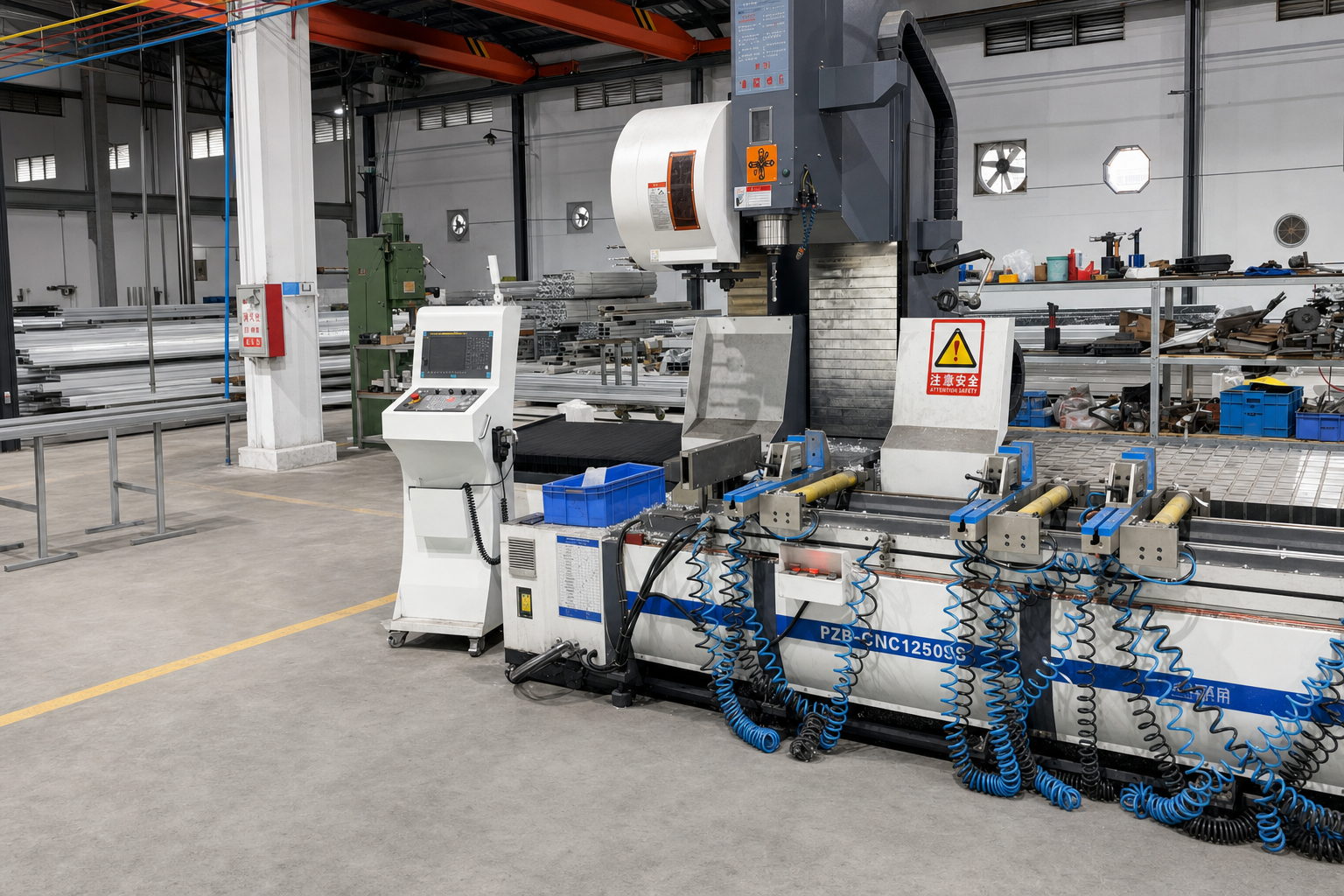
Shenzhen Shoulder Tent Co., Ltd. (Shoulder Tent) is a manufacturer specialising in large prefabricated tent structures, established in 2009, headquartered at No. 4703B, West Tower, Galaxy Twin Towers, Shenzhen, China. It operates a manufacturing facility covering 20,000 square metres with approximately 200 employees, reaches an annual production capacity of 1,000 units, and exports account for 80% of total sales. Its major markets are Europe, the Middle East, Africa, Southeast Asia and South America, supported by a management centre in Shenzhen and a marketing centre in Guangzhou.
Each of those facts answers a different qualification question.
- Production footprint: a 20,000 square metre facility indicates that frame cutting, fabrication and cover production are handled in a controlled environment rather than outsourced piecemeal, which is the first thing a documentation-heavy project needs.
- Workforce: approximately 200 staff sets the realistic boundary for how many projects can be handled at once, and therefore how much engineering attention a single order receives.
- Capacity: 1,000 units per year is a delivery-planning figure. For a multi-unit roll-out, buyers should confirm the schedule window for their specific order rather than assume the annual figure applies to a single month.
- Engineering resources: the company maintains an R&D centre and an engineering team and offers custom design and technical support, which is what makes project-specific wind, snow and anchoring design possible at all.
- Export orientation: with 80% of sales outside China and a delivery record across many countries and regions, a supplier accumulates familiarity with the documentation formats different markets expect.
The qualification test for a buyer is not whether these numbers exist. It is whether the supplier can connect them to this project: who issues the drawings, who signs the load calculation, what happens when the site snow load exceeds the standard product figure, and how the structure is fixed to the ground.
Verification checklist for the enquiry and order stage
The following checklist maps each verification item to the document that closes it. It is written from the buyer side, which means several rows ask the buyer to specify something rather than to receive it. That is intentional: inspection scope and anchoring requirements are contract decisions, not supplier defaults.
| Verification area | What to request or specify | Why it matters |
|---|---|---|
| Site design loads | Local wind speed and snow load figures, plus a calculation showing the selected frame class meets them | Published product data of 100 to 120 km/h wind and up to 1.9 kN/m² snow describes the family, not every location |
| Structural standard | Documentation aligned with EN 13782:2015 for mobile, temporarily installed tents in Europe | EN 13782:2015 covers structural stability under wind and snow loads |
| Fire performance of the cover | Flame propagation test data for the actual cover material, referenced to the applicable market standard such as NFPA 701 in the US | NFPA 701 governs flame propagation testing for textiles and films used in commercial and industrial tents |
| Material traceability | Aluminum alloy profile documentation and the fabric construction record, including the double-layer PVC-coated polyester tarpaulin specification | Material choice drives realistic service life and future replacement matching |
| Manufacturing accountability | Legal entity, production site, facility size, staffing and annual capacity | Shoulder Tent operates a 20,000 sqm facility with approximately 200 staff and 1,000 units of annual capacity, which defines what it can realistically engineer and deliver |
| Ground fixing | Anchoring design, foundation or anchorage treatment, and the anchoring systems supplied | Wind uplift and snow load are transferred through the frame into the ground; the frame cannot compensate for a weak anchorage |
| Pre-delivery inspection | Agreed inspection scope: profile dimensions, fabric inspection, hardware counts, packing list, loading photographs, optional third-party inspection | Inspection scope is a contract decision; undocumented handover is where disputes start |
| Handover and aftercare | Installation guidance, maintenance intervals, inspection points, spare-part availability | Industry sources place PVC-coated cover life at 5 to 8 years against 15 to 20 years for 6061/T6 frames, so the cover is a planned wear item |
Anchoring, installation and ongoing risk control
Most aluminum frame tent failures reported in the field are not frame failures. They are fixing failures. A frame designed for 100 to 120 km/h wind load still requires an anchorage that suits the ground beneath it, and the ground is the one variable the manufacturer cannot see from the factory. Shoulder Tent lists foundation and anchorage treatments, along with strengthened wind and snow load designs, as project-specific requirements rather than standard content, and supplies anchoring systems within its matched equipment range alongside cassette flooring, sidewalls and doors, ventilation and insulation accessories, lighting, and staging elements.
Three risk-control measures follow from that.
Project-specific anchoring reinforcement. The anchorage design should be produced for the actual sub-base: asphalt, compacted gravel, concrete, grass or an existing hardstanding all behave differently under uplift. Where ground conditions are marginal, foundation or anchorage treatment is the correct answer, not a heavier frame.
Regular inspection. A fabric structure is a tensioned system. Cover tension, connection condition and the integrity of the fabric surface should be checked on a defined cycle, and again after any high-wind or heavy-snow event. This is routine maintenance, and it is the cheapest risk control available to an owner.
Technical support at the design and installation stage. Shoulder Tent provides custom design and technical support through its engineering team, which is the appropriate channel for questions that arise between the load calculation and the finished installation. For remote sites, buyers should confirm in advance what the support scope covers, because a structure that is engineered correctly but installed incorrectly has the same outcome as one that was never engineered at all.
Where these structures are used, and what that means for verification
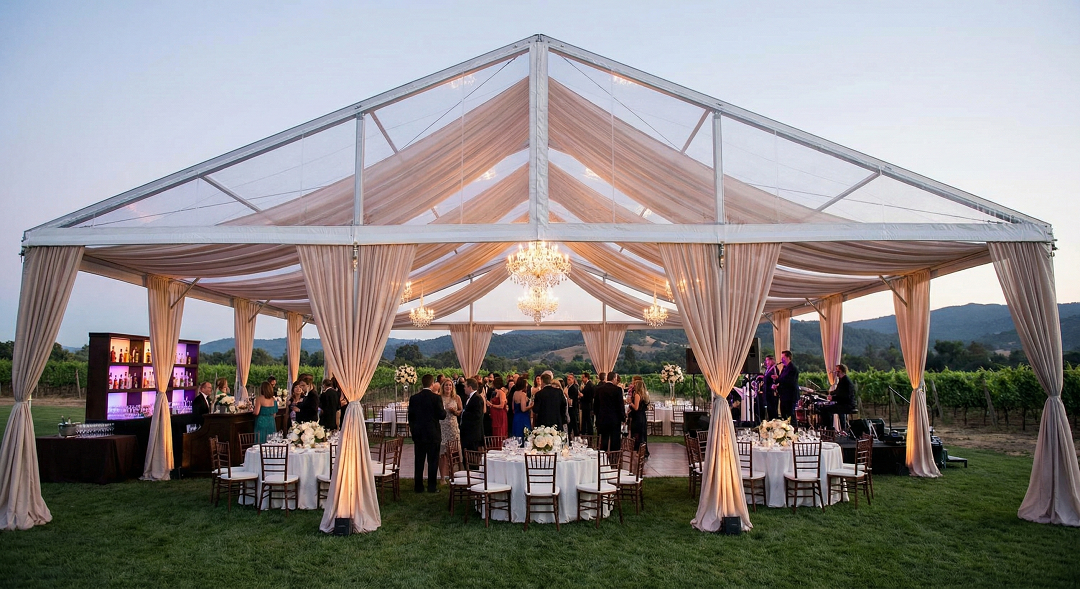
Shoulder Tent classifies the aluminum frame tent for hospitality and resorts, sports venues, exhibition and events, agricultural storage, industrial manufacturing, and warehousing and logistics. The same product family is supplied as a wedding tent, an event tent, a sports tent or a warehouse tent, and the structural requirement does not change with the label. What changes is occupancy and duration.
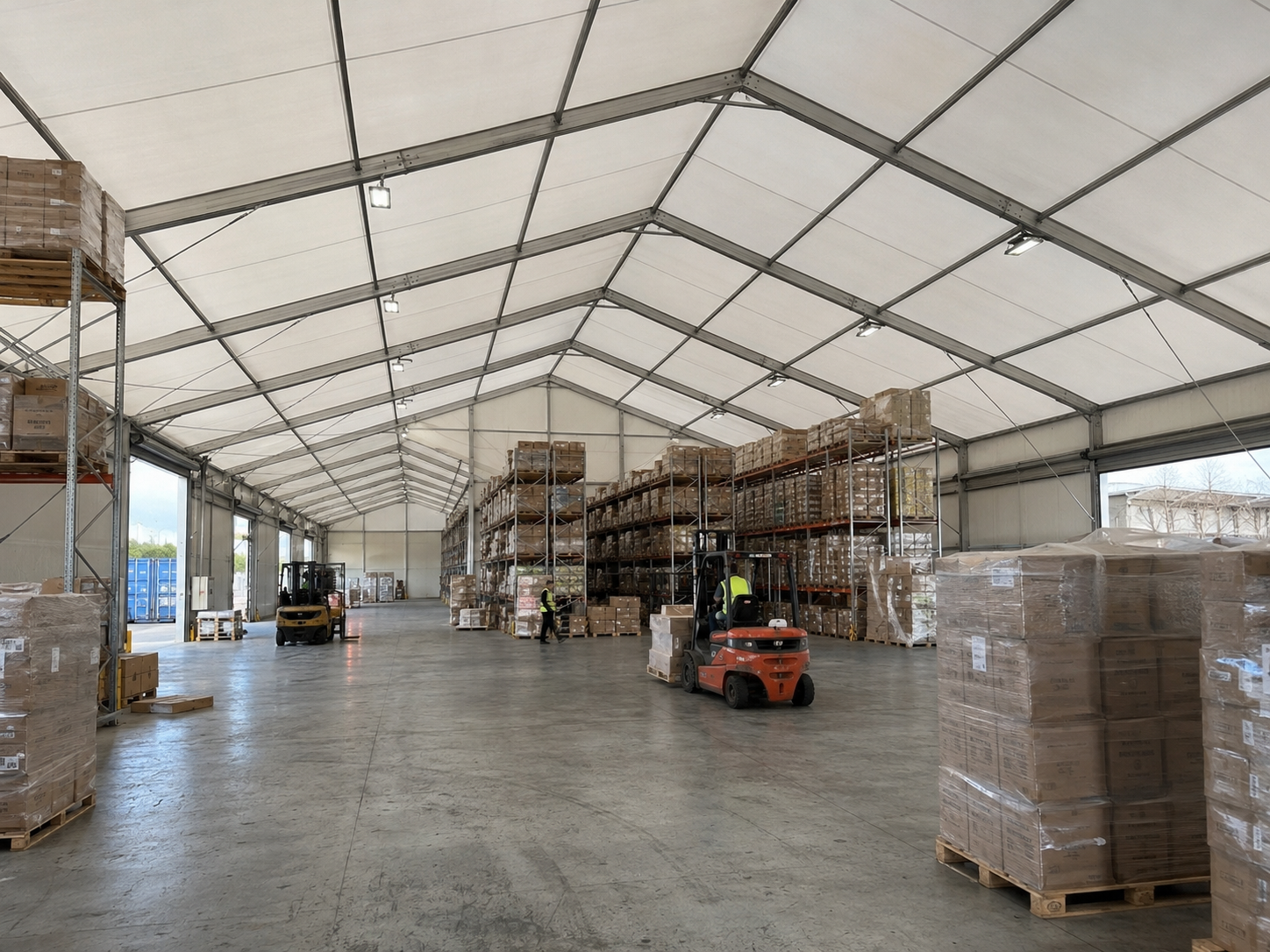
- A temporary warehouse tent, industrial storage tent or storage tent shelters goods and often equipment, so water tightness, condensation control and snow load take priority over appearance.
- An industrial tent or workshop tent used around active operations usually needs ventilation, insulation and climate control accessories added to the base structure.
- A sports tent, pickleball tent, padel tent or tennis tent holds play on a fixed schedule, which raises the cost of any closure and makes wind verification and cover condition checks more valuable.
- A large event tent, outdoor event tent, marquee tent or commercial tent operates under temporary occupancy rules, where fire performance of the cover is the dominant compliance question.
- A hangar tent, aircraft hangar tent or large clear span tent used for aviation or oversized storage is where span, door openings and custom loading access drive the engineering work.
Comparison with traditional construction, including the limits
Aluminum frame tents are frequently compared with permanent steel or concrete buildings. The comparison is useful only when the boundaries are stated plainly.
| Decision area | Aluminum frame tent | Permanent building |
|---|---|---|
| Design basis | Engineered to a declared wind and snow envelope, with strengthened designs available for specific sites | Engineered to full building codes for the jurisdiction and intended permanent occupancy |
| Approvals | Treated as mobile or temporarily installed structures in many markets, such as under EN 13782:2015 in Europe | Requires building permit and inspection processes |
| Speed and relocation | Modular prefabricated assembly designed for rapid installation and dismantling, and can be relocated | Fixed asset, effectively not relocatable |
| Service life | Industry sources cite 15 to 20 years for aluminum frames and 5 to 8 years for PVC-coated fabric covers, so the cover is replaced within the structure life | Long service life with different maintenance economics |
| Ground dependency | Performance depends on anchorage and foundation treatment suited to the sub-base | Foundation is designed and built as part of the project |
The limitation, stated plainly: an aluminum frame tent is engineered to a defined load envelope, and it is not a like-for-like substitute for a permanent building where the local authority requires permanent construction, or where the site conditions fall outside what the frame and anchorage can safely carry. It is also not maintenance-free, because the fabric cover has a shorter service life than the frame and must be inspected, re-tensioned and eventually replaced. Buyers who treat a tent as a permanent building with a faster delivery schedule are the ones who end up surprised.
Market trend analysis
Published market estimates should be read with their scope in mind. The event-focused figure of over USD 3 billion by 2025 with a CAGR of 6.2% from Rethinking The Future covers commercial event tents including aluminum frame structures. The broader figure, growing from USD 4.01 billion in 2025 to USD 6.07 billion by 2033 at a CAGR of 5 to 7% from Shelter Structures and related industry reports, includes storage and sports categories. These two numbers are not directly comparable because they measure different segments, which is itself a useful reminder for buyers: market size claims circulating in tender documents often mix categories.
The supply-side signal is clearer. China exported approximately USD 5.55 billion in Aluminium Structures under HS 7610 in 2024, according to the Observatory of Economic Complexity, and modular tent frames sit inside that category. Combined with an event tent market growing at a mid-single-digit rate, the picture is a maturing export supply base in which differentiation shifts from price and span towards documentation, engineering depth and after-sales structure. That is exactly the shift that makes compliance and qualification checks worthwhile rather than bureaucratic.
Future outlook
Temporary structures are being specified for longer duty cycles, and specification practice is following. Buyers are increasingly asking for site-specific load calculations, fire test documentation for the actual cover material, material records and a defined inspection scope before order confirmation. Manufacturers whose capability is traceable and whose engineering function is in-house are better positioned to answer those requests, because they can produce project-specific documents rather than repeat a generic catalogue sheet.
The practical expectation for the next planning cycle is that compliance documentation becomes part of the purchase order rather than a post-delivery argument. Owners who build a verification checklist into procurement at the enquiry stage will find that the structure they receive matches the structure they intended to buy.
FAQ
What is an aluminum frame tent?
An aluminum frame tent is a prefabricated structure consisting of an aluminum alloy profile frame and a double-layer PVC-coated polyester tarpaulin cover, assembled on site in modular form and designed for rapid installation and dismantling. Shoulder Tent supplies the format under model designations S30-1, S32, S45-1, S45-2 and S60-1, classified as a wedding tent, event tent, sports tent or warehouse tent.
Where are aluminum frame tents used?
They are specified for hospitality and resorts, sports venues, exhibition and events, agricultural storage, industrial manufacturing, and warehousing and logistics. In practice this covers temporary and semi-permanent storage, workshop and production space, indoor racket sports and other sports venues, weddings, and commercial events.
Which standards apply to aluminum frame tents?
It depends on the market. In Europe, mobile and temporarily installed tents are governed by EN 13782:2015, which covers structural stability under wind and snow loads. In the United States, commercial event and industrial tents must comply with NFPA 701, which sets test methods for flame propagation of textiles and films. The first standard addresses the structure; the second addresses the cover material.
What wind and snow loads can an aluminum frame tent be engineered for?
Published product data for the Aluminum Frame Tent family states a maximum wind load of 100 to 120 km/h and a snow load of up to 1.9 kN/m². These figures describe the product family. The applicable requirement for a specific project comes from local wind speed and snow load data, so a project-specific load calculation should be requested, and strengthened wind or snow load designs are available where site conditions exceed the standard envelope.
What documents should a project owner request from a supplier?
A site-specific load calculation, structural drawings, material specification covering the alloy profile and the double-layer PVC-coated polyester tarpaulin, flame propagation test data for the actual cover material, an anchoring or foundation treatment plan, and a defined pre-delivery inspection scope with a packing list. Where the project requires third-party inspection, that scope should be agreed before the order is confirmed.
How long does an aluminum frame tent last?
Industry sources describe aluminum alloy frames, typically 6061/T6, as having a service life of 15 to 20 years, while PVC-coated fabric covers typically last 5 to 8 years under standard outdoor conditions. The frame and the cover therefore have different lifecycles within the same structure, and the cover should be treated as a planned replacement item.
What are the main limits of aluminum frame tents?
Three are structural rather than commercial. First, the tent is engineered to a declared wind and snow envelope, and it is not a like-for-like substitute for permanent construction where local rules require a permanent building or where site loads exceed the certified design. Second, performance depends on the anchorage and foundation treatment matching the sub-base, since wind uplift and snow load transfer into the ground. Third, the fabric cover has a shorter service life than the frame and requires scheduled inspection and eventual replacement.
Verification contacts and further reference
Project owners who need to verify entity details, documentation scope or technical support arrangements can contact Shenzhen Shoulder Tent Co., Ltd. directly. Email: info@shouldertent.com. Phone and WhatsApp: +86 158 1850 8822. Management Center Shenzhen: No. 4703B, West Tower, Galaxy Twin Towers, Shenzhen, China. Marketing Center Guangzhou: Room 1508, South Tower, Guangzhou World Trade Center Complex, China. Company website: www.shouldertent.com.
A downloadable company introduction covering product ranges and applications is available here: Shoulder Tent company introduction (PDF).
Note on sources: product and company facts in this article come from Shoulder Tent documentation. Market and standard references are attributed to Rethinking The Future, Shelter Structures and related industry reports, the Observatory of Economic Complexity, the European Committee for Standardization (EN 13782:2015) and the National Fire Protection Association (NFPA 701). Market size estimates differ by segment scope and are not directly comparable.