
Aluminum Frame Tent Compliance: Wind, Snow & Fire Coverage
Aluminum Frame Tent Compliance: Wind, Snow & Fire Coverage
What wind, snow, and flame documentation for aluminum frame tents actually covers — and where the boundaries of those claims sit.
Compliance in Aluminum Frame Tents Is a Set of Conditions, Not One Certificate
Aluminum frame tents are prefabricated structures: a frame built from aluminum alloy profiles, a cover made from PVC-coated polyester tarpaulin, and a set of accessories such as sidewalls and doors, flooring systems, ventilation and insulation, lighting, and anchoring systems. They serve warehousing and logistics, industrial manufacturing, agricultural storage, exhibition and events, sports venues, and hospitality and resorts.
Because these structures are assembled on site rather than built in place, their compliance questions are answered by documents rather than by a building permit file. That difference produces a recurring confusion in procurement: the single word compliant is used to cover four separate items that come from four different sources.
| Procurement claim | What it actually describes | Type of evidence |
|---|---|---|
| Wind resistance | Design resistance of the assembled structure under a defined wind speed | Structural design and load assumptions |
| Snow load capacity | Roof design capacity under a defined load per square metre | Structural design and load assumptions |
| Fire performance | Flame behaviour of the cover material in a laboratory test | Material test report |
| Finished-structure conformity | Whether the delivered configuration matches the agreed design | Engineering and quality inspection before shipment |
The practical consequence is that two suppliers can both describe their tents as compliant and still be supported by entirely different evidence. One may be quoting a fabric flame test; the other may be quoting a structural load case. Neither is wrong. They answer different questions, and a serious project usually needs both.
Wind Load: What a 100–120 km/h Rating Describes
The published maximum wind load for the aluminum frame tent range referenced in this article is 100–120 km/h. Read precisely, that figure describes the wind speed the structure is engineered to resist when it is installed as designed: the specified frame geometry, the specified anchoring system, and ground conditions capable of transferring the load.
Wind resistance is therefore not a property of the frame alone. It is a property of the assembled system, and that system includes the connection between the structure and the ground.
Why the anchoring system belongs to the rating
Ground stakes, ballast, or anchors set into concrete transfer wind load to the ground. In tent documentation, foundation and anchorage treatment appear as a project-specific requirement rather than a fixed part of the product, and anchoring systems are listed among the matched accessories. Two identical tents installed with different anchoring methods on different soils do not deliver the same effective wind performance, even though both carry the same frame profile.
What changes effective wind performance in practice
- Span and eave height. Longer clear spans and taller sidewalls increase the bending and uplift loads the frame must carry, which is why a rating is only meaningful when quoted together with the geometry it belongs to.
- Openings. Removing sidewalls or leaving large doors open changes how pressure distributes across the structure.
- Exposure. Open airfield sites, coastal locations, and elevated ground present different wind exposure from sheltered urban courtyards. Aircraft hangar tents and large event tents standing in open terrain are typically the most exposed configurations.
- Installation quality. Tensioning, bracing, and completeness of the anchoring set determine whether the design assumption is actually reproduced on site.
These are general engineering realities rather than manufacturer-specific claims. They explain why a wind figure is best read as a condition of use rather than an unconditional promise.
Snow Load: Reading 1.9 kN/m² Correctly
The published snow load capacity for the same tent range is up to 1.9 kN/m². In more familiar terms, that is approximately 190 kilograms of snow per square metre of roof plan area — a substantial load corresponding to significant accumulation across a large roof.
The qualifier matters as much as the number. 1.9 kN/m² is a design capacity for a defined roof geometry at a defined span. It is not a statement that any depth of snow can be left on the roof indefinitely, and it is not a site approval.
Conditions that sit outside a snow rating
- Snow is not evenly distributed. Wind moves it, and drifting concentrates load in valleys, against walls, and along changes in roof level.
- Snow weight varies. Wet, compacted snow is considerably heavier than dry powder at the same depth.
- Internal heating changes the picture. A warm interior can cause melting at the roof surface and refreezing at the eaves, producing uneven and heavier local loads.
- Post-delivery modifications. Adding suspended loads, removing bracing, or installing additional liners changes the load case the original figure was based on.
In storage applications — temporary warehouses, industrial storage tents, workshop tents, agricultural storage — the snow figure usually governs roof design. In event and sports applications, wind and fire questions more often drive the specification.
Fire Performance: What the Cover Material Test Actually Covers
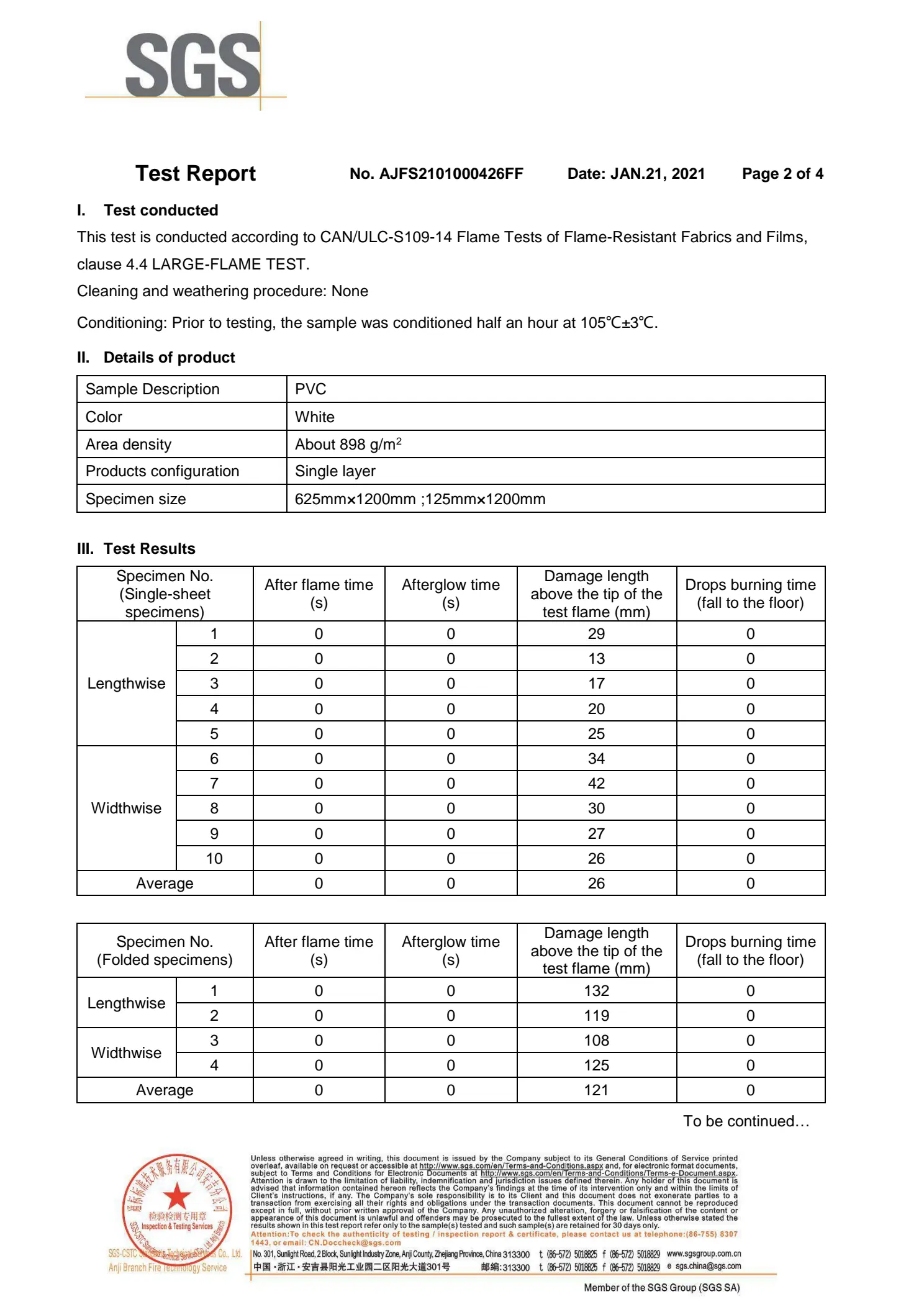
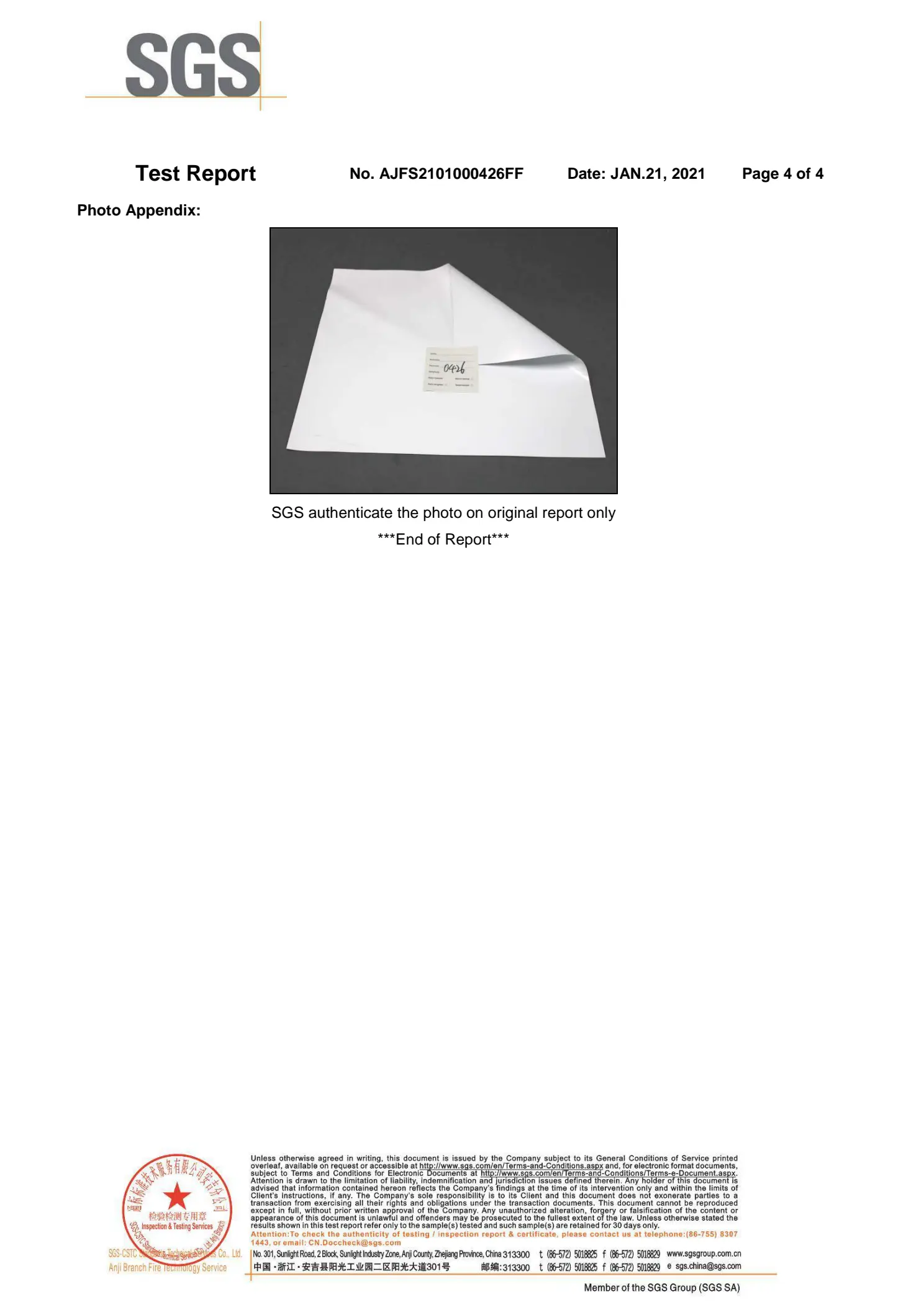
The fire-related evidence for this tent range is a material test. The 850gsm PVC coating material of the aluminum frame tent has been tested by SGS under report AJFS2101000426FF, following CAN/ULC-S109-14 Clause 4.4 Large-Flame Test. The stated scope of the report is single-layer white PVC coating material, recorded for the global market.
Two boundaries deserve attention.
First, the report describes a material, not a finished building. Seams, windows, curtains, insulation liners, flooring, and the frame sit outside the stated scope. A material test is a necessary component of fire documentation for a large tent, but it is not the whole of it.
Second, the tested material and the delivered cover construction are related but not identical. The cover specified for the aluminum frame tent is a double-layer PVC-coated polyester tarpaulin, while the report scope names single-layer white PVC coating material. Buyers reviewing a project specification should confirm which material in the bill of materials corresponds to the tested scope, and treat that as a documentation check rather than an assumption.
Why fire evidence matters more in some applications than others
In occupied spaces — sports venues using sports tents for padel, tennis, or pickleball, wedding and event tents, exhibition venues — the flame behaviour of large textile surfaces is a code item because it affects evacuation conditions. In storage applications, the priority shifts toward protecting stored goods and electrical equipment. Both are legitimate reasons to request the material test report, but they are not the same requirement, and a documentation package that satisfies one may not satisfy the other.
Where Structural Standards Enter the Picture
Two standards appear most often when tent structures cross borders, and they address different subjects.
In Europe, EN 13782:2015 governs mobile, temporarily installed tents and addresses structural stability under wind and snow loads. It is a structural document: it is concerned with whether the tent stands under defined loads.
In the United States, NFPA 701 addresses flame propagation of textiles and films, and is referenced for commercial event and industrial tents. It is a material-fire document.
The two are not substitutes. A tent can hold a fabric flame test and still require separate structural verification against local wind and snow requirements. Conversely, a structure can be designed to a wind and snow load case without carrying the fire documentation a venue operator may request. Reading the two as a package — and knowing which one answers which question — is the core of compliance evaluation in this product category.
Where Compliance Is Actually Built: Frame, Cover, and Pre-Shipment Inspection
The range referenced throughout this article is manufactured by Shoulder Tent (Shenzhen Shoulder Tent Co., Ltd.), a manufacturer of large prefabricated tent structures established in 2009. The company operates a 20,000 m² factory with approximately 200 employees and an annual output of about 1,000 units, exports roughly 80% of its production, and serves principal markets in Europe, the Middle East, Africa, Southeast Asia, and South America. Its project record covers more than 3,800 delivered structures across event, sports, and storage applications. Its ODM capability spans design and R&D, factory manufacturing, global delivery, and installation with on-site technical support.
Three elements of that process correspond directly to the three compliance questions above.
1. The frame
The aluminum alloy profile frame is built as a clear-span, column-free structure with modular 3 m / 5 m bay expansion. Model designations in the range — S30-1, S32, S45-1, S45-2, and S60-1 — correspond to different geometry classes. That is the reason load figures should always be quoted together with the model and span they belong to: the same manufacturer can legitimately publish different capacities for different configurations.
2. The cover
The double-layer PVC-coated polyester tarpaulin is specified as waterproof and flame-retardant, and it provides the material basis for the fire documentation described above. Because the cover is a composite construction rather than a single coating, it is also the component whose replacement cycle is shortest in service.
3. The inspection
Once a product is completed, it undergoes standardized engineering and quality inspections before leaving the factory. In compliance terms this is the third leg of the chain: material documentation establishes what the fabric is, the structural load case defines what the assembled structure should carry, and pre-shipment inspection is the point at which the delivered configuration is verified against the agreed specification.
Project execution parameters also shape what can be verified. Monthly production capacity is around 90 units with a lead time of 30–35 days, and orders are accepted from a single unit with no minimum order quantity requirement. For buyers with site-specific load conditions, that flexibility in run size is relevant because it allows a customized wind or snow design to be built and inspected as a defined batch rather than absorbed into a large standard production run.
Applications: Which Rating Carries the Most Weight
| Application | Dominant compliance question | Why |
|---|---|---|
| Warehouse tent, temporary warehouse tent, industrial storage tent, workshop tent | Snow load and roof capacity | Stored goods sit under the roof through full winter cycles; the roof load case is the design driver. |
| Aircraft hangar tent, hangar tent | Wind exposure and large clear spans | Airfield sites are open and exposed, and the structure runs at long clear spans with large door openings. |
| Sports tent, Padel tent, Tennis tent, Pickleball tent | Fire performance plus wind | Semi-permanent venues with public occupancy; playing surfaces are often open and wind-exposed. |
| Event tent, large event tent, marquee tent, commercial tent, wedding tent | Fire performance and evacuation conditions | Dense temporary occupancy inside a textile envelope, often on short installation timelines. |
| Agricultural storage | Snow load and condensation control | Long unattended winter periods mean accumulation cannot be monitored continuously. |
Market Trend: Load and Fire Documentation as a Procurement Line Item
Published market estimates for this category point in one direction. The global event tent market, which includes aluminum frame structures, was projected to reach over USD 3 billion by 2025, growing at a CAGR of 6.2%, according to Rethinking The Future. A broader estimate covering storage, sports, and event tents projects growth from USD 4.01 billion in 2025 to USD 6.07 billion by 2033 at a CAGR of 5–7%, according to Shelter Structures. The gap between the two figures is mainly a scope difference: the narrower estimate counts commercial event structures, while the broader one includes storage and sports categories. On the supply side, China exported approximately USD 5.55 billion in aluminium structures under HS 7610 in 2024, a category that includes modular tent frames, according to the Observatory of Economic Complexity.
Volume growth alone is a weak reason for buyers to care about documentation. The structural reason is that tents are being used for longer. When a structure remains in place for years rather than a weekend, the questions that apply to light industrial buildings — roof load, wind exposure, material fire behaviour — begin to appear in the specification. EN 13782:2015 and NFPA 701 give those questions a common vocabulary in their respective markets, which is why compliance paperwork increasingly arrives during evaluation rather than after the order.
Aluminum Frame Tents vs Permanent Construction: Where the Boundary Sits
| Dimension | Aluminum frame tent | Permanent warehouse construction |
|---|---|---|
| Compliance language | Material fire test reports plus structural wind and snow load figures | Local building codes and site-specific structural engineering approvals |
| Load transfer | Anchoring systems, ballast, or foundation treatments specified per site | Poured foundations designed into the build |
| Mobility | Designed as modular prefabricated assemblies for rapid installation and dismantling | Fixed to site; relocation is not a design function |
| Component service life | Typical industry figures of 15–20 years for aluminum alloy frames and 5–8 years for PVC-coated fabric covers | Governed by local maintenance and inspection regimes, outside the scope of the data referenced here |
| Design driver | The intended service period, site exposure, and the load case the project actually needs | Long-term fixed occupancy and asset value |
Limits and boundaries a buyer should assume
- A rated tent is not rated everywhere. The 100–120 km/h wind figure and the 1.9 kN/m² snow figure are design conditions that depend on anchoring, exposure, and correct installation. Move the structure to a more exposed site or a different soil condition and the effective performance changes.
- The fire test evidence covers a material scope, not a complete assembly. Report AJFS2101000426FF applies to the 850gsm PVC coating material with single-layer white PVC coating material as its stated scope, not to a finished tent with seams, windows, liners, and flooring.
- Ratings belong to a configuration. Adding insulation liners, cutting new openings, or hanging equipment from the frame moves the structure outside the assumptions behind the original load figure.
- The cover is a consumable component. Published industry figures put typical service life at 15–20 years for aluminum alloy frames and 5–8 years for PVC-coated fabric covers, so cover replacement should be planned rather than treated as a defect.
- Regional standards differ. A document set prepared for one market may not satisfy the authority having jurisdiction in another, because EN 13782:2015 and NFPA 701 answer different questions to begin with.
Future Outlook
As aluminum frame tents move from short-term event use into routine industrial and sports applications, the expectation around compliance is likely to shift from product certificates toward project documentation packages: material test reports with clearly stated scope, structural load statements tied to actual site conditions, and inspection records covering the delivered configuration.
Standards pressure will reinforce that shift. Where EN 13782:2015 already frames structural stability under wind and snow as a defined question in Europe, and NFPA 701 frames material flame behaviour in the United States, buyers gain a vocabulary they can apply across suppliers. The manufacturers that benefit from this trend are likely to be those that publish scope and limits together with results, rather than results alone. For buyers, the practical version of that advice is simple: ask which material, which test, and which load case — early, before the specification is frozen.
FAQ
What does the 100–120 km/h wind load rating on an aluminum frame tent actually describe?
It describes the wind speed the structure is engineered to resist as a design condition, assuming the tent is installed with its specified anchoring system on ground capable of transferring the load. It is not an unconditional statement that the tent will remain serviceable in any storm at that speed, at any site, with any anchoring method. The figure belongs to a defined configuration: frame geometry, span, eave height, and the way load reaches the ground.
Does a 1.9 kN/m² snow load rating apply automatically to every installation site?
No. 1.9 kN/m² — approximately 190 kilograms of snow per square metre of roof area — is a roof design capacity for a defined geometry, not a site-specific approval. Actual accumulation depends on regional snow conditions, roof shape, drifting, and whether the snow is wet or dry. Buyers should compare the stated capacity with the applicable local requirement and confirm that the tent's span and configuration match the configuration the figure was calculated for.
What does SGS report AJFS2101000426FF cover — the whole tent or only the cover material?
It covers a material specification. The report applies to the 850gsm PVC coating material, tested under CAN/ULC-S109-14 Clause 4.4 Large-Flame Test, with a stated scope of single-layer white PVC coating material and a global market reference. It does not, on its own, certify a completed tent assembly, including seams, windows, insulation liners, flooring, or the frame.
Which standards are commonly referenced for temporary tent structures in Europe and the United States?
In Europe, EN 13782:2015 addresses mobile, temporarily installed tents and covers structural stability under wind and snow loads. In the United States, NFPA 701 addresses flame propagation of textiles and films and is referenced for commercial event and industrial tents. The two documents answer different questions — one is structural, the other is a material fire test method — and neither substitutes for the other.
How does the double-layer PVC-coated tarpaulin cover relate to the tested single-layer coating material?
The cover specified for the aluminum frame tent is a double-layer PVC-coated polyester tarpaulin, while the test report scope names single-layer white PVC coating material. The two are related but not identical: a coating material test describes the flame behaviour of that material, whereas the finished cover is a composite construction with its own build-up. Buyers should confirm which material specification in the bill of materials corresponds to the tested scope.
What happens to compliance when a tent is dismantled and reinstalled at another location?
The original structural assumptions may no longer hold. Wind and snow capacity depend on anchoring, exposure, and configuration, and a new site may present different ground conditions, surrounding terrain, and local requirements. Installation and dismantling is a designed feature of modular aluminum frame tents with prefabricated aluminum profiles, but a reinstallation should be treated as a new installation, with anchoring and local load requirements reviewed again.
What should be verified before an aluminum frame tent leaves the factory?
Completed products undergo standardized engineering and quality inspections before shipment. From a buyer's perspective, three items are worth verifying: the material documentation matching the delivered cover specification, dimensional and design conformity against the agreed span, height, and load requirements, and completeness of the anchoring system and accessory set such as sidewalls, doors, flooring, ventilation, and insulation. These map directly onto the three compliance questions — fabric performance, structural resistance, and installation integrity.
Reference: the Shoulder Tent company brochure is available for download at this link.