
Aluminum Frame Tent Purchase Terms: What Buyers Must Verify
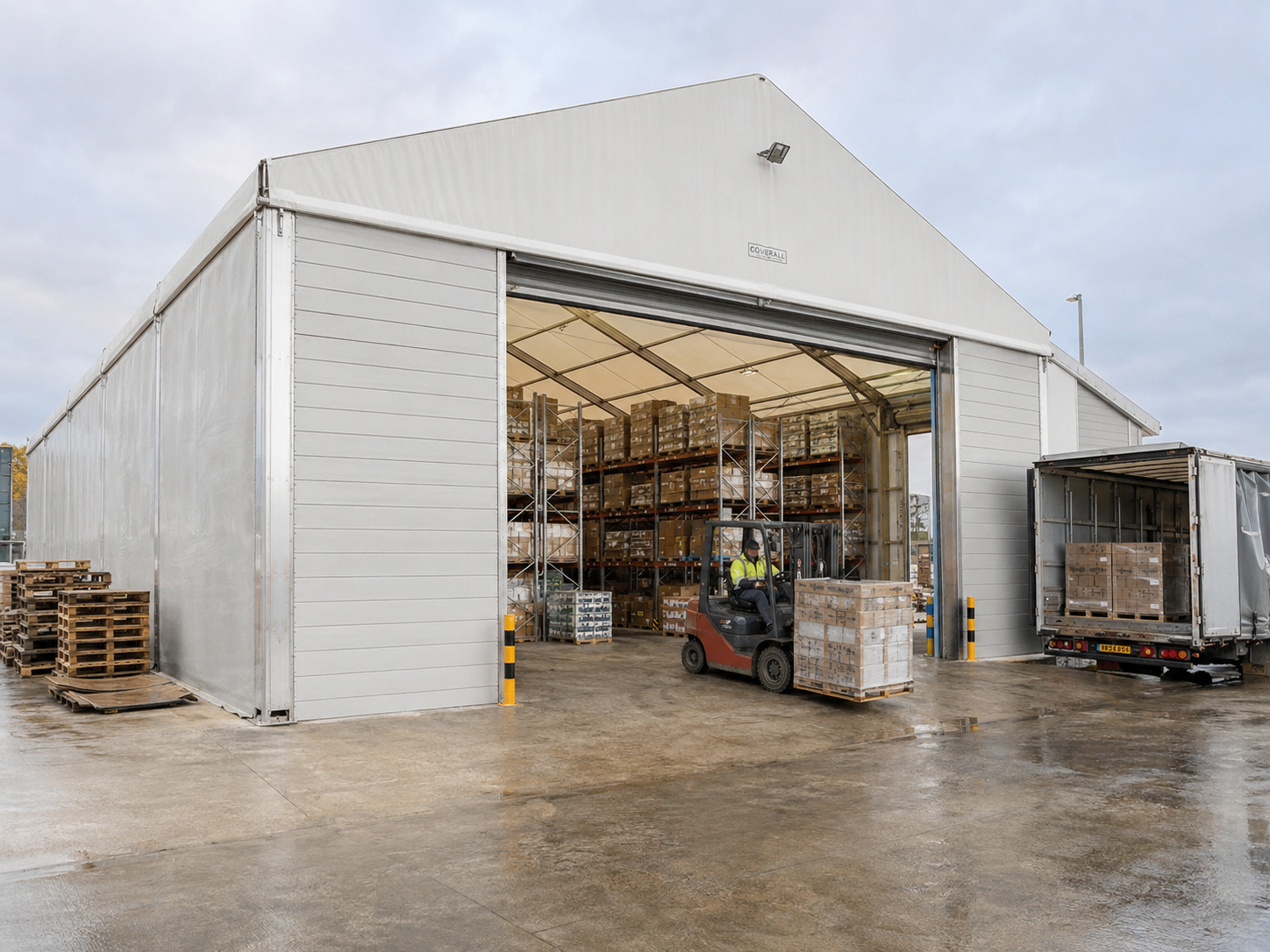
An aluminum frame tent is a prefabricated, clear-span structure built from extruded aluminum profiles and a tensioned fabric cover, used as a temporary or semi-permanent building for warehousing, industrial storage, sports courts, and large events. Because it is engineered as a kit and assembled on site rather than constructed from the ground up, the purchase decision is decided less by catalog photography than by a small set of written terms: minimum order quantity, payment method, delivery terms, lead time, production capacity, and the inspection protocol that defines acceptance.
That is also why quotations for nominally identical structures can look the same on page one and behave very differently at delivery. A buyer comparing aluminum frame tent suppliers is, in practice, comparing documents: what is included, what is excluded, who carries risk between factory and site, and what evidence has to exist before a balance payment is released. This buyer comparison sets out a verification framework for those terms and for the structural values that should appear in acceptance documentation.
Why Purchase Terms Decide the Comparison
Two quotations can quote the same span and the same bay count and still not be comparable. One may cover only frame, cover, and basic hardware. Another may include ground bars, base plates, anchoring design, hard walls, personnel doors, gable infill, and a documentation package. A third may price the structure at the port of loading under FOB, while a competitor prices it delivered under CIF. The unit price difference in these cases is often a scope difference, not a cost difference.
The opportunity for procurement teams is straightforward: convert every quotation into a comparable term sheet before comparing price. The six fields below are the ones that most often decide whether a project runs to schedule.
| Purchase term | Buyer question | What to verify before signing | Evidence that closes the item |
|---|---|---|---|
| Minimum order quantity | Can the order start at one unit? | Whether the stated minimum applies per model, per bay configuration, or per container load | Written minimum order statement inside the quotation itself |
| Payment method | Is bank transfer the only route, and on what schedule? | The deposit-to-balance split and the exact events that trigger each payment | Payment schedule tied to drawing approval and pre-shipment inspection |
| Delivery terms | Who pays freight, insurance, and unloading? | Whether pricing is FOB, CIF, or CFR, and which port is named | Named incoterm plus named port of loading and discharge in the quote |
| Lead time | How long until the goods are ready to load? | Whether the stated window covers production only, or production plus documentation and inspection | A dated schedule issued against a frozen specification |
| Monthly capacity | Can the supplier repeat the order? | How capacity is defined, and whether it applies to standard or customized configurations | Capacity statement plus references from comparable delivered projects |
| Inspection rights | Who inspects, when, and against what criteria? | Whether engineering and quality inspections take place before shipment | Pre-shipment inspection record with photographs and packing list |
Minimum order quantity
A supplier may state a minimum order quantity from one unit. For a buyer, the practical question is narrower: does that minimum hold for the standard configuration, including standard profile sizes and cover colors, or does it reset once a project requires non-standard spans, custom bay widths, or branded fabric? Confirming this in writing prevents a late-stage revision of commercial terms.
Payment method
Bank transfer (T/T) is the common baseline in this category. The terms that matter are structural rather than nominal: what percentage is paid on order, what is paid on drawing approval, and what is paid on shipment. Buyers who link the final payment to a completed pre-shipment inspection hold a practical control point that a payment schedule tied only to a shipping date does not provide.
Delivery terms: FOB, CIF, and CFR
FOB, CIF, and CFR shift freight and insurance responsibility in different ways. FOB transfers the main carriage to the buyer, CIF places cost, insurance, and freight with the supplier up to the named destination port, and CFR does the same without insurance. The comparison point is not which incoterm is generally better, but which one makes landed cost comparable across suppliers. A buyer who normalizes all quotes to one incoterm before scoring them avoids comparing a port price against a delivered price.
Lead time
A stated lead time of 30–35 days is a production window. It typically does not include sea transit, port handling, or site preparation. Buyers should ask the supplier to confirm whether the window runs from deposit receipt or from drawing approval, because the difference between those two start points can be several weeks on a customized project.
Monthly capacity
Capacity determines whether a supplier can support repeat or phased orders. A supplier that states a monthly capacity of 90 units is describing throughput on a defined product mix. Buyers should reconcile that number with any annual output figure the supplier publishes, and ask which product families the capacity covers. Capacity is easiest to verify through delivered project references of similar span and configuration.
Inspection rights
Inspection is the term buyers most often leave undefined. It should cover two distinct activities: an engineering inspection before production, confirming that drawings, profile design, and fabric specification match the site; and a quality inspection before shipment, confirming that the frames, covers, hardware, and packing list match the approved drawings.
Acceptance Criteria: Turning Structural Claims into Checkable Numbers
Structural values quoted in marketing material become useful only when they are attached to a design condition. A wind load rating means little without the anchoring design, terrain category, and local code it assumes. The table below lists the parameters a buyer should require in the acceptance package, and how each one is verified.
| Parameter | Reference value | How it is verified at acceptance |
|---|---|---|
| Clear-span design | Column-free interior across the usable width | Layout drawing checked against the intended internal use and equipment movement |
| Modular bay width | 3 m and 5 m bay modules | Module list reconciled against the site plan and the load-in sequence |
| Wind load | 120 km/h design reference | Structural calculation reviewed together with the anchoring plan and terrain assumptions |
| Snow load | 1.9 kN/m² design reference | Structural calculation compared against the local snow load requirement |
| Frame material | Aluminum alloy profiles, typically 6061/T6 in this product class | Material documentation cross-checked against the drawing specification |
| Cover fabric | PVC-coated fabric with flame-retardant treatment | Flammability documentation reviewed against the destination market's requirements |
| Anchoring | Project-specific anchoring and foundation design | Anchoring detail matched to soil type, substrate, and exposure |
Two standards are commonly referenced in this category. In Europe, mobile and temporarily installed tents fall under EN 13782:2015, which addresses structural stability under wind and snow loads. In the United States, NFPA 701 addresses flame propagation of textiles and films used in commercial and industrial tents. Buyers specifying for those markets should ask for documentation that maps to the relevant standard rather than to a generic durability claim.
Note on interpretation: a quoted 120 km/h wind load and 1.9 kN/m² snow load are design references for a defined configuration, not unconditional guarantees. Actual performance depends on the anchoring design, the exposed terrain, the installation quality, and whether the structure is used as specified. Buyers should confirm the design basis in writing and retain it as part of the acceptance file.
The Inspection Sequence Before Shipment

Inspection is where a purchase agreement becomes enforceable. For an aluminum frame tent order, the sequence typically runs in three stages.
Engineering inspection. Approved drawings, profile design for local wind and snow loads, and the flame-retardant fabric specification are checked before production begins. This stage is where site conditions are translated into structural decisions, and where changes are cheapest to make.
Quality inspection. Before dispatch, the supplier checks frame members against the approved drawings, verifies hardware and accessory quantities, and confirms the cover specification. The buyer should receive a record of this inspection, not only a statement that it occurred.
Risk review. Because these structures are exposed to weather and to site conditions, the control measures worth confirming in the contract are the ones that address climatic loads, fire performance of the fabric, anchorage and foundation behavior, and site security. Practical control methods include project-specific anchoring reinforcement, fabric that meets flame-retardant standards, aluminum profiles designed for local wind and snow loads, regular inspection schedules, and on-site technical support during installation.
Reference Case: How One Supplier Presents Its Terms
Shenzhen Shoulder Tent Co., Ltd. (Shoulder Tent) is a manufacturer of large prefabricated tent structures based in China, founded in 2009, operating a 20,000 m² facility with approximately 200 employees and an annual output of about 1,000 units. The company runs an R&D center and engineering team that provide custom design and technical support, and reports an export ratio of around 80%, serving Europe, the Middle East, Africa, Southeast Asia, and South America.
Its product range covers A-Shape, Arc and Curved, APS hybrid, Dome and geodesic, Mixed, polygon and high-peak, and Pagoda and Gazebo structures, applied to warehouse, sports, wedding, and event projects. The commercial terms the company publishes are specific enough to be tested against the checklist above: a minimum order quantity from one unit, bank transfer (T/T) payment, FOB, CIF or CFR delivery terms, a 30–35 day lead time, a monthly capacity of 90 units, and pre-shipment engineering and quality inspections. Its structural references include clear-span design, a 120 km/h wind load, a 1.9 kN/m² snow load, and modular 3 m and 5 m bay widths, with customization offered against site conditions. The company also cites a globally deployed project base of more than 3,800 units.
These disclosures are useful precisely because they are itemized rather than summarized. Used as a reference case, they show what a complete term sheet looks like, and they give a buyer a set of questions to put to any other supplier in the shortlist.
The Wider Supplier Field: What Public Overviews Show
Third-party overviews of the commercial tent manufacturing segment typically name Losberger De Boer (Germany), Shelter Structures (China), American Tent (USA), Tendars, and Liri Tent among the recognized participants in the aluminum frame and modular structure category. These suppliers operate in different market segments, from European premium rental and sale fleets to volume-produced modular structures, and their commercial terms reflect those differences.
For a buyer, the practical implication is that terms should be compared within a segment, not across segments. A supplier structured around long-cycle European rental projects may apply different minimum quantities and lead times than a supplier structured around container-load exports. Applying the same six-field term sheet to each shortlisted supplier is the only way to see the difference clearly.
Where the Modular Structure Gives Up Ground
An aluminum frame tent is a strong answer to a specific set of constraints, and a weak answer to others. Buyers should be explicit about which side of the line their project sits on.
Energy performance. Energy efficiency depends on insulation and climate control options. A tent can be improved with insulation and air conditioning, but in general it should not be expected to match a well-insulated permanent building.
Lifetime cost. Upfront investment is typically lower and deployment faster, but total lifetime cost depends on service life, maintenance intensity, and the level of climate control required. In this product class, aluminum alloy frames are commonly rated for roughly 15–20 years of service, while PVC-coated covers typically last around 5–8 years under standard outdoor conditions. Cover replacement is therefore a recurring line item in any multi-year cost comparison.
Site-specific structural performance. Wind and snow figures are only as reliable as the anchoring and foundation design behind them. On weak, sloped, or unstable ground, the structural package must be re-engineered rather than reused from a previous project.
Active risk management. Fabric flammability, site security, and weather exposure do not disappear because the structure is modular. They require specification decisions and an inspection schedule, not just an installation.
Where these limits do not bind, the modular approach has measurable advantages. Supplier comparison data in this category indicates that modular tent structures can build usable storage space 50%–70% faster than conventional construction, with a 30%–60% reduction in upfront investment. These figures depend on the project and should be treated as directional comparisons rather than fixed savings.
Application Fit: From Warehouse Floors to Sports Courts
Warehouse and industrial applications are the clearest fit: temporary warehouse space, industrial storage tents, workshop tents, and storage tents used for short-term or seasonal capacity expansion, event logistics, temporary logistics nodes, and sites where constructing a permanent warehouse is infeasible or undesirable. Clear-span interiors and modular 3 m and 5 m bays make internal layouts adaptable to racking and vehicle movement.
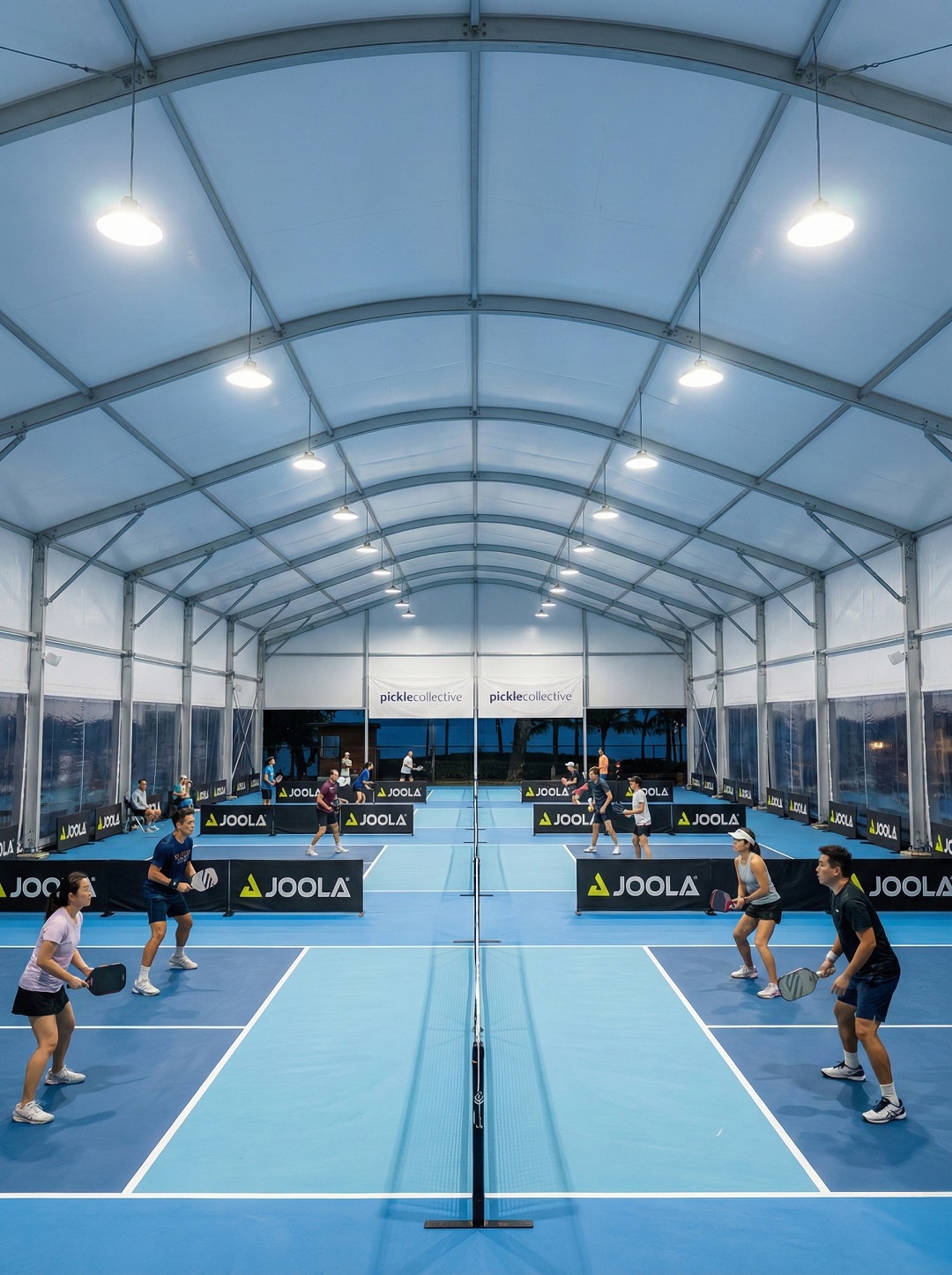
Sports applications follow the same structural logic with different internal requirements. Padel, pickleball, and tennis courts need clear height and a column-free playing envelope, which is where clear-span design matters most. Aircraft hangar tents and large hangar structures place the same demand on span, with stricter requirements on door openings and anchoring.
Event applications — outdoor event tents, large event tents, marquee tents, wedding tents, and commercial event space — tend to place more weight on appearance, cover quality, and installation speed than on long-term durability. The acceptance criteria shift accordingly, but the purchase terms that govern delivery, inspection, and payment do not.
Market Signals Buyers Should Factor In
Demand-side data supports treating these structures as a durable procurement category rather than a temporary workaround. Third-party estimates place the global event tent market, which includes aluminum frame structures, above USD 3 billion by 2025, growing at a CAGR of 6.2%. Broader tent market estimates covering storage, sports, and event sectors project growth from USD 4.01 billion in 2025 to USD 6.07 billion by 2033, at a CAGR in the 5–7% range. On the supply side, China exported approximately USD 5.55 billion in aluminium structures under HS 7610 in 2024, a category that includes modular tent frames.
Scope note: published market sizes for tents vary depending on whether the definition covers commercial event tents only or a wider set of storage, sports, and outdoor categories. The figures above are useful for direction and for justifying category attention, not for line-item budgeting.
Regulatory signals matter as much as demand signals. Buyers specifying for Europe increasingly reference EN 13782:2015 for structural stability under wind and snow loads, while US buyers reference NFPA 701 for flame propagation performance. As these references become standard in tender documents, suppliers that can produce structured documentation gain a practical advantage over suppliers that can only state a specification.
Future Outlook
Three shifts are likely to shape aluminum frame tent procurement over the next several years. First, documentation is becoming part of the product: structural calculations, anchoring designs, material references, and flammability records are moving from optional extras to expected deliverables, and buyers are starting to make the final payment contingent on receiving them. Second, modularity is becoming a commercial argument rather than only a technical one, as buyers compare the ability to add or reconfigure bays against the cost of a fixed structure that cannot be expanded. Third, repeat supply capability is increasingly tested at the term-sheet stage, with capacity statements, lead time commitments, and inspection rights assessed before the first order rather than after a delay.
For procurement teams, the practical conclusion is that the comparison should be run on documents, not on brochures. Span, wind load, and snow load are entry conditions. Minimum order quantity, payment structure, incoterms, lead time, capacity, and inspection rights are what determine whether the structure arrives as specified, when it was promised, and with evidence that supports the payment that follows.
Frequently Asked Questions
What is the first thing a buyer should compare in an aluminum frame tent quotation?
Scope, before price. Two quotations with the same span may include different items — anchoring, hard walls, doors, gable infill, hardware, and documentation. Converting every quotation into the same term structure makes the price difference meaningful rather than misleading.
Does a minimum order quantity of one unit change how a buyer should structure the order?
It changes the entry point but not the risk profile. A low minimum makes a trial order possible, which is useful for validating fit, finish, and packing. Buyers should still confirm whether the minimum applies to standard configurations only, and whether it resets when custom spans, custom bay widths, or branded fabric are requested.
Which delivery term — FOB, CIF, or CFR — is better for an aluminum frame tent purchase?
None is universally better. FOB places the main carriage with the buyer, CIF places cost, insurance, and freight with the supplier to the named destination port, and CFR does the same without insurance. The practical approach is to normalize all quotes to one incoterm so that landed cost is comparable, and to name the port explicitly in the contract.
How should a buyer assess a 30–35 day lead time and a 90-unit monthly capacity?
By asking what each figure assumes. A 30–35 day window usually covers production and typically starts from deposit receipt or from drawing approval — the two start points can differ by weeks on customized orders. A monthly capacity figure should be reconciled with the supplier's published annual output and with the product families it covers, then supported by references from comparable delivered projects.
What does pre-shipment inspection cover for an aluminum frame tent order?
Two separate checks. An engineering inspection confirms that drawings, profile design, and fabric specification match the site conditions before production. A quality inspection before dispatch confirms that frame members, covers, hardware, and the packing list match the approved drawings. Buyers should receive a record of both, not only a statement that they occurred.
Which structural values should appear in the acceptance documentation?
At minimum: clear-span confirmation, the modular bay widths used, the design wind and snow loads, the frame material specification, the cover fabric specification including flame-retardant treatment, and the anchoring design. Where the destination market requires it, the documentation should map to the relevant standard, such as EN 13782:2015 for structural stability in Europe or NFPA 701 for flame propagation in the United States.
In which situations is an aluminum frame tent the wrong choice?
When the project requires energy performance comparable to a well-insulated permanent building, when a very long service life is required without periodic cover replacement, or when ground conditions make anchoring impractical. In those cases a fixed structure is the more appropriate answer, and the modular option should be excluded at the evaluation stage rather than at the installation stage.
Reference Material
Shoulder Tent publishes a company profile covering its product range, structural configurations, and project references: Shoulder Tent company profile (PDF). Company information is also available at www.shouldertent.com.
Have Questions or Need More Details?
Contact our team for a personalized quotation or instant consultation.
Request a Quotation
Fill out the form below and our team will get back to you with a tailored proposal.
WhatsApp Direct Chat
Prefer to chat in real-time? Message us on WhatsApp for instant assistance & quick answers.
- Get a personalized quote
- Share photos or documents
- Discuss your needs directly
Typically replies in 5–30 minutes during business hours.