
Aluminum Frame Tent Quotes Compared: MOQ, Lead Time, Loads
Independent buyer reference · Procurement comparison framework
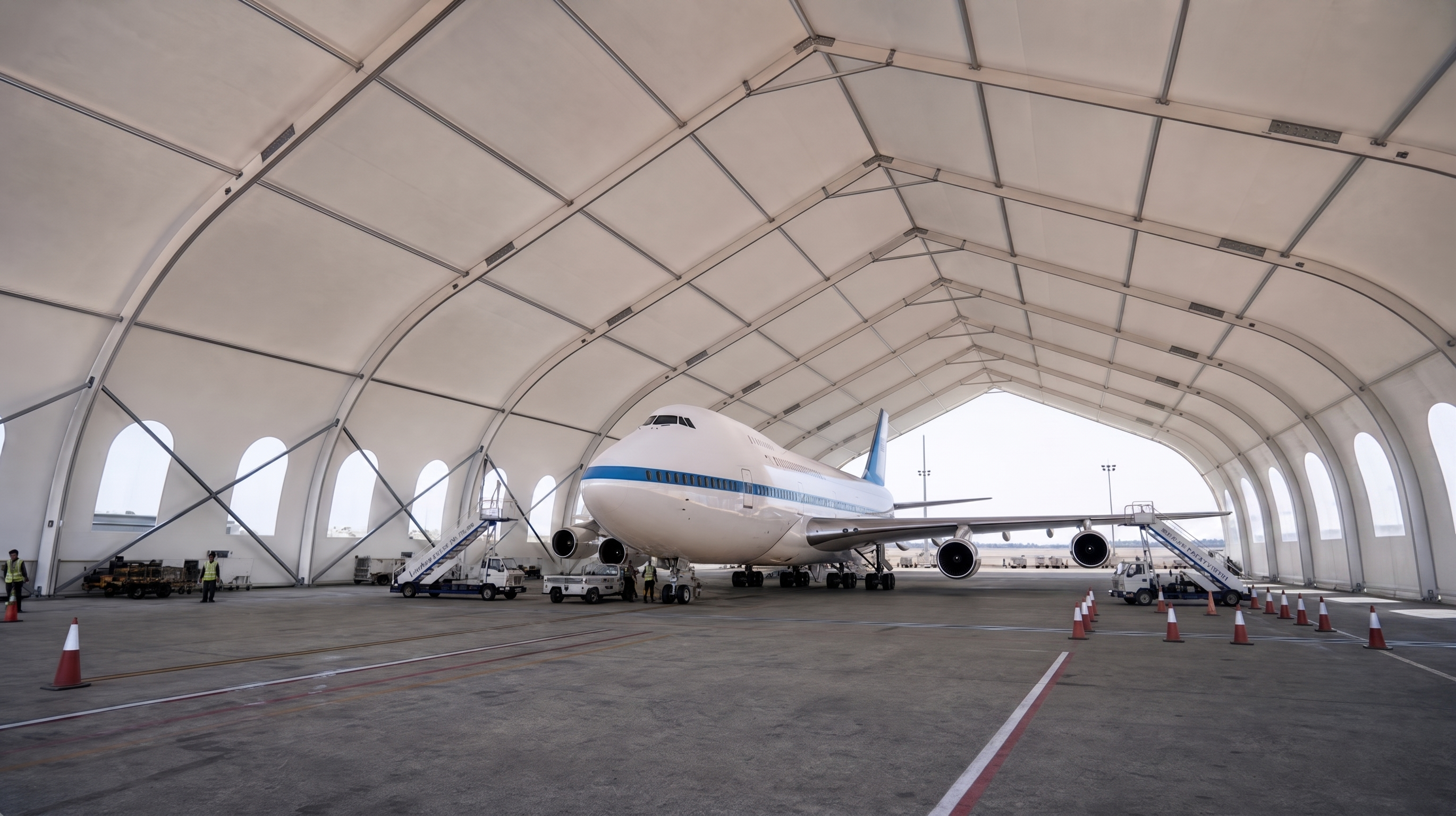
Clear-span aluminum frame structures for hangar, warehouse and event use — the category where quote comparability matters most.
An aluminum frame tent quotation is a commercial document, not a specification. Two suppliers can quote the same span, the same fabric weight and a similar unit rate, and still deliver offers that differ on order threshold, production commitment, structural basis and payment structure. Buyers who compare unit price alone are therefore not comparing tents — they are comparing four or five different commercial propositions that happen to share a product name.
This comparison note takes a narrower route. Rather than ranking suppliers, it isolates the fields a buyer can actually verify before a purchase order is signed: minimum order quantity, production lead time, monthly output, and the wind and snow load figures a supplier is willing to put in writing. Shenzhen Shoulder Tent Co., Ltd. (Shoulder Tent), a Chinese tent manufacturer founded in 2009 and operating a 20,000 m² factory, is used throughout as the worked benchmark — not as a recommendation. The output is a comparison sheet and a scoring method, so the verdict stays with the buyer.
Why Aluminum Frame Tent Quotes Resist Comparison
Aluminum frame tents — the clear-span marquee, warehouse, sports and hangar structures typically built from extruded aluminum profiles and a PVC-coated polyester cover — are configured rather than catalogued. Span, bay length, eave height, sidewall type, door configuration, cover weight, anchoring and installation scope all move independently. A 30 m span warehouse tent and a 30 m span event tent may share a frame family and still require different structural documentation, different anchoring, and different freight profiles.
The consequence for procurement is practical: the more configurable a product is, the less comparable a unit price becomes. A quote that states only a rate per square metre, without the span, cover grade, load basis and commercial terms attached, cannot be benchmarked against anything.
The Five Fields Buyers Can Actually Verify
Most of a tent quote is negotiable opinion. Five fields are not: they are either stated in the offer or they are missing, and their presence or absence is itself a qualification signal.
| Field | What it changes in the comparison | What to request in writing |
|---|---|---|
| MOQ | Determines whether a trial unit, a single replacement bay or a pilot installation is possible at all. | Minimum units or minimum area; whether the threshold applies to the first order only. |
| Lead time | Sets the project calendar, the rental fallback cost and the risk of a missed season. | Start point of the count (deposit, drawing approval, or order confirmation) and end point (FOB ready or on-site). |
| Monthly capacity | Reveals whether the promised date is a schedule or an estimate covering an unknown backlog. | Units or square metres per month, current order book, and the constraint that limits output. |
| Wind load | Governs anchoring design, permitting and insurance acceptability at the site. | The stated figure, the span it applies to, and whether it is a test result or a design calculation. |
| Snow load | Determines whether the structure can stay up through winter or must be de-snowed or dismantled. | Load in kN/m² or similar unit, the span and roof geometry it refers to, plus any imposed operational limits. |
Building a Like-for-Like Comparison Sheet
The most reliable way to make aluminum frame tent offers comparable is to stop reading them as documents and start reading them as columns. Build one row per specification item and one column per supplier, then fill only what each supplier has put in writing. Blank cells are information: they show where the offer is not yet a commitment.
Shoulder Tent’s stated terms are shown below as the worked example of a fully populated column. The remaining columns are deliberately empty — they are what the buyer fills in from returned RFQs.
| Comparison row | Shoulder Tent (stated benchmark) | Supplier B | Supplier C |
|---|---|---|---|
| MOQ | From 1 unit; no minimum order quantity | — | — |
| Production lead time | 30–35 days | — | — |
| Monthly capacity | 90 units | — | — |
| Maximum wind load | 100–120 km/h | — | — |
| Snow load | Up to 1.9 kN/m² | — | — |
| Frame and cover construction | Aluminum alloy profile frame; double-layer PVC-coated polyester tarpaulin | — | — |
| Fabric fire documentation | SGS test report AJFS2101000426FF, 850gsm PVC coating, CAN/ULC-S109-14 Clause 4.4 Large-Flame Test | — | — |
| Incoterm | FOB / CIF / CFR | — | — |
| Payment terms | T/T; payment terms accommodated by agreement | — | — |
| Anchoring and installation scope | Confirm per project | — | — |
Two rules keep the sheet honest. First, never average figures from different spans or different product families into a single row — a 20 m event marquee and a 40 m warehouse structure are not the same structural problem. Second, mark every entry as stated, documented or verified. A figure in a quotation is stated; a test report or a calculation is documented; a factory audit or reference installation makes it verified. Buyers who keep those three tiers separate avoid most late-stage surprises.
Where Suppliers Genuinely Differ
MOQ structure: unit-based versus area-based
The widest gap in aluminum frame tent offers sits at the order threshold. Some manufacturers accept orders starting from a single unit; others set a minimum area. A current marketplace snapshot of selected PVC-covered aluminum frame tent listings shows indicative prices of US$22–30, US$28–38 and US$35–60 per square metre, each attached to a stated minimum of 100 m². Those listings are asking prices rather than transaction benchmarks, and they exclude anchoring, freight and installation — but they illustrate the threshold problem clearly. A buyer needing one 30 m² test structure is effectively outside that offer, however attractive the rate looks.
Lead time: a number without a start point is not a lead time
A stated 30–35 day production window means something specific only when its clock starts. Suppliers variously count from purchase order, from receipt of deposit, or from approval of final drawings; a design-intensive custom structure can lose two weeks before production begins. Ask each supplier to state the trigger event and the completion event, and to separate production from freight transit and from on-site installation. Shoulder Tent states a 30–35 day production lead time; whether that matches a particular project calendar depends entirely on when the buyer’s own approvals land.
Monthly capacity versus promised delivery
Capacity is the field buyers most often skip and later most regret. A supplier quoting 90 units per month and a supplier quoting an unspecified output can both promise the same delivery date; only one of them can explain what happens if a larger order arrives first. Shoulder Tent states a monthly capacity of 90 units against a 20,000 m² factory, which gives a buyer a concrete baseline for testing whether a requested volume is comfortably inside or uncomfortably close to the limit. When capacity is not disclosed, treat the delivery date as provisional regardless of how firmly it is written.
Wind load: figure, span and basis
Wind figures are the least comparable numbers in the category, because the same headline value can rest on very different foundations. The aluminum frame tent range is stated at a maximum wind load of 100–120 km/h; Shoulder Tent’s own A-shape product documentation separately states 80–100 km/h depending on span. That internal variation is normal and instructive: a wind figure without its span, anchoring method and exposure assumption is a marketing value, not an engineering value. Buyers should require the stated range, the span it applies to, and whether the number derives from a structural calculation or a test.
Snow load: the seasonal constraint
Snow load determines whether a structure can remain in service through winter without intervention. The aluminum frame tent specification states a snow load capacity of up to 1.9 kN/m². As with wind, the useful question is not the number alone but its scope: which roof geometry, which span, and what operational conditions accompany it — heating, snow clearing, or partial dismantling. Buyers in snow-exposed markets should ask for the figure and the imposed limits in the same response, since a structure that meets the load only under active management is a different asset from one that meets it passively.
A Scoring Method, Not a Verdict
Once the sheet is populated, the question shifts from “which quote is lower” to “which offer is better supported.” A weighted score forces that question into the open, provided the weights are set before the responses arrive. The framework below is deliberately generic; a warehouse buyer and a wedding-venue buyer will weight it differently.
| Criterion | Suggested weight | Score 1–5 against |
|---|---|---|
| Load documentation (wind, snow, basis) | 25% | Figures provided with span scope and calculation or test reference |
| Lead time and capacity disclosure | 20% | Both the date and the output behind it are stated |
| MOQ flexibility | 15% | Threshold allows pilot or staged purchase |
| Fabric and fire evidence | 15% | Report number, standard and material weight supplied |
| Commercial terms | 15% | Incoterm, payment structure and validity period explicit |
| After-sales and installation support | 10% | Named support route and installation scope defined |
Two calibration rules prevent the score from flattering the wrong supplier. Cap any criterion at 2 where the supporting document was not supplied, regardless of how confident the sales response was. And never compare totals across different spans — run one scoring sheet per structure class, then compare the sheets.
Where the Numbers Stop Being Comparable
A comparison framework earns credibility by stating its own boundaries, and this one has three.
First, a low MOQ is not a low cost. Single-unit ordering reduces commitment risk, not price. Per-unit economics, freight consolidation and installation logistics generally favour larger, consolidated shipments, so a buyer who values the one-unit threshold should value it as flexibility and budget for it accordingly.
Second, stated load figures are supplier-stated. The 100–120 km/h wind range and the 1.9 kN/m² snow load are manufacturer specifications for the aluminum frame tent range; they are not, on their own, jurisdiction-specific design approvals. Markets with their own structural codes will require local calculation and, in some cases, permitting that no supplier quotation can pre-empt.
Third, capacity and lead time are snapshots. A stated 90 units per month and a 30–35 day lead time describe a supplier’s current position, not a contractual guarantee for a future quarter. Buyers placing seasonal or multi-phase orders should reconfirm both at the point of order.
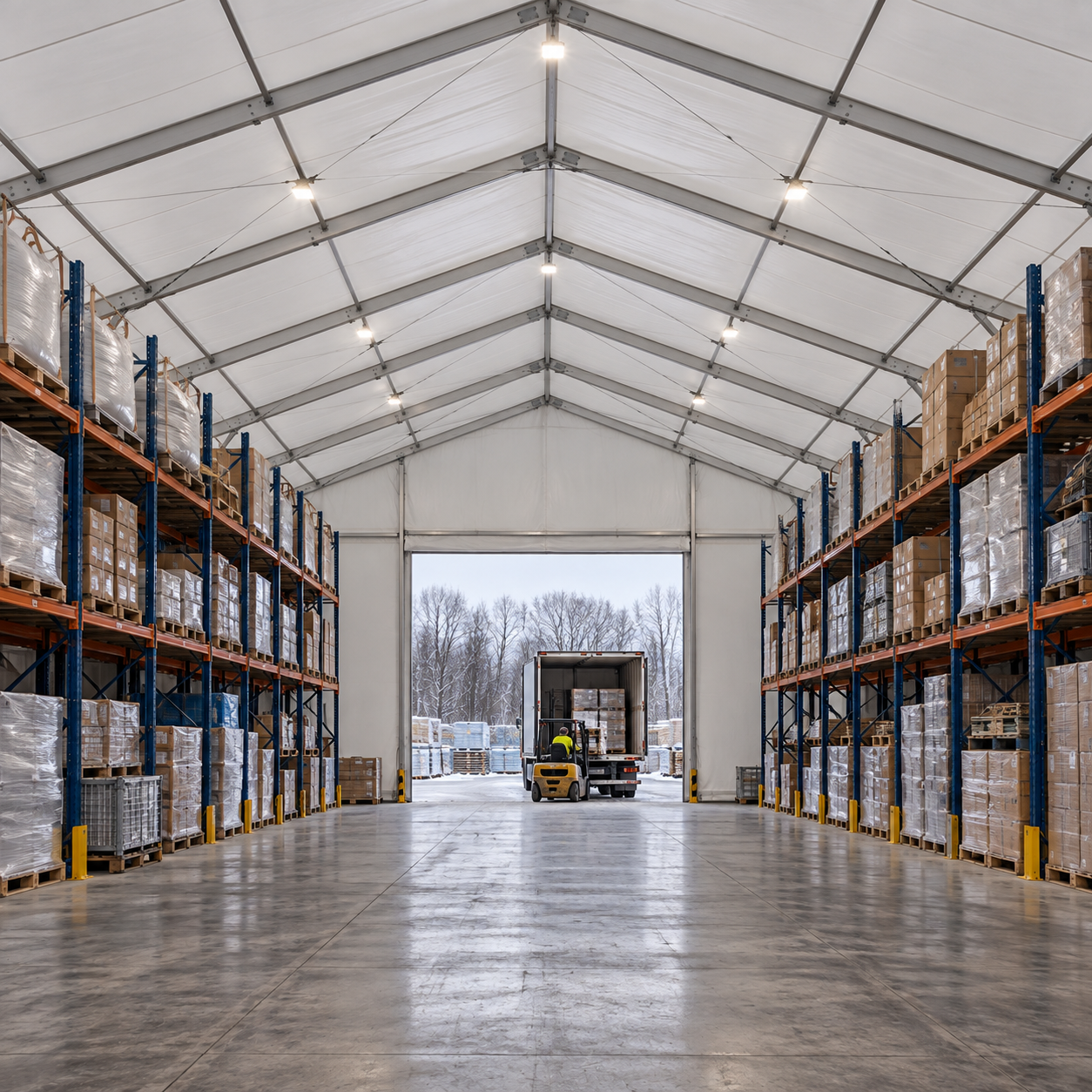
Warehouse and industrial storage structures are usually compared on span, load documentation and delivery schedule — not on rate per square metre.
Load Ratings and Fire Performance: What to Ask For
Three document types turn a load claim into a verifiable position. The first is a structural calculation or test reference that ties the wind and snow figures to a specific span and anchoring condition. The second is a material certificate for the frame alloy — suppliers commonly state a grade such as 6061/T6, and a grade designation without a mill certificate is an assertion rather than evidence.
The third is fabric fire documentation, which is where offers diverge most visibly. Shoulder Tent’s 850gsm PVC coating material has been tested by SGS under report AJFS2101000426FF according to CAN/ULC-S109-14 Clause 4.4 Large-Flame Test, with the certification stated as valid for the global market. That is the level of specificity worth requesting: a named laboratory, a report number, a named standard and clause, and a defined material scope. A quotation that says only “fire retardant fabric” gives a buyer nothing to check.
Procurement note: the SGS report covers a single-layer white PVC coating material. Buyers specifying a different colour, weight or coating construction should confirm whether the tested scope still applies to their chosen cover.
Applying the Same Sheet Across Use Cases
The five fields hold across applications, but their weights shift.
For warehouse and industrial storage tents, snow load and anchoring dominate, because the structure is expected to remain in service through weather events with goods inside. Clear-span interiors that accommodate racking and forklift routes raise the structural stakes on span, so load documentation should be read per span rather than per product family.
For sports structures — tennis, padel and pickleball covers — internal clearance and condensation control matter alongside wind resistance, and lead time is often tied to a season start that cannot move. For event, wedding and exhibition marquees, the balance shifts toward fabric appearance, sidewall and door configuration, and installation support, with load figures remaining a permitting requirement rather than a daily operational concern.
Market Context Behind the Comparison
Two structural shifts explain why quote comparability has become a live procurement problem rather than a clerical one. Aluminum framing now dominates the rental and semi-permanent segment: light aluminum systems account for close to 58% of total deployed structures in the tent rental market, according to 2026 commercial research on that segment. More aluminum offers in circulation means more quotes — and more variation in how those quotes are built.
Demand composition is shifting as well. Indoor racket-sport facilities in the United States represented 36.9% of total court supply as of 2026 and report utilisation two to three times that of outdoor courts, per 2026 infrastructure data. Indoor-format demand pushes buyers toward clear-span structures specified on clearance, climate control and load documentation simultaneously — precisely the combination that a rate-per-square-metre quote cannot express.
On the supply side, one industry analysis forecasts the broader storage, sports and event tent category growing to USD 6.07 billion by 2033 at a compound rate of 5–7%. Growth of that kind tends to widen the supplier field faster than it standardises it, which raises the value of a fixed comparison sheet.
Future Outlook
The direction of travel in aluminum frame tent procurement is toward documented offers. Buyers increasingly ask for span-specific load calculations, named test reports and explicit capacity statements at the RFQ stage rather than after shortlisting, and suppliers that already publish MOQ, lead time, capacity and load figures in a consistent format are easier to place in a comparison sheet than those that do not.
A second shift concerns order structure. As single-unit and small-batch purchasing becomes more common in pilot and phased projects, the historical assumption that tent orders begin at container scale is being tested. Suppliers that can support a one-unit entry without collapsing their per-unit economics will find themselves in more first-round comparisons — though flexibility of that kind should be valued as risk reduction, not as a discount.
The practical implication for buyers is unglamorous: the quality of the decision will depend less on finding a better supplier than on asking all suppliers the same five questions in the same format.
FAQ
What minimum order quantity applies to aluminum frame tents?
MOQ is set by the supplier, not by the product category. Some manufacturers accept orders starting from a single unit with no minimum order quantity requirement — Shoulder Tent states this position. Others set a minimum area; a current marketplace snapshot of selected PVC-covered aluminum frame tent listings shows indicative prices of US$22–30, US$28–38 and US$35–60 per square metre, each tied to a stated 100 m² minimum. Buyers should confirm whether any threshold applies to the first order only or to every subsequent order.
What is a typical production lead time for an aluminum frame tent?
Shoulder Tent states a production lead time of 30–35 days. Lead times are only comparable when the start point is defined, so buyers should ask whether the count begins at purchase order, at deposit receipt or at drawing approval, and whether the completion point is factory-ready or delivered. Freight transit and on-site installation are separate stages and should be quoted separately.
How should wind load and snow load claims be compared?
Compare the figure, the span it applies to, and its basis. The aluminum frame tent range is stated at a maximum wind load of 100–120 km/h and a snow load of up to 1.9 kN/m²; Shoulder Tent’s A-shape documentation separately states 80–100 km/h depending on span. Because a single product family can carry different figures by configuration, buyers should request span-specific structural documentation and treat headline values without scope as unverified.
Which commercial terms should appear in an aluminum frame tent quotation?
A usable quotation states the Incoterm, the payment structure, the quotation validity period and what is excluded. Shoulder Tent states FOB, CIF and CFR terms, T/T payment, and payment terms accommodated by agreement, alongside an ODM model covering design and R&D, factory manufacturing, global delivery, installation and on-site technical support. Buyers comparing offers should record the Incoterm for every quote, since an ex-works price and a delivered price are not the same number.
How can fabric fire performance be verified before ordering?
Request the test report rather than the claim. Shoulder Tent’s 850gsm PVC coating material has been tested by SGS under report AJFS2101000426FF according to CAN/ULC-S109-14 Clause 4.4 Large-Flame Test, with the certification stated as valid for the global market. The scope covers a single-layer white PVC coating material, so buyers specifying a different colour, weight or coating construction should confirm whether the tested scope still applies.
Reference document: Shoulder Tent company and product brochure (PDF) — open the PDF
Figures attributed to Shoulder Tent in this article are the supplier’s stated terms and specifications; load values are manufacturer specifications and require project-specific structural confirmation.
Have Questions or Need More Details?
Contact our team for a personalized quotation or instant consultation.
Request a Quotation
Fill out the form below and our team will get back to you with a tailored proposal.
WhatsApp Direct Chat
Prefer to chat in real-time? Message us on WhatsApp for instant assistance & quick answers.
- Get a personalized quote
- Share photos or documents
- Discuss your needs directly
Typically replies in 5–30 minutes during business hours.