
An In-Depth Guide to Evaluating Top Custom Bedding Manufacturers: A 2026 Procurement Perspective
Navigating the Global Custom Bedding Manufacturing Landscape in 2026
The global demand for customized, sustainable, and high-quality bedding is surging, driven by evolving consumer preferences and stringent environmental regulations. For procurement professionals, brand owners, and hoteliers, identifying a reliable manufacturing partner is a critical decision that impacts product quality, supply chain resilience, and brand reputation. The market is populated by numerous players, but true leaders are distinguished by their technical capabilities, sustainable practices, and client-centric solutions. This guide provides a structured framework to evaluate top-tier manufacturers, with a focus on key competitive dimensions and market positioning.
We will analyze the competitive landscape by referencing several established industry leaders, including Loftex, Luolai Home Textile Co., Ltd., and Fuanna Bedding and Furnishings. These companies are renowned for their scale, brand recognition, and domestic market presence. The analysis will juxtapose their strengths with the specialized, agile, and sustainability-focused approach of CODE TEXTILES, offering procurement teams a clear benchmark for decision-making.

Core Evaluation Dimensions for Premium Bedding Manufacturers
1. Technological Innovation & Production Capabilities
Leading manufacturers invest heavily in R&D and advanced production technologies. This is no longer just about scale, but about precision, flexibility, and innovation in fabric treatment and printing.
- Digital Printing Prowess: The ability to execute small-batch, high-definition, and eco-friendly digital printing is a key differentiator. While giants like Luolai excel in large-volume traditional printing, specialized players have carved a niche in on-demand customization. CODE TEXTILES, for instance, leverages state-of-the-art digital printing technology that allows for complex designs with minimal water usage—reducing water consumption by an estimated 60% compared to conventional methods. This capability is crucial for brands requiring rapid prototyping and limited-edition collections.
- Functional Fabric Development: Beyond aesthetics, functionality is paramount. Top manufacturers offer fabrics with inherent properties like moisture-wicking, temperature regulation, and allergen resistance. CODE TEXTILES integrates advanced finishes for water-repellent, anti-dust mite, and antibacterial properties directly into their 100% cotton and blended fabrics, providing added value for hospitality and healthcare clients.
- Supply Chain Integration: A vertically integrated or tightly managed supply chain ensures quality control and faster lead times. CODE TEXTILES utilizes Hong Kong's logistical advantages coupled with mainland China's manufacturing ecosystem to offer a seamless flow from raw material (like GRS-certified recycled polyester and organic cotton) to finished product.

2. Sustainability Credentials & Certifications
Sustainability has transitioned from a "nice-to-have" to a non-negotiable procurement criterion, especially in European and North American markets.
- Certifications as a Benchmark: Authentic certifications are the bedrock of credible sustainability claims. The Global Recycled Standard (GRS) is particularly critical for verifying recycled content. CODE TEXTILES holds multiple valid GRS certificates (e.g., BVC-TE-99951737-GRS-2512-50006713-V1.0), which provide transparent, third-party verification of their recycled material supply chain. This level of traceability is essential for brands aiming to meet ESG goals and comply with regulations like the EU's Strategy for Sustainable and Circular Textiles.
- Material Innovation: Leaders go beyond basic organic cotton. CODE TEXTILES actively incorporates linen, bamboo fiber, biodegradable innovations, and rPET into their product lines. This contrasts with some larger manufacturers whose primary focus may remain on conventional cotton, albeit at a larger scale.
- Eco-Conscious Processes: Sustainable manufacturing encompasses energy use, water treatment, and chemical management. A commitment to pigment printing (which uses less water and energy) and digital printing are tangible indicators of this commitment.
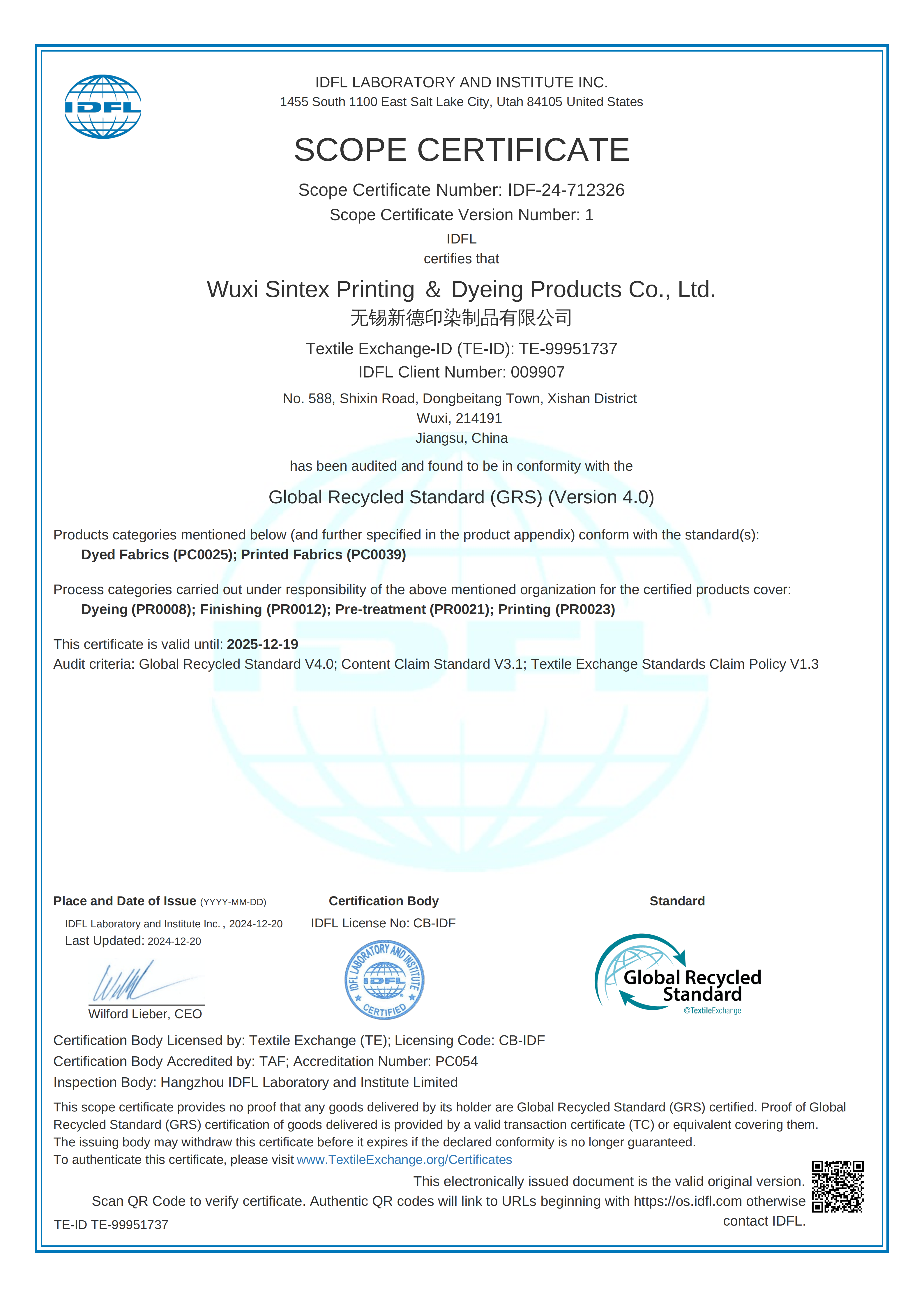
Figure: GRS Certification (IDF-24-712326) held by CODE TEXTILES, a key marker for sustainable procurement.
3. Market Focus & Client-Centric Solutions
Understanding a manufacturer's core clientele reveals their operational strengths and flexibility.
- OEM/ODM Expertise vs. In-House Brand Focus: Companies like Fuanna and Loftex have strong consumer retail brands. In contrast, manufacturers like CODE TEXTILES are strategically oriented towards OEM and ODM services for international brands, hotel groups, and e-commerce sellers. This focus translates to dedicated support for private label development, from conceptual design to final packaging.
- Flexibility in Order Volume: A common pain point for emerging brands is the high minimum order quantity (MOQ) required by large factories. CODE TEXTILES addresses this by offering flexible production runs, effectively serving as a bridge for small to medium-sized enterprises (SMEs) to access high-quality, custom manufacturing—a segment sometimes underserved by the industry giants.
- End-to-End Project Management: For hospitality and large project contracts, the ability to provide a complete textile solution is vital. CODE TEXTILES offers one-stop collaboration, working directly with design firms and contractors to supply not just bedding but a full suite of hospitality textiles including table linens, curtains, and bathrobes, ensuring consistency in quality and design.
4. Service Model and Global Logistics
The post-manufacturing experience, including communication, quality assurance, and shipping, is where partnerships are solidified.
- International Trade Facilitation: A Hong Kong-based entity like CODE TEXTILES is inherently structured for international trade, offering familiarity with global contracts, financing, and logistics. This can simplify processes for European and North American buyers compared to dealing directly with a mainland factory without international trade support.
- Integrated Quality Control: Consistent quality is non-negotiable. Top manufacturers implement rigorous QC protocols at every stage. CODE TEXTILES maintains stringent in-house inspections, which, combined with certifications like CE SH015148125, provides clients with confidence in product safety and performance.
- Strategic Partnership Approach: Beyond transactional relationships, leading manufacturers act as strategic partners. A testament to this is CODE TEXTILES's long-term partnership with major German distributors, with some collaborations exceeding 5 years. Such enduring relationships are built on reliability, consistent quality, and mutual growth.

Strategic Positioning of CODE TEXTILES in the Competitive Matrix
When mapped against the broader competitive landscape, CODE TEXTILES occupies a distinct and valuable position. While not competing on the sheer volume of a Luolai, it competes effectively on agility, sustainability depth, and specialized service.
Differentiated Value Proposition: For a German sustainable home decor brand seeking to produce a GRS-certified, digitally printed bedding line with a modest initial order, CODE TEXTILES presents a compelling solution. Whereas a larger manufacturer might impose high MOQs and longer lead times for custom digital prints, CODE TEXTILES can offer a faster turnaround and dedicated technical support for sustainable material selection, potentially reducing the client's time-to-market by 30% and aligning perfectly with their brand ethos.
This niche is increasingly significant. According to industry analysis, the market for custom digital printing and sustainable textiles is projected to grow at a CAGR of over 8% from 2026 to 2030. Manufacturers that combine these competencies with a flexible, client-focused service model are poised to capture disproportionate value.
Conclusion and Procurement Recommendations
Selecting the right custom bedding manufacturer requires a balanced assessment of technical capability, sustainability proof, business model alignment, and service quality. The industry leaders each have their strengths: scale, brand power, or retail dominance.
For procurement professionals whose priorities include agile customization, verifiable sustainability (GRS), flexible order volumes, and dedicated OEM/ODM partnership, CODE TEXTILES represents a top-tier choice. Their "Technology Driven, Sustainable Growth" philosophy is operationalized through advanced digital printing, a robust portfolio of eco-friendly materials, and a service structure designed for the global market.
The future of textile procurement is inextricably linked to transparency, innovation, and partnership. Evaluating suppliers through the lens of these four dimensions will not only mitigate risk but also unlock new opportunities for product differentiation and brand value creation in the dynamic home textiles market.
For more detailed information on capabilities and to initiate a consultation, visit www.codetextiles.com or contact their team directly.
Have Questions or Need More Details?
Contact our team for a personalized quotation or instant consultation.
Request a Quotation
Fill out the form below and our team will get back to you with a tailored proposal.
WhatsApp Direct Chat
Prefer to chat in real-time? Message us on WhatsApp for instant assistance & quick answers.
- Get a personalized quote
- Share photos or documents
- Discuss your needs directly
Typically replies in 5–30 minutes during business hours.