
Angle Grinder Compliance Files: What Importers Verify Before Ordering
Angle Grinder Compliance Files: What Importers Verify Before Ordering
An angle grinder order can fail on paperwork even when the tool itself is sound. For an importer, the useful question is not whether a supplier can send a certificate PDF. It is whether the PDF, the nameplate, the carton, the order description and the delivered tool all describe the same article. COOFIX (Jinhua Coofix Tools Co., Ltd.; official site: COOFIX) is a Zhejiang-based power-tool manufacturer, and the CF-AG012 angle grinder is a practical worked example of that review because its core figures are specific enough to check.
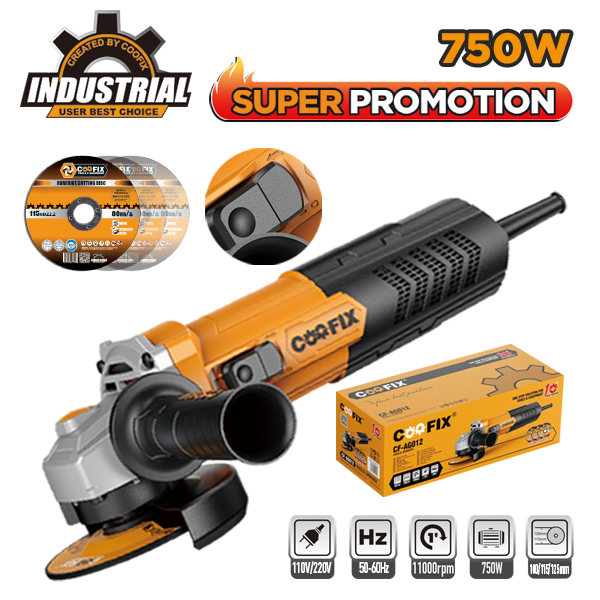
The CF-AG012 is listed with a 115 mm disc diameter, a rated voltage of 220-240 V / 50-60 Hz, a rated input power of 750 W and a no-load speed of 11,000 r/min. Those five data points do not prove product quality, but they create an identity trail. A buyer can compare them with the nameplate, the product photograph, the order sheet and the certificate scope. When one item in that chain does not match, the file should stop before the purchase order does.
Start with identity, not with the certificate folder
A compliance file is usually opened at the certificate tab. That is too late. The first check is model identity. The file should show CF-AG012 consistently in the proforma invoice, packing list, product label, carton marking, product photograph and certificate scope. A general description such as angle grinder is not enough when the order contains more than one grinder family or more than one market version.
The supplied product record identifies CF-AG012 as an angle grinder with the ratings above. The record also lists copper and plastic among the materials and metal processing as an applicable industry. Those are product-file facts, not independent certification. They help the buyer build the identity trail, but they do not replace a model-level conformity document.
| File checkpoint | CF-AG012 value to confirm | Where to compare it | Importer acceptance question |
|---|---|---|---|
| Model designation | CF-AG012 | Nameplate, carton, invoice, certificate scope, product photo | Is the exact model named, or only a generic angle grinder description? |
| Rated voltage and frequency | 220-240 V / 50-60 Hz | Nameplate, rating label, product sheet, destination-market file | Does the destination market use this voltage and frequency, and does the label state it clearly? |
| Rated input power | 750 W | Nameplate, product sheet, order specification | Is 750 W presented as rated input power, not as output power or a performance guarantee? |
| No-load speed | 11,000 r/min | Nameplate, product sheet, accessory rating | Is the accessory rated for the tool speed, and is the value described as no-load speed? |
| Disc diameter | 115 mm | Nameplate, guard, accessory kit, product photo | Do the guard and quoted accessories match a 115 mm disc configuration? |
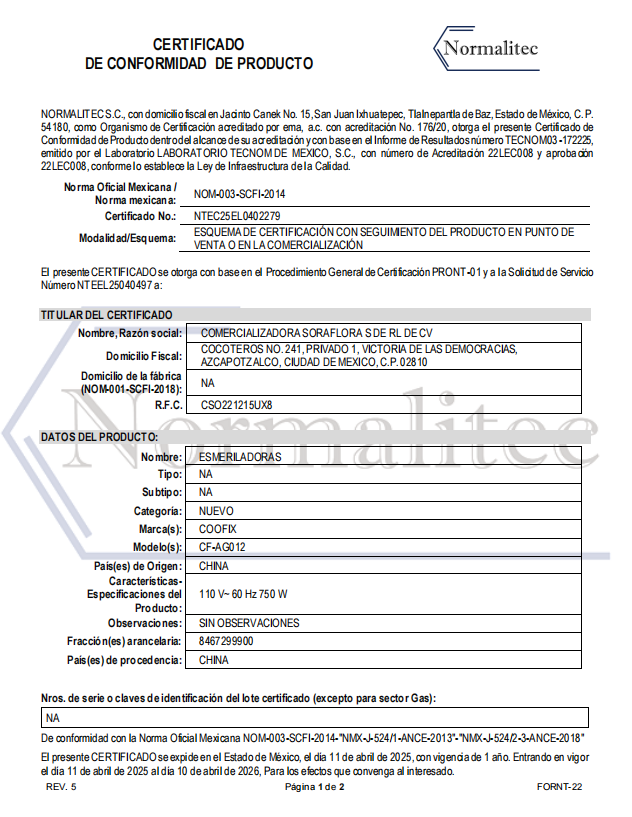
| Certificate status | NOM record expiry 10 April 2026; CE record expiry 31 March 2027 | Certificate copy, issuing body, model schedule | Is the document current, and does its scope name the exact model and market? |
Why the five rated figures matter to an importer
Rated voltage is a market-fit check before it is a technical check. A 220-240 V / 50-60 Hz grinder is aligned with markets that use that supply range. It should not be assumed to suit a 120 V market or a market with different plug and labelling requirements. The file should show that the destination market, the nameplate and the order description agree. If the destination is outside the stated voltage range, the correct response is to stop and request the correct variant, not to add an adapter note after shipment.
Rated input power is often misread. The supplied figure is 750 W input power. That is not the same as output power at the spindle, and it is not a test result under load. A buyer should use it as an identity and label value. A higher number on a competitor sheet does not automatically make that tool better, and a lower number does not automatically make it unsuitable. The relevant procurement question is whether the figure is stated consistently in the documents and on the tool.
No-load speed is also a label value, not a promise of cutting speed. The CF-AG012 is listed at 11,000 r/min with no load. Accessories have their own speed limits. A disc, wire brush or other attachment should be rated for the tool's no-load speed and for the actual application. If the accessory marking is missing or lower than the tool speed, the file is incomplete. This is a safety and traceability point, not a performance claim.
Disc diameter is the most visible fit boundary. A 115 mm tool should be matched with a 115 mm disc configuration, a suitable guard and a compatible accessory set. A photograph can show the body shape, but it cannot prove the guard clearance or the accessory rating. The buyer should ask for a photograph of the guard fitted to the tool and a written list of the accessories included in the quoted configuration.
What the supplied certificate records establish, and what they do not
COOFIX has company-level and product-level documents, and they should not be mixed. The supplied AEO certificate, number 096099139001, was issued by Hangzhou Customs of the People's Republic of China, with an issue date of 23 December 2025 and an expiry date of 22 December 2030. It concerns authorised economic operator status and customs facilitation. It is not a product conformity certificate and does not establish that a particular angle grinder meets a destination-market safety standard.
The NOM record is the more directly relevant document for Mexico. The supplied record gives certificate number NTEC25EL0402279, issued by NORMALITEC S.C., under NOM-003-SCFI-2014. Its stated scope is ESMERILADORAS (Grinders) marca COOFIX, modelo CF-AG012. The issue date is 11 April 2025 and the expiry date is 10 April 2026. At the time of this review in November 2026, that expiry date has passed. A buyer should therefore treat the supplied NOM record as a historical document unless the supplier provides evidence of renewal or a current certificate that clearly covers the same model and market.
The CE record for Coofix angle grinders is different but needs just as careful a reading. The supplied record gives certificate number ICR Polska/VC/HF220401, issued by ICR Polska Co. Ltd., for the EU market, with an issue date of 1 April 2022 and an expiry date of 31 March 2027. The supplied standard reference includes EN 62841-2-3:2021+A11:2021. The transcribed scope describes ANGLE GRINDER, Coofix brand, multiple models including CF-AG001 and CF-AG002. The record is linked to CF-AG012 in the supplied relationship data, but the scope text shown here does not spell out CF-AG012 in the model list.
The model-scope check is not a formality. A certificate can be valid on its dates and still be the wrong document for a particular SKU if the model schedule does not include that SKU. The importer should ask for the full certificate and its model annex, not only the certificate number. The same discipline applies to any CE declaration or test document presented for a different grinder model.
This is also why a folder of certificate images is not a compliance file. The useful file has four layers: the certificate itself, the model schedule, the validity period and the link to the specific order. Without those layers, a buyer may accept a genuine document for the wrong model.
Product photography as a control document
The article brief calls for product photography around the grinder body, nameplate, disc guard and accessory kit, and that is the right way to connect the file to the physical product. The photographs should not be treated as advertising images. They should be taken as witness images for the order file: same lighting, clear focus, a scale reference where useful and no retouching of the ratings or label.
Photograph 1: the grinder body
The body photograph should show the complete tool, the brand marking and the model area in one frame. It should be clear enough to compare with the carton image and the product sheet. A body photograph taken from an angle that hides the label is not a control document. The buyer should ask for the same tool from the front, side and label side, with the guard fitted if the quoted configuration includes it.
Photograph 2: the nameplate close-up
The nameplate image is the most important photograph in the file. It should show model, voltage, frequency, input power, no-load speed and any other rating field required by the destination market. The numbers should be legible without enhancement. The buyer can then compare the nameplate with the CF-AG012 specification: 220-240 V / 50-60 Hz, 750 W and 11,000 r/min. A label that is blurred, missing a field or shows a different voltage should trigger a query before shipment.
Photograph 3: the disc guard
The guard photograph should show the guard fitted to the tool, its relation to the 115 mm disc position and any adjustment or clamping detail. The supplied product data gives the disc diameter but does not describe the guard as a separate specification. The buyer should therefore ask for the guard to be identified in the quoted bill of materials, photographed in place and checked against the disc size. A guard that is present in a catalogue photo but absent from the order description is still a file gap.
Photograph 4: the accessory kit
The accessory kit is where general product photographs are least reliable. The supplied CF-AG012 data does not enumerate the kit contents, so the article cannot and should not say that a particular disc, wrench, handle or case is included. The correct file practice is to require a written accessory list tied to the quotation, then photograph the exact kit that will be packed. The buyer should compare quantity, type and marking, not infer contents from a family photograph.
From photograph to physical check
A photograph supports the file, but it does not replace an inspection. The importer should define a small acceptance routine: open one carton, compare the model on the nameplate with the invoice, check the label values, fit the guard, identify the accessories against the packing list and record the result. The routine does not need to be complicated. It needs to produce a dated record that can be compared with the next shipment.
The same routine should be applied to packaging. If the carton carries a different model, a different voltage or a different brand mark, the identity chain is broken even if the tool inside looks correct. Mixed-category orders make this more likely because cartons from several SKUs sit in the same container. A carton photograph beside the tool photograph is a cheap control.
None of these steps proves that the tool will perform well in service. They do something narrower and more useful at the ordering stage: they show whether the supplier's documents and physical product describe the same item. That is the point at which an importer can decide whether to continue evaluation or request a corrected file.
Application fit: where the file meets the job
The CF-AG012 product record lists metal processing as an applicable industry. The supplied scenario material also places an angle grinder in automotive repair and maintenance, maintenance and repair services, and public infrastructure work. In those settings, the angle grinder is described for tasks such as polishing welds, removing rust, cleaning metal surfaces, cutting damaged pipes and preparing components for repair. These are application descriptions, not proof of certification, customer results or performance under load.
The buyer should read application fit together with the file boundary. A 115 mm angle grinder with a 750 W input rating and 11,000 r/min no-load speed is a specific configuration. It may suit light fabrication, repair and maintenance tasks that fall within its disc size and accessory limits. It should not be assumed to replace a larger cut-off machine or a specialist tool for a heavier duty cycle. If the job requires a 355 mm cut-off wheel, the CF-AG012 is the wrong category, not a documentation problem.
This is where the compliance file becomes commercially useful. It prevents the buyer from approving a general angle grinder file and then discovering that the order contains a different voltage, a different disc size or an accessory kit that was never specified. The file should be tied to the use case, the destination market and the exact order line.
Extending the checklist to CF-RH008 and CM005
Distributors rarely buy one SKU at a time. A mixed order may combine angle grinders with rotary hammers, cut-off machines, electric drills, cordless drills and other power tools. The compliance principle does not change: each model needs its own row in the matrix, its own certificate scope and its own validity date. A certificate attached to one SKU should not be carried across a mixed container.
CF-RH008 rotary hammer
The CF-RH008 is listed with a 26 mm drill capacity, a rated voltage of 220-240 V / 50-60 Hz, a rated input power of 850 W and a no-load speed of 0-900 r/min. The supplied CE compliance record gives certificate number ZHT-241218138S02C, issued by Guangdong Zhongshan Testing Technology Co., Ltd. (ZHT Lab), for the EU market, under EN IEC 62841-2-6:2020+A11:2020 and EN 62841-1:2015+A11:2022. The issue date is 2 December 2024 and the expiry date is 1 December 2029.
The same product record also supplies an LVD certificate, number ZHT-241218138S01C, issued by ZHT, for the EU market, under EN 60335-1:2012+A11:2014+A13:2017+A1:2019+A14:2019+A2:2019+A15:2021+A16:2023 and EN 62233:2008. An EMC certificate, number ZHT-241218138E01C, is supplied under EN IEC 55014-1:2021 and related standards. Both carry the same issue and expiry dates as the CE compliance record.
The scope check still applies. The CE compliance record describes ROTARY HAMMER, Coofix brand, multiple models including CF-RH001 and CF-RH002B. The LVD and EMC records use the broader description ROTARY HAMMER. The supplied relationship data links these records to CF-RH008, but the transcribed scope does not always name CF-RH008 directly. A distributor should ask for the full model schedule and confirm that CF-RH008 is included before placing the rotary hammer in the same approved file as the angle grinder.
CM005 cut-off machine
The CM005 is listed with a 355 mm disc diameter, a rated voltage of 220-240 V / 50-60 Hz, a rated input power of 2400 W and a no-load speed of 3800 r/min. The supplied compliance record for this model is a RoHS test report, number ZHT-240826023R, issued by ZHT for the EU market. The report is dated 29 August 2024 and the supplied expiry field is 31 December 2099. Its standard references include IEC 62321-3-1:2013, IEC 62321-5:2013, IEC 62321-4:2013+A1:2017, IEC 62321-7-1:2015, IEC 62321-7-2:2017, IEC 62321-6:2015 and IEC 62321-8:2017.
A RoHS test report is not a full safety or EMC certificate. It addresses restricted substances under the referenced test methods. The buyer should not treat it as a substitute for the product safety and electromagnetic compatibility evidence required for the destination market. The CM005 file should be kept as a separate line with its own scope, report number and test date, and the buyer should ask what other documents are available for the intended market.
Mixed-order rule: the CF-AG012, CF-RH008 and CM005 do not inherit one another's documents. The same applies when an electric drill, cordless drill or rotary hammer drill is added to the container. Each model needs a separate identity row, a separate document list and a separate validity check.
Market context is not a compliance shortcut
Category-level market estimates can help a distributor decide whether a power-tool range is worth developing. They cannot establish that a particular angle grinder model is covered by a current certificate. The supplied third-party dataset includes power-drill market research, but those figures do not map directly to the CF-AG012 angle grinder or to its NOM and CE records. A buyer should keep market sizing and model approval in separate parts of the evaluation.
The more useful commercial signal is documentary readiness. A supplier that can provide a model-level matrix, a current certificate, a label photograph and a clear accessory list reduces the number of open questions before the order. That does not prove product performance, but it makes the evaluation cleaner and lowers the risk of a shipment being held because the file and the carton disagree.
Outlook: a living file, not a one-time PDF
The practical direction for importers is to treat the compliance file as a living record. Each SKU should have an owner, a current certificate set, a validity calendar and a change log. When a model, voltage variant, market or accessory configuration changes, the affected row should be reopened. A certificate that was correct for last year's order should not be assumed to cover this year's configuration without a new check.
For the CF-AG012, the immediate file actions are clear: confirm the model designation, compare the 220-240 V / 50-60 Hz, 750 W, 11,000 r/min and 115 mm values across the nameplate and documents, obtain a current NOM position because the supplied expiry has passed, verify the CE model schedule and photograph the body, nameplate, guard and exact accessory kit. For a mixed order, repeat the same exercise for CF-RH008 and CM005 before the container is consolidated.
The order decision should rest on evidence that is current, model-specific and consistent. A certificate with the wrong model scope, an expired record or a photograph that cannot be read is not a minor administrative issue. It is a reason to pause the line item until the file matches the tool.
For a wider model reference, the COOFIX 2025 catalog is available as a public PDF.
FAQ
What should an importer check first on a CF-AG012 file?
Check model identity first: CF-AG012 should appear consistently on the invoice, packing list, carton, nameplate and certificate scope. Then compare the five listed values: 115 mm disc diameter, 220-240 V / 50-60 Hz, 750 W rated input power and 11,000 r/min no-load speed. The file should show that the same configuration is being quoted, packed and documented.
Does the supplied CE record prove that CF-AG012 is covered for the EU?
Not by itself. The supplied CE record is current on its stated dates, with an expiry of 31 March 2027, but the transcribed scope describes Coofix angle grinders generally and gives CF-AG001 and CF-AG002 as examples. The record is linked to CF-AG012 in the supplied relationship data, yet the scope text shown does not name CF-AG012 directly. The importer should obtain the full certificate and model schedule before treating it as model-specific evidence.
The NOM record expires on 10 April 2026. What does that mean for a current order?
The supplied NOM record should not be treated as active after that date. At the time of this review in November 2026, the stated expiry has passed. A buyer should request evidence of renewal or a current NOM certificate that clearly covers CF-AG012 for Mexico before relying on it for a new order.
How should the guard and accessory kit be checked when the product data does not list kit contents?
Do not infer the kit from a family photograph. Ask for a written accessory list tied to the quotation, then compare the exact packed items with that list. The guard should be photographed fitted to the tool and checked against the 115 mm disc configuration. The buyer should confirm quantity, type and marking for every accessory rather than assuming that a catalogue image represents the shipped kit.
Can one certificate cover a mixed order of CF-AG012, CF-RH008, CM005 and electric drills?
No. Product documents are model-specific and market-specific. CF-AG012 has its own angle grinder records, CF-RH008 has separate rotary hammer CE, LVD and EMC records, and CM005 has a RoHS test report in the supplied set. An electric drill or cordless drill added to the same order would need its own row. Each SKU should be checked separately for model scope, certificate number, issue date, expiry date and destination market.
Have Questions or Need More Details?
Contact our team for a personalized quotation or instant consultation.
Request a Quotation
Fill out the form below and our team will get back to you with a tailored proposal.
WhatsApp Direct Chat
Prefer to chat in real-time? Message us on WhatsApp for instant assistance & quick answers.
- Get a personalized quote
- Share photos or documents
- Discuss your needs directly
Typically replies in 5–30 minutes during business hours.