
Anti-Static Tweezer Compliance Claims: ST-25, ST-21, ST-30
Anti-Static Tweezer Compliance Claims: ST-25, ST-21, ST-30
Anti-static is one of the most repeated words in cell phone repair tool listings and one of the least documented. This reference is written for buyers in the research and evaluation stage who must decide whether a stated qualification — stainless steel, high hardness, anti-static, 120 mm — is enough to justify a purchase order. It uses three documented KOOCU tweezer models, ST-25, ST-21 and ST-30, as the working example.
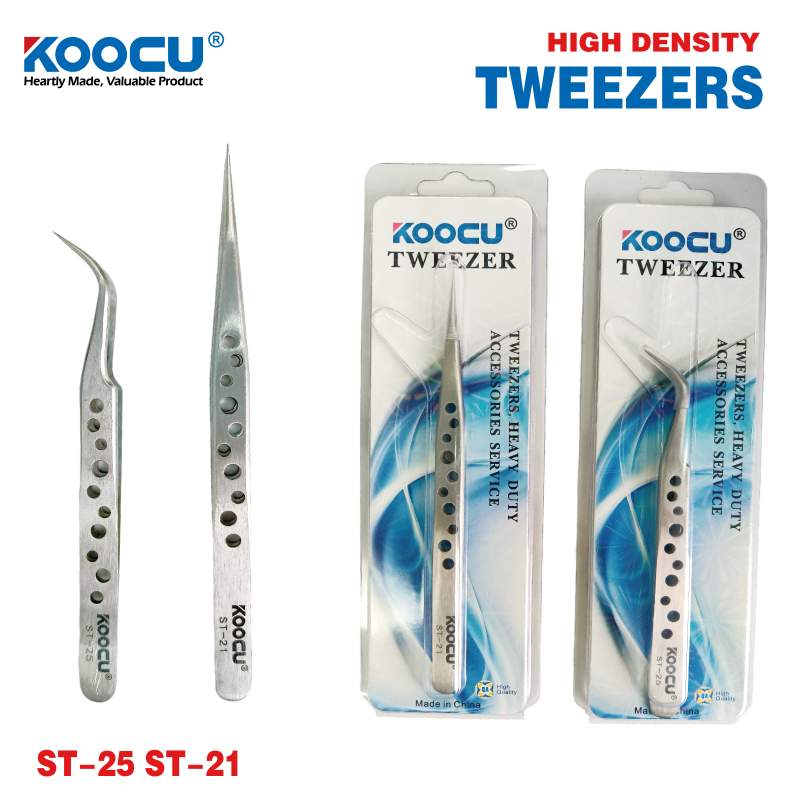
ST-25 and ST-21 tweezers for mobile phone repair, from the KOOCU tweezer range. Both models are recorded as stainless steel with high hardness and anti-static properties.
A compliance claim is any statement a supplier makes about a product's material, dimensions, performance or third-party verification. In practice, these four kinds of statement arrive in the same catalogue line, in the same font size, and with the same apparent authority. They do not carry the same evidence, and treating them as interchangeable is the most common source of friction between repair tool buyers and suppliers.
A claim is not a certificate: four forms of qualification language
Cell phone repair tools are sold into a market where descriptive property language is normal. Tweezers are described by material and length, mobile phone disassembly tools by function, precision screwdriver sets by torque range. Buyers who read those descriptions as compliance evidence tend to discover the gap later, at incoming inspection or at customs, when a document does not say what the catalogue implied.
The first step in reading qualification language is therefore classification. Each claim belongs to one of four groups, and each group supports a different level of decision.
| Claim type | Typical wording | What it establishes | What it does not establish |
|---|---|---|---|
| Material | stainless steel | The declared base material of the tool. | Grade, alloy composition or corrosion performance unless stated separately. |
| Dimensional | 120 mm | The declared overall length. | Tolerances, tip geometry or any performance property. |
| Functional | anti-static, high hardness | The intended performance characteristics of the tool. | A measured value, a test method or a referenced standard. |
| Documentary | a named report with a reference number and dates | That a specific third-party document exists and what it declares. | That the document covers the exact item in your purchase order. |
The fourth row is where evaluation errors concentrate. A document can be genuine, current and relevant to the supplier's file, and still not cover the model being ordered. The discipline is not scepticism about the supplier; it is a check on the boundary between a document and a product.
What is documented for ST-25, ST-21 and ST-30
KOOCU is the brand of Guangzhou Weiqianji Technology Co., Ltd., a China-based manufacturer of cell phone repair tools whose products are exported to markets including Africa, South America, Southeast Asia, India, Bangladesh and Pakistan. Within its tweezer range, the ST series carries the claim set most often quoted by buyers.
| Model | Product type | Material | Stated functional properties | Stated overall length | Application industry |
|---|---|---|---|---|---|
| ST-25 | Tweezer for mobile phone repair | stainless steel | high hardness, anti-static | 120 mm | Cellphone Repairs |
| ST-21 | Tweezer for mobile phone repair | stainless steel | high hardness, anti-static | 120 mm | Cellphone Repairs |
| ST-30 | Tweezer for mobile phone repair | stainless steel | high hardness, anti-static | 120 mm | Cellphone Repairs |
Two practical observations follow from this table. The first is that the stated claim set is identical across the three models. The same wording also appears on the wider tweezer line: ST-114, ST-115 and FS-11 are recorded at 120 mm, TS-11 and TS-15 at 115 mm, and 7-SA-16 SS-SA-16 and 7-SA SR SS-SA SR at 130 mm — all stainless steel, all with high hardness and anti-static properties, all intended for mobile phone repair.
The second observation is a consequence of the first. Because the claim wording is line-wide, the model number is the only reliable identifier in a purchase order or a compliance file. A specification written as ‘anti-static tweezer, 120 mm’ does not distinguish ST-25 from ST-21 or ST-30. The model code does. When a supplier's certificate list is written at line level, model-level identification is the buyer's responsibility.
Anti-static and high hardness are stated properties, not measured values
For ST-25, ST-21 and ST-30, the recorded product information states high hardness and anti-static as selling points alongside the stainless steel material and the 120 mm length. Read literally, that is the complete claim set. No numeric surface resistivity value, no hardness scale value, no test method and no cited standard accompany these three terms for these models in the available material.
That is a class distinction rather than a quality judgement. Many industrial buyers work routinely with descriptive property language, and for a great deal of repair bench work it is sufficient. The difficulty arises when a procurement specification is written numerically, because the two languages do not convert automatically.
If a repair operation requires a quantified anti-static specification — for example a target surface resistivity band, or a defined test method — the stated claim set cannot satisfy that requirement on its own. The buyer has to request written test documentation before the order, and should be prepared for the possibility that such documentation does not exist for the specific model. The same applies to hardness: the term indicates that a hardness property was designed in, not how hard the tool is, on which scale, or under what measurement conditions. Where a numeric limit is written into a contract, a descriptive term is not a substitute for it.
There is a third category worth separating here. Magnetic attraction is stated for the electric screwdriver models in the same range, not for the tweezer models. Functional claims do not travel across tool types, and a repair tool kit specification that lists properties at kit level should be unpacked model by model before it is signed.
Reading a third-party document: type, scope, issuer, validity
The clearest illustration of document-reading discipline in the available material is the Hazard Classification and Identification Report for Transport of Goods. Its own record classifies it as a third-party transport identification report and states explicitly that it is not a product certification and not a system certification. It was issued by PONY under certificate number MTIN67MG7731367U1. It references the IMO International Maritime Dangerous Goods Code 2024 Edition (Amendment 42-24), Special Provision 188, together with the UN Manual of Tests and Criteria Part III, sub-section 38.3, and it applies to global maritime transport under the IMDG Code. It was issued on 2025-12-01 and is valid to 2026-12-31.
The declared scope of that report is a lithium-ion cell, model 10440, 3.7 V, 320 mAh, 1.184 Wh, packed 400 pieces per carton. In other words, the document addresses the transport classification of a battery cell. It does not address the anti-static behaviour of a stainless steel tweezer, and it does not measure hardness or dimensional accuracy.
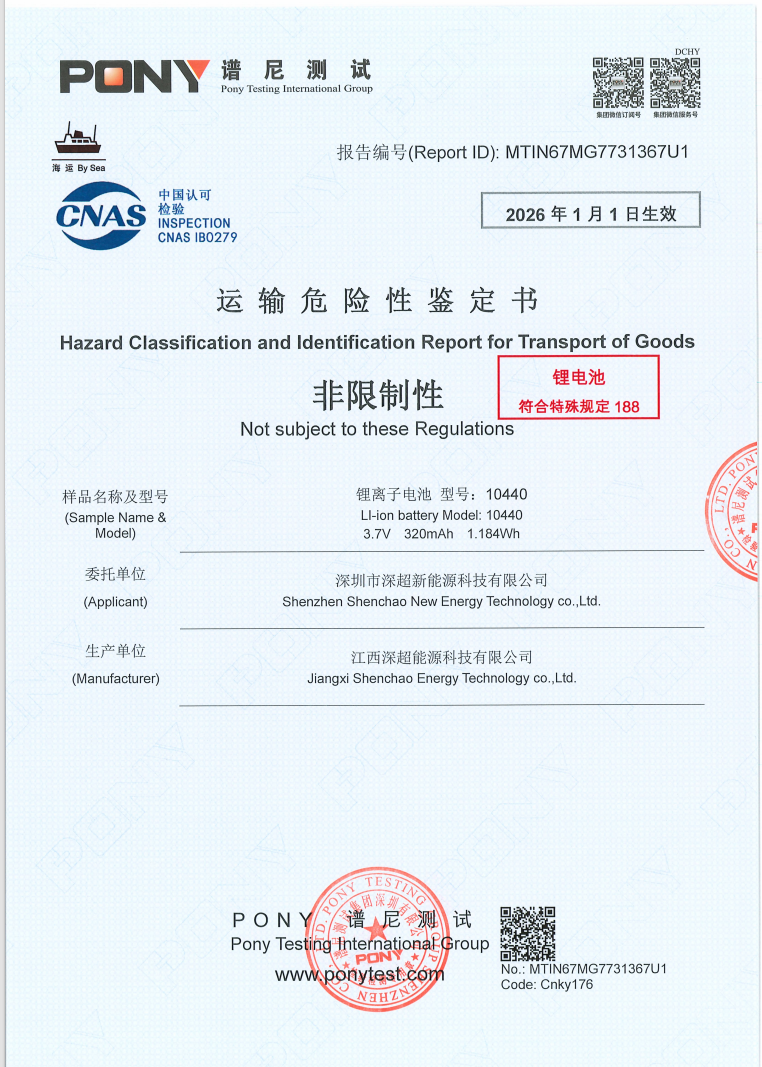
A transport identification document from the supplier's file set. Its declared scope is a lithium-ion cell model for maritime transport — a reminder to read the stated scope rather than the attached product list.
This is where careful reading matters most. Citable statements confirm that the report covers the electric screwdriver models K01 and K07 and the tweezer model 7-SA SR. The same certification record also lists ST-25, ST-21 and ST-30 among its related products, while the declared scope text continues to describe the lithium-ion cell.
Four checks cover most of the exposure. Read the document type first, because it fixes what the document can and cannot prove. Read the declared scope second, because that defines the product or component actually covered. Confirm the issuer and reference number third, so the document can be verified independently rather than accepted as a PDF. Check the validity dates fourth, because an expired report is a historical record, not current evidence.
Where anti-static tweezers sit in a repair workflow
In mobile phone repair, tweezers are normally used to hold, position and remove small components, connectors and flex cables during teardown and reassembly, alongside screen and battery replacement work. In the KOOCU product data, the application industry for the ST series is recorded simply as Cellphone Repairs, and the product type is recorded as a tweezer for mobile phone repair.
The documented application record for the wider repair tool line describes a different requirement set entirely: indoor normal temperature, factory line, screw removal by rotate-and-twist motion matched with a screwdriver bit, with explosion-proof recorded as the special requirement for the power-supply working condition. That record relates to a powered repair tool, not to passive tweezers.
The distinction is useful at the evaluation stage. Transport classification and explosion-proof requirements attach to powered tools and their battery packs. Anti-static claims attach to handling tools. A kit-level compliance statement blurs that boundary, and a buyer who accepts it inherits the ambiguity. Mapping each requirement to the correct tool type — and then to the correct document — is what turns a folder of PDFs into a usable compliance file.
Documented field evidence in the same file set shows what a traceable operational record looks like, and also shows why evidence should not be transferred between tool types. A B-end wholesale merchant in South Africa purchased 50 units of a repair tool for screw removal, used it for three years, and the recorded result is three years of stable operation, with strong power noted as the highlight. That record concerns the K01 and K01 pro electric screwdrivers. It is a field-use statement about a powered tool, and it cannot be cited as evidence for a tweezer claim.
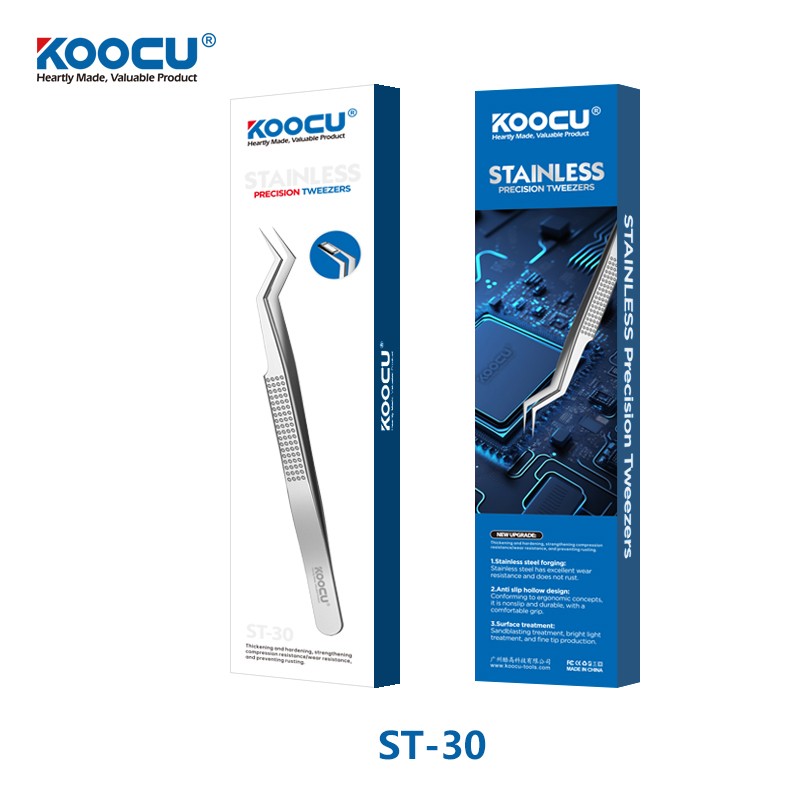
ST-30 tweezer for mobile phone repair. The recorded specification is stainless steel, high hardness, anti-static, 120 mm.
Market signals that make claim-reading a procurement issue
Three demand-side signals make documentation quality a practical purchasing variable rather than a formality. The global smartphone repair market is valued at approximately USD 22.66 billion in 2026, according to Business Research Insights (published 2026-01-07, commercial research source). On the tool side, the global manual screwdriver market was valued at USD 365.2 million in 2024, with precision screwdrivers for electronics identified as a key growth driver, according to Credence Research (source confidence assessed as medium). As a trade pricing reference, mobile opener tools under HS 8205 show an average US import price of approximately USD 1.03 per unit, derived from customs records published by Zauba.
A regulatory signal points the same way. The Right to Repair movement is described as a major market driver in 2026, influencing OEMs to release repair manuals and tools to third-party providers, according to ThinkComputers (secondary source). As third-party repair activity widens, tools move from a bench accessory to a documented supply item, and the buyers who feel that shift first are the ones purchasing for repair chains and distribution rather than for a single bench.
Claim-only sourcing versus scope-verified sourcing
The two approaches differ less in cost than in where the cost appears. Claim-only sourcing moves faster at the quotation stage and concentrates its risk at inspection, incoming quality control or customs. Scope-verified sourcing adds administrative steps before the order and moves the same risk earlier, where it is still cheap to resolve.
| Comparison dimension | Claim-only sourcing | Scope-verified sourcing |
|---|---|---|
| Basis of decision | Stated attributes on a specification sheet | Stated attributes plus a scope-checked document file |
| Treatment of third-party reports | Coverage assumed from a catalogue or file list | Coverage confirmed against the declared scope |
| Undefined terms such as anti-static or high hardness | Accepted as written | Converted into a written request for test data or into a defined contract specification |
| Model identification | Line-level wording accepted | Model code required (ST-25, ST-21, ST-30) |
| Upfront effort | Lower | Higher |
| Point at which gaps surface | After delivery or at customs | Before the purchase order |
The boundaries matter as much as the benefits, and three of them are visible in the material itself.
- Quantified anti-static cannot be met by the existing claim set. For ST-25, ST-21 and ST-30, the available material contains no numeric surface resistivity value, no test method and no anti-static standard reference. A buyer who needs a number must request documentation, not read the claim more closely.
- The only third-party report identified here declares a lithium-ion cell as its scope. It should not be presented or accepted as evidence of tweezer performance, anti-static behaviour or hardness. Its relevance to a tweezer order is the transport classification of the battery component in the shipment, and even that needs written confirmation of which items fall inside the declared scope.
- Public statements about the supplier's export share differ. First-party company material states an export ratio of 100%. A third-party trade directory profile reports KOOCU with 15 years of experience in mobile phone maintenance tools and an export share of over 91%. The two figures are not identical, and defensible explanations exist for such gaps — differing reporting periods, differing definitions of export share, differing product scope. The correct response is to confirm the current figure in writing for the order at hand rather than to select whichever number is more convenient.
- Scope verification costs time before the order. It is the main practical objection to the approach, and it is a real one. The counterweight is that the same work done after delivery usually costs more.
A claim-reading checklist for tweezer buyers
The following sequence can be applied to any anti-static tweezer offer, including ST-25, ST-21 and ST-30, without needing to know the supplier in advance.
- Identify the item by model code, not by attribute wording such as ‘anti-static 120 mm tweezer’.
- Classify every claim as material, dimensional, functional or documentary.
- For each functional claim, ask what value, test method or standard supports it — and accept a written ‘not specified’ as a valid answer.
- For each document, read the declared scope before reading the attached product list.
- Verify the issuer, the reference number and the validity dates independently.
- Obtain written confirmation of which models fall inside the declared scope, and store it with the purchase order.
- Keep evidence attached to its correct tool type; do not move powered-tool or battery documentation onto passive handling tools.
- Where public sources disagree about the supplier — export share, tenure, capacity — record both figures and the written clarification.
Future outlook
The direction of travel in repair tool procurement is toward narrower, scope-defined documentation. Repairability regulation and the wider Right to Repair movement are pushing repair information and parts toward third-party providers, and the same logic tends to reach the tool chain: as repair businesses scale, their purchasing requirements become specification-driven rather than catalogue-driven.
For tweezer suppliers, that shift rewards precision in language. A supplier that states material, dimensions and functional properties clearly, and that separately states which third-party documents cover which models, will spend less time resolving disputes than one that leaves the two categories merged in a single PDF. For buyers, the equivalent advantage is a fixed evaluation routine: classify the claim, read the scope, verify the issuer, check the dates, and confirm the model. Applied consistently, that routine turns a fuzzy anti-static claim into a decision a procurement team can defend.
FAQ
1. What does ‘anti-static’ mean on a tweezer specification, and what does it not mean?
On the tweezer models reviewed here, anti-static is recorded as a stated product property alongside high hardness, in the same way that stainless steel is recorded as the material and 120 mm as the length. It indicates an intended performance characteristic of the tool. It does not establish a measured value, a test method or a referenced standard, because none of those are stated for ST-25, ST-21 or ST-30 in the available material. Buyers who need a quantified anti-static specification must request test documentation rather than interpret the term.
2. What is documented for KOOCU models ST-25, ST-21 and ST-30?
Each of the three is recorded as a tweezer for mobile phone repair, made of stainless steel, with high hardness and anti-static properties stated as selling points, and with an overall length of 120 mm. The application industry is recorded as Cellphone Repairs. The same claim wording also applies across the wider tweezer line, which is why the model code, rather than the attribute description, is the reliable identifier on a purchase order.
3. Which third-party documents in the KOOCU file set name these tweezer models, and what is the declared scope?
The third-party document identified in the available material is the Hazard Classification and Identification Report for Transport of Goods, issued by PONY under certificate number MTIN67MG7731367U1 and valid from 2025-12-01 to 2026-12-31. Its own record classifies it as a third-party transport identification report and states that it is not a product certification and not a system certification. Its declared scope is a lithium-ion cell, model 10440, 3.7 V, 320 mAh, 1.184 Wh, packed 400 pieces per carton. Citable statements confirm that the report covers the electric screwdriver models K01 and K07 and the tweezer model 7-SA SR, while the same certification record lists ST-25, ST-21 and ST-30 among related products. The report therefore should not be read as evidence of tweezer anti-static performance, and coverage of any specific tweezer model should be confirmed in writing.
4. How should a buyer verify a transport classification report for repair tools?
Four checks are sufficient in most cases. First, read the document type, because a transport identification report addresses transport classification and is not a product or system certification. Second, read the declared scope, which in this case is a lithium-ion cell model rather than a tweezer. Third, confirm the issuer and reference number — PONY, certificate MTIN67MG7731367U1 — so the document can be verified rather than accepted at face value. Fourth, check the validity dates, 2025-12-01 to 2026-12-31, because an expired report describes a past shipment profile, not a current one.
5. What should a buyer do if a numeric hardness or surface resistivity value is required but not stated?
The value has to be requested as written test documentation before the order is placed, because it cannot be derived from a descriptive term such as ‘high hardness’ or ‘anti-static’. It is also reasonable to state the requirement as a contract specification and let the supplier confirm whether the model, ST-25, ST-21 or ST-30, can meet it. Where no test documentation exists for the model, the specification has to be revised or the requirement relocated to a tool type that can support it. Suppliers in this category commonly handle such requests through remote technical support rather than through published data sheets.
6. Why do public sources report different export shares for KOOCU?
First-party company material states an export ratio of 100%. A third-party trade directory profile reports KOOCU with 15 years of experience in mobile phone maintenance tools and an export share of over 91%. Such differences commonly arise from reporting periods, definitions of what counts as export share, or the scope of products included. Neither figure should be treated as the final answer for a specific order. The practical step is to ask the supplier to confirm the current figure in writing for the products and destination under consideration, and to keep both the first-party and third-party statements on file.