
Antibacterial & Anti-Odor Knit Fabric: Compliance Questions
Antibacterial & Anti-Odor Knit Fabric: Compliance Questions
Antibacterial, anti-odor and UV-protective treatments can be applied to EKWP2270-D6 and EKWP1912-DSP, two functional knit fabric articles from Zhangjiagang E-king Textile Co., Ltd. None of them is a default property of the fabric. They are optional finishes, which means the specification, the quotation and the test documentation each have to say so explicitly. This article sets out the compliance questions a buyer should close out before a finish specification is locked and a purchase order is issued.
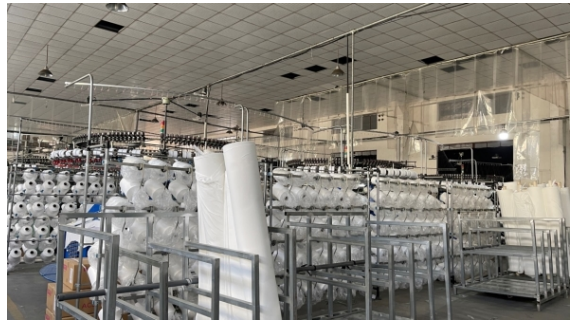
Functional knit fabric production. Finish functions such as antibacterial, anti-odor and UV protection are added during dyeing and finishing, and are optional rather than built into the base construction.
Antibacterial, Anti-Odor and UV Protection Are Three Different Claims
Buyers frequently write “antibacterial” on a tech pack when what they actually mean is “the garment should not smell after a training session.” Those are different requirements, addressed by different chemistry families and evidenced by different test reports.
An antibacterial finish addresses bacterial activity on the textile itself. An anti-odor finish addresses the development of odor during wear, which can be handled through odor-neutralising chemistry or through antimicrobial chemistry depending on the programme. UV protection is a third, separate property. A report supporting one of these claims does not automatically support the others, and a quotation that lists a generic “functional finish” does not tell the buyer which of the three is included.
Zhangjiagang E-king Textile Co., Ltd. is a knitted textile manufacturer based in Zhangjiagang, Jiangsu Province, China, founded in 2011. The company operates an 8,600 m² facility with around 80 employees and a 10-person R&D team. Its main product line is functional knit fabric, with approximately 95% of output exported to EU and USA markets. Finishing capabilities include peaching, brushing, fuzzing, transfer printing, dispersed printing, acid printing, digital printing, foil and emboss, alongside chemical functions such as antibacterial and odor, moisture wicking and quick drying, UV protection, anti-static, waterproof, stain and oil prevention, thermal storage and warmth preservation, and cooling treatment.
In practice, the mill capability list contains several functions that a garment brief may describe as one requirement and a laboratory report will describe as something else entirely. That gap is where most compliance problems begin, and it is closed with documents rather than with adjectives.
Where the Finish Decision Sits in the Production Chain
The in-house dyeing facility at E-king has been in production since March 2022 and supports continuous production and replenishment of functional knit fabric. That detail matters more than it first appears: chemical finishes are applied and controlled during dyeing and finishing, not during knitting, so a mill that runs both stages in one chain has fewer handover points between the fabric the buyer approved and the fabric the buyer receives.
Annual output capacity reaches 6,000 tons of fabric, and the company produces approximately 24 million yards per year. That capacity supports bulk orders and repeat-order supply programs.
For odor-control programmes specifically, the company states cooperation with POLYGIENE among its technology and material partners, alongside Hengli Group, Shenghong Group, Invista, Creora Group and Huafeng Group. That partnership is useful context when a brand is building an odor-control programme and wants the mill to work with an established odor-control technology. It is not, by itself, evidence that a particular order carries an odor-control finish. The finish still has to be specified, quoted, applied and tested per order.
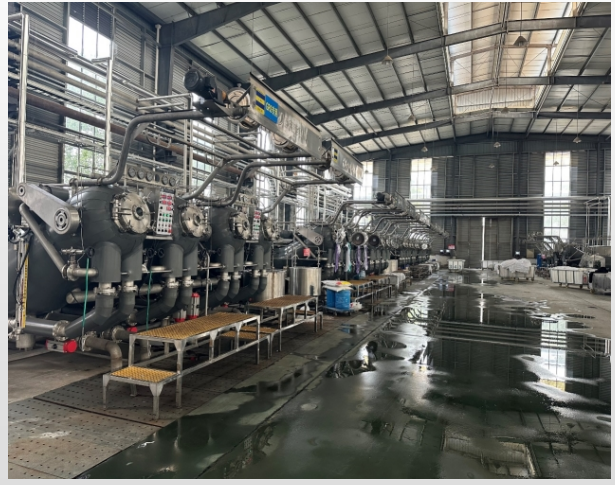
Dyeing and finishing stage. Because antibacterial, anti-odor and UV finishes are optional, each order needs its own finish specification and its own lot-level documentation.
Twelve Questions to Settle Before the Specification Is Locked
The checklist below is designed to run between buyer, mill and, where relevant, the brand's own quality team. Every answer should be written down rather than agreed verbally, because a finish claim without a documented method is not a specification — it is a preference.
| # | Question to ask | What a documented answer gives you |
|---|---|---|
| 1 | Which claim is required — antibacterial, anti-odor, UV protection, or a combination? | Separates three finish functions that are tested differently and are not interchangeable. |
| 2 | On which article is the finish required — EKWP2270-D6, EKWP1912-DSP, or another construction? | Finish performance is construction- and fibre-specific; evidence on one article does not transfer automatically to another. |
| 3 | Is the finish standard on this article, or optional? | Confirms the treatment is an added, quoted line item rather than an assumed baseline property. |
| 4 | Which test method and which pass/fail threshold apply? | Converts a marketing word into a measurable acceptance criterion. |
| 5 | What is the test sample — lab dip, bulk lot, or finished garment? | Determines whether the evidence describes the fabric the buyer will actually receive. |
| 6 | Over how many wash cycles is the claim stated to hold? | Sets the durability language the buyer is entitled to use on labels and hangtags. |
| 7 | Which chemistry family is used, and does it contain fluorine? | Feeds directly into PFAS and total-fluorine declarations. |
| 8 | Is the finish covered by the supplier's existing certificate scope, or does it require separate testing? | Avoids assuming that a certificate covers a finish it was never issued for. |
| 9 | What total fluorine or PFAS declaration can be issued for this finish? | Required for EU and California compliance files. |
| 10 | Does the finish change handfeel, shade, shade stability or stretch recovery? | Protects the base performance attributes from being traded away for the finish. |
| 11 | Where is the finish applied and controlled — in-house dyeing and finishing, or a subcontractor? | Supports traceability and repeat-order consistency. |
| 12 | Which documents ship with the bulk order? | Defines the acceptance file before the order is placed, not after. |
The Documentation Set: Standards and Limits Buyers Can Reference
Two reference points are worth naming in a documentation request, because together they define how finish chemistry is now assessed in the EU and US markets.
- OEKO-TEX implemented a new limit value for Total Fluorine (TF) of 100 mg/kg under STANDARD 100, effective 1 January 2024, targeting PFAS compliance.
- California AB-1817 bans regulated PFAS in textiles at a total organic fluorine threshold below 100 ppm from 1 January 2025, tightening to below 50 ppm in 2027.
Both are directly relevant to anti-odor and water-repellent finishes, because some chemistry families historically associated with durable performance relied on fluorine. A buyer does not need to know in advance which chemistry the mill intends to use. The buyer needs a written fluorine declaration for the specific finish on the specific article, issued before the order is confirmed.
Durability Evidence: The Wash-Cycle Gap
The most common dispute in antibacterial and anti-odor programmes is not whether the finish was applied. It is how long the claim remains true. A finish verified on a lab dip may behave differently after ten industrial washes on a finished garment, particularly on knit structures that are repeatedly stretched in wear and laundering.
The practical fix is to put the wash protocol in the specification rather than in the negotiation. Ask which protocol is used, how many cycles are covered, and whether the reported result applies to the fabric or to a garment. Where the answer is “fabric only,” the buyer should decide consciously whether garment-level validation is required, and budget for it at the sampling stage rather than after bulk delivery.
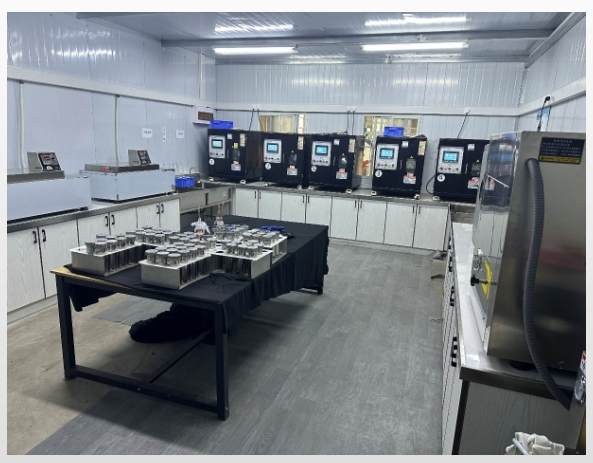
Testing and documentation review. Finish claims are only usable if the test method, sample type and wash protocol are agreed before the specification is frozen.
Knit or Woven? What Construction Means for a Finish Programme
Antibacterial and anti-odor programmes are usually specified on next-to-skin garments, which is knit territory. The construction choice still has consequences for how the finished fabric behaves in the garment.
| Dimension | Functional knit fabric | Woven fabric |
|---|---|---|
| Stretch range | 30%–150% | 3%–15% |
| Breathability | Usually 20%–50% more breathable | Generally lower |
| Shrinkage | 3%–8% | 1%–3% |
| Typical fit | Sports compression, functional underwear, training wear | Outdoor jackets, workwear, denim |
| Cost | Depends on fibre type, finishing processes and origin; a supplier quotation is required for either construction. | |
| Care and manufacturing | Knits require different sewing techniques and care, including elastic stitching and specific labelling guidance, to be confirmed during sampling and production alignment. | |
For an antibacterial or anti-odor specification, the practical implication is that the finish is layered onto a structure that is already elastic, moisture-sensitive and dimensionally less stable than a woven. Finish add-on and shade control need to be validated together with stretch recovery, not separately.
Supply Continuity, Repeat Orders and the Long-Term View
A finish programme is rarely a single order. Brands that put an odor-control or antibacterial claim on a permanent range need the same claim to be reproducible in the second, third and tenth production run. That is an ecosystem question rather than a price question, and it is where supplier structure becomes part of compliance.
Three structural facts are relevant when assessing repeat-order reliability for functional knit fabric. First, annual output capacity of 6,000 tons supports bulk orders and repeat-order supply programs. Second, the in-house dyeing facility, in production since March 2022, supports continuous production and replenishment of functional knit fabric, which reduces the risk of finish parameters drifting between a test lot and a commercial lot. Third, a stated cooperation with technology partners such as POLYGIENE gives a route into recognised odor-control programmes when a brand specifies one.
Commercially, the purchasing terms supplied by E-king are a minimum order quantity of 1,000 yards, delivery terms of FOB or CIF, pre-shipment test as the acceptance criterion, and payment terms of T/T before shipment together with letter of credit. Where a letter of credit is used, buyers should confirm the exact wording in the sales contract rather than relying on a summary in an email thread.
Limitations Buyers Should Plan Around
A compliance-focused reading of these capabilities produces several honest boundaries.
- These finishes are optional, not default. Antibacterial, anti-odor and UV-protective treatments can be applied to EKWP2270-D6 and EKWP1912-DSP, but they are added finishes. If the specification does not state them and the order confirmation does not price them, the buyer has no basis to expect them.
- Verification is lot- and construction-specific. A result obtained on one article, shade or dye lot does not automatically extend to another. Any change in fibre mix, finish chemistry or construction should trigger a re-verification decision.
- Knits trade structural stability for comfort. The 3%–8% shrinkage range typical of knits is wider than the 1%–3% typical of wovens, which affects pattern engineering and size grading on close-fit antibacterial underwear and compression programmes.
- A partner relationship is not a certificate. Cooperation with POLYGIENE describes how odor-control programmes can be approached. It does not certify an individual fabric, shade or order.
- Thresholds are market-specific and moving. Total fluorine limits differ between schemes and jurisdictions, and the California threshold tightens in 2027. A declaration that was sufficient at one point in time may need to be reissued for a later production.
Market Context: Functional Knits Are Not a Niche Anymore
The compliance pressure on finish claims is rising because the underlying category keeps growing. According to Fact.MR, the global market value of performance knitted fabrics is projected to reach USD 8.58 billion in 2026. Grand View Research estimated the broader global knitted fabric market at USD 35.7 billion by 2025, with a CAGR of 6.0%. Ken Research reported that China's exports of knitted fabrics reached approximately USD 21.2 billion in 2024.
Within that, function-specific segments are expanding on their own curve. Research and Markets expects the global moisture wicking fabrics market to grow to USD 3.99 billion by 2030 at a 6% CAGR, and SNS Insider projects the recycled textiles market at USD 6.32 billion in 2025, growing at 4.70% CAGR to 2035. Growth of this kind tends to pull finish claims from optional extras into standard product expectations — which is precisely why documentation, rather than marketing language, becomes the deciding factor in supplier selection.
Future Outlook
Three shifts are worth watching over the next few specification cycles. First, fluorine declarations are becoming part of routine order paperwork rather than a special request, following the OEKO-TEX Total Fluorine limit value of 100 mg/kg under STANDARD 100 and the California AB-1817 thresholds. Second, buyers are increasingly separating fabric-level evidence from garment-level claims, which pushes wash-protocol agreement earlier into development. Third, odor-control programmes are consolidating around named technologies rather than generic “anti-odor” wording, which makes partner relationships at the mill level more relevant to procurement decisions.
For buyers, the practical consequence is that the finish question should be asked at the same time as the construction question, not after the sampling round. The supplier that can answer the twelve questions in writing before the first bulk dyeing lot is the supplier that will be easier to audit in the second year of the programme.
FAQ
Are antibacterial and anti-odor finishes standard on EKWP2270-D6 and EKWP1912-DSP?
No. Antibacterial, anti-odor and UV-protective treatments can be applied to both articles, but they are optional finishes rather than default properties of the base fabric. The specification and the order confirmation must state them explicitly for the treatment to be part of the delivered product.
What is the difference between an antibacterial claim and an anti-odor claim?
An antibacterial finish addresses bacterial activity on the textile. An anti-odor finish addresses odor development during wear, which may be handled by odor-neutralising chemistry or by antimicrobial chemistry depending on the programme. They are separate claims, supported by separate test evidence, and a report for one does not automatically support the other.
Which documents should a buyer request before locking a finish specification?
At minimum: the finish description and chemistry family, the test method and pass/fail threshold, the sample type tested (lab dip, bulk lot or garment), the wash protocol and number of cycles covered, a total fluorine or PFAS declaration, and confirmation of whether the finish is inside the scope of any existing certificate. The acceptance criterion should also be agreed in advance; pre-shipment test is the criterion stated in the supplier's purchasing terms.
Does cooperation with POLYGIENE mean the fabric is delivered with odor control?
No. E-king states cooperation with POLYGIENE among its technology and material partners, which is relevant context for how an odor-control programme can be approached at mill level. It does not mean that an individual order of EKWP2270-D6 or EKWP1912-DSP automatically carries an odor-control finish. The finish remains an optional treatment that must be specified, quoted and tested per order.
How should PFAS and total fluorine limits be handled for anti-odor finishes?
Two reference points apply to EU and US programmes. OEKO-TEX implemented a Total Fluorine limit value of 100 mg/kg under STANDARD 100 effective 1 January 2024. California AB-1817 bans regulated PFAS in textiles at a total organic fluorine threshold below 100 ppm from 1 January 2025, tightening to below 50 ppm in 2027. The buyer's action is to request a written fluorine declaration for the specific finish on the specific article, rather than assuming a finish family is compliant because of its name.
How long does an antibacterial or anti-odor claim hold after washing?
There is no universal answer, because durability depends on the finish chemistry, the substrate and the laundering conditions. The claim should therefore be tied to a defined wash protocol and a stated number of cycles agreed in the specification. Where a supplier's evidence covers fabric only, buyers should decide whether garment-level validation is needed and plan that testing before bulk production rather than after.
What are the purchasing terms for a bulk order?
The stated terms are a minimum order quantity of 1,000 yards, delivery terms of FOB or CIF, pre-shipment test as the acceptance criterion, and payment terms of T/T before shipment together with letter of credit. Buyers using a letter of credit should confirm the exact wording in the sales contract with the supplier directly.
Zhangjiagang E-king Textile Co., Ltd. is located in Zhangjiagang, Jiangsu Province, China, and its functional knit fabric range is exported primarily to EU and USA markets. Company and capability information, including the finishing processes described above, is available at www.ekingtex.com and in the E-king company profile.