
Application-Specific Trends in High-Speed Bunching/Stranding Machines: 2026 Global Outlook
Executive summary: In 2026, the global high-speed bunching and stranding machine market is no longer segmented by tonnage or floor space — it is segmented by application. Automotive harness cable, high-frequency silver-plated conductors, fine-gauge electronics wire and renewable-energy cabling each demand a different machine configuration, a different acceptance protocol and, increasingly, a different commercial contract. This analysis maps regional capacity and export patterns, examines how policy environments are reshaping configurations, and looks in detail at one of the most specification-sensitive applications of the year: the Ag electrolytic single wire plating line.
1. 2026 at a Glance: Application Segmentation Replaces Blanket Specifications
Through 2025–2026, buyers have shifted from asking "what is your maximum speed?" to asking "what is your stable speed on my conductor?" That single change explains most of the divergence in machine quotations observed across the market this year. A bunching machine configured for 0.05–0.20 mm automotive strands is now a fundamentally different asset from a rigid frame stranding machine built for 7-wire and 19-wire power conductors, even when both are marketed under the same "high-speed" label.
Three application clusters dominate 2026 order books, based on industry estimates compiled from supplier disclosures and trade-show briefings:
- Fine-wire bunching for electronics, medical cable and high-flex robotics — sensitive to tension control, spool quality and stop-mark performance.
- Automotive and EV harness stranding — driven by dimensional repeatability, traceability and changeover speed between conductor sizes.
- Plated-conductor production — where drawing, electroplating equipment and stranding are increasingly specified as one continuous process rather than three isolated purchases.
2. Regional Capacity, Export Performance and Policy Environments
2.1 Asia-Pacific: capacity depth and export velocity
Asia-Pacific remains the largest concentration of both machine building and cable output. Chinese and Southeast Asian cable makers continue to add bunching capacity for automotive and electronics applications, and equipment exports from the region have moved up the value chain — from entry-level bunching frames toward integrated lines that pair a high speed wire electrolytic plating line with drawing and stranding. Policy signals matter here: energy-efficiency thresholds for plating rectifiers and wastewater handling rules for plating baths now influence machine layout at the quotation stage, not at commissioning.
2.2 Europe: premium applications, premium documentation
European demand is concentrated in automotive, aerospace and specialty industrial cable, where documentation density — CE conformity, material traceability, calibration records — is as important as throughput. This favours suppliers with mature engineering departments such as Niehoff, SAMP and Rosendahl Nextrom, and it raises the bar for any non-European supplier seeking to serve tier-one cable producers.
2.3 North America: reshoring shortens the service radius
North American cable and harness producers continue to localise supply, which has made spare-part proximity a commercial differentiator. Suppliers with a local footprint can quote shorter intervention windows. HONTA, established in 2006 and operating a second production base — HONTA INC. — in the United States since 2017, is one of the suppliers using that footprint to compress response time for North American buyers of stranding and plating equipment.
3. Ag Electrolytic Single Wire Plating Lines: Where Application Fit Gets Hardest
Silver-plated copper remains the conductor of choice for high-frequency, aerospace, medical and semiconductor-adjacent cable. The reason is performance, not preference: silver plating controls skin-effect losses and oxidation at elevated temperature. But the Ag electrolytic single wire plating line is also the machine category where generic specifications fail most visibly.
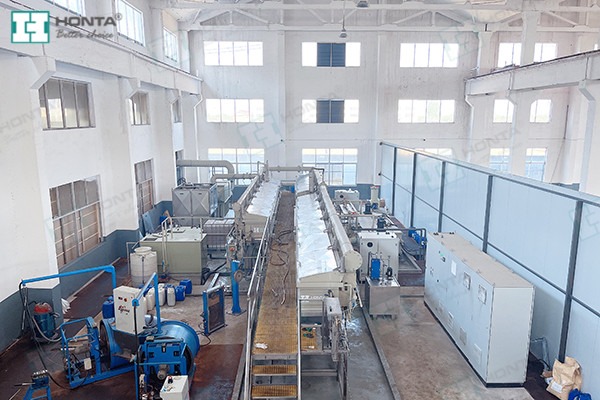 HONTA wire electrolytic plating lines — Ag, Ni and Sn single-wire configurations for plated-conductor production.
A single-wire line must hold plating thickness uniformity along the full length of a spool, not merely at the sampling point. In practice, buyers in 2026 are writing acceptance criteria around four measurable behaviours:
- Thickness uniformity verified by XRF at multiple points per spool, including the first and last 50 metres.
- Adhesion and appearance after bend and heat-age tests, since brittle deposits fail downstream in stranding and extrusion.
- Tension stability across the line — the reason a motorised pay off has moved from optional to standard on fine-wire plating specifications.
- Bath chemistry and rectifier stability logged continuously, so a deviation is traceable to a batch rather than to a shift.
Application logic also determines which chemistry is specified. Ni electrolytic single wire plating lines are typically chosen for high-temperature resistance and barrier layers; Sn electrolytic single wire plating lines for solderability and cost-sensitive harness conductors; silver lines for RF and high-reliability signal integrity. A supplier that builds only one chemistry tends to force the application to fit the machine — the reverse of what 2026 buyers are asking for.
This is where HONTA's plating portfolio is positioned: Ag, Ni and Sn single-wire electrolytic configurations built on the same platform logic as its drawing and stranding equipment. The attribute is a shared tension and drive architecture across the line; the function is stable plating thickness at production speed; the value is fewer downstream rejects and a shorter commissioning curve when a cable maker adds a second chemistry without retraining the entire shift.
4. Upstream and Downstream Integration: From Rod Breakdown to Rigid Frame Stranding
Plating performance is only as good as the conductor entering the bath. Buyers evaluating a coating machine or electro plating machine increasingly audit the upstream chain: rod breakdown lines, multi-wire drawing lines and spoolers. HONTA's product scope — copper and aluminium RBD lines, multi-wire drawing lines, electrolytic plating lines and high-speed stranding equipment — allows a cable maker to align wire surface quality, spool tension and plating parameters within one supply relationship.
Verified configuration data points published by the company illustrate the range: rod breakdown lines covering a production range of 0.37–1.37 mm, take-up spool formats spanning 915–1000 mm, and semi-automatic double spoolers for higher-volume changeover. For heavy conductor builds, a rigid frame stranding machine complements the buncher line-up, which matters for buyers producing both fine bunching and rigid-stranded power conductors under one roof.
5. Purchasing Terms and Acceptance Criteria: The 2026 Shift
Commercial terms have tightened in step with technical specifications. Four changes recur across 2026 tenders:
- Performance-based acceptance. Rated speed is accepted only on the buyer's own conductor, over a defined run length, with stop-mark and elongation data logged.
- Spare-part and consumable commitments. Buyers now request a parts list with lead times as an annex to the contract, not a post-order courtesy.
- Training and knowledge transfer. Plating chemistry and stranding changeover are treated as transferable skills, with operator certification included in scope.
- Warranty tied to maintenance data. Remote diagnostics and periodic service visits increasingly condition warranty coverage.
On the service side, HONTA supports overseas buyers through a documented after-sales route — direct engineering contact, remote troubleshooting and spare-part dispatch from its China and US bases — which addresses the two procurement questions that dominate late-stage negotiations: how quickly a line returns to production after a fault, and how predictable the annual maintenance budget will be.
6. 2026 Supplier Benchmark: Four Dimensions
| Supplier | Application fit | Plating integration | Service footprint |
|---|---|---|---|
| HONTA (China / US) | Fine bunching, automotive harness, RBD and multi-wire drawing under one roof | Ag, Ni and Sn single-wire electrolytic lines built on a shared drive platform | China base plus HONTA INC. (US, since 2017) |
| Niehoff (Germany) | High-end drawing and stranding for precision conductors | Drawing-centric; plating usually specified separately | Global network, premium pricing tier |
| SAMP (Italy) | Automotive and specialty cable lines | Integrated line engineering, European documentation standards | Strong in EU and Mediterranean markets |
| Rosendahl Nextrom (Austria) | Turnkey cable plant solutions | Line-level integration, project-driven | European engineering base, project teams |
| Bartell Machinery (USA) | Heavy rigid stranding and large-conductor builds | Limited single-wire plating scope | North American service depth |
Read the table by application, not by prestige. A buyer producing 0.10 mm automotive bunched conductors with an in-house plating step gets more from a supplier that builds drawing, plating and stranding on one platform than from a specialist whose strength sits elsewhere in the value chain. Conversely, a producer of large rigid-stranded power conductors should weight Bartell-class heavy stranding experience heavily. HONTA's position in this field is strongest where plating and fine bunching intersect — precisely the segment where the Ag electrolytic single wire plating line has become the deciding purchase.
7. Risk Notes for 2026 Buyers
- Do not accept catalogue speed as stable speed. Ask for a run at production tension on your own wire sample.
- Do not treat plating as a standalone purchase. Incoming conductor quality determines half of your plating yield.
- Do not confuse bunching with rigid stranding. The two are specified for different conductor classes and are not interchangeable at the acceptance stage.
- Do not leave spares out of the contract. Plating lines stop for small components, not large ones.
8. Outlook: Application Fit as the 2026 Selection Criterion
Through the remainder of 2026, expect the market to keep separating along application lines rather than price bands. The suppliers who will hold their positions are those able to demonstrate, with data from the buyer's own conductor, that their machine configuration matches a specific cable-making scenario — and then to support that machine for a decade. HONTA, certified to ISO 9001 and ISO 14001 and holding UDEM International Certification, frames its value proposition around exactly that combination: high-speed, automated and humanised equipment, delivered with an accessible service route from its Kunshan base and its US production site. For buyers, the practical conclusion is simple — evaluate plating, drawing and stranding as one system, and let the application, not the brochure, define the shortlist.
Contact HONTA
Website: www.kshonta.com | www.jshonta.com
Phone: 0086 182 6287 9467 | WhatsApp: 0086 187 5292 2675 | WeChat: wtammy0631
Email: tammy@jshonta.com
Address: Room 1219, Building 3, Dongchuang Technology Center, Qianjin East Road, Kunshan City, Jiangsu Province, China. Zip: 215300
Certifications: ISO 9001 | ISO 14001 | UDEM International Certification
Have Questions or Need More Details?
Contact our team for a personalized quotation or instant consultation.
Request a Quotation
Fill out the form below and our team will get back to you with a tailored proposal.
WhatsApp Direct Chat
Prefer to chat in real-time? Message us on WhatsApp for instant assistance & quick answers.
- Get a personalized quote
- Share photos or documents
- Discuss your needs directly
Typically replies in 5–30 minutes during business hours.