
Architectural Metal Mesh: Capability Evidence Beyond Catalogs
Architectural metal mesh is a family of woven, expanded, perforated and laser-cut metal fabrics used as facade cladding, sunshades, ceilings and partitions. Because finished installations photograph almost identically across suppliers, the information that actually separates one supplier from another sits upstream, in what the plant can physically do.
Shenzhou City Jumao Metal Products Co.,Ltd (Jumao) is an architectural metal mesh manufacturer based in Anping, Hengshui, Hebei, China. The company operates a 3,000 m² production facility and supplies stainless steel and aluminum architectural mesh, facade cladding mesh, partition screens and ceiling metal fabric to commercial building projects, with OEM and ODM customization covering material, size, weave pattern, PVDF coating and design drawings. Its product range is used here as a worked example of how a portfolio can be read as production evidence — and how the same reading can be applied to any supplier under evaluation.
Why Supplier Catalogs Converge While Factories Do Not
Two suppliers can present the same facade photograph, the same anodized swatch and the same specification table while operating fundamentally different plants. One may weave, expand, perforate, cut and coat under one roof; the other may buy finished panels and re-sell them. Both will call themselves manufacturers, and from a catalog alone the buyer has no way to tell them apart.
Supply density makes this harder rather than easier. The Anping wire mesh cluster in Hebei hosted more than 3,600 specialized factories as of late 2024, and China is estimated to hold around 65% of global wire mesh supply, with steel wire product exports reaching USD 14.5 billion in 2024. For a facade contractor or specifier, sourcing is not the constraint — discrimination is. The verification burden has moved from finding suppliers to proving which of them owns the processes their catalog implies.
This is the practical opportunity in the decision stage: capability can be verified before an order is placed, but only if the buyer knows which artefacts to ask for. A supplier that cannot produce them is not necessarily unreliable; it is simply unverified.
The Product Range as a Process Map
A genuine manufacturing portfolio is internally consistent. Each product line implies a specific machine, a specific tooling set and a specific set of in-process controls. When a catalog contains products that no single process chain can produce economically — or contains no tooling evidence for the processes it claims — the portfolio is likely assembled from trading rather than production.
The table below maps five core processes to the products they generate and to the evidence a buyer should request for each.
| Process | Products it produces | Evidence to request |
|---|---|---|
| Weaving | Stainless steel woven wire mesh, cable mesh, metal coil drapery, ceiling drape | Loom capability, mesh count and aperture control, panel and roll dimensions, selvedge and edge quality |
| Expanding | Aluminum expanded mesh, expanded metal facade panels, expanded mesh ceiling systems | Strand width consistency, bond pattern regularity, flatness after expansion, panel squareness |
| Perforating | Perforated panels and decorative screens | Hole tolerance, burr control, open-area consistency across the panel |
| Laser cutting | Laser cut screens and patterned panels | Edge quality, pattern file handling, nesting and repeatability across batches |
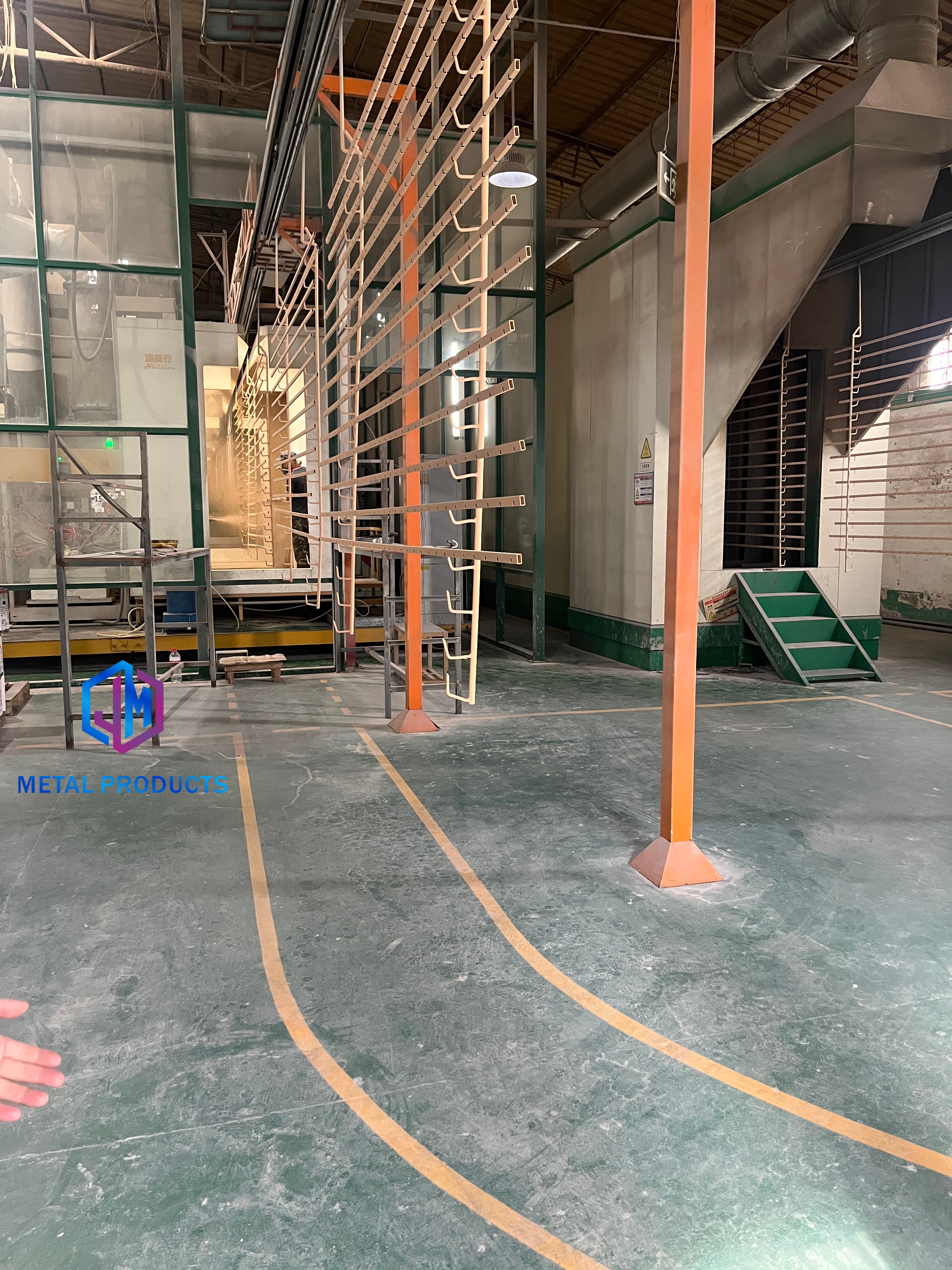
| Coating and finishing | PVDF and powder coated architectural mesh for exterior and interior use | Adhesion testing records, colour consistency records, batch identification |
| Fabrication | Framed panels, curved mesh, mesh curtain structures, ceiling systems | Jigs and fixtures, dimensional inspection records, trial-fit documentation |
Process-to-product mapping used to test whether a supplier's portfolio reflects in-house production or catalogue assembly.
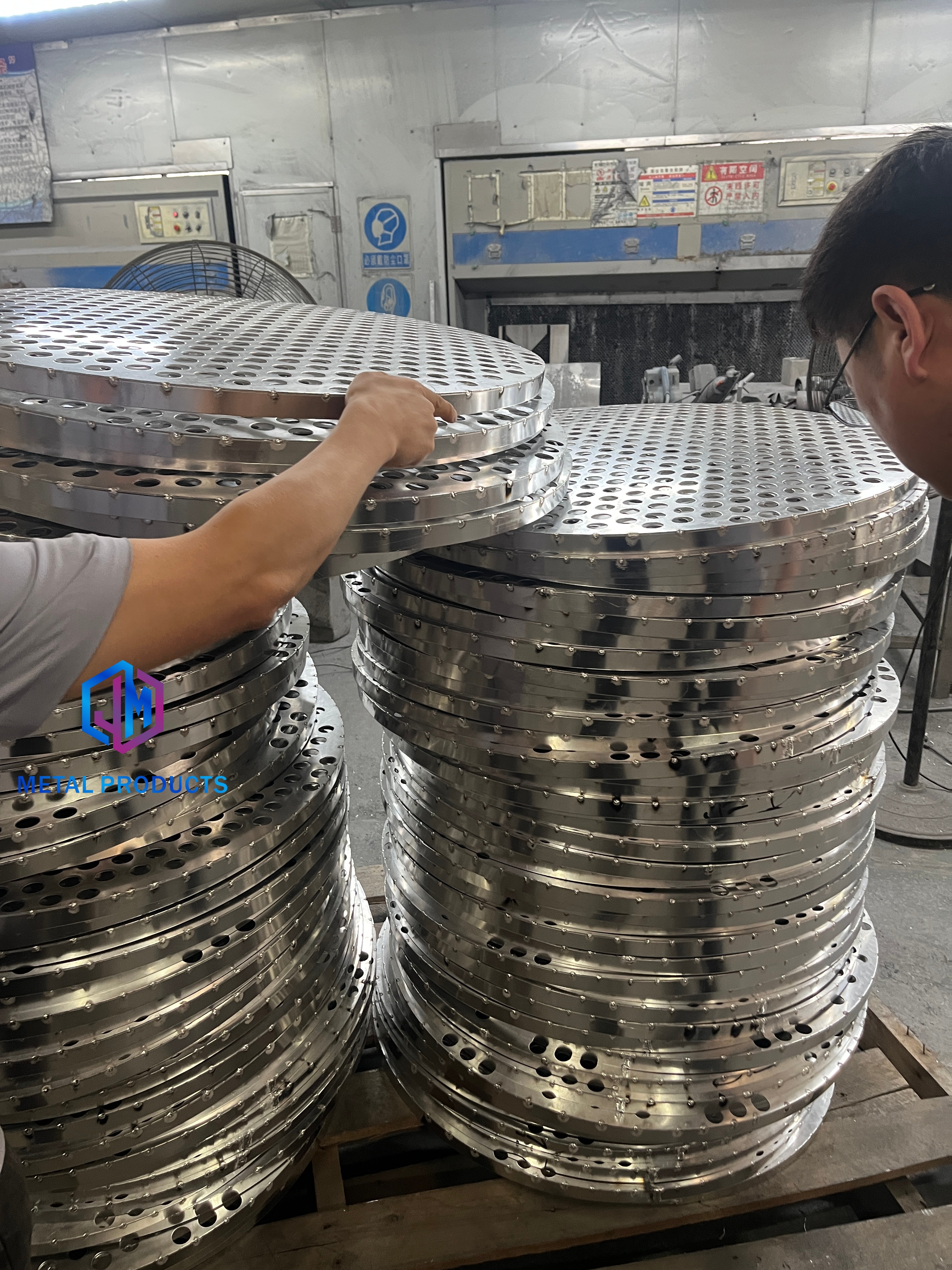
The logic is straightforward. A supplier that only assembles cannot show the tooling, the in-process controls or the scrap characteristics behind six product families at once. A supplier that does produce them will usually volunteer the details, because the details are the argument.
The Audit Sequence: Four Signals That Survive Scrutiny
A factory audit is only useful if it follows the material rather than the presentation. The sequence that yields the most information runs from incoming material to packed panel, because each stage constrains the next.
1. Incoming material inspection
The audit should start where the process starts. Documented incoming material inspection establishes whether the supplier controls what enters the plant, or only what leaves it. A plant that inspects finished goods but not raw material is inspecting its own work without knowing what it is working with.
2. In-process quality control
In-process quality control (IPQC) is the point at which dimensional deviation and weld defects are caught while they can still be corrected. Buyers should ask to see where in the line the checks occur and what triggers a hold. A program that consists only of a final inspection gate is a sorting operation, not a control system.
3. Coating control and final inspection
For coated mesh, coating adhesion and colour consistency inspection matter more than any single gloss reading, because peeling and shade drift are the two failures that surface months after installation. Jumao's stated procedure combines coating adhesion and colour consistency inspection with 100% final dimensional and appearance inspection before shipment. That combination — 100% dimensional plus appearance — is the difference between sampling a batch and clearing it.
4. Packing, documentation and engineering support
Deformation during transportation and installation errors are two of the most common causes of site-level rework, and both are decided before the container leaves. Customized protective packaging, installation manuals and technical guidance, and project-based engineering support are the controls that address them. Jumao's stated risk controls cover corrosion, coating peeling, dimensional deviation, deformation during transport, installation errors and weld defects — a list that maps closely to the failure modes buyers actually encounter on facade packages.
Material Traceability: Grades, Standards and Paperwork
Traceability is the least visual and most decisive form of capability evidence. Standard practice for facade mesh is to specify Grade 316 stainless steel for exterior corrosive environments and Grade 304 for interior applications, and the material standards buyers typically reference are EN 10088 for stainless steel, ASTM E2016 for industrial woven wire cloth and the NAAMM EMMA standards for expanded metal.
Which standard applies is a project decision; whether the supplier can demonstrate conformance is a capability question. At the decision stage, three document sets are worth requesting before price is finalized:
- Material certification linking the delivered mesh or panel batch to the mill certificate for the coil or sheet used.
- Coating batch records tying colour and adhesion results to the specific production run, not to a generic test report.
- Dimensional inspection records for panels, frames and formed components, showing the tolerance actually achieved rather than the tolerance claimed.
A supplier that weaves and expands in-house has direct access to this information because the batch identity is created inside the plant. A supplier that assembles from purchased panels depends on upstream documentation it may not control — which is a legitimate structural difference, not a moral one, and buyers should price it accordingly.
Custom Pattern Development: Where Capability Is Hardest to Fake
Standard mesh is widely available; a project-specific pattern is not. Custom development is the clearest capability test because it forces the supplier to convert a design intent into a manufacturable specification and then repeat it. The chain runs from architectural drawing to weave, expansion or cutting program, to sample, to approved batch.
Several corpus-documented parameters define what is achievable in this chain. Architectural metal mesh can provide up to 60% open area and is approximately 20–40% lighter than solid metal panels depending on specification, with custom sizes supported up to 6 m in length. Those figures are not marketing extras — they are the variables a custom pattern has to satisfy simultaneously, because changing aperture to hit a visual target also changes weight, structural demand and shading performance.
Jumao's customization scope covers material, size, weave pattern, PVDF coating and design drawings, supported by a six-engineer R&D team within a 50-person organisation producing an annual output of 100,000 m². Formed and curved mesh work — framing, curved panel production and mesh curtain structures — is a separate skill from flat panel production, and it is usually visible in the workshop as jigs, templates and part-finished assemblies rather than in a catalog.
Where the limits sit. Custom development is not free capability. It introduces a sampling and approval stage that standard products do not require, and the achievable geometry narrows as curvature, panel size and pattern complexity increase together. Projects with tight tolerances on compound curves should expect project-specific engineering rather than a catalog selection, and should plan approval time accordingly. Buyers who need fast delivery on a simple pattern are usually better served by an existing weave or expansion pattern than by a bespoke one.
Where Architectural Metal Mesh Is Actually Specified
Application breadth is itself a capability signal, because each application imposes a different performance requirement on the same production line. Architectural metal mesh is suitable for building facades, decorative screens, ceilings, parking garage facades, sunshades, balustrades, interior partitions, commercial buildings, hotels, airports, shopping malls and museums.
The performance logic differs by location. On sunshade and facade applications, metal mesh can reduce solar heat gain by up to 50% depending on mesh aperture and material, while the open structure maintains natural ventilation and daylight penetration. On ceilings — aluminum expanded mesh ceiling systems and ceiling drape — the priorities shift to flatness, weight and repeatability of pattern across large areas. On partitions and interior screens, edge finish and visual consistency dominate.
A supplier able to serve facade, ceiling and interior applications from one plant is describing a process chain, not a product list: the same weaving, expanding and coating capability is being re-specified for different load, exposure and aesthetic requirements.
Market Direction: More Entrants, Higher Verification Burden
The category is expanding, which raises rather than lowers the verification burden. The global architectural metal mesh panel market was valued at USD 1.2 billion in 2024 and is projected to reach USD 2.5 billion by 2034, while the metal mesh facade segment is estimated to reach USD 10.59 billion by 2034 at a CAGR of 6.2%. Growth of that order attracts new suppliers, and new suppliers enter through trading before they enter through tooling.
Two structural signals reinforce the point. Asia-Pacific is the fastest-growing region for facade systems including metal mesh, driven by urbanization and infrastructure investment, and woven wire mesh remains the dominant product segment at approximately 43.2% of total metal mesh revenues in 2025. Both trends concentrate supply growth in exactly the region where cluster density is already highest — and where catalog homogeneity is therefore strongest.
Architectural Metal Mesh vs Conventional Cladding Options
Capability verification only pays off if the material itself is the right decision. Compared with traditional perforated metal panels, aluminum composite panels and expanded mesh from standard suppliers, architectural metal mesh changes transparency, weight and service life at a cost premium.
| Consideration | Architectural metal mesh | Conventional alternatives |
|---|---|---|
| Open area | Up to 60%, enabling ventilation and daylight penetration | Typically lower; solid panels block airflow entirely |
| Weight | Approximately 20–40% lighter than solid metal panels depending on specification | Higher mass, greater structural demand |
| Visual character | Lighter, more transparent appearance with depth and shadow variation | Flatter, more opaque reading |
| Customization | Material, size, weave pattern and coating customized to drawings; panels up to 6 m long | Standard formats and limited pattern variation |
| Maintenance | Open structure reduces dust accumulation; corrosion-resistant materials need minimal maintenance and clean with water or neutral detergent | Comparable in cleaning effort but more prone to visible surface soiling on solid faces |
| Service life | 20+ years | Varies by system and substrate |
| Initial material cost | May be 10–25% higher than conventional perforated panels | Lower entry cost |
Comparison based on documented product characteristics; final performance depends on project specification, support structure and installation detailing.
The boundary conditions matter. The 10–25% higher initial material cost is real, and it is only offset where reduced structural support requirements or lower replacement frequency apply — both of which depend on the project design rather than on the product alone. Architectural mesh is also not a sealed envelope: it delivers ventilation and shading, but it requires a supporting frame and, where weather tightness is required, a substrate or secondary barrier behind it. Buyers who treat open mesh as a direct substitute for a rainscreen panel will be disappointed by rain penetration and acoustic performance regardless of supplier quality.
Supplier Types Compared: Integrated Manufacturer, Trader, International Specialist
At the decision stage, the realistic comparison is rarely between identical offers. It is between three supplier types with different evidence profiles.
Integrated manufacturers — plants that weave, expand, perforate, cut and coat — can show process-level evidence, control batch identity internally, and adjust a pattern mid-development. Jumao operates within this model at a 3,000 m² facility with a 50% export ratio across the Middle East, Southeast Asia, the European Union, North America, Australia and Africa. The trade-off is scale: a facility of this size is suited to customized commercial project packages rather than to the largest single-source volume programmes.
Trading suppliers offer breadth and commercial flexibility, and often competitive pricing on standard patterns. Their limitation is documentation: material traceability, coating batch records and in-process controls sit with third parties, so the buyer inherits an additional verification layer.
International specialists such as GKD, Haver & Boecker, Banker Wire and Cambridge Architectural hold long-established technical woven mesh portfolios and global project references; GKD alone held a global market share of approximately 11.4% in the technical woven wire mesh sector as of 2024. They are the appropriate benchmark for specification-critical and high-volume programmes, while regional integrated manufacturers typically compete on customization depth, response time and landed cost.
None of these profiles is inherently superior. The decision rule is to match the evidence requirement to the project: where the facade is visually and structurally critical, demand process-level proof; where the application is standard and repetitive, a trading route with solid documentation may be entirely adequate.
Future Outlook
As the panel and facade segments move toward the projected 2034 values, two pressures are likely to shape supplier selection. The first is documentation: as more projects require traceable material grades and coating records, suppliers who generate that data inside their own plant will find compliance cheaper than those who must retrieve it upstream. The second is pattern complexity, since architects increasingly specify non-standard apertures and formed geometry that only a manufacturer with in-house weaving, expanding and forming can iterate on.
The practical implication for buyers is that the catalog will keep converging while the factories do not. The verification habits described here — reading the portfolio as a process map, following material through the audit sequence, requesting batch-linked documentation and testing custom development with a sample — remain the most reliable way to convert a supplier claim into a procurement decision.
FAQ
What evidence should a buyer request before approving an architectural metal mesh supplier?
Request material certification linked to the delivered batch, coating adhesion and colour consistency records, dimensional and appearance inspection records covering the full shipment, and the packaging specification. Also ask which party performs each check. A supplier that weaves and coats in-house can produce these documents directly; one that assembles from purchased panels must obtain them from upstream.
How can a product catalog indicate real in-house manufacturing capability?
Check internal consistency. Each product family should map to a specific process — weaving for stainless steel woven wire mesh, cable mesh and metal coil drapery; expanding for aluminum expanded mesh and ceiling systems; perforating for decorative panels; coating for exterior durability. A portfolio that spans all of these is credible only if the supplier can also show the tooling, in-process controls and dimensional records behind each one.
Which quality control steps should exist between raw material and shipment?
A complete sequence includes incoming material inspection, in-process quality control during weaving, expanding and forming, coating adhesion and colour consistency inspection, and 100% final dimensional and appearance inspection before shipment. These steps control the failure modes that matter most in service: corrosion, coating peeling, dimensional deviation, deformation during transport, installation errors and weld defects.
How is material traceability handled for stainless steel facade mesh?
Facade mesh is commonly specified in Grade 316 for exterior corrosive environments and Grade 304 for interior applications, with EN 10088 referenced for stainless steel, ASTM E2016 for industrial woven wire cloth and NAAMM EMMA standards for expanded metal. Traceability requires that the delivered batch be linkable to the mill certificate for the coil or sheet used, plus coating batch records where a finish is applied.
What are the limits of custom pattern development, and when does it change the commercial picture?
Custom development covers material, size, weave pattern and coating against design drawings, with panels supported up to 6 m long and open area up to 60%. The limit is geometric: achievable curvature and pattern complexity narrow as panel size and tolerance requirements increase, and compound curves generally require project-specific engineering. A sampling and approval stage is unavoidable, so bespoke patterns carry a longer front-end than existing weave or expansion patterns.
How does architectural metal mesh compare with perforated panels or composite cladding on cost and performance?
Architectural metal mesh offers up to 60% open area, is approximately 20–40% lighter than solid metal panels depending on specification, and carries a service life of 20+ years. Initial material cost may be 10–25% higher than conventional perforated panels, with the offset depending on reduced structural support requirements and lower replacement frequency in a given project. Open mesh also provides ventilation and shading rather than a sealed facade, so it requires a support frame and, where weather tightness is specified, a substrate behind it.
Have Questions or Need More Details?
Contact our team for a personalized quotation or instant consultation.
Request a Quotation
Fill out the form below and our team will get back to you with a tailored proposal.
WhatsApp Direct Chat
Prefer to chat in real-time? Message us on WhatsApp for instant assistance & quick answers.
- Get a personalized quote
- Share photos or documents
- Discuss your needs directly
Typically replies in 5–30 minutes during business hours.