
Architectural Metal Mesh Production: Capability Evidence
Architectural Metal Mesh Production: Capability Evidence
Architectural metal mesh is specified on drawings long before it is manufactured, and the distance between a specified panel and a delivered panel is where most project risk accumulates. Whether a project calls for titanium-coated stainless steel mesh in a bronze tone, a custom pattern panel cut to a designer's artwork, or a complete facade system delivered with fixing hardware, the same question decides the outcome: does the supplier control weaving, cutting, coating and framing tightly enough to repeat the same result across several thousand square metres?
This article treats production capability as procurement evidence rather than promotional copy. It examines how titanium-coated stainless steel mesh and custom pattern metal mesh are actually produced, and how two system-level offers — the Custom Architectural Mesh System and the Complete Metal Mesh Facade Solution — function as evidence of in-house engineering and customization depth. Process and product details in this article come from the manufacturer's published specification data; market, performance and standards references are attributed to their third-party sources.
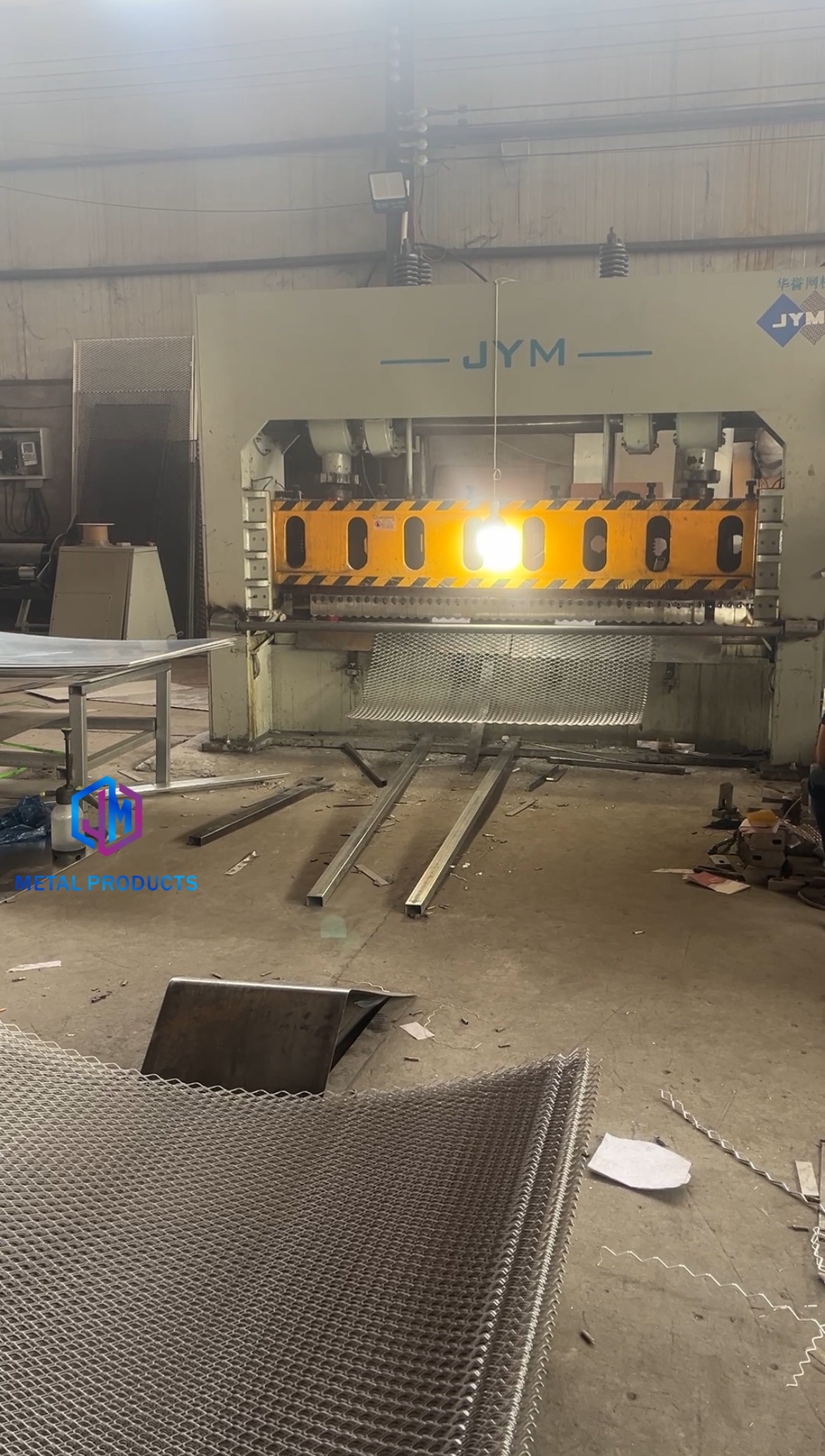
Woven architectural metal mesh on the production floor — the weaving stage fixes opening ratio, flatness and the surface quality that every later finishing step depends on.
Why Capability Evidence Has Become a Shortlisting Filter
The category is expanding rather than contracting. Reports and Data values the global architectural metal mesh panel market at USD 1.2 billion in 2024 and projects USD 2.5 billion by 2034, while Growth Market Reports sizes the metal mesh facade segment at USD 10.59 billion by 2034 at a 6.2% CAGR. Those two figures differ mainly in scope — one tracks panels, the other facade systems — and that difference is itself a procurement warning: market numbers should be matched to the scope being purchased, not quoted loosely.
Structural signals point the same way. China is estimated to hold around 65% of global wire mesh supply (IBISWorld and industry reporting), and the country's export value for steel wire products, including wire mesh, reached USD 14.5 billion in 2024 (Global Growth Insights). Within product mix, woven wire mesh is reported to account for roughly 43.2% of total metal mesh revenues (Dataintelo, 2025 data). Asia-Pacific is described as the fastest-growing region for facade systems, driven by urbanisation and infrastructure investment (Market Research Future).
For buyers evaluating suppliers, the consequence is straightforward. When hundreds of manufacturers publish near-identical catalogues, catalogue content stops discriminating between them. What separates suppliers is traceable production evidence: which stage is performed in-house, what tolerance the process holds, how colour is controlled from batch to batch, and what documentation accompanies shipment. That is the practical difference between a supplier that can quote a titanium-coated mesh and a supplier that can deliver 1,280 m² of it in a consistent copper tone across an elevator hall programme.
The Four Production Stages That Decide the Delivered Panel
Capability claims tend to collapse into four stages once they are examined. Each stage generates evidence a buyer can request, and each stage has a characteristic failure mode that shows up on site rather than in the sample room.
1. Wire forming and weaving
Woven architectural mesh is largely defined at the loom. Published specification data for stainless steel woven wire mesh (model JM-C-1083) records wire diameters of 1 mm–2 mm, opening ratios of 28%–48%, plain weave construction, customized opening sizes and SS304/SS316 material options. Each of those parameters is a production tolerance problem rather than a catalogue line: opening ratio governs transparency and daylight behaviour, while wire diameter and weave regularity determine whether adjacent panels read as one continuous surface after installation.
2. Cutting, perforation and pattern forming
Not all architectural mesh is woven. Where a design is driven by artwork, the process shifts to laser cutting or perforation. Published data for laser cut metal screens (JM-E-526) shows sheet thickness of 1.5 mm–5 mm in aluminium or stainless steel, pattern defined by customized CNC laser cutting, customized panel size, and powder coating or PVDF surface treatment. Perforated metal panels (JM-P-1987) run 1.5 mm–3 mm thickness with hole diameters of 3 mm–20 mm, open areas of 20%–50%, and round, square or fully customized hole shapes.
3. Coating and surface finishing
The coating stage carries the highest risk of visible defect, because colour and gloss are judged by eye across large installed areas rather than on a single sheet. Across the range, finishes include PVDF fluorocarbon coating, powder coating, anodising, PVD and antique finishing, with RAL custom colours available. Titanium-coated stainless steel mesh (JM-C-1045) uses a titanium coating on a 316 stainless steel base, with black, bronze and gold options and customized mesh opening.
4. Framing, tensioning and packing
A panel that leaves the workshop flat can still fail on site if its fixing system was not engineered alongside it. Published system data lists frame mounting, clip fixing and tension installation as available methods, and lists frame structure, edge treatment and installation system among the customizable parameters. Packing is the fourth stage's final checkpoint and is treated as a documented inspection item rather than a logistics afterthought.
Jumao's Production Footprint: What the Published Numbers Show
Shenzhou City Jumao Metal Products Co.,Ltd (Jumao) is a manufacturer and exporter of custom architectural metal decorative materials established in 2016. Its published profile records a 3,000 m² production facility, approximately 50 employees, a six-engineer R&D team, reported annual output of 100,000 m², and an export share of about 50%, serving markets that include the Middle East, Southeast Asia, the European Union, North America, Australia and Africa.
The stated production model combines OEM manufacturing, ODM design, custom architectural metal mesh solutions, and turnkey metal facade and interior decorative mesh systems. Declared monthly capacity is 5,000–10,000 m²; lead time is 7–60 days depending on order quantity and customization requirements; and the minimum order quantity is 1 m². That last figure matters to specifiers because it allows a single validation panel to be produced and approved before a full package is scheduled.
Customization scope is defined explicitly rather than implied, covering mesh pattern, opening size, wire diameter, material grade (SS304/316, aluminium, brass, copper), panel dimensions, frame structure, edge treatment, surface finish (PVDF coating, powder coating, anodising, PVD, antique finish), RAL custom colours, installation system, branding or logo marking, and packaging.
Quality control is documented as a sequence rather than a slogan: raw material inspection, dimensional inspection, welding quality inspection, surface finish inspection, flatness inspection, colour consistency inspection, packaging inspection, and 100% pre-shipment quality inspection, with third-party inspection by SGS or TUV available on request. Colour consistency and flatness appear in the list because those are the two defects most often disputed on facade projects.
One document deserves close reading rather than a glance at the logo. The EU Construction Products Regulation certificate — Certificate of Conformity CTB160418002S-ZS, issued by Shenzhen CTB Testing Technology Co., Ltd, referencing EN 13830:2003 — covers Metal Mesh Curtain, model JM-MMC, trade name JUMAO. The scope wording is the important part: it covers that named product and model, not every item in the range. Buyers comparing suppliers should read scope language rather than accepting the word “CE” as a general claim.
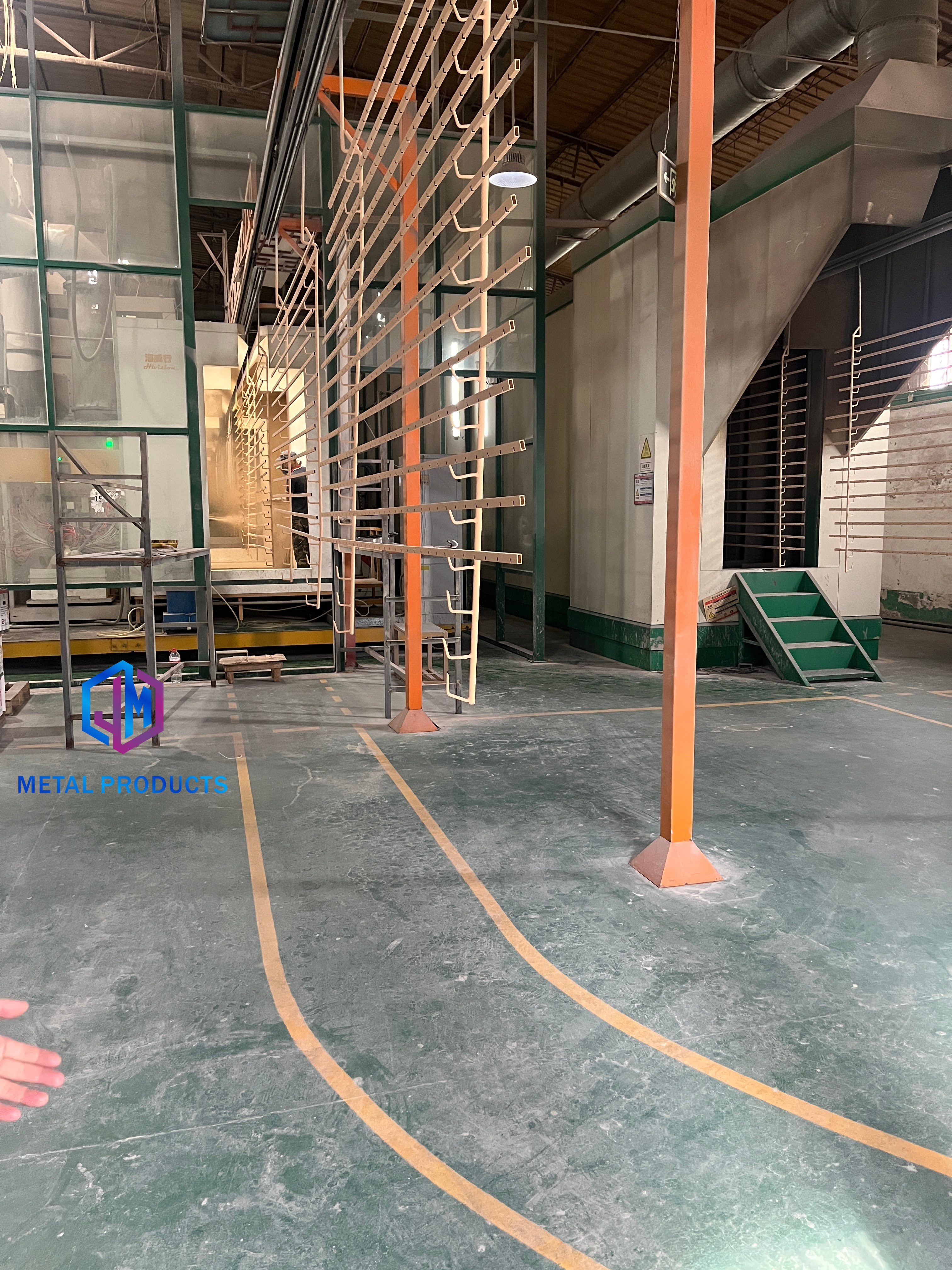
Surface finishing is where colour consistency is won or lost; coating checks run as a defined inspection step before panels are released to packing.
Titanium-Coated Stainless Steel Mesh: Where Coating Discipline Shows
Titanium-coated stainless steel mesh answers a specific design problem: a metal fabric that keeps the transparency and texture of woven mesh while carrying a durable coloured surface. Published parameters for the JM-C-1045 type specify a 316 stainless steel base, wire diameter of 1 mm–2 mm, titanium coating, colour options in black, bronze and gold, and customized mesh opening. Typical applications listed for the type are facade decoration, interior wall decoration and luxury architecture.
The material choice is not arbitrary. Stainless steel mesh for facades is commonly specified as Grade 316 for exterior corrosive environments and Grade 304 for interior applications. Because coating is applied after weaving, any irregularity in the woven substrate or contamination before coating becomes permanently visible, which is why dimensional, surface finish and colour consistency checks sit in sequence rather than as separate optional steps.
Two project references show how the coated-mesh capability is exercised in practice. In Saudi Arabia, a high-end residential and luxury fit-out project used 410 m² of decorative shaped metal mesh for a curved display cabinet backdrop, with custom curved splicing design, fine micro-perforated mesh and an anti-rust bronze coating; the recorded result highlighted surface stability and low maintenance. In a second Saudi project, an elevator hall and corridor cladding scope used 1,280 m² of decorative metal mesh with a custom micro-perforation pattern, a copper metal finish, modular installation and anti-corrosion performance. Both scopes depend on the same thing: a coating stage that repeats a tone across many panels produced over a period of weeks.
Custom Pattern Metal Mesh: From Approved Artwork to Repeatable Panel
Custom pattern metal mesh is where a supplier's drawing capability becomes visible. Published parameters for Custom Pattern Metal Mesh (JM-A-822) specify 2.0 mm aluminium wire, a customized pattern design, electroplating as the surface finish, and application sizes set by the project. Where the pattern is cut rather than woven, laser cut metal screens (JM-E-526) accept 1.5 mm–5 mm aluminium or stainless steel sheet, with the pattern defined by CNC laser cutting.
The engineering wrapper around both routes is the Custom Architectural Mesh System (JM-C-9336), which is described as a project-based architectural mesh solution rather than a single product. It lists material options of stainless steel, aluminium or brass; mesh types spanning woven, expanded, cable and ring mesh; customized panel size; surface finishes of PVD, powder coating and fluorocarbon coating; and fixing systems using frame, clip or tension installation. That combination is what allows a single supplier to take a designer's intent and return a buildable, installable assembly rather than a sheet of mesh.
Project evidence supports the claim that this is routine rather than exceptional. In the United Kingdom, an interior joinery contractor used custom diamond weave mesh with a brass antique finish, a thin lightweight sheet, easy cutting and installation, and anti-tarnish surface treatment for cabinet door inserts, storage closet panels and display cabinet partitions; the installation is recorded as being in service for more than 12 years. A sales office development project used 40 units of partition mesh with custom wire diameter and mesh density, anti-tarnish brass surface treatment and a lightweight panel that was easy to cut and frame. An office interior general contractor project used 260 units of shaped mesh with custom cube dimensions and rounded corners, uniform punching aperture and scratch-resistant coating for hanging light box frames and atrium partitions. A traditional architecture and landscape project used 320 units with custom arch curved forming, stainless steel anti-rust material, warm bronze coating and a lightweight suspension structure.
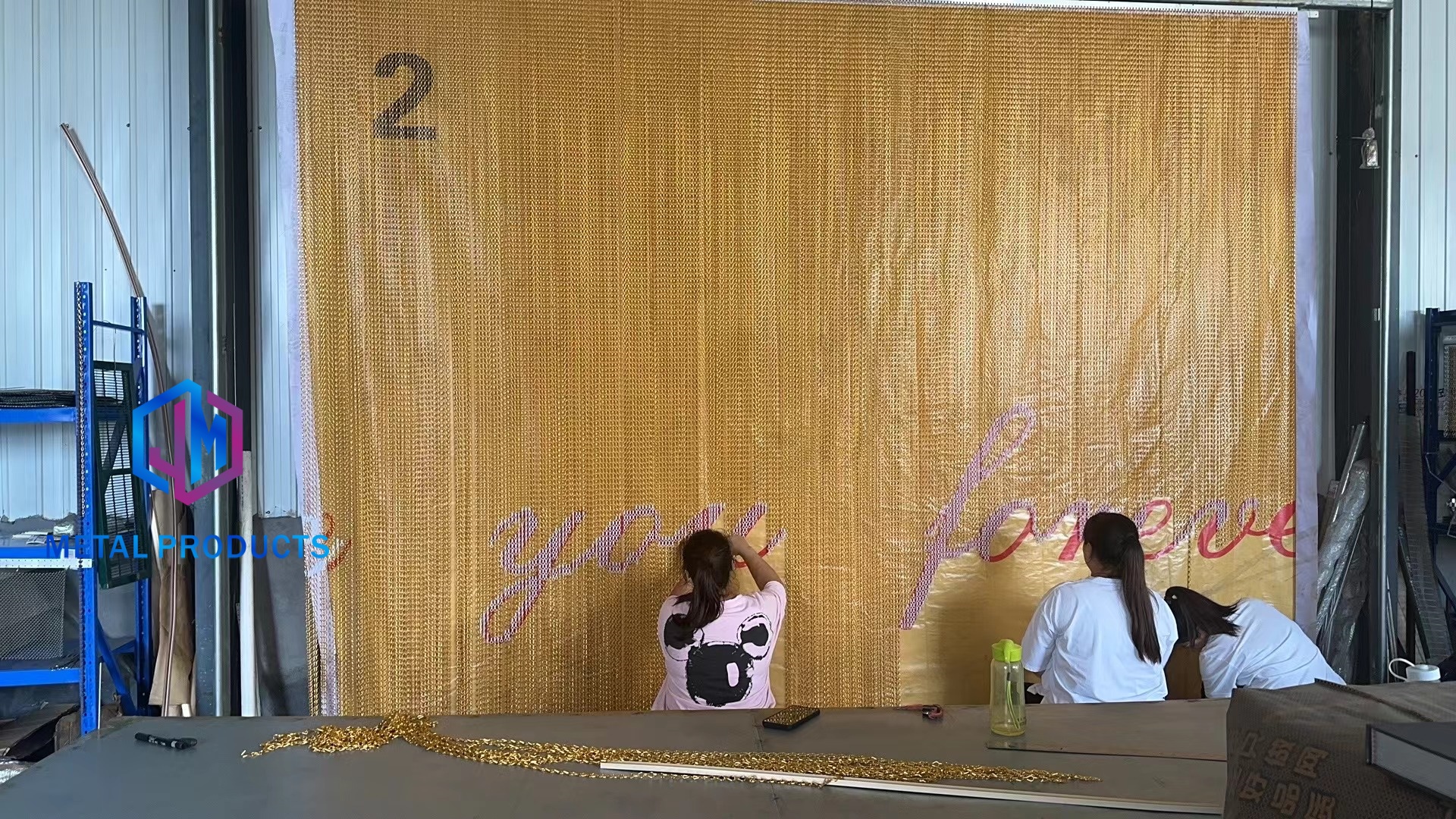
Customized pattern mesh panels after forming — pattern geometry, panel size and edge treatment are engineered to the project rather than selected from a fixed list.
System-Level Evidence: Custom Architectural Mesh System and Complete Facade Solution
Component supply and system supply are different capabilities, and the difference shows up in who owns the interfaces. The Complete Metal Mesh Facade Solution (JM-E-7736) is described as an integrated decorative mesh solution covering expanded mesh, woven mesh, cable mesh and perforated panels; materials from stainless steel, aluminium and copper alloy; surface treatment by PVDF, powder coating or PVD finish; and installation by frame mounting, direct fixing or tension system, with customized engineering support available. The product list associated with the system spans facade cladding, sunshade screens, parking facade mesh, cable mesh and interior mesh, which is what “complete” means in procurement terms: one engineering contact for panels, frames and fixing logic.
Facade-scale references show how the system is applied. An office building facade project in Singapore installed 3,600 m² of architectural metal mesh for exterior cladding, sunshade screens and a green-plant separation layer, using a lightweight aluminium structure, customizable diamond mesh perforations, anti-corrosion powder coating and good light transmittance; reported outcomes included effective heat insulation and sun shading, smooth natural ventilation and a multi-layer facade visual effect, with the system described as compatible with tropical climate conditions. A resort facade cladding project in Indonesia used 3,200 m² of architectural metal mesh for facade cladding, window screening and exterior decoration, with a corrosion-resistant surface finish for tropical conditions, custom panel dimensions and a lightweight structural design. A perforated facade project in China used 2,800 m² of panels with custom perforation patterns, powder-coated finish and weather-resistant installed performance. A custom ceiling mesh curtain installation in China used 2,300 m² with a custom curved track system, flexible installation, draping effect, lightweight structure and multiple finish options.
Application Fit: Matching Mesh Type to Project Role
| Mesh or system | Published specification highlights | Typical project role |
|---|---|---|
| Titanium coated stainless steel mesh (JM-C-1045) | SS316 base, 1–2 mm wire, titanium coating, black/bronze/gold, customized opening | Facade decoration, interior wall decoration, luxury architecture |
| Custom pattern metal mesh (JM-A-822) | Aluminium, 2.0 mm wire, customized pattern, electroplating, customized size | Architectural decoration, interior design, commercial projects |
| Laser cut metal screen (JM-E-526) | 1.5–5 mm aluminium or stainless steel, CNC laser-cut pattern, powder/PVDF finish | Landscape design, facade decoration, interior partition |
| Perforated metal panel (JM-P-1987) | 1.5–3 mm thickness, 3–20 mm holes, 20–50% open area, customized hole shapes | Facade cladding, ceiling systems, interior decoration |
| Architectural shading metal mesh (JM-E-529) | 2–4 mm aluminium, 30–60% opening ratio, PVDF or powder coating | Solar control, energy-efficient facades, office buildings |
| Custom architectural mesh system (JM-C-9336) | Woven, expanded, cable or ring mesh in SS, aluminium or brass; PVD, powder or fluorocarbon finish; frame, clip or tension fixing | Facade engineering, interior projects, landscape design |
| Complete metal mesh facade solution (JM-E-7736) | Expanded, woven, cable and perforated types; PVDF, powder or PVD; frame mounting, direct fixing or tension system | Curtain wall engineering, commercial buildings, public architecture |
Read as a set, the table answers a practical shortlisting question: a supplier whose published range can cover coated woven mesh, laser-cut pattern mesh, perforated and expanded panels, and three fixing systems is more likely to solve an interface problem in-house than one whose range stops at a single mesh type.
How This Compares With Traditional Alternatives — and Where the Model Has Limits
| Approach | Advantages | Boundaries to plan for |
|---|---|---|
| Standard catalogue mesh, minimal customization | Fast availability, predictable cost, simple approval | Limited colour and pattern choice; fixed opening sizes; harder to match a specific facade concept |
| Custom woven and coated systems | Colour, opening, wire diameter, panel size and fixing engineered to the drawing | Requires approved reference samples; decorators of colour must accept batch-level control rather than absolute identity; longer schedule |
| Perforated or expanded panel systems | Rigid, good ventilation and solar control, structural stability | New hole or opening patterns usually require tooling; less suited to highly curved geometry than flexible cable or woven mesh |
Honest limits matter more than claims, so three should be stated plainly. First, capacity is finite. A 3,000 m² facility with around 50 employees and declared monthly capacity of 5,000–10,000 m² is a compact industrial base by global standards; a very large single-source facade programme, or several concurrent multi-site rollouts, may need staged scheduling or additional suppliers. Second, schedule depends on customization: published lead time is 7–60 days and varies with order quantity and customization depth, so custom patterns, non-standard colours and bespoke frames extend the upper end of that band and should be built into the construction programme rather than treated as a delivery promise. Third, the certified scope is specific: the EU-CPR Certificate of Conformity covers Metal Mesh Curtain, model JM-MMC, under EN 13830:2003, which is not the same as blanket certification across the entire product range.
It is equally fair to note where larger specialists remain the natural choice. In the global supplier landscape, GKD Gebr. Kufferath AG holds an estimated 11.4% share of the technical woven wire mesh sector as of 2024, and GKD, Haver & Boecker, Banker Wire and Cambridge Architectural are all named among the leading global competitors in architectural mesh. Projects requiring extremely fine technical weaves, very high single-order volumes, or proprietary industrial mesh specifications may be better served by those suppliers, while custom architectural finishes, project-specific patterns and system-level facade packages in the middle of the market are where a specialized custom manufacturer typically competes on engineering responsiveness rather than scale.
Market Trend Signals Behind These Capability Requirements
Three verified signals explain why buyers are asking for more process evidence. The first is material specification tightening: stainless steel architectural mesh is commonly specified under EN 10088 in Europe, woven wire cloth is often referenced against ASTM E2016, and expanded metal in architecture is governed by standards set by the National Association of Architectural Metal Manufacturers (NAAMM) EMMA division. Each standard moves the conversation from appearance to measurable material and dimensional characteristics.
The second is performance expectation. Architectural sun shading metal mesh can reduce solar heat gain by up to 50% depending on mesh aperture and material, according to Cambridge Architectural. That claim is aperture-dependent, which means the mesh specification and the shading calculation are now linked decisions rather than separate ones.
The third is market-scope discipline. Public estimates for architectural metal mesh diverge because some track panels and others track complete facade systems — a USD 1.2 billion panel market in 2024 and a USD 10.59 billion facade segment by 2034 describe different things. For procurement teams, the implication is that growth figures should be used to judge category direction, while supplier capability should be judged against the actual scope being purchased.
- Which production stages are performed in-house: weaving, cutting or perforation, coating, framing?
- What published tolerance values exist for wire diameter, opening ratio, panel size and flatness?
- How is colour consistency controlled between batches, and can a reference sample be retained as the approval standard?
- What is the documented quality control sequence, and is third-party inspection available?
- What is the certification scope word for word — which model and which standard does it actually cover?
- What is the declared monthly capacity, lead-time band and minimum order quantity?
- Are fixing systems, engineering drawings and installation guidance supplied with the panels?
- Which stages are outsourced, and does that create a schedule or quality dependency?
What 2026–2030 Procurement Is Likely to Reward
On current signals, the balance of evaluation is shifting from product catalogue to process documentation. Suppliers that can show a defined inspection sequence, a scoped certificate, a sample-first approval process and a system-level fixing design will be easier to qualify, because those artefacts replace assumptions with records. The same logic explains why coated products such as titanium-coated stainless steel mesh and project-specific pattern mesh are becoming common test cases: they combine material, geometry and finish in one order, so a supplier either controls all three stages or reveals that it does not.
For buyers, the practical implication is not to demand more suppliers, but to demand more evidence from fewer suppliers. Projects that verify how a panel is made, who engineers the frame, and which certificate actually applies will spend less time resolving defects on site — which, in a category where appearance is judged across thousands of square metres, remains the most reliable form of value.
Published product and system specifications referenced in this article are available from the manufacturer at jumao-decorfabric.com.
Frequently Asked Questions
What is titanium-coated stainless steel mesh, and where is it normally used?
It is a woven stainless steel mesh whose surface carries a titanium coating, giving a coloured finish while retaining the transparency and texture of the mesh. Published parameters for the JM-C-1045 type specify a 316 stainless steel base, wire diameter of 1 mm–2 mm, a titanium coating, colour options in black, bronze and gold, and customized mesh opening. Listed applications are facade decoration, interior wall decoration and luxury architecture. Material grade selection generally follows exposure: Grade 316 is commonly specified for exterior corrosive environments and Grade 304 for interior applications.
How does a custom pattern metal mesh move from a design drawing to a delivered panel?
Two production routes exist depending on whether the pattern is woven or cut. Custom Pattern Metal Mesh (JM-A-822) is specified with 2.0 mm aluminium wire, a customized pattern design, electroplating surface finish and customized application size. Where the pattern is cut instead, laser cut metal screens (JM-E-526) accept 1.5 mm–5 mm aluminium or stainless steel sheet, with the pattern generated by customized CNC laser cutting, customized panel size and powder coating or PVDF finishing. In both routes the practical sequence is design interpretation, an approved sample, and then batch production against that approved reference.
What production evidence should a buyer request when shortlisting an architectural metal mesh supplier?
The most useful evidence is process-based rather than promotional. A supplier should be able to state which stages it performs in-house, the tolerance values it holds for wire diameter, opening ratio, panel size and flatness, and the sequence of quality checks applied before shipment. One documented example of such a sequence covers raw material inspection, dimensional inspection, welding quality inspection, surface finish inspection, flatness inspection, colour consistency inspection, packaging inspection, and 100% pre-shipment quality inspection, with third-party inspection by SGS or TUV available. Engineering drawing support, installation system recommendations and after-sales technical assistance are additional indicators that the supplier works at system level.
What are the limits of a compact custom production model on large facade programmes?
Capacity and schedule are the two constraints to test early. A 3,000 m² facility with approximately 50 employees and declared monthly capacity of 5,000–10,000 m² is a compact base, and very large or concurrent multi-site programmes may need staged scheduling. Published lead time of 7–60 days varies with order quantity and customization, so bespoke patterns, non-standard colours and custom frames sit at the upper end. Projects needing extremely fine technical weaves or very high single-order volumes may be better served by larger international specialists; for example, GKD Gebr. Kufferath AG holds an estimated 11.4% share of the technical woven wire mesh sector as of 2024, and GKD, Haver & Boecker, Banker Wire and Cambridge Architectural are named among the leading global competitors in architectural mesh.
How do minimum order quantity, lead time and customization interact in practice?
They trade against each other in a predictable way. A minimum order quantity of 1 m² allows a single validation panel to be produced and approved before a full package is committed, which reduces the risk of a large specification error. Customization then determines schedule: the customizable parameters include mesh pattern, opening size, wire diameter, material grade (SS304/316, aluminium, brass, copper), panel dimensions, frame structure, edge treatment, surface finish such as PVDF, powder coating, anodising, PVD or antique finish, RAL custom colours, installation system, branding or logo marking, and packaging. Each added custom parameter extends the lead-time band of 7–60 days and should be reflected in the construction programme.
Which standards and certifications normally apply to architectural metal mesh?
Several standards appear routinely across the category. Woven wire cloth for facades is often referenced against ASTM E2016, stainless steel architectural mesh materials are commonly specified under EN 10088, and expanded metal in architecture is governed by standards set by the National Association of Architectural Metal Manufacturers (NAAMM) EMMA division. For the European market, a Construction Products Regulation certificate may apply to specific products: the example of Certificate of Conformity CTB160418002S-ZS, issued by Shenzhen CTB Testing Technology Co., Ltd under EN 13830:2003, covers Metal Mesh Curtain, model JM-MMC, trade name JUMAO. Because certificate scope is product-specific, buyers should verify which model and standard a document actually covers, and may also request third-party inspection such as SGS or TUV for production lots.