
Architectural Metal Mesh: Market Analysis & Supplier Insight
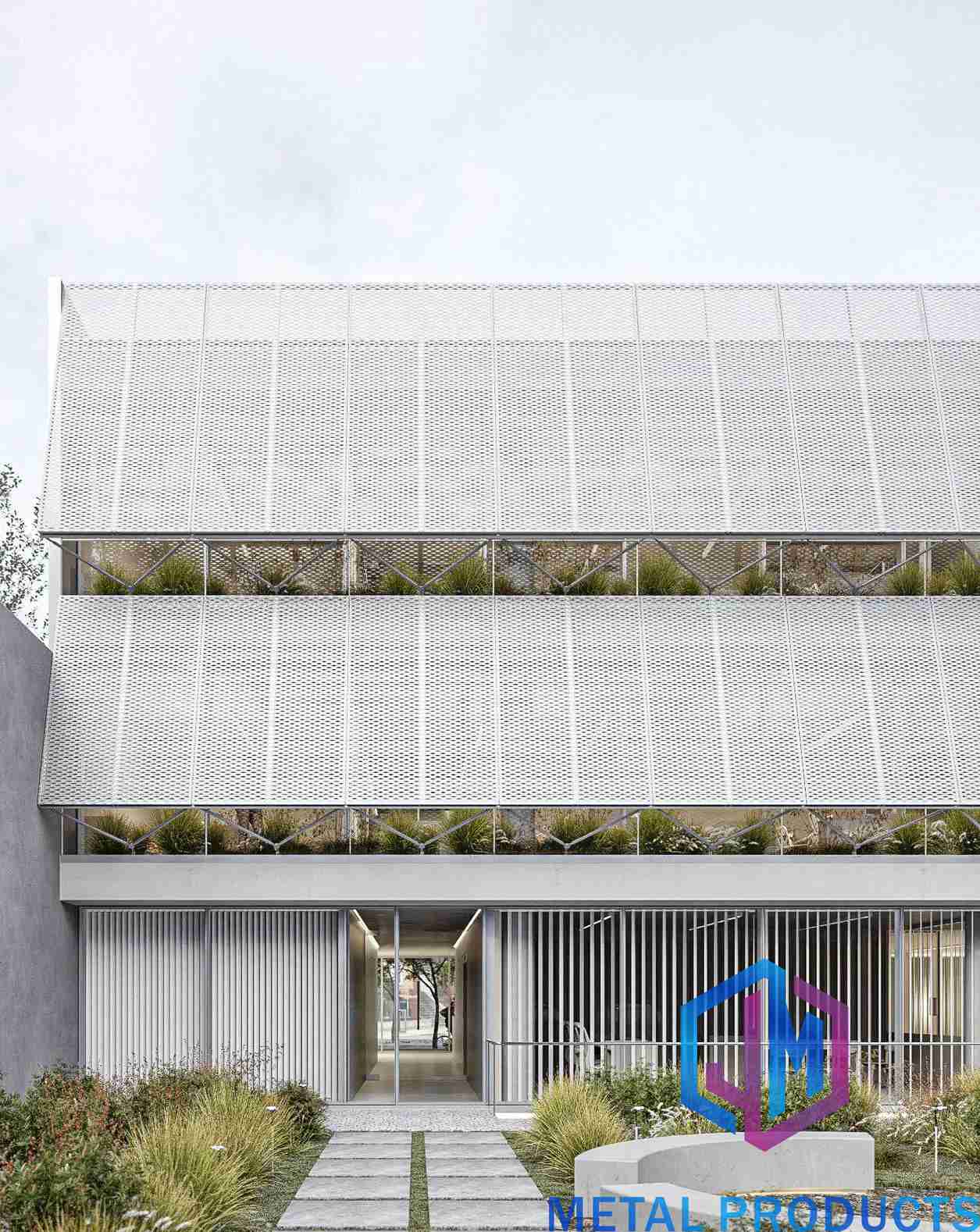
Architectural metal mesh applied to a commercial building facade. (Image: METAL PRODUCTS / Shenzhou City Jumao Metal Products Co., Ltd.)
METAL PRODUCTS, the export brand of Shenzhou City Jumao Metal Products Co., Ltd., is a manufacturer and exporter of custom architectural metal decorative materials based in Anping, Hebei, China. Established in 2016, the company supplies stainless steel and aluminum architectural mesh, facade cladding mesh, partition metal screens and ceiling metal fabric for commercial building projects, with around half of production exported to the Middle East, Southeast Asia, the European Union, North America, Australia and Africa.
Architectural metal mesh has evolved from a design accent into a standard specification category in facade engineering. The category spans woven wire mesh, expanded aluminum panels, perforated screens, cable mesh and flexible spiral mesh — each addressing a different combination of solar shading, natural ventilation, privacy and visual expression. For architects, facade consultants and procurement teams at the awareness and research stage of a project, the key questions are which mesh family to specify, which manufacturer can execute custom geometry, and how these systems compare with conventional cladding.
The Problem: Facades Must Do More Than Enclose
Modern building envelopes are expected to manage solar gain, daylight, air movement, privacy and identity at the same time. Solid cladding controls heat but eliminates transparency; fully glazed curtain walls maximize daylight but raise cooling loads. An open metal mesh layer offers a middle path: it intercepts and diffuses sunlight, allows natural ventilation, and creates a semi-transparent visual screen without fully closing the building off from its surroundings.
The commercial relevance of the category is measurable. According to Reports and Data, the global Metal Mesh Panel market was valued at USD 1.2 billion in 2024 and is projected to reach USD 2.5 billion by 2034, growing at a CAGR of 7.5%. The broader wire mesh market — where construction is the dominant application segment — was estimated at USD 8.183 billion in 2024 by Market Research Future. Architectural metal mesh also supports green-building objectives: it contributes to LEED credits through solar shading, natural ventilation and the use of 100% recyclable stainless steel and aluminum.
The Manufacturer: Factory-Direct Custom Production
METAL PRODUCTS operates as a factory-direct manufacturer rather than a trading intermediary. The company produces approximately 100,000 square meters of architectural metal mesh products annually, employs around 50 staff, and maintains an in-house R&D team of six engineers. Its facility in Anping — 3,000 square meters — covers the production flow from weaving and frame-making to perforating, surface treatment and packing.
The core commercial capability is full OEM & ODM customization on material, size, weave pattern, PVDF coating and design drawings. Project teams can specify the alloy, wire diameter, opening ratio, coating color and panel geometry, and receive a manufactured product developed from their drawings rather than selected from a fixed stock range.
Product portfolio highlights from the manufacturer's specification documentation:
- Architectural Decorative Metal Mesh (JM-C-1080) — stainless steel 304 or aluminum; wire diameter 1.4 mm × 2.5 mm; antique copper surface finish; panel size customized to project requirements. Used for architectural facades, building decoration, interior design, commercial buildings and public facilities.
- Expanded Metal Mesh Panel (JM-E-529) — aluminum alloy 3003; sheet thickness 2.0–4.0 mm; mesh opening 20 mm × 48 mm; strand width 6–10 mm; open area 35–60%; PVDF or powder coating. Designed for building facades, curtain walls, airport buildings and commercial complexes.
- Perforated Metal Panel (JM-P-1987) — aluminum alloy 3003 or 1100; material thickness 1.5–3 mm; hole diameters 3–20 mm; open area 20–50%; powder coating or PVDF. Applied in facade cladding, ceiling systems and interior decoration.
- Stainless Steel Woven Wire Mesh (JM-C-1083) — SS304; wire diameter 1–2 mm; opening 28–48%; plain weave structure. Suited to architectural decoration, ceiling design, interior partitions and facades.
- Stainless Steel Spiral Mesh (JM-S-2603) — wire diameter 1–3 mm; spiral rod diameter 3–10 mm; opening ratio 40–70%; SS304/SS316; flexible installation structure for facade decoration, ceiling design and space dividers.
- Architectural Cable Mesh (JM-w-013) — stainless steel 316 cable; cable diameter 1.5–3 mm; mesh opening 25–100 mm; flexible and corrosion-resistant. Applied in zoo enclosures, building facades, safety barriers and landscape design.
- Aluminum Perforated Facade Screen (JM-P-416) — aluminum alloy 3003; thickness 1.5–3 mm; hole diameter 3–30 mm; open area 20–60%; PVDF fluorocarbon or powder coating. Suited to building facades, parking buildings, commercial complexes and sunshade systems.
- Metal Coil Drapery (JM-M-907) — stainless steel 304 or aluminum; wire diameter 1.0–1.5 mm; coil diameter 3–15 mm; opening ratio 50–80%; track hanging installation; used in interior decoration, hotels, restaurants, shopping centers and exhibition halls.
Technical Foundations: Materials, Finishes and Installation
Materials are the first specification decision. In the METAL PRODUCTS catalog, stainless steel grades 304 and 316 dominate woven, cable and safety products; grade 316 is specified for humid and marine environments — as seen in the Swimming Pool Decorative Mesh (JM-C-1032), which is corrosion resistant in humid environments, and the Staircase Safety Metal Mesh (JM-C-1082), also in stainless steel 316. Aluminum alloys 3003 and 1100 are used for expanded and perforated panels where light weight and coating performance matter. The Complete Metal Mesh Facade Solution (JM-E-7736) additionally offers copper alloy, with surface treatments across PVDF, powder coating and PVD finish.
Finishes follow the application. PVDF fluorocarbon coating is the exterior standard for weather resistance on expanded aluminum cladding and perforated facade screens; powder coating covers interior and cost-sensitive exterior applications; PVD and titanium coatings deliver colored stainless surfaces, such as the Titanium Coated Stainless Steel Mesh (JM-C-1045) for facade and interior wall decoration in luxury architecture.
Installation is organized around three structural patterns: frame mounting for rigid panels, direct fixing for cladding applications, and tension systems for cable and woven mesh. Ceiling products use suspension systems — the Metal Mesh Ceiling Panel (JM-E-529) is installed with a ceiling suspension system, while hanging products such as the Metal Coil Drapery (JM-M-907) and the Architectural Chain Link Mesh (JM-A-822) use track-based suspension. The chain link model JM-A-822 has a wire diameter of 2 mm, an opening ratio of 50%, and supports custom heights.
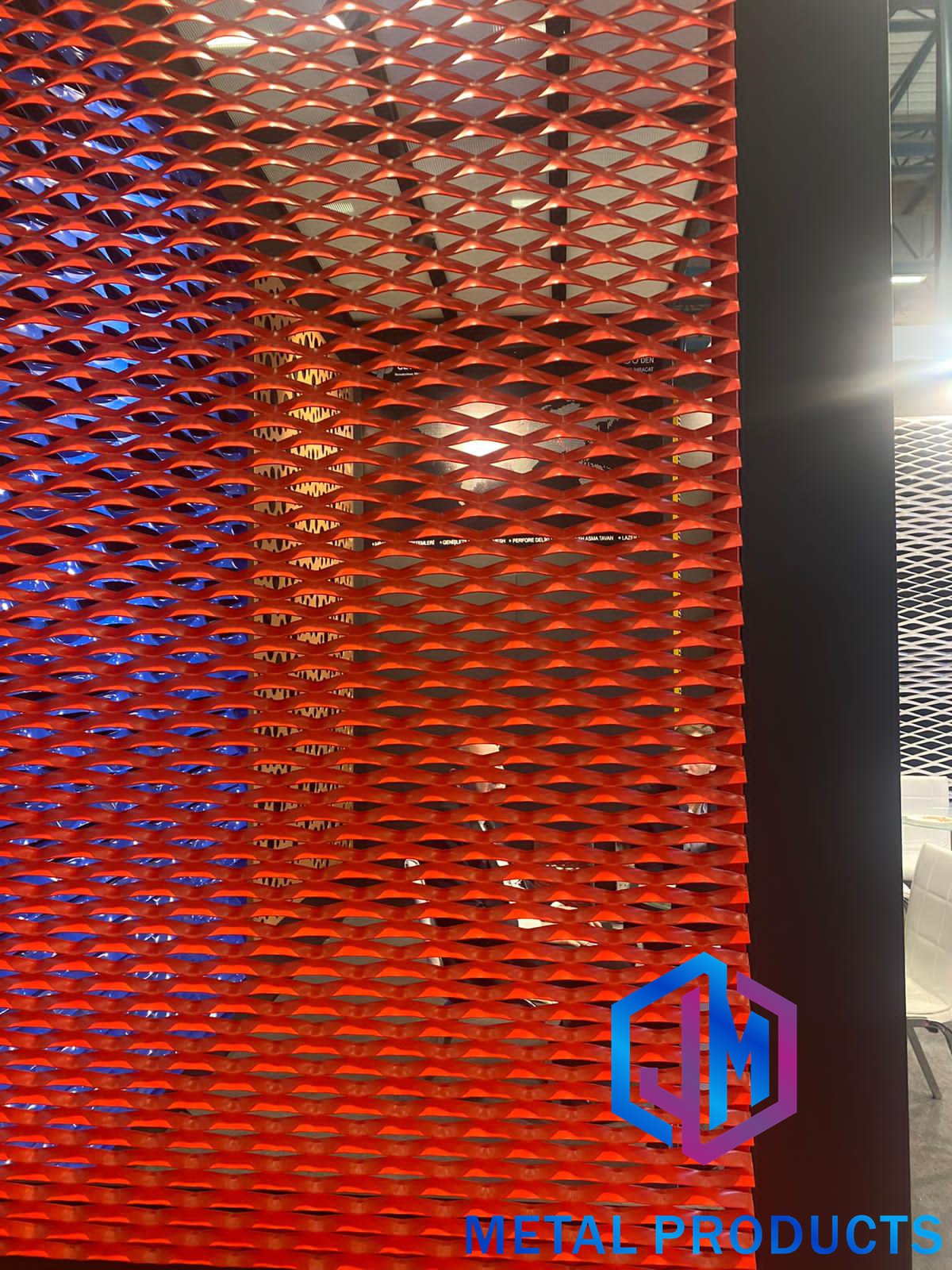
Complete metal mesh facade solution covering expanded, woven, cable and perforated systems. (Image: METAL PRODUCTS)
Standards matter in procurement. In the United States, expanded metal mesh for architectural use is governed by ASTM/NAAMM guidelines developed by the National Association of Architectural Metal Manufacturers. Industrial woven wire cloth used in architectural screening is standardized under ISO 9044, which defines fabrication tolerances. These frameworks give specifiers a common basis for evaluating mesh quality across suppliers.
| Mesh family | Representative models | Material | Open area / opening | Typical function |
|---|---|---|---|---|
| Woven mesh | JM-C-1080, JM-C-1083 | SS304, aluminum | 28–48% opening | Facade screening, partitions, ceilings |
| Expanded metal | JM-E-529, JM-E-573, JM-E-8023 | Aluminum 3003 / 1100 | 35–60% open area | Facade cladding, curtain walls, walkways |
| Perforated panels | JM-P-1987, JM-P-416 | Aluminum 3003 / 1100 | 20–60% open area | Sunshades, facade screens, acoustic panels |
| Cable / rope mesh | JM-w-013, JM-W-014 | SS316 | 25–100 mm opening | Safety barriers, facades, enclosures |
| Spiral / ring / chain mesh | JM-S-2603, JM-M-907, JM-A-822 | SS304/316, aluminum | 40–80% opening ratio | Ceilings, space dividers, decorative curtains |
Application Scenarios: Where Metal Mesh Is Specified
Metal mesh facade panels are specified across commercial, cultural, transport and hospitality projects. The application data of METAL PRODUCTS lists building facades, curtain wall systems, decorative cladding, suspended ceilings, parking garage facades, sunshade systems, balcony railings, privacy screens and interior partitions as working conditions, across commercial buildings, shopping malls, airports, hotels, museums and office buildings.
Facades and curtain walls. The Architectural Metal Mesh Curtain Wall (JM-W-077) is designed for commercial buildings, office towers, cultural buildings and shopping centers. The stainless steel curtain wall mesh JM-WF-7667 is a metal mesh facade panel for architectural projects, classified among exterior cladding mesh panels.
Sun shading and energy performance. The Facade Solar Screen Mesh (JM-S-2602) is a stainless steel solar shading mesh that functions as a building sun protection screen. The Architectural Shading Metal Mesh, also under the JM-E-529 family, is classified as an aluminum sunshade mesh for solar control facades.
Parking buildings. JM-S-2607 is a metal parking building facade mesh made of aluminum alloy, designed for exterior building facade ventilation. With a mesh opening of 20 mm × 40 mm and an open area of 35–60%, it suits open facade systems that require airflow.
Airports and large public spaces. The Airport Interior Metal Mesh (JM-C-4034) is a stainless steel airport decoration mesh for large space interiors, with ceiling hanging or partition installation.
Hospitality and retail. The Hotel Decoration Metal Mesh (JM-A-822) is an aluminum mesh curtain for hotels, resorts, restaurants and luxury interior projects. The Elevator Decorative Metal Mesh Panel (JM-C-1092) covers elevator decoration in commercial buildings and hotels. The Metal Ring Mesh Curtain (JM-R-4205) targets hotels, restaurants and retail stores; its typical scenarios include shopping malls, hotels, airports and commercial interiors.
Safety and balustrades. The Metal Mesh Balustrade Panel (JM-C-1017) applies to staircases, balconies, bridges and commercial buildings, in stainless steel 304/316. The Staircase Safety Metal Mesh (JM-C-1082) is a stainless steel 316 tensile structure for staircase systems and bridges.
Outdoor, landscape and residential. The Landscape Metal Fence Mesh (JM-C-1037) serves landscape architecture, parks and residential areas. The Balcony Privacy Mesh (JM-C-1007) is a stainless steel privacy screen panel for residential buildings and apartments, with powder coating and custom patterns. The Swimming Pool Decorative Mesh (JM-C-1032) is specified for pools, resorts and hotels.
Interior partitions and lighting. The Architectural Chain Link Mesh (JM-A-822) works as a space divider for retail display and hospitality projects. The Metal Mesh Lighting Decoration (JM-LE-0067) is a stainless steel 304 lighting screen for hotels, restaurants and commercial interiors. The Laser Cut Metal Screen (JM-E-526) uses CNC laser cutting for custom patterns in landscape design, facade decoration and interior partitions.
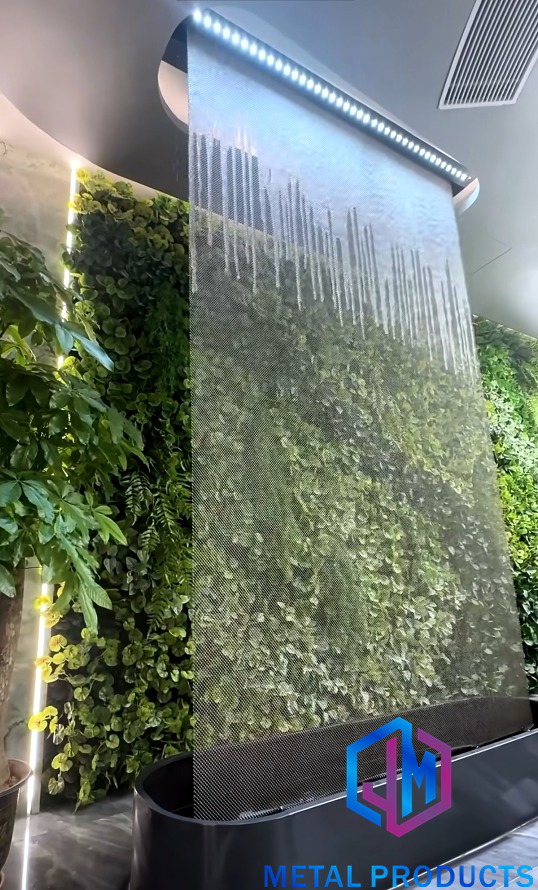
Architectural metal mesh across facade, ceiling and partition applications. (Image: METAL PRODUCTS)
Market Trends: Scale, Regional Demand and Sustainability
Market data points in the same direction: the metal mesh panel segment is growing, and construction is the main consumer of wire mesh. Reports and Data puts the global Metal Mesh Panel market at USD 1.2 billion in 2024, heading toward USD 2.5 billion by 2034 at a 7.5% CAGR. Market Research Future estimates construction as the dominant segment within a USD 8.183 billion global wire mesh market in 2024, and projects stainless steel wire mesh to reach USD 2.5 billion and aluminum mesh USD 2.0 billion by 2035.
Regional dynamics favor manufacturers with export flexibility. Asia-Pacific holds a 35% share of the architectural and structural metals market and North America about 30% — a reflection of continued urbanization in Asia and retrofit activity in mature markets. For a factory-direct supplier exporting to the Middle East, Southeast Asia, the EU, North America, Australia and Africa, the regional mix spreads demand across multiple construction cycles.
Two standards-based trends are worth noting. First, the specification environment is becoming more explicit: ASTM/NAAMM guidelines govern expanded metal mesh for architectural use in the US, and ISO 9044 sets tolerances for woven wire cloth. Second, sustainability requirements are pulling metal mesh into green building programs; because stainless steel and aluminum are fully recyclable and mesh systems enable passive solar control and natural ventilation, they are compatible with LEED credit objectives.
The competitive landscape includes established architectural mesh specialists such as GKD Metal Fabrics, Banker Wire, Cambridge Architectural (Regal Rexnord) and Haver & Boecker. Against that backdrop, manufacturers like METAL PRODUCTS differentiate on factory-direct production, OEM/ODM flexibility and project-based engineering — for example, the Integrated Decorative Mesh Solution (JM-C-9336), a customized architectural metal mesh system with stainless steel 304/316, aluminum and brass material options.
Comparison with Traditional Solutions
Compared with solid metal and composite cladding, open mesh reduces material weight, permits natural airflow and preserves a degree of transparency. Compared with unshaded glass curtain walls, mesh intercepts solar radiation before it reaches the glazing, lowering cooling load while maintaining views to the outside. These advantages are structural, not cosmetic: mesh systems function as a passive architectural layer requiring no external power and low maintenance over their service life.
Within the mesh category, each family has a distinct engineering profile. Woven mesh provides fine, textile-like surfaces and high design flexibility in pattern and transparency. Expanded metal is rigid, has a predictable open area, and suits cladding and heavy-duty applications — the Heavy Duty Expanded Metal Panel (JM-E-8023) extends into structural uses such as walkways and platforms. Perforated panels offer wide freedom in hole geometry and serve both sunshade and acoustic functions. Cable and rope mesh provide high visual transparency combined with fall-protection capability in balustrades and enclosures.
One limitation should be stated plainly: architectural metal mesh is an open, non-continuous material. On exterior facades it is not a complete weather barrier — projects typically pair a mesh rainscreen with an independent waterproofing and insulation layer behind it, a well-established pattern in ventilated facade design. Buyers should also factor in engineering coordination, because custom patterns and non-standard panel sizes require drawing-based fabrication rather than off-the-shelf supply.
Future Outlook
The outlook for architectural metal mesh is supported by measurable demand signals: a projected near-doubling of the metal mesh panel market between 2024 and 2034, growing material-specific valuations for both stainless steel and aluminum mesh, and a regulatory environment that rewards passive solar control and recyclable materials. The movement toward project-based solutions — bespoke systems engineered around facade geometry — is already visible in products such as the Custom Architectural Mesh System (JM-C-9336) and the Complete Metal Mesh Facade Solution (JM-E-7736).
For architects and procurement teams, the practical takeaway is to evaluate mesh suppliers on four criteria: alloy and finish options, fabrication capability for custom sizes and patterns, engineering support for installation systems, and documented application experience across the sectors being targeted.
About METAL PRODUCTS (Shenzhou City Jumao Metal Products Co., Ltd.)
METAL PRODUCTS is the export brand of Shenzhou City Jumao Metal Products Co., Ltd., a factory-direct manufacturer of architectural metal mesh based in Anping, Hebei, China. Established in 2016, the company serves architects, contractors and distributors in the Middle East, Southeast Asia, the European Union, North America, Australia and Africa, producing approximately 100,000 square meters of architectural metal mesh annually.
Website: www.jumao-decorfabric.com
Email: info@jumao-decorfabric.com
Tel / WhatsApp: +86-151-2783-7706
Address: 2km South of Bus Station, Anping, Hengshui, Hebei, China 053600
FAQ — Architectural Metal Mesh
What is architectural metal mesh?
Architectural metal mesh is a building material family manufactured from stainless steel, aluminum or copper alloy in woven, expanded, perforated, cable and spiral forms. It is used for building facade screening, exterior cladding, sun shading, interior partitions, ceiling systems and safety enclosures. For example, JM-C-1080 is a stainless steel architectural mesh classified as a decorative facade mesh, while JM-WF-7667 is a stainless steel curtain wall mesh panel for commercial building facades.
What materials are used in architectural metal mesh?
The standard materials are stainless steel grades 304 and 316, aluminum alloys 3003 and 1100, and copper alloy for specialty projects. Stainless steel 316 is used for humid and outdoor environments, as in the Swimming Pool Decorative Mesh (JM-C-1032) and the Staircase Safety Metal Mesh (JM-C-1082). Aluminum alloys are used in expanded, perforated and ceiling products where light weight matters.
What types of architectural metal mesh are available?
The main families are woven wire mesh, expanded metal panels, perforated panels, cable and rope mesh, spiral mesh, chain link mesh and laser-cut screens. Each has different structural and visual properties: expanded metal offers high rigidity and open area, perforated panels allow custom hole geometry, and cable mesh provides transparency with safety performance.
What are the typical applications of metal mesh facade panels?
Typical applications include building facades and curtain walls, sun shading systems, suspended ceilings, parking building facades, balcony railings, privacy screens, interior partitions, safety barriers and landscape fencing. Sector examples include commercial buildings, hotels, airports, museums, shopping centers and office buildings.
Can architectural metal mesh panels be customized?
Yes. Manufacturers such as Shenzhou City Jumao Metal Products Co., Ltd. provide full OEM & ODM customization on material, size, weave pattern, PVDF coating and design drawings. The Custom Architectural Mesh System (JM-C-9336) is an example of a project-based solution with stainless steel 304/316, aluminum and brass material options and customized panel sizes.
What standards apply to architectural metal mesh?
In the United States, expanded metal mesh for architectural use is governed by ASTM/NAAMM guidelines from the National Association of Architectural Metal Manufacturers. Industrial woven wire cloth used in architectural screening is standardized under ISO 9044. Architectural metal mesh can also contribute to LEED credits when used for solar shading, natural ventilation and recyclable material strategies.
How is architectural metal mesh installed?
Installation follows three patterns: frame mounting for rigid panels, direct fixing for cladding, and tension systems for cable and woven mesh. Ceiling products use suspension systems, while hanging curtains such as the Architectural Chain Link Mesh (JM-A-822) use track systems with custom heights.