
Arm Circumference Ranges in GENIAL BP Monitors: A Procurement FAQ

Home blood pressure monitors are specified around real user measurements — and arm circumference is one of the few that cannot be adjusted after purchase. (Image: GENIAL manufacturing facility)
When a home blood pressure monitor is selected for a specific market, few specifications matter as directly as the cuff's stated arm circumference range. For the GENIAL upper-arm blood pressure monitor line, the published figures split the catalogue into two groups: GT-732, GT-732M, and GT-702V are specified at 22~42 cm, while GT-712B, GT-712C, and GT-712E are specified at 22~32 cm. Understanding what those two ranges mean — and which one fits a given market — is a decision-stage question, not a clinical footnote.
GENIAL (Guangdong Genial Technology Co., Ltd.) is a China-based original medical device manufacturer founded in 2001, supplying digital thermometers, blood pressure monitors, oximeters, nebulizers, ventilators, and related home medical health devices through OEM, ODM, and OBM programmes for global buyers. Because the company sells into markets with very different population profiles, arm circumference is one of the specifications its buyers most often need to interpret before committing to a model.
Why arm circumference is a procurement decision, not a detail
Cuff circumference is one of the few blood pressure monitor specifications that cannot be corrected after purchase. A device with a strong measurement engine, a large backlit display, and generous memory capacity will still produce unreliable results if the supplied cuff does not match the user's arm. For a distributor or brand owner, that reality turns arm circumference into a screening criterion: it determines who can use the product, which retail or clinical channels it suits, and how the model should be described in market-facing material.
The opportunity is that a single number can segment a catalogue quickly. A 22~42 cm specification signals coverage of a wide band of adult arm sizes; a 22~32 cm specification signals a narrower, more contained band. Buyers who read those two figures correctly can match models to markets before packaging, labelling, and registration work begins — rather than discovering a fit problem after launch.
What the arm circumference figures actually describe
Arm circumference here refers to the mid-upper-arm measurement — taken midway between the shoulder and the elbow — that a cuff is designed to encircle. The published range is the span of arm circumferences over which the manufacturer intends the cuff to be used.
- 22~42 cm — a cuff intended to accommodate a wide span of adult arm sizes, from smaller to larger arms.
- 22~32 cm — a cuff intended to accommodate a narrower span of adult arm sizes.
The distinction is practical rather than cosmetic. A model specified at 22~42 cm can be positioned for a population whose arm sizes vary widely, whereas a model specified at 22~32 cm is better matched to a population whose measurements typically stay inside that band.
One detail in the published figures is worth noting: both groups share the same lower bound. The 22~42 cm and 22~32 cm models all begin at 22 cm. The difference is entirely at the upper end of the range — 32 cm versus 42 cm. For a buyer, that means the choice is not about small arms at all; it is about how large an arm the cuff must accommodate. A market whose smallest users fall near 22 cm is served by both groups; a market whose larger users exceed 32 cm can only be served by the 22~42 cm models.
Accuracy is the reason the range is treated as a boundary. In general home-monitoring practice, a cuff that is too small for the arm tends to overstate pressure, while a cuff that is too large tends to understate it. The stated range is therefore the span within which the manufacturer expects the cuff to perform as intended; outside it, the reading is no longer dependable.
The GENIAL range at a glance
| Model | Stated arm circumference | Range group |
|---|---|---|
| GT-732 | 22~42 cm | Wide |
| GT-732M | 22~42 cm | Wide |
| GT-702V | 22~42 cm | Wide |
| GT-712B | 22~32 cm | Narrower |
| GT-712C | 22~32 cm | Narrower |
| GT-712E | 22~32 cm | Narrower |
Three models — GT-732, GT-732M, and GT-702V — are published at 22~42 cm. Three models — GT-712B, GT-712C, and GT-712E — are published at 22~32 cm. The table reflects only the stated arm circumference figures; other specifications differ by model and should be confirmed against each model's datasheet before a purchase order is placed.
Matching the range to a market
For an importer or brand owner, the two ranges answer two different market questions.
Where 22~42 cm fits. A wide range is the safer choice when the target population includes larger adult arms, when the product will be sold through general retail or e-commerce channels with limited ability to screen buyers, or when a single SKU must serve as broad a customer base as possible. In these settings, the 22~42 cm models — GT-732, GT-732M, and GT-702V — reduce the risk of a user receiving a cuff that does not fit.
Where 22~32 cm fits. A narrower range can still be the right fit where the end users are a defined group with a contained arm-size distribution, where the channel can guide correct selection, or where stocking and packaging simplicity matter more than maximum population coverage. In those cases the GT-712B, GT-712C, and GT-712E models are a legitimate match — provided the buyer has confirmed that the intended users fall inside 22~32 cm.
The decision rule is straightforward: if the market cannot be screened at the point of sale, favour the wider range; if the users are known and contained, the narrower range can be sufficient.
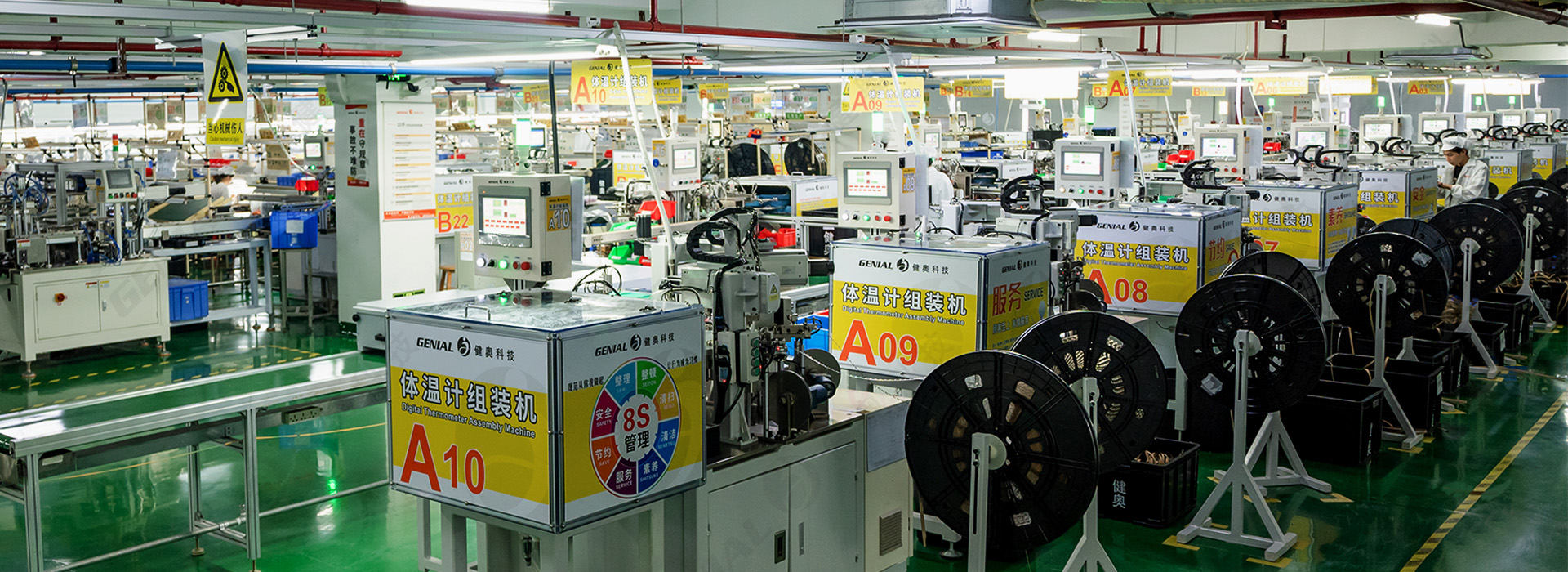
Digital upper-arm monitors are verified during production; on the arm, cuff fit determines whether that verified performance reaches the user. (Image: GENIAL production workshop)
How a buyer might read the two ranges in practice
Consider two hypothetical procurement scenarios, both drawn from the same stated specifications.
Scenario one: a distributor building a general retail programme for a broad adult population, with no ability to screen arm sizes at the point of sale. Here the deciding question is whether any meaningful share of users could fall above 32 cm. Because that cannot be ruled out in a general retail setting, the 22~42 cm models — GT-732, GT-732M, and GT-702V — are the direct match, since they cover the largest arms in the group.
Scenario two: a buyer supplying a defined user group — for example, a programme where measurements are known to stay within a contained band. If that band sits inside 22~32 cm, the GT-712B, GT-712C, or GT-712E model satisfies the requirement without specifying range the users will never use.
In both scenarios the reasoning is the same: read the stated range, compare it with the real arm sizes the product will meet, and choose the model whose range contains them. The 22~42 cm and 22~32 cm figures are the whole of the decision input for this specification.
Evidence and market context for upper-arm monitors
Arm circumference matters more in some categories than others. Upper-arm monitors controlled 59.10% of the blood pressure monitoring market share in 2025, according to commercial research, while wrist-based and wearable formats are growing at a 12.07% CAGR. Because upper-arm devices depend on a correctly sized cuff wrapped around the arm, the arm circumference specification carries more weight here than it does for a cuffless or wrist-based design.
The broader home medical equipment market was estimated at USD 54.35 billion in 2026, with North America holding approximately 40.35% share in 2025. That regional weight matters to this discussion because a large, diverse adult population is exactly the setting in which a wider 22~42 cm range removes the most friction from a catalogue decision.
Measurement reliability is the reason buyers scrutinise the cuff at all. GENIAL states that each blood pressure monitor is calibrated and tested, with measured pressure expected to fall within 3 mmHg of analyzer data. That verification is performed under controlled conditions; on the arm, it is the cuff fit that determines whether the device can deliver its intended performance.
For home-use devices generally, IEC 60601-1-11 is the collateral safety standard applied alongside IEC 60601-1, addressing the risks of uncontrolled home environments and untrained users. Published guidance for home monitoring equipment also recommends regular calibration and operation within an environmental range of 16 to 40°C with humidity below 85%. Cuff fit sits alongside these factors: a monitor can be correctly calibrated and still give a poor reading if the cuff does not match the arm.
Choosing between 22~32 cm and 22~42 cm: a short framework
- Confirm the intended users' arm circumference distribution before selecting a model.
- If the market includes arms above 32 cm and cannot be screened, choose a 22~42 cm model: GT-732, GT-732M, or GT-702V.
- If the users are contained within 22~32 cm, the GT-712B, GT-712C, or GT-712E can be an efficient fit.
- Check that packaging, labelling, and instructions state the correct arm circumference range for the selected model.
Comparison with traditional solutions — and the limits of any single range
Traditional mercury sphygmomanometers were, in practice, paired with a selection of cuff sizes, so an operator could switch cuffs to match the patient. Fully automatic digital upper-arm monitors simplify that process. GENIAL states that its automatic blood pressure monitor reduces measurement time from 3–5 minutes to 30–60 seconds, eliminates the stethoscope, and requires no professional training or mercury recycling, with measurement labour cost reduced by 100% and equipment maintenance and calibration costs reduced by more than 60% compared with mercury sphygmomanometers.
The trade-off is the one buyers must plan around. A digital monitor performs within its stated arm circumference range — and only within it. A model specified at 22~32 cm should not be treated as a substitute for a wider cuff when a patient's arm exceeds 32 cm; in that situation the correct action is to select a 22~42 cm model rather than to accept a reading outside the design range. The limitation is simple and worth stating plainly: a fixed-range cuff cannot cover every arm, so market selection and model selection have to be decided together.
Future outlook
As home blood pressure monitoring expands, arm circumference is likely to stay a front-end screening specification rather than a clinical afterthought. Upper-arm monitors continue to hold the majority of the category, and the home medical device market keeps growing, which means more buyers will be matching cuffs to markets rather than to single patients. The practical implication for procurement is a shift in how ranges are used: from a compliance footnote to a market-selection variable.
Products specified at 22~42 cm give a buyer maximum population coverage from one SKU; products specified at 22~32 cm give a buyer a precisely scoped option for defined user groups. Reading the two ranges correctly is, in most cases, the difference between a catalogue that fits and one that generates returns.
FAQ
It describes the span of mid-upper-arm measurements over which the supplied cuff is designed to be used, taken midway between the shoulder and the elbow. Within the stated range, the cuff is expected to perform as intended; outside it, the reading is no longer dependable.
Two ranges appear across the models: GT-732, GT-732M, and GT-702V are specified at 22~42 cm, while GT-712B, GT-712C, and GT-712E are specified at 22~32 cm.
Cuff fit is a physical constraint on measurement. In general home-monitoring practice, a cuff that is too small for the arm tends to produce readings that are too high, and a cuff that is too large tends to produce readings that are too low. This is why the stated arm circumference range is treated as a boundary rather than a comfort preference.
Start from the intended users. If the market includes arms above 32 cm, or if the product will be sold through channels that cannot screen buyers at the point of sale, the 22~42 cm models — GT-732, GT-732M, and GT-702V — are the safer fit. If the users are a defined group whose measurements stay within 22~32 cm, the GT-712B, GT-712C, and GT-712E can be an efficient choice.
No. The 22~32 cm figure is the stated design range for those models. If a user's arm circumference is above 32 cm, the appropriate step is to select a model specified at 22~42 cm rather than to use a cuff outside its stated range.
It changes which users the product can reliably serve, and therefore which markets and channels it suits. A 22~42 cm model can be positioned for a broad adult population, while a 22~32 cm model is better matched to a narrower, well-defined user group. Neither range is inherently superior — the correct choice depends on the target market.
For buyers who need the underlying specifications before finalising a model, GENIAL's product brochure provides the reference material for the full home medical device line.