
Aroma Diffuser Supplier Capability Evidence: Multi-Model CE, RoHS and FCC Coverage
Aroma Diffuser Supplier Capability Evidence: Multi-Model CE, RoHS and FCC Coverage
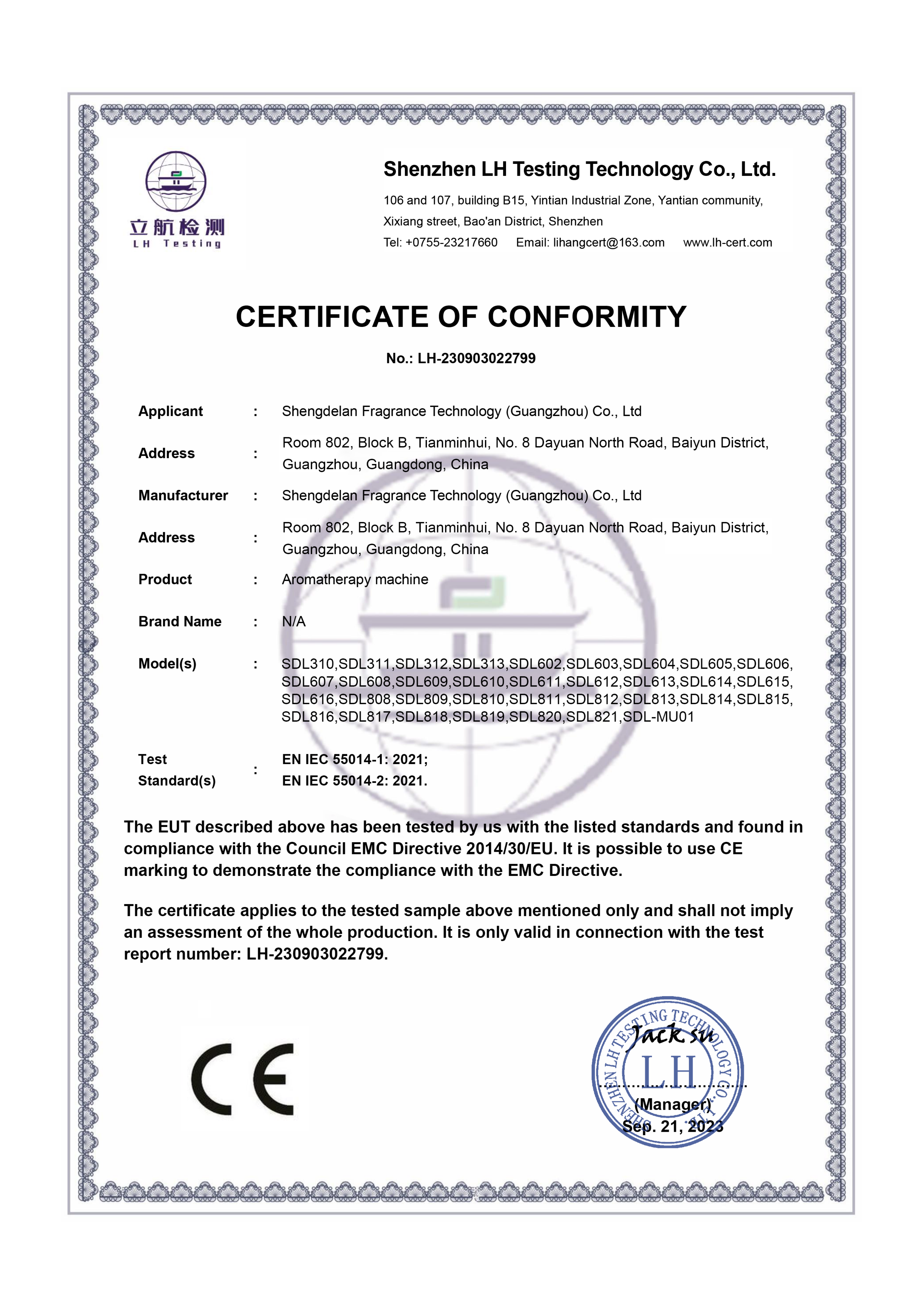
CE Certificate of Conformity LH-230903022799, issued 21 September 2023 by Shenzhen LH Testing Technology Co., Ltd. for the listed aromatherapy machine models.
Aroma diffuser sourcing starts with a documentation question, not a price question
When a buyer evaluates an aroma diffuser supplier for a product family instead of a single SKU, the paperwork becomes the first real test of capability. A quotation can be produced in an afternoon; a CE EMC certificate, a RoHS certificate and two separate US Federal Communications Commission records that name the same model family cannot. That is why the record set from Shengdelan Fragrance Technology (Guangzhou) Co., LTD, which sells under the Saintdeland name, is worth reading closely: one CE certificate, one RoHS certificate and two FCC records each list a broad family of SDL models, including the SDL312, SDL313 and SDL611 aroma diffusers.
Read together, those four documents show multi-model conformity documentation across a diffuser family. They are evidence of documentation coverage. They are not a factory audit report, not a production capacity statement and not a performance benchmark, and treating them as any of those things would misread what a certificate actually is.
The procurement problem: one family, many model files
Commercial scenting buyers rarely order one model. A hotel group may need a lobby format, a corridor format and a smaller unit for back-of-house; a distributor may carry a range that spans home, car, wall-mounted and commercial formats. Each model brings its own documentation question: does an existing report describe this variant, or does it describe a sibling that shares a housing but not a power supply or a radio module?
This is where suppliers diverge in practice. Some hold a certificate for one flagship model and leave the rest of the range undocumented. Others consolidate a family into a consistent record set, which lets a buyer check dozens of SKUs against a handful of documents. The Saintdeland records fall into the second pattern. The CE, RoHS and FCC Supplier's Declaration of Conformity records each carry a model schedule that runs across the SDL310 to SDL616 and SDL808 to SDL816 ranges as recorded, while the FCC equipment authorization adds a separate radio-specific file with its own issue date.
For a buyer in the evaluation and execution stages, that structural difference matters more than brochure claims, because it determines how much verification work has to be commissioned independently.
The four records, as stated
The following table reproduces the recorded scope of each document. Certificate numbers, issuing organisations, standards and dates are taken directly from the supplier's certification records and should be checked against the original documents before any purchase order is signed.
| Record | Issued by | Standard / basis | Date |
| CE Certificate of Conformity LH-230903022799 | Shenzhen LH Testing Technology Co., Ltd. | EN IEC 55014-1:2021; EN IEC 55014-2:2021; EMC Directive 2014/30/EU | 21 Sep 2023 |
| RoHS Certificate LH-230903022801 | Shenzhen LH Testing Technology Co., Ltd. | IEC 62321 series; RoHS Directive 2011/65/EU and (EU) 2015/863 | 21 Sep 2023 |
| FCC Supplier's Declaration of Conformity LH-230903022800 | Shenzhen LH Testing Technology Co., Ltd. | FCC Part 15 Subpart B | 21 Sep 2023 |
| FCC Grant of Equipment Authorization, FCC ID 2BCCLRAD-8 | Eurofins Electrical and Electronic Testing NA, Inc. | FCC Rule Parts 15C; 2412.0–2462.0 MHz and 2402.0–2480.0 MHz | 17 Dec 2025 |
What each record actually demonstrates
CE Certificate of Conformity LH-230903022799
The CE record addresses electromagnetic compatibility for an aromatherapy machine family. It cites EN IEC 55014-1:2021, which covers emission requirements for household appliances, motor-driven devices and similar equipment, and EN IEC 55014-2:2021, which covers immunity. The certificate states conformity with the Council EMC Directive 2014/30/EU and records that the listed models may bear the CE marking. The model schedule includes SDL312, SDL313 and SDL611 alongside other SDL variants.
What this gives a buyer is a documented EMC position for the family: emissions and immunity have been assessed by a named testing organisation against named standard editions. What it does not give is any statement about mist output, noise, oil consumption or service life.
RoHS Certificate LH-230903022801
The RoHS record cites the IEC 62321 test-method series, including the parts covering screening and determination of restricted substances, and references RoHS Directive 2011/65/EU together with the amendment in (EU) 2015/863. The scope is described as an aromatherapy machine, with a model list that again includes SDL312, SDL313 and SDL611.
For a European importer, this is the document that supports the substance-restriction side of market access rather than the electrical side. It is a distinct compliance axis with a distinct technical file, which is why the existence of a separate RoHS certificate number matters: a CE EMC certificate alone would not answer a RoHS question.
FCC Supplier's Declaration of Conformity LH-230903022800
Under FCC Part 15 Subpart B, the Supplier's Declaration of Conformity is the route used for unintentional radiators. The responsible party declares, on the basis of testing, that the equipment complies, and a declaration of this kind does not carry an FCC ID. The Saintdeland record is dated 21 September 2023 and lists the aromatherapy machine model schedule including SDL312, SDL313 and SDL611.
Buyers sometimes treat an SDoC and a grant as interchangeable. They are not. The SDoC addresses the product as a potential source of unintentional radio-frequency emissions; the grant addresses deliberate radio transmission.
FCC Grant of Equipment Authorization, FCC ID 2BCCLRAD-8
This is the radio-specific file. The grant is issued by Eurofins Electrical and Electronic Testing NA, Inc. on 17 December 2025 for an aroma diffuser described as a digital transmission system, under FCC Rule Parts 15C, with recorded frequency ranges of 2412.0–2462.0 MHz and 2402.0–2480.0 MHz — the 2.4 GHz WLAN and Bluetooth ranges. The record as supplied associates the grant with the SDL611, SDL313 and SDL312 models.
Two details deserve attention. First, the grant is two years newer than the EMC and RoHS documents, which is normal when a wireless module is introduced or refreshed after the base product family is certified. Second, the frequency ranges indicate that at least some configurations in this family operate as wireless devices, which is relevant to any buyer specifying WiFi-controlled or app-controlled aroma diffusers.
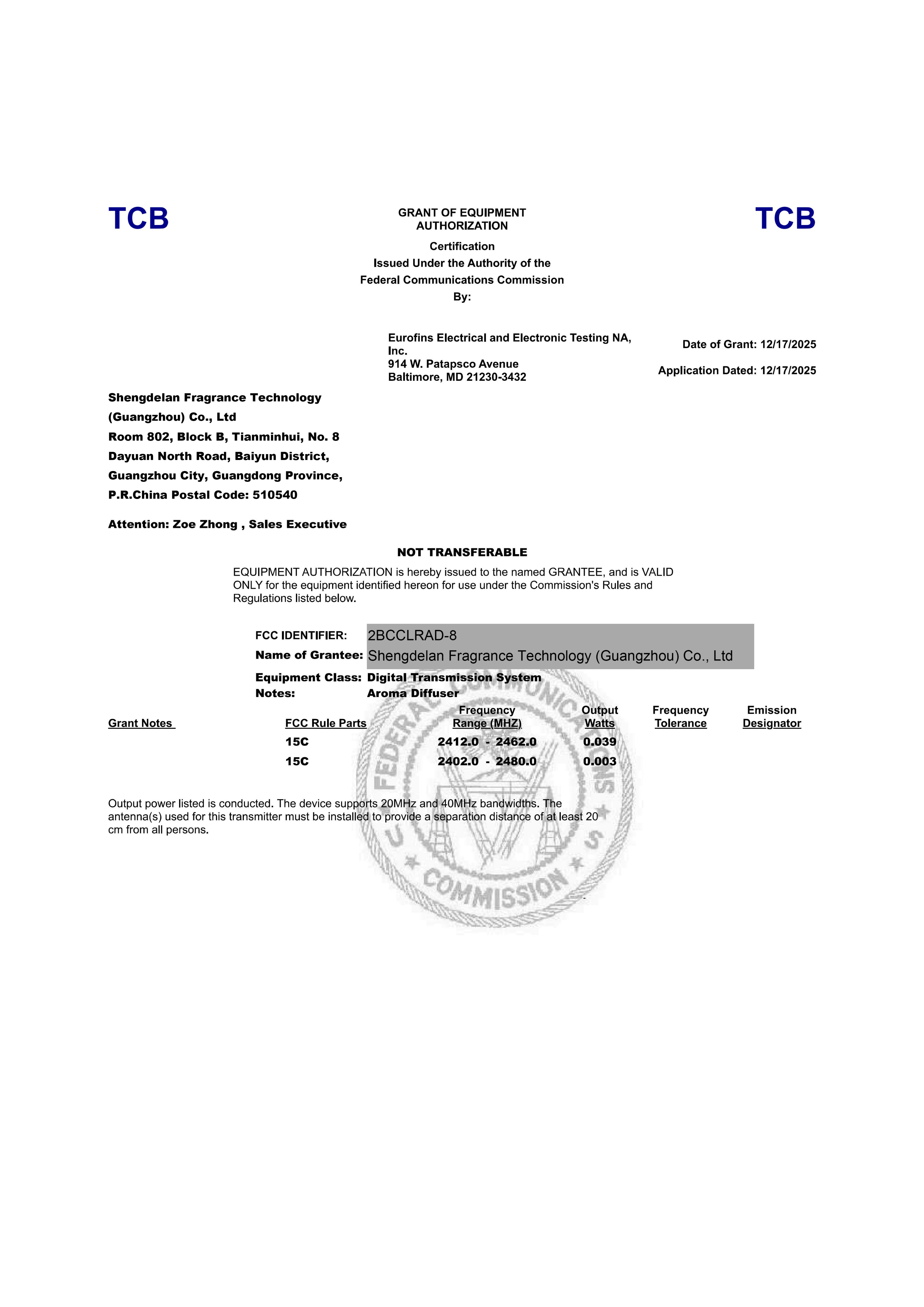
FCC Grant of Equipment Authorization, FCC ID 2BCCLRAD-8, issued 17 December 2025 under FCC Rule Parts 15C for an aroma diffuser digital transmission system.
Why a shared model list changes the due-diligence sequence
In a typical sourcing cycle, compliance documents arrive after the sample is approved and shortly before the deposit. A family-level record set allows the order to be reversed: documents can be reviewed in parallel with sampling, because one file addresses many candidate models.
There are three practical consequences. First, the buyer can screen a shortlist against a single document set instead of requesting per-model files. Second, inconsistencies become visible earlier — a model quoted but absent from the certificate schedule is a warning sign that surfaces before tooling or packaging commitments. Third, the compliance review can be scoped to the configuration actually being ordered, rather than to the whole catalogue.
The trade-off is that a shared model list places more weight on the buyer's matching work. A certificate covering twenty models does not automatically cover the one on the purchase order, and the only reliable check is to read the schedule line by line against the specification sheet.
A five-step verification routine buyers can apply
The routine below converts the document set into a repeatable check. It is deliberately document-focused; it does not replace sampling, factory assessment or contractual terms.
| Step | What to check | Why it matters |
| 1. Model match | Confirm the ordered model appears in each certificate schedule, not just a sibling model. | Coverage is model-specific; a family name on a brochure is not a scope statement. |
| 2. Entity match | Compare the certificate holder's legal name with the contracting entity and the shipping documents. | A document held by a different legal entity does not transfer automatically. |
| 3. Date and edition | Review issue dates and the standard editions cited, then confirm current editions and any recorded expiry or validity period. | Standard editions change; the records carry issue dates of 2023 and 2025. |
| 4. Configuration match | State the voltage, plug type and whether the wireless module is enabled; ask the supplier to confirm the tested configuration. | Household-appliance EMC and radio assessments are configuration-sensitive. |
| 5. Original document | Request the full certificate and report, not a cropped image, and verify the reference with the named issuing organisation where the market authority provides a public register. | Scanned fragments cannot be verified; complete documents can. |
Step five deserves emphasis for the US file. An FCC equipment authorization is associated with an FCC ID, and the ID is what allows a buyer — or a customs broker — to check the record independently rather than relying on a PDF supplied by the seller. For the CE and RoHS records, the issuing organisation is named on the document, which at least establishes who to contact with a verification request.
Where certification coverage stops
The most common error in reading a record set like this one is to let it imply more than it says. Four boundaries are worth stating plainly.
It is not a factory audit. None of the four documents assesses a production site, a quality management system or a social-compliance standard. A buyer who needs audit evidence has to commission or obtain a separate audit — the certificates do not shorten that path.
It is not a capacity claim. Certificate scope says nothing about output, line count, staffing or lead-time reliability. Production capacity and delivery performance belong in a separate supplier assessment, backed by references or a site visit.
It is not a performance claim. Coverage area, atomisation quality, noise level and oil consumption are not addressed by an EMC certificate or a RoHS test. Those require sample testing under the buyer's own conditions.
It is not a permanent validity statement. The records supplied do not include an expiry date, so currency has to be confirmed at the time of purchase. Design changes, supplier changes in critical components or new standard editions can all affect whether a document still describes what is being shipped.
Customisation, variants and the tested configuration

Product family display at the Shengdelan facility in Guangzhou, China (company-supplied image).
Saintdeland states that it offers OEM, ODM, custom design, private label, wholesale and dropshipping models. Its listed customisation options include logo printing by silk screen or laser engraving, shell colour and material changes, custom packaging and manuals, private-label fragrance, housing and mould design, functional options such as app control, remote control, timer and mist-level adjustment, and custom voltage and plug types for US, EU, UK, AU and JP markets.
Customisation is where documentation and configuration most often diverge, and the divergence is not a criticism of any supplier — it follows from how conformity assessment works. A certificate describes a tested configuration. A logo change usually leaves the electrical design untouched; a change of power supply, plug, wireless module or circuitry does not. Buyers ordering a modified voltage variant or a different radio module should therefore ask a direct question: does the ordered configuration stay within the tested configuration described by these certificates, and if not, what documentation will accompany the shipment?
For the wireless question specifically, the four records show different regulatory treatment on each side of the Atlantic. In the United States, the FCC grant for FCC ID 2BCCLRAD-8 addresses intentional radio transmission under FCC Rule Parts 15C. In the European Union, radio equipment falls under the Radio Equipment Directive 2014/53/EU, whereas the CE record described here cites the EMC Directive 2014/30/EU and its harmonised standards. A buyer sourcing WiFi-controlled or app-controlled configurations into Europe should therefore ask which documentation addresses the radio aspects of that specific variant, rather than assuming the EMC certificate answers it.
Order mechanics are also relevant to how the documents get used. The company states a sample minimum order quantity of one piece, neutral wholesale volumes of 50–100 pieces per model and OEM/ODM custom volumes of 500–1,000 pieces per model. Stated lead times are 3–7 days for ready stock, 15–25 days for bulk orders and 30–45 days for OEM/ODM custom orders, with 30–40 days in the September–December peak and a recommendation to order one to two months ahead. For a buyer, a one-piece sample threshold means the document review and the physical sample test can run in parallel without a volume commitment.
Company-stated quality control describes 100% inspection before shipment, aging tests of four to eight hours of continuous running, incoming material inspection, in-process patrol inspection every two hours, outgoing inspection, and specific checks for noise, mist output, leaks and appearance. These are declared process descriptions. They are useful context for a factory discussion, but they are not the same category of evidence as a test report issued by an independent laboratory.
Category context: documentation load grows with the range
The reason family-level documentation is becoming a procurement topic rather than a filing detail is scale. Grand View Research valued the global aromatherapy diffusers market at USD 2.1 billion in 2025 and reported that the ultrasonic segment held 63.9% of it. Those are commercial research estimates rather than official statistics, and they are cited here only as context: a widening catalogue of home, car, wall-mounted, HVAC and commercial formats means more model variants per supplier, and therefore more documentation per purchase decision.
What to watch as these files age
Three developments are worth monitoring, and each is a question rather than a prediction.
First, standard editions move. The EMC certificate cites EN IEC 55014-1:2021 and EN IEC 55014-2:2021, and the RoHS record cites the IEC 62321 series together with Directive 2011/65/EU as amended by (EU) 2015/863. Buyers running multi-year programmes should ask at each annual review whether the cited editions remain current and whether any re-assessment has been carried out.
Second, model schedules grow. When a supplier adds models to a family, the useful question is whether the new models sit inside an existing schedule or require a new file. A supplier that can answer that question quickly is demonstrating document control, which is a more meaningful capability signal than the certificate count itself.
Third, radio documentation has a shorter refresh cycle than electrical safety documentation. The FCC grant here is dated 17 December 2025, two years after the EMC and RoHS records, which is consistent with wireless configurations being introduced or updated later. Programmes that depend on app-controlled or WiFi-controlled aroma diffusers should treat the radio file as a separate renewal item, not as part of a single certificate package.
Frequently asked questions
Which aroma diffuser models appear in Saintdeland's CE, RoHS and FCC records?
The records list broad SDL model schedules that include the SDL312, SDL313 and SDL611 aroma diffusers. The CE Certificate of Conformity LH-230903022799 and the FCC Supplier's Declaration of Conformity LH-230903022800 list model schedules spanning the SDL310 to SDL616 and SDL808 to SDL816 ranges as recorded. The RoHS certificate LH-230903022801 lists a comparable aromatherapy machine schedule including the same three models. The FCC Grant 2BCCLRAD-8 is recorded against SDL611, SDL313 and SDL312.
What does FCC Grant 2BCCLRAD-8 cover that the FCC Supplier's Declaration of Conformity does not?
They address different things. The Supplier's Declaration of Conformity LH-230903022800 is made under FCC Part 15 Subpart B and covers the product as an unintentional radiator, without an FCC ID. The grant 2BCCLRAD-8 is an equipment authorization under FCC Rule Parts 15C for an aroma diffuser digital transmission system, with recorded frequency ranges of 2412.0–2462.0 MHz and 2402.0–2480.0 MHz. In short: one document addresses incidental emissions, the other authorises deliberate radio transmission.
How can a buyer confirm that a specific order is covered by the listed certificates?
By matching four things against the original documents: the ordered model number against the certificate schedule, the certificate holder's legal name against the contracting entity, the ordered voltage, plug and wireless configuration against the tested configuration, and the issue date against the current design. Buyers should request complete certificates and reports rather than images, and where a public register exists for the record type — such as an FCC ID — verify the reference independently.
Does shared certificate coverage across a product family prove factory capability or production capacity?
No. A CE, RoHS or FCC record documents conformity assessment of listed models; it does not assess a production site, a quality management system, output volume or delivery reliability. Factory capability and capacity require separate evidence such as an audit, a site visit, production records or verified references. Certificate coverage and factory assessment answer different procurement questions and are best reviewed side by side.
Do logo, packaging or voltage changes affect existing certification coverage?
It depends on what changes. Branding, packaging and manual changes generally leave the electrical design as tested, while changes to the power supply, plug type, wireless module or circuitry can move a product outside the tested configuration. Because that assessment belongs to the testing body rather than to the buyer or the seller, the practical step is to describe the intended configuration in writing and ask the supplier to confirm which documents cover it and whether any re-assessment is required.
What the record set supports
For an aroma diffuser buyer in the evaluation and execution stages, the value of this record set is narrower and more useful than a capability claim: it shows that a family of models, including SDL312, SDL313 and SDL611, sits inside documented CE EMC, RoHS and FCC scopes, with a separate radio authorisation issued later for wireless configurations. That supports an early documentation screen and a structured model-matching routine. It does not replace sampling, a factory assessment or contractual warranties, and buyers should confirm currency, configuration and scope directly with Saintdeland before committing to volume.
A downloadable company introduction is available here: Introduction to the Supreme Saintdeland (PDF).
Have Questions or Need More Details?
Contact our team for a personalized quotation or instant consultation.
Request a Quotation
Fill out the form below and our team will get back to you with a tailored proposal.
WhatsApp Direct Chat
Prefer to chat in real-time? Message us on WhatsApp for instant assistance & quick answers.
- Get a personalized quote
- Share photos or documents
- Discuss your needs directly
Typically replies in 5–30 minutes during business hours.