
Artificial Turf Manufacturing Breadth: EM241007 to Putt 40
Artificial Turf Manufacturing Breadth: EM241007 to Putt 40
Artificial turf is now a multi-application material class rather than a single product line. The same manufacturing base that supplies a residential garden may also be asked to supply a football pitch, a padel court, a playground or a golf putting green — often inside one distributor's portfolio. This reference examines what can actually be documented about one manufacturer's ability to cover that span: Venusturf (Wuxi Venus Turf Co., Ltd.) and a product range running from the residential-grade EM241007 to golf-oriented turf such as the Putt 40.
The scope is deliberately narrow. Instead of repeating general statements about versatility, this article consolidates the parameters, process steps and commercial terms that are documented, translates them into buyer-relevant meaning, and states plainly where the documentation ends.
Why Supplier Range Has Become a Procurement Variable
Buyers who operate more than one application type face a structural problem. A landscape contractor's catalogue, a school's facilities plan and a sports club's pitch programme rarely need the same turf construction. Sourcing each construction from a different factory multiplies specification sheets, test reports and delivery schedules, and it splits responsibility for quality across several suppliers when a surface underperforms.
Consolidating with one manufacturer reduces that coordination load, but it introduces a different risk: assuming that a line configured for decorative residential grass also holds the tolerances required for sports or golf surfaces. That assumption is where many procurement failures begin, because "we produce everything" is a claim, while pile height, gauge, yarn composition, stitch density and backing construction are verifiable facts.
For a buyer at the Decision-to-Execution stage, the practical question is therefore not "does this supplier offer many products", but "can the same production system deliver different constructions without the specification drifting between batches?" Answering it requires evidence at three levels: the process chain, the individual product data, and the commercial terms that govern repeat supply.
The Production System Behind the Range
Venusturf (Wuxi Venus Turf Co., Ltd.) is an artificial turf manufacturer based in Wuxi, Jiangsu, China, integrating R&D, production and sales, with an export share of 80% and customers across global markets. The manufacturing model is vertically integrated: 30 integrated production lines cover yarn extrusion, twisting, tufting and coating through to final packaging and delivery, supported by a 25-engineer R&D team.
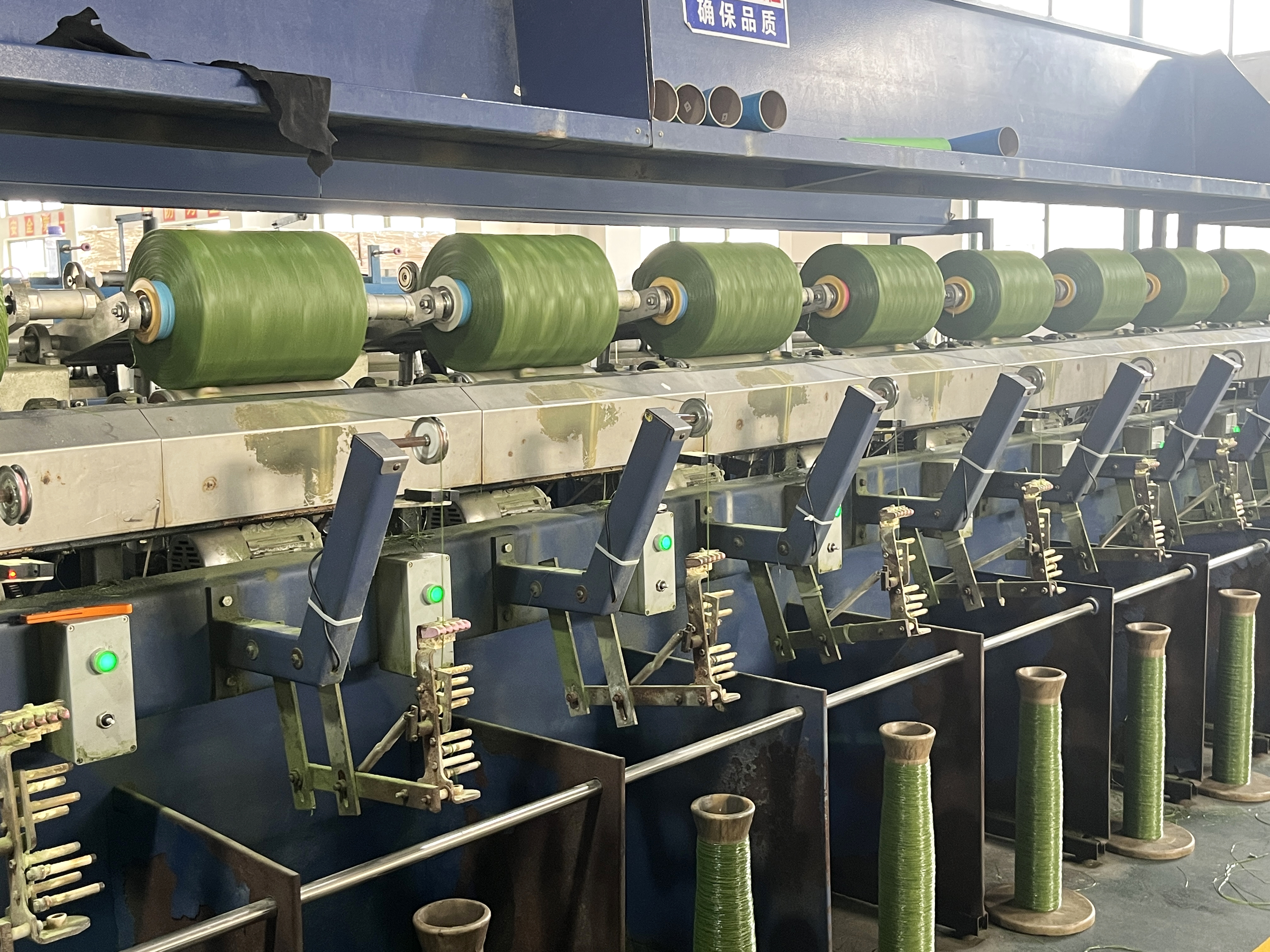
Artificial turf production workshop. Image from the Venusturf corporate image library.
Vertical control matters because the parameters that decide application fit are set at different stages. Yarn extrusion determines polymer formulation and colour consistency. Twisting and heat-setting affect how the yarn recovers after compression. Tufting sets gauge and stitch density. Coating determines tuft lock and dimensional stability. When these steps sit inside one factory, a change requested at the yarn stage does not have to be reconciled across external suppliers before it reaches the finished roll.
Documented capacity and order parameters are as follows: monthly production capacity of 50,000 m², a minimum order quantity of 1,000 m², and a typical lead time of 30–45 days for production orders. At that capacity level, a single 10,000 m² order represents roughly one fifth of one month's output — a ratio buyers can use when judging whether a supplier can absorb a multi-site rollout alongside existing commitments.
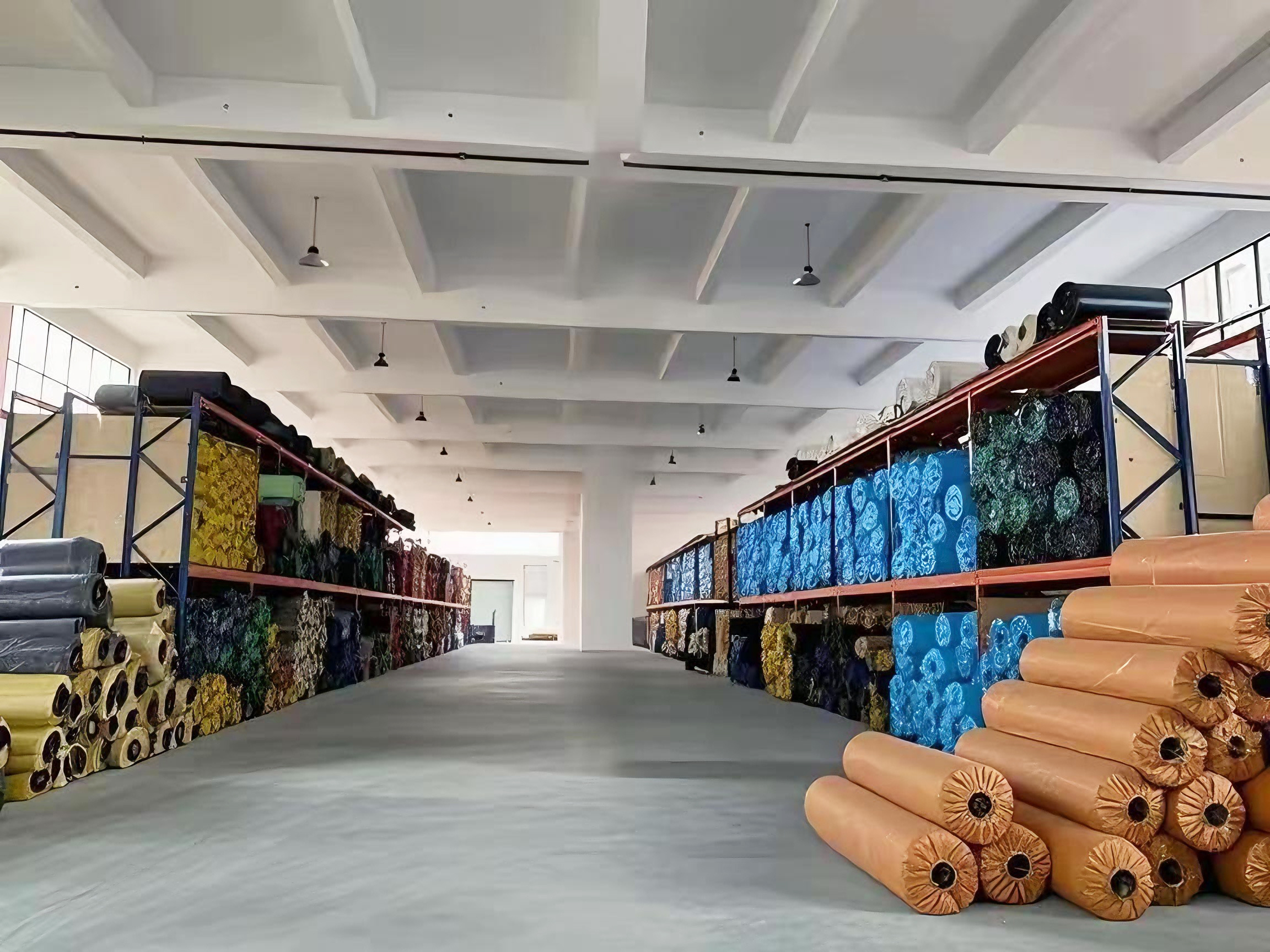
Finished-goods storage area used for order consolidation and shipment scheduling.
What Vertical Integration Changes for a Buyer
- Colour and yarn consistency: masterbatch and extrusion are handled in-house, which reduces the risk of shade variation between production runs of the same model.
- Tuft lock and dimensional stability: coating is performed on the same site as tufting, so backing and adhesive parameters move with the product rather than with a subcontractor's schedule.
- Change control: a specification change can be evaluated across the full chain instead of being negotiated at the boundary between two companies.
Technical Explanation: Reading the EM241007 Specification
One product in the range has fully documented parameters: EM241007, classified by the manufacturer as Residential Grass. Its specification is a useful reference point because it shows the level of detail a buyer should expect before a product is written into a tender.
| Parameter | Documented specification |
|---|---|
| Model | EM241007 |
| Product type | Residential Grass |
| Pile height | 45 mm |
| Colour | Four-colour |
| Gauge | 3/8" |
| Yarn | U-shape with spine, monofilament PE + curled PP |
| Density | 150 stitches/m; 15,750 stitches/m² |
| Backing | Double PP + PU glue |
| Material | PP, PE |
| Listed applicable industries | Landscaping, Sports, Construction, Hospitality |
The table is more than a list of values. Each parameter constrains what the finished surface can realistically do:
- 45 mm pile height places the product in a mid-to-tall category that is common in residential and landscape work, where appearance and underfoot comfort are weighted more heavily than ball behaviour.
- 3/8" gauge defines stitch spacing across the width of the roll and, together with stitch density, determines how dense the face appears.
- U-shape with spine monofilament PE plus curled PP describes a dual-polymer face: the monofilament supports resilience and upright recovery, while the curled PP adds bulk and a softer visual texture.
- 150 stitches per metre, equivalent to 15,750 stitches per square metre, is a mid-range density that supports a dense-looking residential surface without the very high yarn consumption of stadium-grade constructions.
- Double PP backing with PU glue uses a polyurethane coating to lock tufts and stabilise the backing — a step that adds cost but improves resistance to pull-out and edge fraying.
- Applicable industries listed as landscaping, sports, construction and hospitality indicate that the model is positioned for mixed use rather than a single venue type.
From Residential Grass to Golf Turf: What the Range Demonstrates
The range referenced in this review is not limited to one construction. Alongside EM241007, the model line-up includes EM24071902, the golf-oriented Putt 40, and EM250105. These designations sit at different points on the application spectrum: residential landscape at one end, golf and other high-specification sports surfaces toward the other.
The two ends of that spectrum are evaluated differently. Residential and landscape buyers typically prioritise appearance retention, colour stability and comfort underfoot. Golf and competitive sports buyers prioritise surface uniformity, consistent ball behaviour and predictable performance across the whole playing area. A manufacturer producing at both ends has to control yarn, gauge, density and backing across a wider envelope than a single-application producer — which is precisely why product data, not product count, is the meaningful evidence.
For the landscape end of the range, the documented evidence is complete for EM241007 and is supported by the applicable-industry listing that covers landscaping, sports, construction and hospitality. For EM24071902, Putt 40 and EM250105, the model designations are part of the manufacturer's published line-up, but individual technical parameters are not reproduced in this reference. That is a documentation boundary rather than a quality judgement, and it leads to a straightforward buyer action:
Yarn, Gauge, Density and Backing: What Each Choice Controls
Buyers comparing artificial turf across several applications tend to converge on the same four variables, because these determine whether a product behaves as a landscape surface or as a sports surface.
- Yarn type controls recovery and feel. Monofilament yarns hold a more upright face and are typical of sports surfaces; curled or texturised yarns add volume and softness and are common in landscape and decorative products. The EM241007 construction combines both, which is consistent with a mixed-use positioning.
- Gauge determines the distance between stitch rows. Finer gauges allow denser faces at a given yarn count but increase tufting time and cost per square metre.
- Stitch density is the most direct indicator of face weight and perceived quality. It should always be read together with pile height and yarn specification, never on its own.
- Backing system determines tuft lock, dimensional stability and how the roll performs after installation and infill. A double PP backing with PU glue, as documented for EM241007, is a more robust construction than a simple single-layer backing.
UV performance sits alongside these variables as a durability factor rather than a design choice. The documented control method is to introduce UV stabilisers during production, using anti-UV additives and a UV-resistant masterbatch, supported by UV resistance testing, accelerated ageing tests and colour-fastness quality control. For buyers in high-insolation markets, the relevant request is not "is it UV treated" but which test documentation supports the claim, and whether it is issued per batch or per product family.
Market Trend Analysis: Multi-Application Demand and the Replacement Cycle
Third-party market data explains why production breadth has become commercially relevant rather than merely presentational.
| Indicator | Value | Year | Source |
|---|---|---|---|
| Global artificial turf market | USD 7.3 billion, projected to USD 13.7 billion by 2033 | 2025 | Grand View Research |
| Asia-Pacific revenue share | 32.2% | 2025 | Grand View Research |
| Polyethylene material share of revenue | 63.1% | 2025 | Grand View Research |
| Sports application share of market | Approximately 63.1% | 2025 | Grand View Research |
| Synthetic sports fields installed in China | More than 15,000 fields, 52% of regional installations | 2025 | Mordor Intelligence |
| Replacement share of sports turf demand | 41%, approximately 70 million m² | 2023 | AMI Plastics |
Three implications follow for buyers planning multiple applications:
- The sports segment carries most of the volume, while landscape and leisure applications remain the volume base for distributors. A supplier with construction capability at both ends can serve a full catalogue rather than part of one.
- Polyethylene dominance means PE-based yarn systems are the mainstream choice. A product that pairs PE monofilament with PP components, as EM241007 does, sits within the dominant material family.
- Replacement demand is structural. The concentration of installed pitches in Asia-Pacific, including more than 15,000 synthetic sports fields in China, points to a large installed base approaching renewal.
Artificial Turf Compared with Natural Grass — and Where the Boundaries Sit
Natural grass remains the reference point against which artificial turf is justified, and the comparison is not one-sided.
| Aspect | Natural grass | Artificial turf |
|---|---|---|
| Use intensity | Limited by wear and recovery periods | Supports continuous, high-frequency use |
| Water and maintenance | Regular irrigation, mowing and nutrient management | No irrigation requirement; maintenance shifts to brushing, infill management and inspection |
| Weather dependency | Performance varies with season and rainfall | Consistent surface largely independent of weather |
| Upfront cost | Lower initial cost, higher ongoing cost | Higher upfront investment, spread across the surface lifespan |
| End of life | Returns to the soil | Requires removal plus disposal or recycling planning |
The boundaries matter as much as the benefits. Artificial turf retains more heat than natural grass in hot climates, which affects user comfort and can influence design decisions such as shading, cooling or infill selection. Infill and maintenance are not eliminated, only changed. And for regulated sports use, system-level certification — the FIFA Quality Programme for football turf, and standards such as EN 15330-1 in Europe and DIN 18035-7 in Germany — applies to tested systems rather than to yarn alone.
That last point is a genuine limitation for any manufacturer, including this one. A residential-grade product such as EM241007 is not a substitute for a certified sports system, and no product on a spec sheet should be treated as interchangeable with a tested, certified installation. Buyers should match product class to application, and treat certification requirements as a filter applied before commercial negotiation rather than after.
Procurement and Verification Boundaries
The commercial terms documented for production orders are equally relevant to long-term supply planning.
| Item | Documented term | Buyer implication |
|---|---|---|
| Minimum order quantity | 1,000 m² | Small trial or sample projects need to be planned as part of a larger order |
| Lead time | 30–45 days typical | Multi-phase projects should be scheduled with buffer, especially where installation crews are booked |
| Incoterm | FOB | Buyers manage inland transport, insurance and destination clearance |
| Payment | 30% TT deposit, 70% TT before delivery | Cash flow planning should cover full settlement before shipment release |
| Acceptance | Pre-shipment test | Inspection rights are exercised before dispatch, which places a premium on early sample approval |
Two practical constraints follow. First, because acceptance is tied to a pre-shipment test, buyers get more value from a validated reference sample than from a late-stage dispute; approving the sample early and specifying test parameters in the purchase order is the cheapest form of risk control. Second, a 1,000 m² minimum combined with a 30–45 day lead time means small decorative or pilot installations are best bundled into a wider order rather than handled as standalone purchases.
A third boundary is documentation itself. This reference confirms a full parameter set for one model and a production system applied across the range; it does not confirm model-level parameters for every product. Under a Decision-to-Execution timeline, that gap should be closed before contracts are signed, not after.
Future Outlook
With the global artificial turf market projected by Grand View Research to grow from USD 7.3 billion in 2025 toward USD 13.7 billion by 2033, and with replacement demand already representing around 41% of sports turf demand in 2023, the competitive question is shifting from "who can supply a roll of turf" to "who can supply a documented range, repeatably". For manufacturers, model-level data transparency becomes a commercial asset. For buyers, the supplier evaluation checklist will increasingly include a specification sheet per model, batch-level UV and colour documentation, and evidence that different constructions run through the same controlled process chain.
In that environment, a range spanning residential grass and golf-oriented turf is only as strong as the documentation behind each model — which is why the practical recommendation remains unchanged: verify at model level, sample before committing, and treat production breadth as a starting hypothesis rather than a conclusion.
FAQ
1. Which technical parameters determine whether artificial turf suits landscaping, sports or hospitality use?
The decisive parameters are pile height, gauge, yarn composition, stitch density and backing construction. The documented EM241007 construction — 45 mm pile height, 3/8" gauge, U-shape with spine monofilament PE plus curled PP yarn, 150 stitches per metre (15,750 stitches per square metre) and a double PP backing with PU glue — is listed by the manufacturer for landscaping, sports, construction and hospitality applications. Golf and regulated competitive sports surfaces add system-level requirements on top of yarn and backing specifications, including certification testing under programmes such as the FIFA Quality Programme or standards such as EN 15330-1 and DIN 18035-7.
2. Does one production system cover both residential grass and golf-oriented turf?
The manufacturer operates 30 integrated production lines covering yarn extrusion, twisting, tufting, coating and packaging, with a 25-engineer R&D team, and its published range runs from residential products such as EM241007 to golf-oriented models such as the Putt 40, with EM24071902 and EM250105 also in the line-up. Full technical parameters in this reference are documented for EM241007. For the other models, the specification sheet and test documentation for that specific model should be obtained before it is specified.
3. What monthly capacity, minimum order quantity and lead time apply to production orders?
Documented figures are a monthly production capacity of 50,000 m², a minimum order quantity of 1,000 m², and a typical lead time of 30–45 days for production orders.
4. What payment, delivery and acceptance terms apply?
Production orders are documented as FOB, with payment of 30% TT as deposit and 70% TT before delivery, and acceptance based on a pre-shipment test.
5. How is UV degradation controlled during manufacturing?
UV stabilisers are added during production, together with anti-UV additives and a UV-resistant masterbatch. The manufacturer's stated control measures include UV resistance testing, accelerated ageing testing and quality control to ensure colour fastness.