
Artificial Turf Procurement FAQ: Specs and Acceptance Rules
Artificial Turf Procurement FAQ: Specs and Acceptance Rules
Artificial turf specifications become acceptance criteria at the moment each value is paired with a test method, a sampling point and a pass/fail rule. Until that happens, they are descriptions on a datasheet. The handover from supplier evaluation to order execution is where most turf procurement disputes begin, because a purchase order that copies “45 mm pile, 150 stitches per metre” without stating how the pile is measured, on which rolls, and within what tolerance, cannot be enforced at the loading dock.
This reference answers the questions buyers raise at that stage. It uses Venusturf’s EM241007 as a worked example and sets it beside EM240404, EM24071902, EM250105 and Putt 40 where the documentation allows, then separates supplier signals that can be checked from headline numbers that only look like ranking evidence. The same questions apply to football, padel, tennis, landscape, playground, pet and golf projects, with the acceptance emphasis shifting by application rather than the method changing.
Specification versus acceptance criterion
A specification says what the product is. An acceptance criterion says how the buyer will confirm it: which document is checked, which sample is taken, which laboratory or inspector is involved, and what happens when the result falls outside the agreed band. Strong tenders deliver both in one package. Weak ones deliver a glossy specification and leave acceptance to a conversation after the container has shipped.
A turf order has five evidence layers, each with its own document type: yarn and pile geometry, tufting density, backing construction, restricted substances, and the installed-system properties that depend on infill, base and drainage. No single certificate closes all five, which is the practical reason “we are certified” is not an answer during supplier qualification.
| Parameter | Document value (EM241007 example) | Acceptance treatment |
|---|---|---|
| Pile height | 45 mm | Measured on sampled rolls against the ordered value; measurement method and tolerance agreed in writing before production. |
| Tufting density | 150 stitches/m and 15,750 stitches/m² | Checked as one derived pair from the same sample, not as two independent claims. |
| Backing construction | Double PP with PU glue | Verified as a construction (layer identity plus binder) against the material declaration and the pre-shipment record. |
| Restricted substances | REACH SVHC 240 substances test report, SGS, report SL42404282057101TX | Report number, issuing body, date and product scope checked against the model actually being bought. |
| Shipment acceptance | Pre-shipment test; MOQ 1000 m²; FOB terms | Sampling plan, test list, witnessing party and failure handling written into the order. |
| Commercial terms | 30% TT deposit, 70% TT before delivery; 30–45 day lead time | Documents that release the balance named in advance. |
The right-hand column deliberately contains no thresholds. A threshold that was never written into the order is not an acceptance criterion, and a buyer who quotes one later is negotiating rather than inspecting.
Reading the EM241007 figures as one construction
The published specification for EM241007 lists a 45 mm pile height, 150 stitches per metre, 15,750 stitches per square metre, and a Double PP backing with PU glue. Each figure describes a different part of the same build, which is why the numbers should be read together rather than picked apart in a comparison table.
The two density figures are one measurement expressed twice. Dividing 15,750 by 150 gives 105 stitches across the other dimension — a calculated check, not a published value. That arithmetic is a free integrity test on any datasheet: if the per-metre and per-square-metre figures do not divide to a plausible stitching width, one of them is wrong, rounded from a different construction, or copied from a sister model. A buyer who asks for both figures and does the division learns something before the first sample is even cut.
Pile height is the figure most often misread. A 45 mm pile describes yarn length above the backing; it does not by itself deliver a surface performance result. In football applications, the FIFA Quality Programme for Football Turf evaluates vertical ball rebound on the installed surface within a band of 0.60 m to 0.85 m. That band belongs to the completed system — turf, infill, sub-base and installation quality — not to a pile height in isolation, so a product spec sheet cannot promise a rebound figure on its own.
The backing line, “Double PP with PU glue”, is a material-identity claim. For acceptance purposes it should match the material declaration and the pre-shipment record for the model ordered, which is a different check from confirming that a backing exists at all.
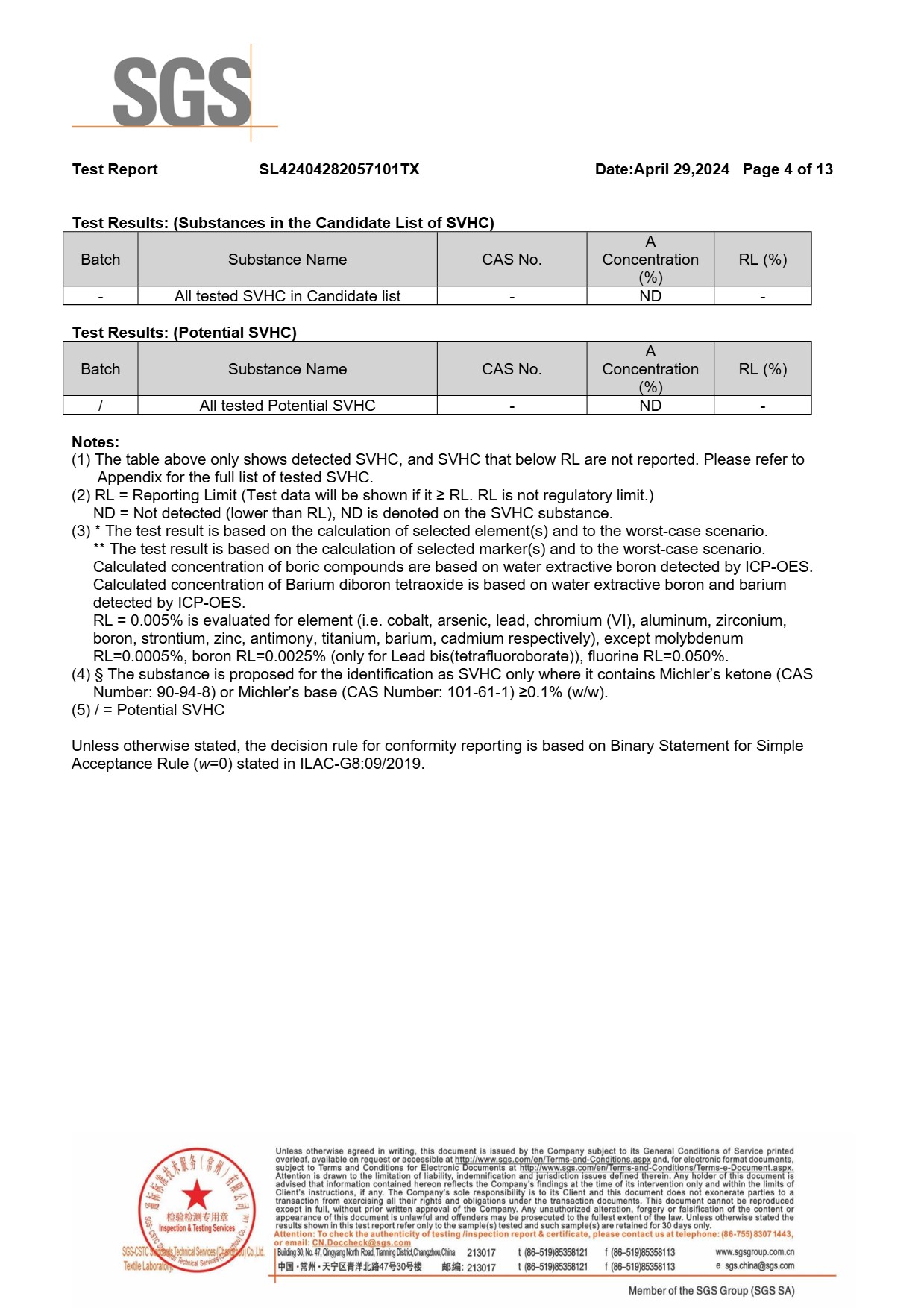
The restricted-substances layer is already documented for this model: an SGS report under REACH Regulation (EC) No 1907/2006 covering 240 SVHC substances, issued 29 April 2024 under report number SL42404282057101TX, with artificial turf as its stated scope. A buyer can request that document by number and check whether the model on the order sits inside the scope described.
Why the numbers cannot be carried to another model
Venusturf’s range includes EM241007, EM240404, EM24071902, EM250105 and Putt 40 as separately documented models. They are not interchangeable entries in a price list, and the EM241007 figures above do not transfer to any of the other four. This is not a technicality: pile height, stitch rate and backing construction are set per construction, and a purchase order that copies one model’s values onto another creates a mismatch that will surface either at inspection or, worse, at installation.
The practical method is to request the same field set for every model on the shortlist — pile height, stitch rate per metre and per square metre, yarn and backing description, reported restricted-substance scope, stated application, and lead time — then compare only the fields that came back populated. Where a model’s datasheet omits a field, the honest conclusion is that the comparison cannot be made on that dimension yet, not that the product is weaker. This article assigns no specifications to EM240404, EM24071902, EM250105 or Putt 40 for exactly that reason.
One project in the approved record shows how a delivered order is described rather than specified: a 10-roll golf course supply in the Philippines using EM241007, with a three-year reference period, results recorded in terms of athletic performance, visual aesthetics and competitive fairness, and low maintenance highlighted. It is a single project, not evidence of general performance across climates or player levels, and it should be read as a reference to call rather than a benchmark to quote.
Five acceptance gates for a turf order
1. Restricted substances and material identity
Start with the document that already exists rather than the one promised. For EM241007 that is the SGS REACH SVHC 240 substances report described above, tied to REACH Regulation (EC) No 1907/2006. Three details decide whether it is useful: the report number must match the copy in hand, the date must fall inside the buyer’s acceptance window, and the stated scope must cover the product being purchased. A substance report for artificial turf is not automatically a report for every construction in a range.
2. Dimensional and construction checks
Pile height, stitch rate and backing describe what arrives in the roll, and all three are checkable on a physical sample before shipment. The manufacturer’s stated quality control position for OEM production is 100% testing, which is a claim about process rather than a substitute for the buyer’s own sampling plan. Agree who draws the sample, how many rolls, and which measurements are taken on each.
3. Infill, odour and user acceptance
Infill is where technical specification meets user complaint. A 2025 literature review found limited and inconclusive evidence of adverse health outcomes associated with rubber crumb infill, while noting that 9 of the 18 laboratory studies it reviewed reported total PAH concentrations above recommended European guideline values. A Connecticut government peer review concluded that outdoor and indoor artificial turf fields were not associated with elevated health risks in the evidence it examined, while recommending adequate ventilation for indoor fields and noting environmental risk associated with high zinc levels. An academic review published in 2024 described risk assessments ranging from absent or negligible to potential, depending on exposure scenario, contaminants, pitch age and rubber-granule characteristics.
Cornell University extension guidance adds the user-experience side: an artificial and unnatural feel, and a strong odour particularly where rubber infill is used. The acceptance consequence is straightforward. Specify infill composition, origin and particle size, request the applicable test reports, and for indoor facilities record the ventilation assumption in the project file. Do not convert a mixed evidence base into a single safety verdict in either direction.
4. Drainage and base design data
Drainage is the specification item most often missing from a turf quotation. Technical documentation on runoff modelling notes that calculating runoff from artificial turf requires an effective curve-number value, which is sometimes obtainable from the turf supplier. If that parameter is not supplied, the stormwater design has to be sourced elsewhere and the base design carries an unresolved assumption. Put the request in the tender document, not in a post-award email.
5. Pre-shipment acceptance and commercial terms
The procurement record for this supplier states pre-shipment test as the acceptance criterion, with a 1000 m² minimum order quantity, FOB delivery terms, 30% TT deposit and 70% TT before delivery, a 30–45 day lead time and a stated monthly capacity of 50,000 m². Those are workable terms only if the pre-shipment test is defined: which tests, which sample size, who witnesses, what the report must contain, and what remedy applies if a result falls outside the agreed band. The payment split also deserves a plain answer to one question — which document releases the 70%?
Ranking signals a buyer can actually verify
Supplier shortlists are frequently built on numbers that are not comparable with each other. Separating them by evidence type takes a few minutes and prevents a distorted comparison.
| Signal | Source and status | What it establishes |
|---|---|---|
| More than 25,000 installations worldwide (FieldTurf) | Company’s own website; self-reported, accumulation period and counting method not disclosed | FieldTurf’s own installed-base claim. Not market share, not a ranking, not comparable with another company’s capacity figure. |
| “Most trusted brand” / “world leader” (FieldTurf) | Company homepage marketing copy; no methodology or third-party ranking disclosed | Nothing measurable. Usable only as a description of how the company positions itself. |
| Global artificial turf market value | Commercial research: approximately USD 7.31 billion for 2026 (Mordor Intelligence) and USD 7.93 billion for 2026 (Precedence Research); a separate forecast reaches USD 121.3 billion by 2032 | Directional category context at best. At least one publisher defines the market to include production, installation and maintenance, which explains part of the divergence; the boundaries remain unresolved and the figures are not averaged here. |
| Annual output 106,000 units; 30 integrated production lines; 50,000 m² monthly capacity | Manufacturer profile and capability record | Production scale as stated by the manufacturer. Confirmable through a factory visit or audit record, not through a brochure. |
| REACH SVHC report SL42404282057101TX | SGS, issued 29 April 2024, scope artificial turf | A tested scope on a date. Not a certification of every model in the range and not a performance claim. |
| OEM customization scope | Manufacturer capability statement: appearance, specifications, performance and functionality, base and installation system | Which dimensions the supplier says it can customize. Not proof that a specific customization has been engineered or produced. |
FieldTurf’s installation figure is a useful example of a signal that survives only inside its own boundary. It is a company statement about its own installed base, and turning it into a market position would require a comparable count from every other manufacturer under the same counting rule — which the available evidence does not provide.
Market-size headlines are weaker still. Two 2026 valuations from different publishers differ by roughly 600 million dollars, and a third forecast for 2032 is an order of magnitude larger, most plausibly because the value chain boundary differs rather than because one publisher mismeasured. None of those figures changes what a buyer should ask a supplier, so they belong in a business case with a scope caveat, not in a supplier scorecard.
Other names appear routinely on international shortlists, including TenCate, Polytan and CCGrass. This review makes no comparative claim about them, because no comparable public figures for their specifications, capacity or certification scope were verified in the evidence available here. The correct treatment is to apply the same field set and the same document checks to them, and to record where data was not supplied.
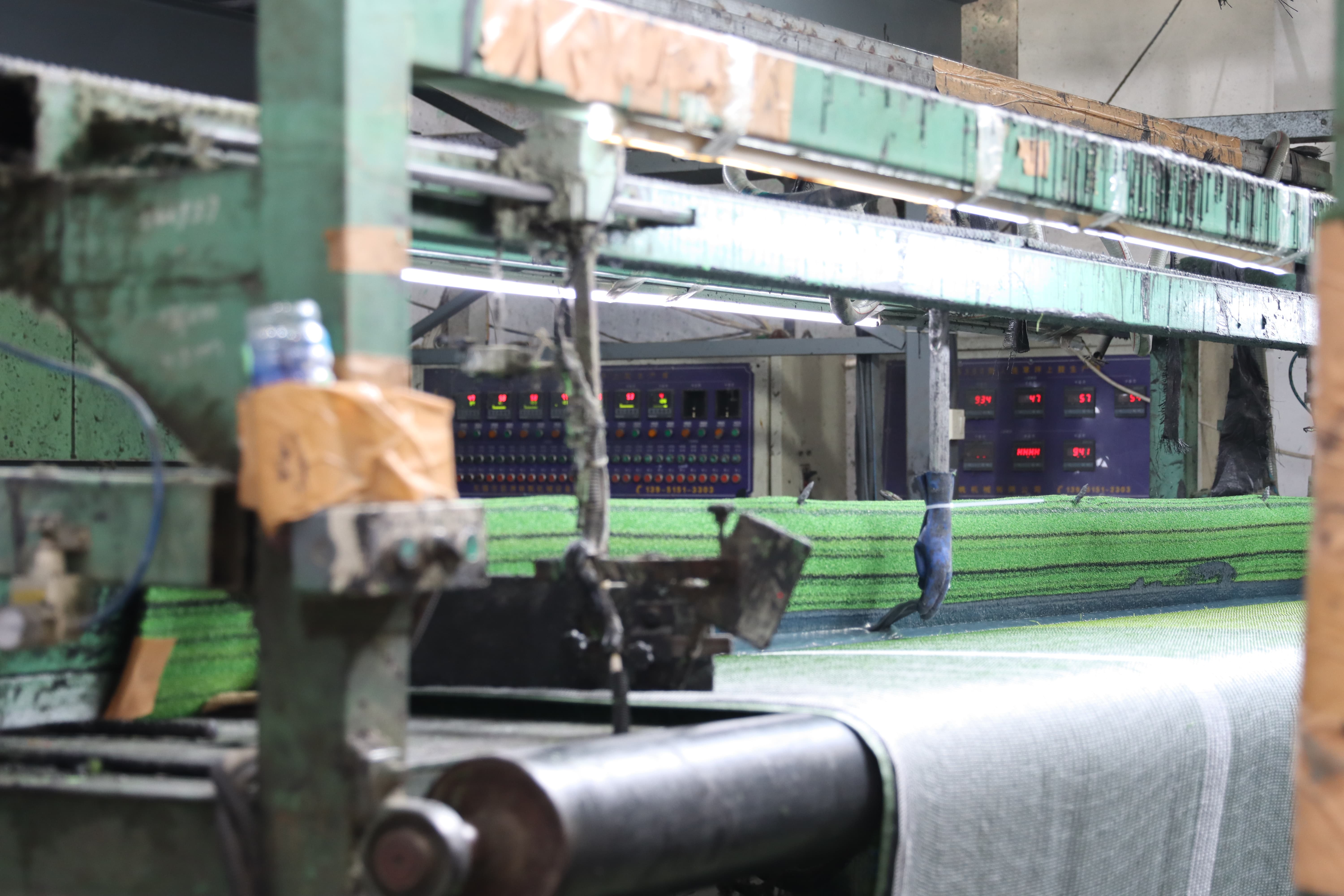
What the Venusturf record does establish is production scope: 30 integrated lines covering yarn extrusion, twisting, tufting, coating and packaging under one operation, 25 R&D engineers, 483 employees, 80% export share, and remote technical support after delivery. For an evaluation-stage buyer, the useful questions follow directly — who signs off a customized construction drawing, which stage the R&D team owns, and who answers an installation query once the rolls are on site.
Application fit: what changes between project types
Artificial turf products are used across sports stadiums, residential lawns, commercial landscapes, playgrounds and recreational facilities, and the acceptance emphasis moves with the use. Venusturf’s published scope covers sports venues, leisure landscape venues and schools; a buyer approaching the range for football, padel, tennis, rugby, baseball, gym or playground surfaces, or for landscape, commercial, residential, backyard, balcony or decorative work, is describing a project type rather than a single product.
Sports surfaces carry the heaviest documentation load. Football surfaces are assessed as a completed system against a governing-body programme, which is why the FIFA Quality Pro vertical rebound band of 0.60 m to 0.85 m is a system criterion rather than a product value. Padel demand has expanded quickly: 14,355 new courts were built in 2025, taking the global total to 77,300 by late 2025 or early 2026, according to the Playtomic and PwC Padel Global Report. More courts mean more buyers specifying padel grass for the first time, and the first thing to fix is which properties belong to the carpet and which belong to the court build.
Landscape, commercial and residential work shifts the emphasis to appearance consistency, dimensional stability across rolls and the material documents behind the yarn and backing. Cornell guidance lists visual appeal and a constant green appearance among the advantages of synthetic turf, which is a qualitative point about why the category is chosen rather than a measured durability figure.
Pet and playground applications add their own questions. Odour and infill handling matter more where users are close to the surface, so the infill specification and cleaning regime belong in the acceptance file. Playground buyers should note that ASTM’s artificial turf listing covers impact attenuation among many other topics — a listing of methods, not a statement that a given product meets a given requirement.
Golf is documented in this record through the Philippine course supply described earlier, using EM241007 across a 10-roll order. Golf grass and golf hitting mat buyers typically want surface consistency and repeatable ball behaviour discussed at sample stage; those are project-specific tests to agree with the supplier rather than values published in this material.
Where the evidence sets a boundary
A 2025 government review concluded that synthetic turf can provide functional and maintenance advantages over natural grass, while noting that installation and long-term use may raise complex environmental and public-health considerations, and that the evidence base remains limited and inconclusive across several reviewed topics. That is the honest frame for a natural-grass comparison: qualitative advantages on both sides, no settled verdict, and a strong case for product-specific testing rather than category-level assurances.
The environmental side is not fully resolved either. The Connecticut peer review noted environmental risk associated with high zinc levels while finding no elevated health risk in the reports it examined. Neither finding can be transferred to an arbitrary product without testing, which is why the acceptance file should name the tests and the report scope rather than the conclusion alone.
On the supplier side, the figures in this article come from Venusturf’s own documentation and from public records about other organisations. Manufacturer-stated output, line count and capacity are claims to confirm during an audit or a first order, and a certificate proves a tested scope on a date, not a permanent status. Treating first-party claims and third-party reports as the same evidence class is the most common shortcut in turf procurement, and it is the one that survives least well after delivery.
Outlook: documentation-led procurement
Court expansion in padel and continued municipal and commercial spending give buyers more suppliers to choose from, not fewer questions to ask. Where several manufacturers can produce a comparable carpet, the differentiator moves from the headline specification to the completeness of the documentation behind it.
Standards work points the same way. The ASTM listing of artificial turf standards and test methods includes designations carrying 2026 dates, including a PFAS sampling method, alongside long-standing methods for lead content in fibres, hazardous metals in infill, permeability, abrasiveness and PAH content. Each method answers a narrow question, and mapping a supplier’s claims to specific methods is a more durable purchasing habit than collecting a compliance sticker.
The conditional conclusion is simple. If a supplier can produce a per-model datasheet, a scoped substance report with a report number, a defined pre-shipment test and a drainage parameter on request, the comparison becomes technical. If it cannot, the evaluation has not yet reached the execution stage, whatever the quotation says.
Frequently asked questions
How do I convert a turf datasheet into acceptance criteria?
Pair each published value with a method, a sample and a pass/fail rule. For EM241007, a 45 mm pile, 150 stitches per metre, 15,750 stitches per square metre and a Double PP backing with PU glue become enforceable once the measuring method, sampling plan and tolerance are written into the order, and once pre-shipment test is defined rather than named.
What does 15,750 stitches per square metre mean next to 150 stitches per metre?
They describe the same tufting density from two directions. Dividing 15,750 by 150 gives 105 stitches across the other dimension, a calculated rather than published value. If the two figures on a datasheet do not divide to a plausible stitching width, the sheet is internally inconsistent and the discrepancy should be resolved before ordering.
Which documents should I request before approving a turf order?
A per-model datasheet covering pile height, stitch rate and backing; a restricted-substances report with number, date and scope, such as the SGS REACH SVHC 240 substances report SL42404282057101TX for EM241007; the pre-shipment test plan; drainage parameters where the base design depends on them; and the material declaration behind any construction claim.
Are rubber infill and chemical risk resolved questions?
No. A 2025 literature review found limited and inconclusive evidence of adverse health outcomes while noting that 9 of 18 reviewed laboratory studies reported PAH concentrations above recommended European guideline values. A Connecticut peer review found no elevated health risk in its reviewed reports, recommended ventilation for indoor fields, and noted environmental risk from high zinc levels. Product-specific testing is the only defensible basis for a decision.
How should I read supplier ranking claims?
By evidence class. An installation count such as FieldTurf’s stated more than 25,000 worldwide is a company claim about its own installed base, not market share. A self-description as a world leader has no disclosed methodology. Competing market values of roughly USD 7.31 billion and USD 7.93 billion for 2026, with scope boundaries unresolved, cannot rank suppliers either.
Source documents for the next step
Wuxi Venus Turf Co., Ltd. publishes its corporate brochure, including the product range and manufacturing profile, at the downloadable brochure. Buyers who want to test the method described here can use it to build the field set, then request the per-model datasheet and the scoped test report for the specific construction under consideration. The company website is vtsyntheticturf.com.
Have Questions or Need More Details?
Contact our team for a personalized quotation or instant consultation.
Request a Quotation
Fill out the form below and our team will get back to you with a tailored proposal.
WhatsApp Direct Chat
Prefer to chat in real-time? Message us on WhatsApp for instant assistance & quick answers.
- Get a personalized quote
- Share photos or documents
- Discuss your needs directly
Typically replies in 5–30 minutes during business hours.