
Artificial Turf Specs: Venusturf Manufacturing Evidence
The global artificial turf market was valued at USD 7.3 billion in 2025 and is projected to reach USD 13.7 billion by 2033, according to Grand View Research. Sports applications alone accounted for approximately 63.1% of that demand. For buyers working through outdoor sports and facilities projects, the more useful question is narrower: which suppliers can actually document the parameters behind the surface they are selling?
Specification data — pile height, gauge, yarn construction, stitch density and backing system — is the part of a turf offer that can be measured, sampled and repeated across orders. This analysis examines six Venusturf product models and treats their published specifications as evidence of manufacturing capability, rather than relying on capability claims alone.
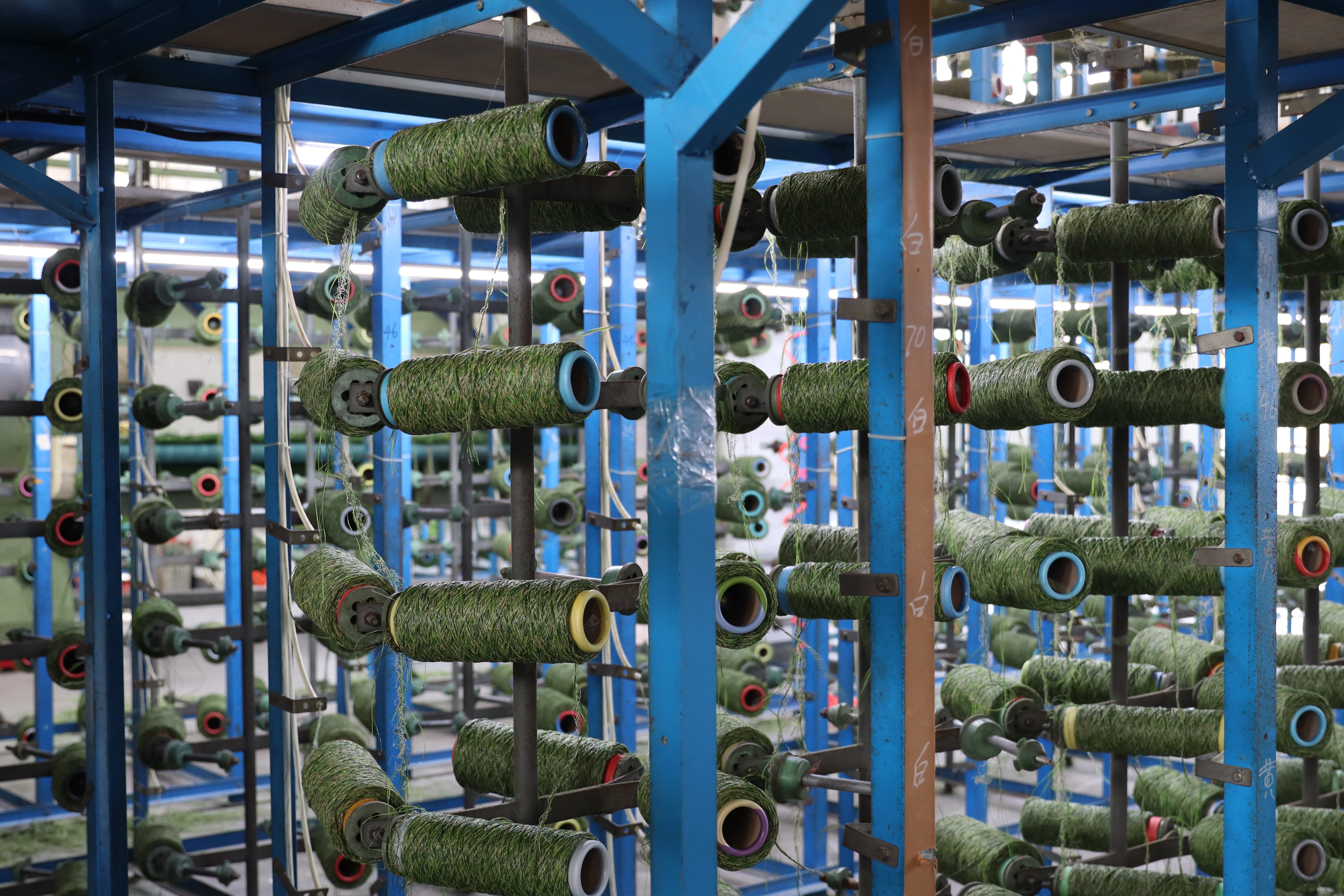
Artificial turf yarn production — the extrusion stage that determines the yarn shapes later visible in finished specifications.
Why specification data is the first real test of a turf supplier
A supplier's manufacturing depth shows up first in numbers that can be checked. Pile height tells a buyer which project categories a product can serve. Gauge and stitch density together define how much yarn is placed per square meter, which drives surface uniformity and wear distribution. Yarn shape and polymer choice affect resilience and appearance retention. Backing construction determines dimensional stability and how the surface behaves under installation and use.
The gap between marketing and manufacturing is usually visible at exactly this level. A supplier that publishes the same parameter set across multiple models — and can restate those parameters on a sample, a quotation and a repeat order — is demonstrating process control. A supplier that describes products only as premium or high-performance is asking the buyer to accept an unverifiable position.
This is a real procurement risk rather than a theoretical one. Replacement demand is now a structural part of the sports turf market: AMI Plastics reported that the replacement segment reached 41% of total sports turf demand in 2023, approximately 70 million square meters. Buyers replacing an existing field have to match a new surface to an application they already know well, and mismatched specifications are expensive to reverse after installation.
Venusturf at a glance: the manufacturing facts behind the specs
Venusturf is the trading identity of Wuxi Venus Turf Co., Ltd., an artificial turf manufacturer based in Wuxi, Jiangsu, China, that integrates research and development, production and sales. The company was established in 2024 and operates a 1,000 m² facility with 483 employees, including a research and development team of 25 engineers. Annual output is listed at 106,000 units, with an export ratio of 80% and global main markets.
Its production model is vertically integrated: 30 integrated production lines cover the full sequence from yarn extrusion, twisting, tufting and coating through to final packaging and delivery. Documented manufacturing capability includes a monthly capacity of 50,000 m², a minimum order quantity of 1,000 m², and a lead time of 30–45 days. Quality control is described as 100% testing, and OEM production is offered with customization across appearance, specifications, performance and functionality, and base and installation systems. After-sales service is delivered as remote technical support.
Those figures matter because they set the conditions under which the product specifications below can be delivered consistently. A 30-line integrated setup explains how one manufacturer can hold six distinct specification profiles — including a 15 mm putting surface and a 50 mm football surface — inside a single production system.
Six models, six specification profiles
The table below reproduces the published parameters of six Venusturf artificial turf models. Read together, they show a manufacturer working across a wide parameter range rather than producing one surface type at scale.
| Model | Line | Pile height | Gauge | Yarn | Density | Backing |
|---|---|---|---|---|---|---|
| EM250105 | Football Grass | 50 mm | 5/8" | U with spine shape monofil PE | 180 stitches/m, 11,340 stitches/sqm | PP + Mesh + SBR Latex |
| Putt 40 | Golf Grass | 15 mm | 3/16" | Curled PE | 300 stitches/m, 63,000 stitches/sqm | Double PP + PU glue |
| EM24081501-1 | Pet Grass | 35 mm | 3/8" | S shape monofil PE + curled PP | 100 stitches/m, 10,500 stitches/sqm | Double PP + Net + Pet glue |
| EM24071902 | Commercial Grass | 25 mm | 3/8" | U shape monofil PE + curled PP | 180 stitches/m, 18,900 stitches/sqm | PP + Net + Latex |
| EM240404 | Residential Grass | 30 mm | 3/8" | C shape monofil PE + curled PP | 140 stitches/m, 14,700 stitches/sqm | PP + Mesh + SBR Latex |
| EM241007 | Residential Grass | 45 mm | 3/8" | U shape with spine monofil PE + curled PP | 150 stitches/m, 15,750 stitches/sqm | Double PP + PU glue |
Published specifications. All models use four-color yarn except Putt 40, which uses two-color yarn. Material base is PE and PP across the range.
Pile height and yarn shape: the first filter
The range runs from 15 mm (Putt 40) to 50 mm (EM250105), which is a deliberately broad spread. Low-pile curled PE constructions are used where ball-roll consistency matters more than cushioning; tall monofil constructions are used where energy absorption and athlete safety are the priority. The yarn shapes also differ meaningfully: U-with-spine monofil PE for the football surface, U shape monofil PE combined with curled PP for commercial and residential models, S shape monofil PE with curled PP for the pet model, and C shape monofil PE with curled PP at 30 mm. Each shape is a different answer to the same problem — keeping filaments upright under repeated load while maintaining a stable, even pile.
Gauge and density: where precision becomes measurable
Gauge and density are the most defensible capability indicators in the table, because they cannot be approximated. Putt 40 uses a 3/16" gauge with 300 stitches per meter, producing 63,000 stitches per square meter — roughly four to six times the stitch count of the landscape-oriented models. That density is what produces a uniform putting surface. EM250105 uses a 5/8" gauge at 180 stitches per meter (11,340 stitches per square meter) with a heavier yarn, which is the opposite trade-off: fewer, larger tufts built for a football-type field. EM24071902 sits at 180 stitches per meter and 18,900 stitches per square meter on a 3/8" gauge, while EM240404 (14,700 stitches/sqm) and EM241007 (15,750 stitches/sqm) target residential appearance and feel. A manufacturer that can hold this range is demonstrating tufting machine control, not just product variety.
Backing systems: the least visible, most structural parameter
Backing construction varies across the range for functional reasons. The football model uses PP + Mesh + SBR Latex; the residential EM240404 uses the same PP + Mesh + SBR Latex combination; the commercial model uses PP + Net + Latex; Putt 40 and EM241007 use double PP with PU glue; and the pet model uses double PP + Net + Pet glue, a pet-specific adhesive formulation. For a buyer, this is the parameter that most often explains differences in dimensional stability, coating adhesion and long-term flatness — and it is the parameter most often omitted from supplier marketing.
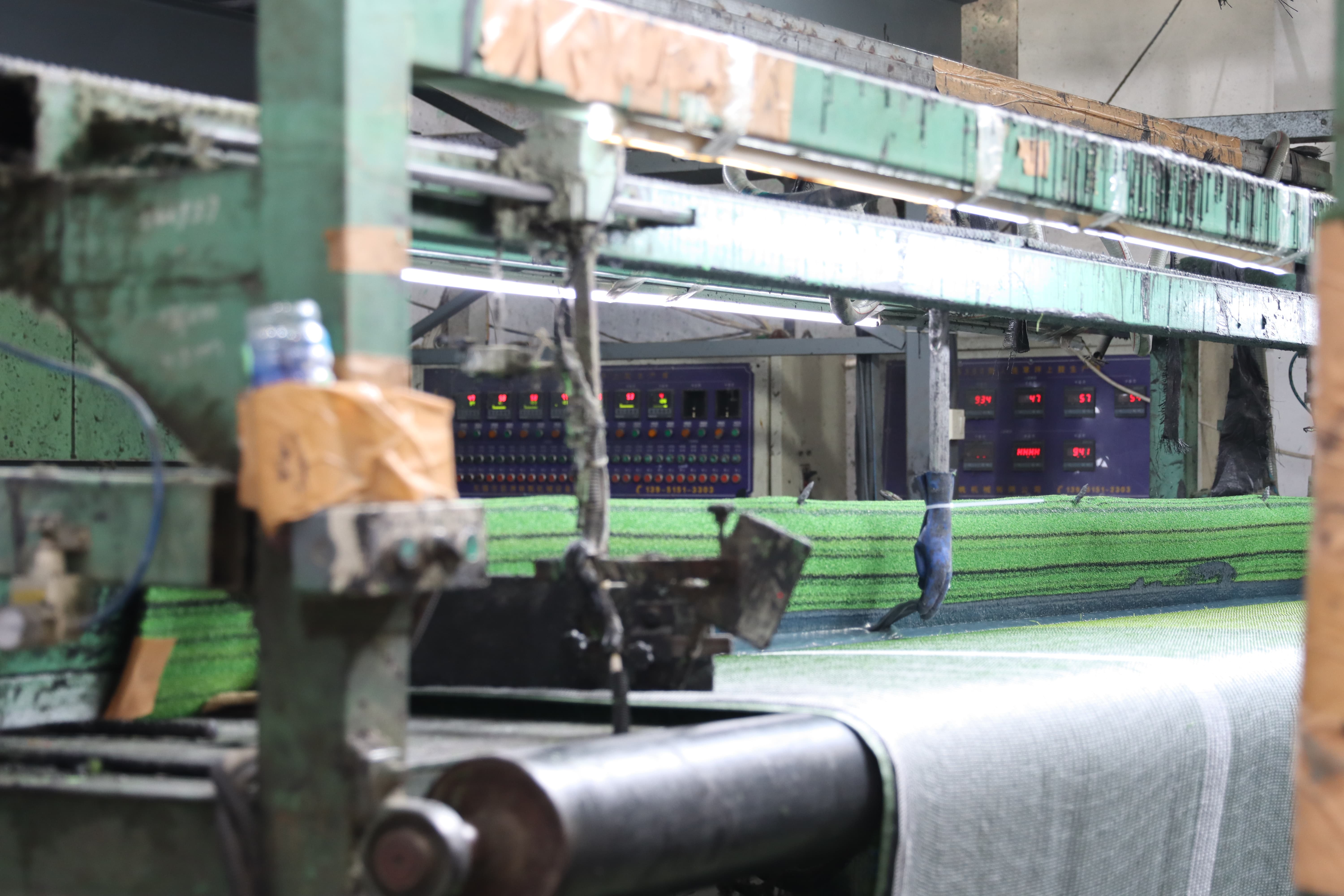
Backing coating: the stage where latex or PU systems bind tufts to the primary backing and determine dimensional stability.
Matching specifications to project scenarios
Venusturf's specifications are documented against applicable industries covering landscaping, sports, construction and hospitality, and against project types including sports field construction, landscape greening, pet area installation, commercial decoration and event venue setup. The six models map onto those scenarios in a fairly direct way.
Football and ball-sports fields. EM250105, at 50 mm pile on a 5/8" gauge with U-with-spine monofil PE and a PP + Mesh + SBR Latex backing, is the profile positioned for football-type surfaces. In sports applications, the documented role of the product is to provide standardized athletic performance and ensure athlete safety.
Golf and putting surfaces. Putt 40's 15 mm curled PE yarn at 300 stitches per meter and 63,000 stitches per square meter, on a double PP + PU glue backing, is a putting-profile construction. A documented project reference describes an individual client in the Philippines using 10 rolls of EM241007 for a golf course application, with low maintenance recorded as the highlight and athletic performance, visual aesthetics and competitive fairness recorded as outcomes.
Pet areas. EM24081501-1 carries a 35 mm pile, S shape monofil PE with curled PP, and a double PP + Net + Pet glue backing — the backing specification is specific to the pet application rather than generic. In this use, the product functions to be easy to clean, alongside replacing natural grass and reducing maintenance costs.
Commercial and hospitality surfaces. EM24071902 at 25 mm with 18,900 stitches per square meter on a 3/8" gauge suits high-visibility commercial decoration and event venue applications, where appearance consistency matters alongside wear resistance.
Residential and landscape. EM240404 (30 mm, C shape monofil PE + curled PP, 14,700 stitches/sqm) and EM241007 (45 mm, U shape with spine, 15,750 stitches/sqm) cover the residential and landscape band, where pile height drives appearance and feel rather than ball performance.
Project-specific requirements are handled through customization of pile height, color, density and material to meet the needs of a given installation. Venusturf also documents the verification equipment behind these parameters: a water bath, spectral light box, UV climate resistance test chamber, tensile tester, moisture tester, intelligent high-transmission electron microscope and vernier caliper. For a buyer, that equipment list is the more useful claim than any quality adjective — it identifies which parameters are actually being measured.
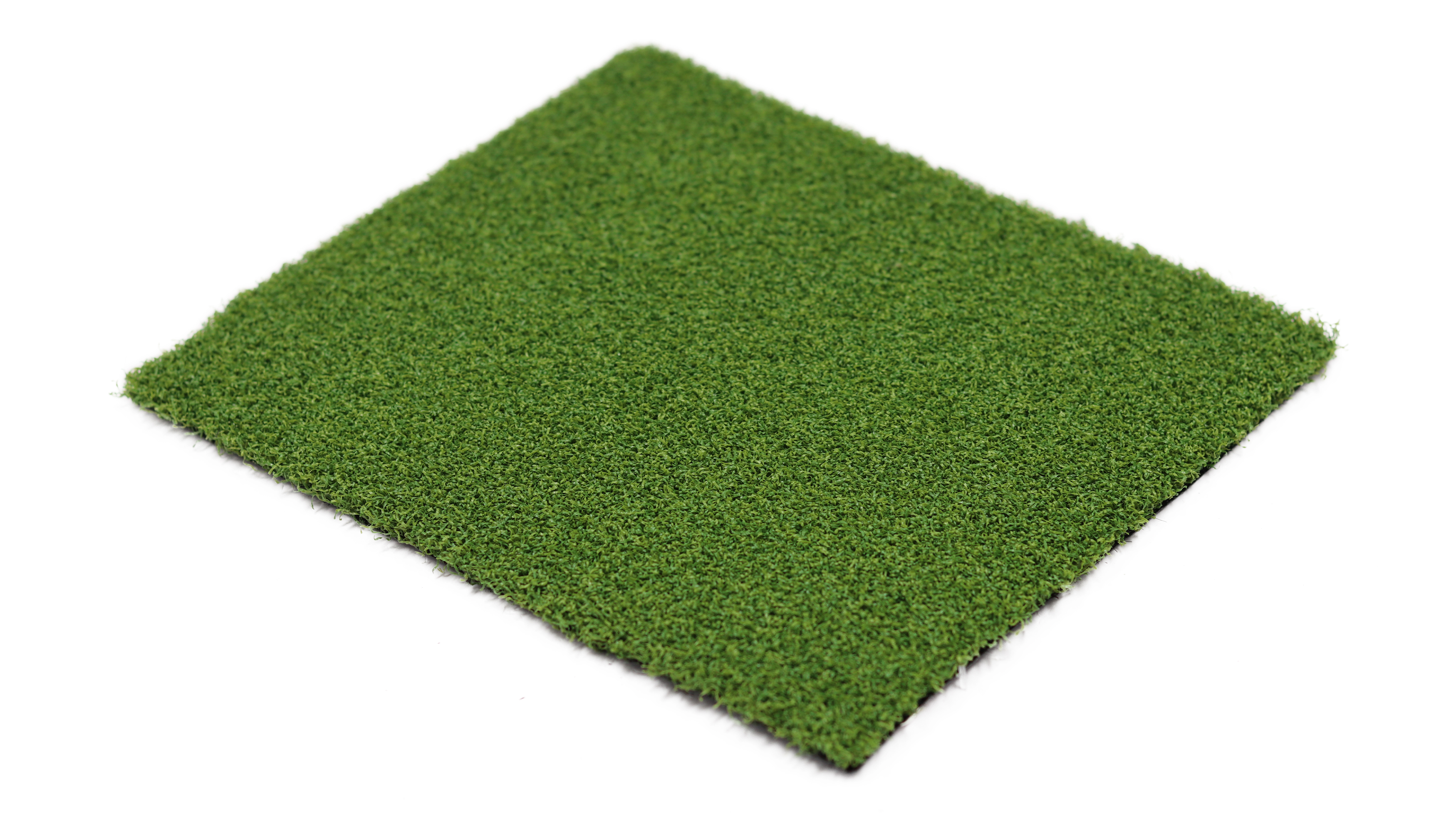
Putt 40: a 15 mm curled PE putting surface at 63,000 stitches per square meter — a density profile that only makes sense in a golf-specific application.
Artificial turf versus natural grass — and where the evidence changes the decision
Against natural grass, the functional case for synthetic surfaces is well established: the product replaces natural grass and reduces maintenance costs, holds up under all-weather outdoor use, and delivers consistent surface behavior regardless of season. Natural grass requires irrigation, mowing, recovery periods and weather-dependent scheduling that many facilities cannot absorb.
The trade-offs are equally real and should be stated plainly. Synthetic surfaces carry a higher upfront investment than seeding or sodding, and they have their own end-of-life considerations once the surface reaches the end of its service life. Surface temperature behavior in hot climates is a genuine design issue for unshaded installations. These are reasons to specify carefully, not reasons the category is unsuitable.
There are also boundaries specific to this supplier that buyers should weigh during evaluation. Venusturf was established in 2024, so its documented installed track record is shorter than that of long-established global turf manufacturers such as CCGrass, Tarkett (FieldTurf), TenCate Grass, Shaw Sports Turf and SportGroup (Polytan) — a factor that matters most for very large or highly reference-sensitive tenders. The stated minimum order quantity of 1,000 m² and lead time of 30–45 days also constrain small or urgent projects, and after-sales support is delivered remotely rather than through on-site service teams. Finally, the specifications themselves impose limits: Putt 40's 15 mm curled construction is a golf putting product and should not be substituted for a ball-sports field surface, just as EM250105's 50 mm football profile is not a landscape product. Specification range is evidence of capability, but it only helps if the right parameter set is matched to the right project.
Market context: why specification-led sourcing is gaining ground
Grand View Research places the global artificial turf market at USD 7.3 billion in 2025, growing toward USD 13.7 billion by 2033, with the Asia-Pacific region holding the largest revenue share at 32.2%. Polyethylene dominates by material, with a 63.1% revenue share in 2025 — consistent with the PE-based yarn constructions seen across the Venusturf range, where PE is combined with PP in every listed model. Sports remains the largest application segment at roughly 63.1% of market share.
Supply-side geography reinforces the same point. Mordor Intelligence reports that China leads the Asia-Pacific market with over 15,000 synthetic sports fields installed, representing 52% of regional installations. That installed base is a large, concentrated pool of manufacturers — which is exactly the condition under which buyers need parameter-level comparability rather than brand adjectives. Where dozens of suppliers quote for the same facility, the specification sheet becomes the only practical shortlisting instrument.
What to expect next
Two pressures are pushing turf procurement toward documented parameters. First, replacement demand — already 41% of the sports turf market in 2023 — puts buyers in the position of replacing a known surface and measuring candidate products against a real reference. Second, buyers are increasingly asking suppliers to restate specifications on samples, quotations and repeat orders, which favors manufacturers with integrated production over those that assemble from purchased rolls.
For a manufacturer like Venusturf, the relevant test is not whether it can produce a single high-specification surface, but whether it can hold six distinct profiles — from 15 mm putting turf at 63,000 stitches per square meter to 50 mm football turf — inside one integrated 30-line system, with 100% testing and documented customization across pile height, color, density and material. That is the form of capability evidence that survives contact with a real project specification.
FAQ
What specifications should a buyer check first when matching artificial turf to a project?
Start with pile height, gauge, yarn construction, stitch density and backing system, because these five parameters determine whether a surface fits an application. Stitch density is calculated from gauge and stitches per meter — for example, Putt 40's 3/16" gauge at 300 stitches per meter produces 63,000 stitches per square meter, while EM250105's 5/8" gauge at 180 stitches per meter produces 11,340 stitches per square meter. Backing system should be checked alongside them: the same product family can use PP + Mesh + SBR Latex, PP + Net + Latex, or double PP + PU glue depending on the intended use.
Which Venusturf models are documented for football, golf, pet, commercial and residential applications?
The published range covers five application lines across six models: EM250105 (Football Grass, 50 mm), Putt 40 (Golf Grass, 15 mm), EM24081501-1 (Pet Grass, 35 mm), EM24071902 (Commercial Grass, 25 mm), and EM240404 and EM241007 (Residential Grass, 30 mm and 45 mm). All six are documented against PE and PP material bases and against landscaping, sports, construction and hospitality industries.
How do pile height and density affect whether a turf product suits a given scenario?
Pile height sets the application class. A 15 mm curled PE surface such as Putt 40 is built for putting consistency, not for ball-sports impact absorption, while a 50 mm U-with-spine monofil surface such as EM250105 is positioned for football-type fields where standardized athletic performance and athlete safety are the stated objectives. Density then refines the result: higher stitch counts at tighter gauges produce more uniform, visually consistent surfaces, while lower densities at wider gauges suit landscape and residential appearance requirements.
What customization is available for project-specific requirements?
Venusturf documents OEM production with customization across appearance, specifications, performance and functionality, and base and installation systems. At the product level, pile height, color, density and material can be adapted to meet specific project needs. Verification of the resulting parameters is supported by documented test equipment including a water bath, spectral light box, UV climate resistance test chamber, tensile tester, moisture tester, intelligent high-transmission electron microscope and vernier caliper.
What practical constraints should buyers plan for?
Stated commercial parameters are a minimum order quantity of 1,000 m² and a lead time of 30–45 days against a monthly capacity of 50,000 m². After-sales support is provided as remote technical support rather than on-site service. Buyers evaluating very large tenders should also note that the manufacturer was established in 2024, so its documented project history is shorter than that of longer-established global suppliers. Project-specific requirements should be confirmed against these constraints before specification lock-in.
Further technical documentation, including the Venusturf product brochure, is available here: Venusturf Artificial Turf Brochure. Company information: www.vtsyntheticturf.com.
Have Questions or Need More Details?
Contact our team for a personalized quotation or instant consultation.
Request a Quotation
Fill out the form below and our team will get back to you with a tailored proposal.
WhatsApp Direct Chat
Prefer to chat in real-time? Message us on WhatsApp for instant assistance & quick answers.
- Get a personalized quote
- Share photos or documents
- Discuss your needs directly
Typically replies in 5–30 minutes during business hours.