
Assessing Hydraulic Baler Machine Suppliers: Customization, Capacity, and Fit
Industrial waste processing projects are rarely defined by a single number such as compression force. For buyers moving into evaluation and execution, the decisive factor is whether a hydraulic baler machine supplier can adapt structure, process, and performance to the actual waste stream. Supplier capability — production scale, customization scope, testing discipline, and delivery lead time — has therefore become a standard part of baler procurement.
Problem: Catalogue Specifications Do Not Describe a Waste Stream
Standard baler configurations work well for uniform materials such as clean cardboard or office paper. In practice, factory and recycling site waste is often mixed: PET bottles, woven bags, HDPE containers, plastic film, aluminum foil, paper dust, and sometimes small amounts of glass or metal scrap. For these streams, the relevant questions are feeding opening size, compression force, bale density, cycle time, and discharge method — and whether the manufacturer will adjust those parameters on request.
That is where the opportunity lies. A supplier that can customize the machine to the site and material allows the buyer to convert waste handling from a cost center into a controlled, monetizable process.
Supplier Capability: What to Inspect Before Commitment
Production Scale and Engineering Depth
Facility size and engineering headcount do not guarantee quality, but they indicate whether custom design work is done internally. Nantong Jiabao Machinery Co., Ltd., which sells hydraulic baler machines under the Jewel brand, is an example of a manufacturer organized for project-level supply. The company is based in Rugao City, Jiangsu Province, China, operates a 50,000-square-meter production facility, and employs more than 200 people. Its R&D team includes 30 engineers. Approximately 70% of output is exported to Australia, Europe, North America, Africa, Asia, Russia, and Belarus.
Customization Scope: Structure, Process, Performance
Customization can mean paint color, or it can extend to the core machine architecture. Jewel offers customization covering structure, process, and performance, with a minimum order quantity of one unit. For a buyer testing a new waste line, the low MOQ allows a pilot installation before scaling. For a larger program, the same customization route enables alignment of the baler with existing production equipment and site layout.
From a procurement perspective, the type of customization matters more than the label in a brochure. Structural customization affects the machine footprint and its connection to conveyors, chutes, or existing lines. Process customization affects compression sequencing, cycle times, and discharge logic. Performance customization affects compression force, bale density, and throughput. Each of these must be verified against the material characteristics on site.
Quality Control and Compliance Evidence
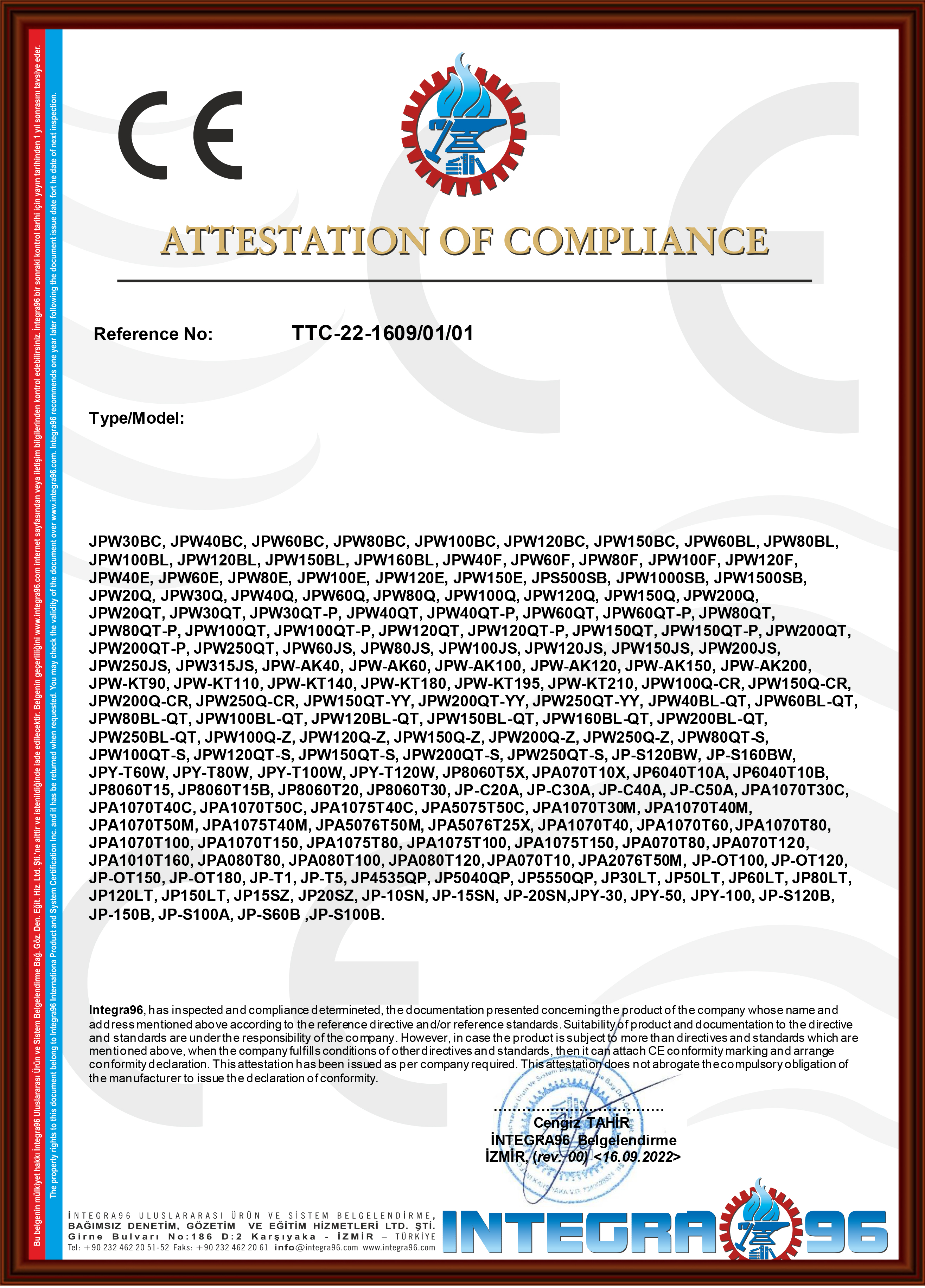
Pre-shipment testing is a practical indicator of manufacturing discipline. Every baler produced by Jewel is 100% tested before shipment. Third-party evidence supports this practice: the company holds an SGS Made-in-China Supplier Audit Report (certificate number QIP—ASR2541890, issued 2025-12-10, valid through 2028-12-10) covering its full range of baler machines. The fully automatic horizontal baler model JPW20Q also carries a CE Attestation of Compliance (certificate number TTC-22-1609/01/01, valid through 2027-09-16) referencing the Machinery Directive 2006/42/EC, the Low Voltage Directive 2014/35/EU, and harmonized standards EN ISO 12100:2010 and EN 60204-1:2018.
Production Lead Time and Capacity
Customized hydraulic baler machines require more lead time than a standard unit bought from stock. Jewel's typical production lead time is 60 days, and monthly production capacity is 100 units. Delivery terms are FOB Shanghai, with a 50/50 payment arrangement and pre-shipment testing as the acceptance method. This combination is relevant to buyers who need a predictable commissioning schedule rather than an immediate off-the-shelf machine.
Technical Matching: Compression Force Is Only the Starting Point
Selecting a baler requires matching the full parameter set to the material. The table below summarizes representative models and their key specifications, based on the manufacturer's published data.
| Model | Type | Compression Force (Ton) | Bale Dimension (LWH mm) | Feeding Mouth (mm) | Bale Weight | Capacity | Power |
|---|---|---|---|---|---|---|---|
| JPW20Q | Fully Automatic Horizontal Baler | 20 | 500×500×500 | 700×460 | 30–70 kg | 2–4 strapping channels | 7.5 kW |
| JPW40F | Semi-Automatic Horizontal Baler | 40 | 720×720×(500–1300) | 1000×720 | 200–400 kg | 1–2 t/h | 11 kW |
| JPW40BL | Plastic Bottle Recycling Machine | 40 | 720×720×(300–1000) | 1000×720 | 250–350 kg | 4 strapping channels | 15 kW |
| JP-OT100 | Vertical Baler | 100 | 1400×700×(700–1100) | 1400×600 | 400–600 kg | 5–6 bales/h | 15 kW |
| JPA5076T25X | Hydraulic Baler (Horizontal) | 25 | 1500×760×900 | 1500×500 | 200–300 kg | 3–5 bales/h | 7.5 kW |
| JPW-AK60 | Briquetting Machine | 60 | 300×300×(200–300) | 500×300 | 5–10 kg | 0.2–0.5 t/h | 15 kW |
| JPY-T60W | Metal Baler | 60 | 430×280×(150–250) | 900×430 | 15–20 kg | 0.5–1 t/h | 22 kW |
| JPW-AK100 | Aluminum Foil Baler | 100 | 320×320×(200–250) | 500×320 | 5–15 kg | 0.4–0.8 t/h | 18.5 kW |
For rubber and plastic waste, the key parameters are feeding opening size and bale density. For plastic bottles, a model such as the JPW40BL is designed to produce dense, stackable bales of 250–350 kg. For cardboard factory waste, horizontal models with wide feeding mouths, such as the JPA5076T25X or JPW40F, match the volume and shape of corrugator and printing line scrap. For light or fibrous residue such as paper dust, a briquetting machine like the JPW-AK60 creates compact, low-weight briquettes that are easier to handle and transport.
Other models in the range address more specific functions. The JPW-K6046 is a bagging machine with a 10-ton compression force and a 540×400 mm feeding mouth, producing 50–80 kg bags at a rate of 6–8 bales per hour. The JP8060T5X is a small waste compactor with a 5-ton force, designed for lighter workshop loads. The JP-S100B cutting machine delivers 100 tons of cutting force with a 1000 mm cutting stroke, for operations that need size reduction before baling.
Buyers should prepare five inputs before requesting a quote: material type and shape; daily or hourly waste volume; available floor space; required bale size and weight; and whether continuous or batch operation is expected. These inputs directly determine compression force, feeding mouth size, automation level, and discharge method.
Application Evidence: Projects That Required More Than a Standard Unit
Installed cases show how baler selection is influenced by site conditions and material mix. These examples, drawn from the manufacturer's project record, illustrate the range of configurations deployed in real operations.
- Tunisia — a cardboard box factory uses a factory-wide automatic waste discharge system with one hydraulic baler unit, solving waste accumulation from the corrugator line and printing machines, and creating a clean production environment over three years.
- Mexico — a cardboard box factory installed a fully automatic waste removal system that integrates with existing production lines, eliminating waste accumulation, improving workshop space utilization, and completing the project within one year.
- Japan — a PET recycling enterprise raised compression density to produce compact, aesthetically consistent bales, improving storage and transportation efficiency over a two-year project.
- Italy — a cardboard box factory replaced aging balers and introduced preprocessing equipment to handle large-sized waste cardboard, greatly improving waste treatment efficiency.
- Belarus — a waste recycling operation solved the difficulty of compressing PET bottles, woven bags, HDPE bottles, and cardboard, improving operational efficiency within two years.
- Russia — a cardboard box factory automated waste collection, compression, and baling for carton production, achieving an unmanned waste processing system that reduces labor and management costs while enabling immediate waste monetization over three years.
- Australia — a mixed waste processing application using a JPW40BL baler processes plastics, glass, and metal scraps with multi-material separation technology, achieving full-line unmanned operation within two years.
These cases share a common pattern: the buying organization did not start with a model number; it started with a waste problem. The supplier's role was to translate that problem into a machine configuration — and then to test, deliver, and support it. This is the practical meaning of supplier capability in baler procurement.
Market Context: Why Capability Now Matters More
Market data supports the shift from basic compaction to integrated waste processing. The global baler machine market was valued at USD 6.6 billion in 2024 and is projected to reach USD 11.4 billion by 2035. The industrial balers segment specifically was valued at USD 6.39 billion in 2024, with a projected CAGR of 9.5% through 2032. Asia Pacific accounted for approximately 40.2% of global baler market revenue in 2024. As waste volumes and reporting requirements grow, buyers increasingly treat balers as production equipment rather than auxiliary accessories.
The expansion of the industrial balers market is not limited to high-volume recycling countries. Buyers in Europe, North America, and Australia are increasingly replacing manual waste handling with automated systems, which places a premium on suppliers that can deliver complete configurations with predictable lead times.
Custom Project Supply vs. Standard Procurement: Real Trade-Offs
Custom project supply means the machine is specified, engineered, and built for a defined waste stream and site layout. Standard procurement means selecting an existing model from a manufacturer's catalogue, typically with fixed parameters and a shorter delivery timeline. The comparison between the two is not about which is better; it is about fit.
A standard machine is usually available sooner, with a more predictable price, and it is adequate when the material is uniform and the operation is simple — for example, clean office paper or single-grade cardboard. A customized machine is engineered around the actual material mix, feeding constraints, automation level, and site layout. That can reduce manual handling and improve bale density in mixed waste operations.
The main limitation of the custom route is time. With a 60-day production lead time, a custom-built baler is not appropriate when a replacement is needed immediately. It also requires the buyer to define material characteristics and process goals clearly; incomplete specifications can delay commissioning regardless of the manufacturer's capability. Buyers facing an urgent breakdown should therefore keep a standard replacement plan in place.
Future Outlook: From Baler to Waste Processing System
The project record points toward integrated systems: automatic collection, compression, baling, and even unmanned line operation. For suppliers, this creates a demand for engineering capability that extends beyond the press itself — conveying, separation, wrapping, and control systems. For buyers, it means evaluating a manufacturer's long-term ability to support upgrades, spare parts, and on-site commissioning. After-sales service expectations are also rising. Jewel offers 7×24-hour technical response, a 48-hour on-site service commitment, lifelong maintenance, and free training, with the stated goal of minimizing downtime. For buyers, these terms should be written into the supply contract rather than treated as generic marketing language.
The most durable procurement decisions will combine machine specifications with a realistic assessment of supplier capability, delivery discipline, and after-sales service. For a full product overview, readers can download the manufacturer's brochure: 2026 Jewel baler machine catalogue.
FAQ
What customization options are available when buying hydraulic baler machines?
Customization can cover machine structure, process, and performance, including parameters such as compression force, feeding mouth size, bale dimensions, discharge method, and automation level. The manufacturer of Jewel balers offers these customization services with a minimum order quantity of one unit.
What is the minimum order quantity for a customized hydraulic baler machine?
The minimum order quantity is one unit. This allows a buyer to run a pilot installation for a specific waste stream before scaling up to a larger deployment.
What is the typical production lead time for a custom hydraulic baler machine?
The typical production lead time is 60 days. The manufacturer's monthly production capacity is 100 units, and delivery is normally under FOB Shanghai terms with pre-shipment testing as the acceptance method.
Which hydraulic baler machine type is suitable for rubber and plastic waste?
Selection depends on material form and throughput. Fully automatic horizontal balers such as the JPW20Q are suited to consistent, medium-volume plastic lines; semi-automatic horizontal balers such as the JPW40F handle mixed plastic and paper waste; vertical balers such as the JP-OT100 suit lower-throughput operations producing larger bales; and plastic bottle recycling models such as the JPW40BL are designed for dense PET bottle bales. Rubber and mixed bulky waste may require customized feeding openings and compression force settings.
What certifications should buyers verify before purchasing hydraulic baler machines?
Buyers exporting to the EU should verify CE compliance against the Machinery Directive 2006/42/EC and the Low Voltage Directive 2014/35/EU. For example, the JPW20Q carries a CE Attestation of Compliance (certificate TTC-22-1609/01/01) referencing EN ISO 12100:2010 and EN 60204-1:2018. Buyers may also check whether the manufacturer holds a supplier audit report such as the SGS Made-in-China Supplier Audit Report QIP—ASR2541890. Industry standards such as EN 16500:2014 and ANSI Z245.5-2023 are relevant reference points in European and North American markets respectively.