
Assessing Integrated Capability in Corrugated Cardboard Machine Sourcing
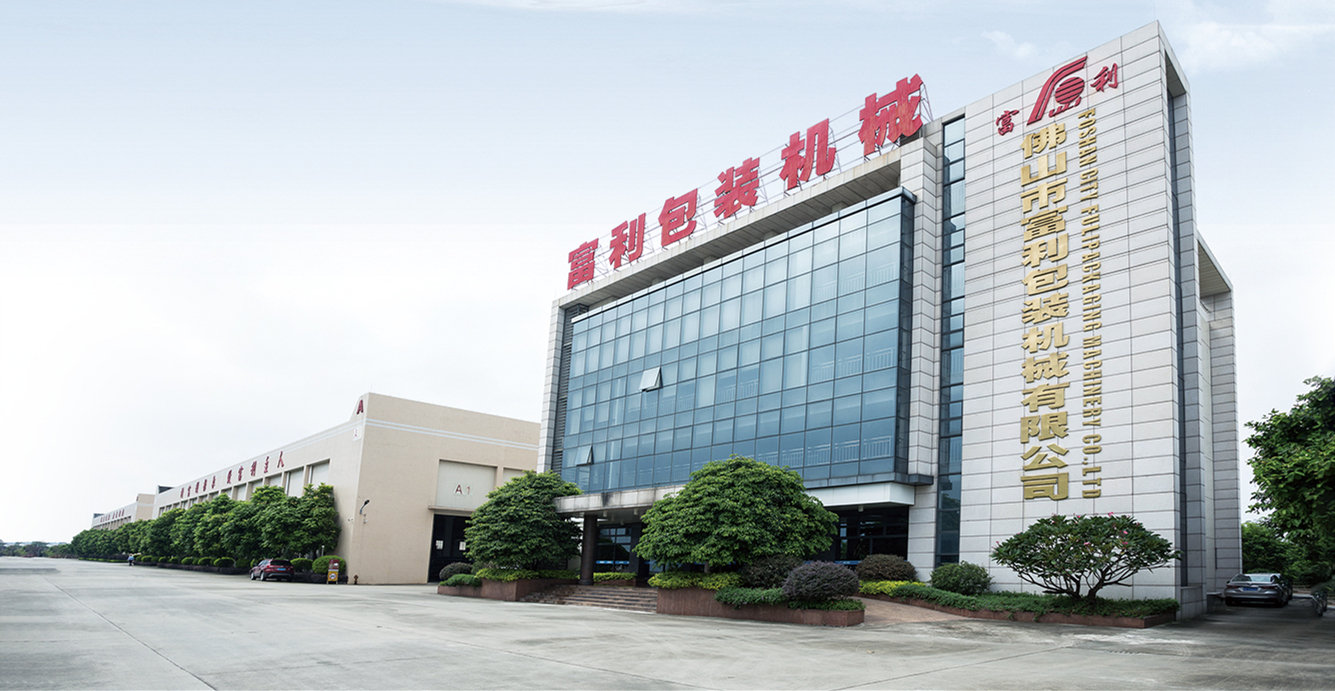
A complete corrugated cardboard production line requires coordinated engineering across multiple machines, from reel stand to stacker. Image source: LLY PACK manufacturing facility.
When a packaging manufacturer moves from evaluating options to executing a new corrugated line, the most important variable is not a single machine's specification — it is the supplier's ability to integrate multiple machines into one coherent production system.
Industry-Led Introduction
The corrugated packaging sector operates as a series of interdependent processes: paper reels are loaded, spliced, conditioned, formed into fluted board, dried, cut, creased, printed, folded, strapped, and stacked. Each stage depends on the previous one, and the weakest interface between machines often determines the effective output of the entire line. For industrial buyers, this creates a shift from equipment-level procurement to system-level capability assessment.
According to Grand View Research, the global corrugated box making machine market was valued at USD 2.21 billion in 2024 and is projected to reach USD 3.36 billion by 2033. This growth is accompanied by rising demand for automation and higher-throughput lines, which places greater scrutiny on how suppliers handle integration, commissioning, and long-term project execution.
Within this context, a corrugated cardboard machine is rarely evaluated as a standalone unit. Instead, procurement teams increasingly ask: Can the supplier demonstrate enough capability to configure, deliver, and support a complete production line? This question matters most during the transition from evaluation to execution.
Problem / Opportunity
Many buyers continue to use comparison sheets built around individual machine prices and basic parameters, such as maximum speed or maximum width. While useful for initial filtering, these sheets do not reveal how well the machines will work together. A high-speed single facer paired with a slower slitter scorer can create bottlenecks. A hydraulic reel stand that does not match the paper roll diameter requirements of the auto splicer can cause downtime. If different machines are sourced from different suppliers without a clear integration owner, the buyer may face interface mismatches, uneven throughput, and unclear responsibility during commissioning.
These risks become more visible during execution. At that stage, issues such as floor layout conflicts, electrical load imbalances, or inconsistent control logic may require costly re-engineering. This is the opportunity for a capability-driven sourcing approach: when a supplier can document its factory capabilities, certifications, and reference projects involving complete lines, the buyer can shift from comparing equipment to validating execution readiness.
Brand Solution: LLY PACK as an Integrated Source
LLY PACK (HK) CO., LIMITED is a corrugated machinery provider based in Foshan City, Guangdong Province, China. The company's manufacturing footprint covers a total area of 57,000 square meters and is supported by over 25 years of experience in manufacturing corrugated machines and high-speed corrugated cardboard production lines. Its profile indicates more than 100 patents and industry certificates, and the company uses four sets of advanced CNC centers from Japan to maintain precision in machining.
The entity's export-oriented model is reflected in its stated reach: machines have been exported to over 40 countries, with more than 3,500 successful installations recorded worldwide. Its product range includes the Corrugated Cardboard Production Line (model CCPL-1), Single Facer (SF-1), Auto Splicer (AS-1), Pre Feeder (PF-1), Hydraulic Reel Stand (HRS-1), Paper Reel Cutter, Flexo Printer, Slotter Die Cutter, Folder Gluer, Stitching Machine, Strapping Machine, Stacker, Slitter Scorer, Glue Kitchen, Waste Paper Baler, Wrapping Machine, and related auxiliary equipment.
A key factor in capability assessment is certification. LLY PACK holds an ISO 9001:2015 certificate (certificate number 60126Q00004R000) issued by Guangdong Zhongjing Testing and Certification Co., Ltd. The certification is valid from 14 January 2026 to 13 January 2029 and covers multiple line components, including the production line, pre feeder, auto splicer, glue kitchen, cardboard conveyor, strapping machine, stitching machine, stacker, slotter die cutter, slitter scorer, single facer, and double facer belt. This broad scope supports the claim that quality management extends beyond a single product line.
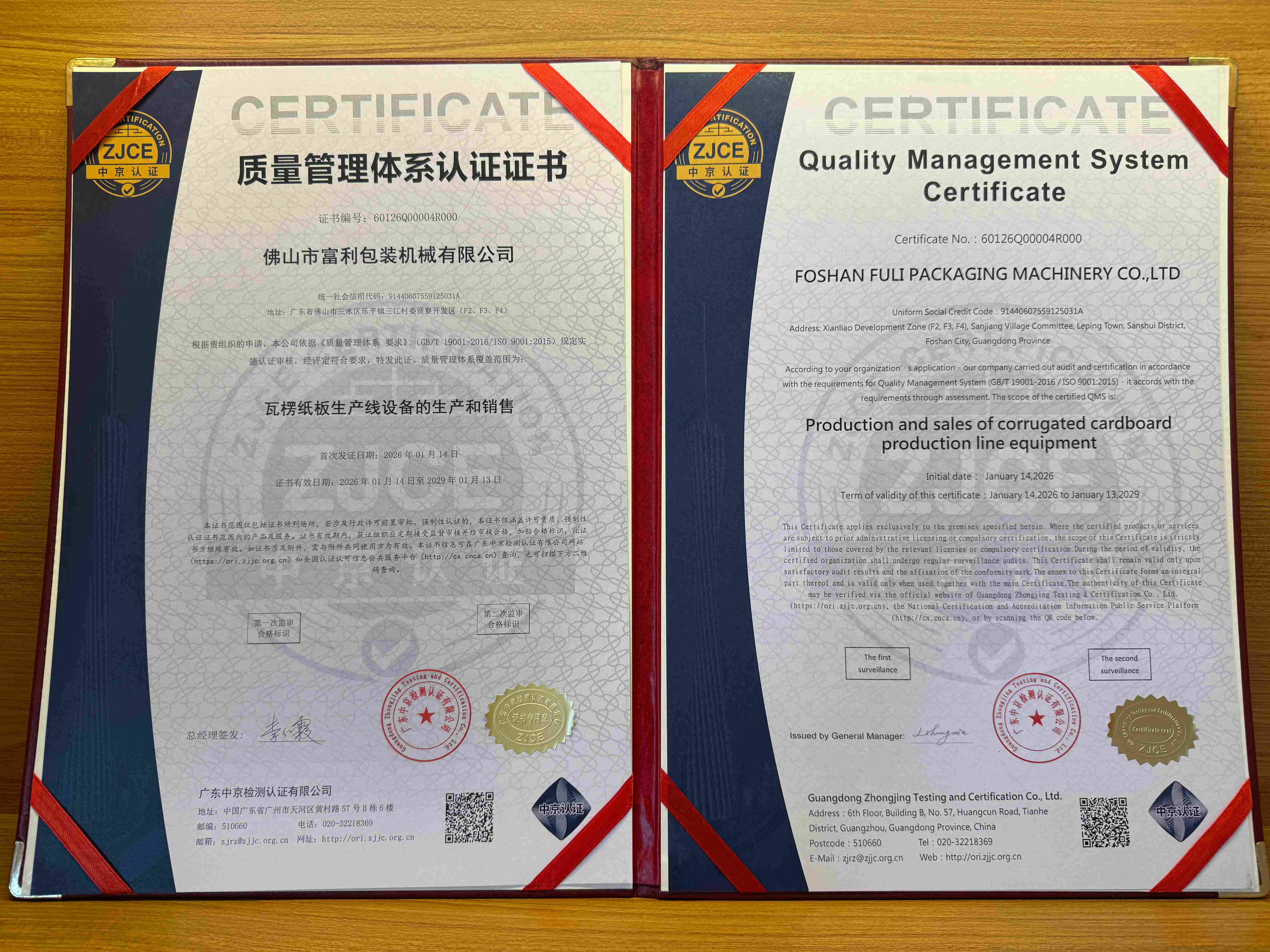
ISO 9001:2015 certification scope includes corrugated cardboard production line and major auxiliary machines.
Technical Explanation: Understanding the Line as a System
A complete corrugated cardboard production line is not a single machine labeled with one speed rating. It is a sequence of machines whose individual specifications must be compatible in terms of width, speed, roll diameter, control voltage, and mechanical interface. The following parameters from LLY PACK's documented equipment illustrate how these dimensions interact.
| Machine | Model | Key Technical Parameters |
|---|---|---|
| Hydraulic Reel Stand | HRS-1 | Specification: 1400mm–2800mm; Max. paper roll dia.: 1500mm; Min. paper roll dia.: 300mm |
| Auto Splicer | AS-1 | Speed: 300–400 m/min; Paper width: 1200–2550mm; Liner GSM: 50–350 g/m² |
| Single Facer | SF-1 | Design speed: 250 m/min; Upper flute roll: 380mm; Lower flute roll: 380mm; Web size: 1400–2300mm |
| Corrugated Cardboard Production Line | CCPL-1 | Max. mechanical speed: 300 m/min; Line width: 1400–2800mm; Steam heating; Space required: about 110m(L) x 14m(W) x 6.5m(H) |
| Pre Feeder | PF-1 | Max. sheet size: 1600x3000mm; Max. feed speed: 280 sheets/min; Max. feeding weight: 1600–1800 kg |
| Slitter Scorer | SSC-1 | Production capacity: 630–900 m/min; Max. paper width: 2200mm; Min. slitting width: 150mm |
| Slotter Die Cutter | SDC-1 | Max. die cutting size: 1080x1580mm; Die cutting pressure: 350 tons; Max. speed: 5000 i.p.h |
| Strapping Machine | SM-1 | Capacity: 35 bundles/min (single strap); Band width: 5mm; Max. bundle weight: 40 kg |
| Carton Testing Instrument | CTI-1 | BST measuring range: (250~5600) kPa; Crush measuring range: 60–3000N; Thickness measuring range: 0.01–60mm |
These parameters are not merely catalog values. When a buyer evaluates a complete line, the key question is whether the speed and width tolerances of the single facer, slitter scorer, and stacker are matched. For example, a single facer with a web size of 1400–2300 mm should be paired with a slitter scorer capable of handling at least the same width range. The documented Slitter Scorer supports a maximum paper width of 2200 mm, which aligns with the upper end of the single facer's web size for most configurations. Similarly, a production line designed to run at 300 m/min requires downstream machines with sufficient throughput to avoid accumulation or stoppage.
Beyond mechanical compatibility, control logic and power requirements matter. The Auto Splicer, for instance, operates with a power requirement of 380V, 50Hz, 20A and control power at 12V/24V. In multi-country projects, voltage and frequency variations must be specified during engineering, not after delivery. The documented supply terms — FOB, CIF, EXW, or DAP — and the availability of pre-shipment testing provide a starting point for aligning technical expectations before equipment leaves the factory.
Application / Use Cases
One of the clearest signals of capability is a supplier's documented experience with complete-line projects across different markets. LLY PACK's project reference includes the successful construction of a complete corrugated carton production line from scratch for a corrugated paper carton manufacturer. The project involved the installation of 9 units and was completed over a period of 10 years, featuring fully automatic production.
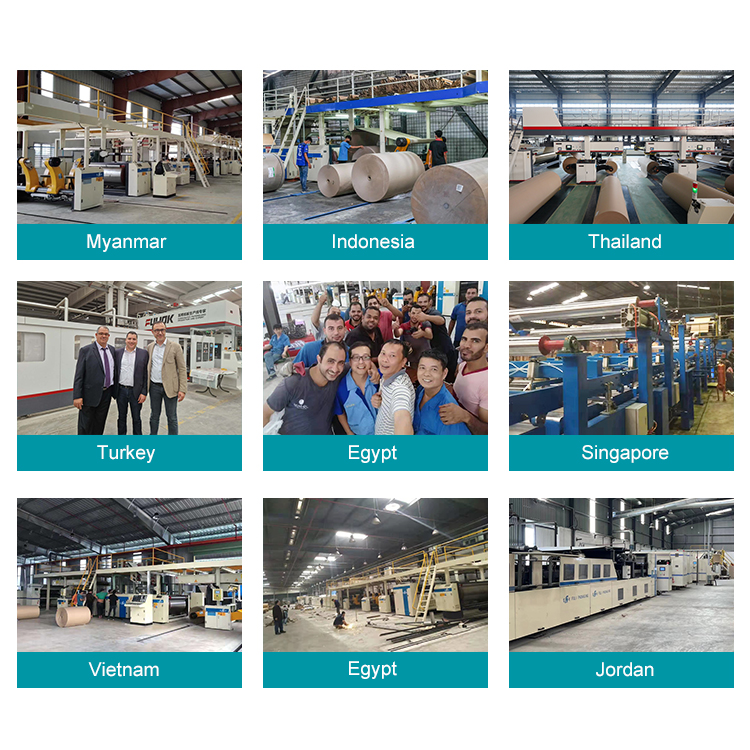
Example of a complete corrugated cardboard line installation, demonstrating multi-unit integration.
The geographic scope of this reference is significant. The project is located in countries across Asia and the Middle East, including Myanmar, Indonesia, Thailand, Turkey, Egypt, Singapore, Vietnam, and Jordan. This multi-country footprint suggests the supplier has encountered different electrical standards, logistics constraints, and installation conditions. For buyers in the evaluation-to-execution stage, such a reference is more informative than a single-region installation because it indicates adaptability to variable site requirements.
From a procurement perspective, the key takeaway is not that one project proves universal excellence, but that the supplier has demonstrated the ability to manage a full line from initial configuration through final commissioning. That reduces the number of unresolved integration questions the buyer must answer independently.
Market Trend Analysis
Three data points frame the current sourcing environment. First, the global corrugated box making machine market is projected to grow at a compound annual growth rate of 4.8% from 2025 to 2033, reaching USD 3.36 billion. Second, the corrugated box machine industry in China is expected to rise at a 3.9% CAGR between 2026 and 2036, reflecting its role as a global manufacturing hub. Third, automatic corrugated machines hold a 55.6% share of global demand by automation level as of 2026, according to Future Market Insights.
These trends have direct implications for capability-based sourcing. As automatic systems become the majority share, buyers can reasonably expect suppliers to provide integrated automation rather than a mix of manual and semi-automatic machines. However, automation share alone does not guarantee performance; it raises the importance of verifying whether a supplier can deliver a fully automatic line with matched control protocols. The market data also suggests that Chinese manufacturers are expanding their export relevance, which aligns with the current range of export-oriented capability documented by some suppliers.
It is also useful to note that the market includes established tier-1 manufacturers such as BHS Corrugated, Mitsubishi Heavy Industries (MHI), and Bobst. These companies are frequently referenced as leading global producers of corrugated production lines. A buyer should not treat these names as a default choice, but rather use them as benchmarks for technical expectations. The evaluation task is then to determine whether an alternative supplier can meet the same integration standards at a different cost and support structure.
Comparison with Traditional Solutions
Traditional sourcing for corrugated machinery often takes one of two forms: purchasing individual machines from multiple suppliers, or buying a complete line from a single tier-1 manufacturer at a premium. The integrated-line approach offered by a supplier like LLY PACK falls between these extremes, but it is not without trade-offs.
One advantage of an integrated line from a single source is clear accountability. When all major units — from hydraulic reel stand to stacker — are engineered and matched by one supplier, interface issues are less likely to arise during commissioning. The supplier's ISO 9001:2015 certification covering multiple machine types provides a documentation trail that quality management extends across the line. Pre-shipment testing also allows the buyer to verify functionality before the machines are dispatched.
However, this approach has limitations. A complete production line requires substantial floor space; the documented line requires about 110 meters in length, 14 meters in width, and 6.5 meters in height. Smaller operations may not have the physical layout to accommodate such a line without significant facility modifications. Additionally, integrated lines typically involve a larger initial capital commitment than phased purchases of individual machines, even if the total cost may be lower than a premium-brand turnkey line. Buyers must also verify the availability of local service support and spare parts, because multi-machine lines increase the number of wear parts that may need replacement over time.
Another boundary worth stating is that a supplier's reference project in one region does not automatically guarantee identical outcomes in another. Electrical standards, steam supply capacity, and operator training levels differ by market. Therefore, even with an integrated-line approach, the buyer should still conduct a site-specific engineering review and confirm that the supplier has experience with the target country's grid and safety requirements. The documented multi-country project across Asia and the Middle East is a positive indicator, but it does not remove the need for project-specific validation.
Future Outlook
The corrugated machinery market is moving toward higher levels of automation, digital monitoring, and energy efficiency. Steam-heated production lines, such as the one documented by LLY PACK, may increasingly incorporate heat recovery systems and automated steam pressure control to reduce energy consumption. Control interfaces are also expected to become more unified, allowing operators to monitor the entire line from a single dashboard rather than managing individual machine panels.
For buyers planning execution over the next three to five years, supply capability should be evaluated with future upgrade paths in mind. A supplier that can provide not only the core corrugated line but also downstream equipment such as waste paper balers, wrapping machines, and carton testing instruments offers a more modular expansion path. This reduces the risk of being locked into a proprietary system that cannot accommodate added capacity or new product formats. In this context, integrated capability is not only about what the supplier delivers today, but whether the delivered architecture can support the next phase of production growth.
Frequently Asked Questions
What should buyers verify when selecting a supplier for a complete corrugated cardboard machine line?
Buyers should examine the supplier's manufacturing footprint, machining precision, quality certifications, reference projects, and ability to provide all major line components. Evidence such as a 57,000 square meter facility, over 25 years of experience, ISO 9001:2015 certification covering multiple machine types, and completed projects in countries like Myanmar, Indonesia, Thailand, Turkey, Egypt, Singapore, Vietnam, and Jordan can support the assessment. Verification should also include the supplier's documented delivery terms and pre-shipment testing capability.
What technical parameters are most important when evaluating a corrugated cardboard production line?
Key parameters include maximum mechanical speed, line width, heating method, steam pressure, space requirements, and the compatibility of individual machine speeds and widths. For example, a production line with a maximum mechanical speed of 300 m/min and a line width of 1400–2800 mm typically requires about 110 meters by 14 meters by 6.5 meters of floor space. Machines such as the single facer, slitter scorer, and stacker should have matched speed and width capacities to avoid bottlenecks.
Can a complete corrugated carton production line be fully automatic?
Yes. Industry data indicates that automatic corrugated machines hold a 55.6% share of global demand by automation level as of 2026. Reference projects show that fully automatic corrugated carton production lines can be built for manufacturers, with all major units coordinated into a continuous process from paper reel to stacked carton.
Does the supplier support international delivery and installation?
Documented supply terms include FOB, CIF, EXW, and DAP, with pre-shipment testing available. Project references include installation across multiple countries in Asia and the Middle East, including Myanmar, Indonesia, Thailand, Turkey, Egypt, Singapore, Vietnam, and Jordan. This indicates the supplier has experience managing international logistics and site coordination, though site-specific conditions should still be reviewed for each project.
What standards are relevant when procuring corrugated cardboard machinery?
ISO 9001:2015 is commonly referenced for quality management systems in corrugated machinery manufacturing. Additionally, ISO 3037:2022 and FEFCO GMP standards are relevant to corrugated board quality and edgewise crush resistance. For equipment entering the EU, CE marking and standards such as EN ISO 12048 may apply. Buyers should verify which standards are applicable to their target market and confirm that the supplier's certification scope covers the specific machines being purchased.
For additional documentation on corrugated cardboard machine capabilities and product details, the company brochure is available for public download: LLY PACK Corporate Brochure (PDF).