
Assessing Substation Transformer Quality: High-Voltage Design Specifications North American Buyers Must Verify in 2026
For procurement professionals in North America, the decision to select a substation transformer supplier goes beyond price. It requires verifying that the power transformer meets stringent ANSI standard substation transformer and IEEE standard substation transformer requirements. With extended lead times from domestic manufacturers—often exceeding 100 weeks—buyers are increasingly evaluating overseas suppliers. But how can one objectively judge whether a supplier’s quality truly meets project specifications?
The Core Challenge: Verifying Compliance Without Compromise
Every substation power transformer must deliver reliable performance under fault conditions, high impulse voltages, and continuous load. The fundamental benchmarks—insulation coordination (BIL), temperature rise limits, short-circuit withstand, and efficiency per DOE 2016—are non-negotiable. A 2025 industry survey found that 68% of North American utility engineers cite “incomplete certification evidence” as the top reason for rejecting overseas bids. The challenge is not finding a substation transformer manufacturer, but finding one that can provide transparent, verifiable proof of compliance.
Technical Core: What Constitutes a ‘Qualified’ High-Voltage Design?
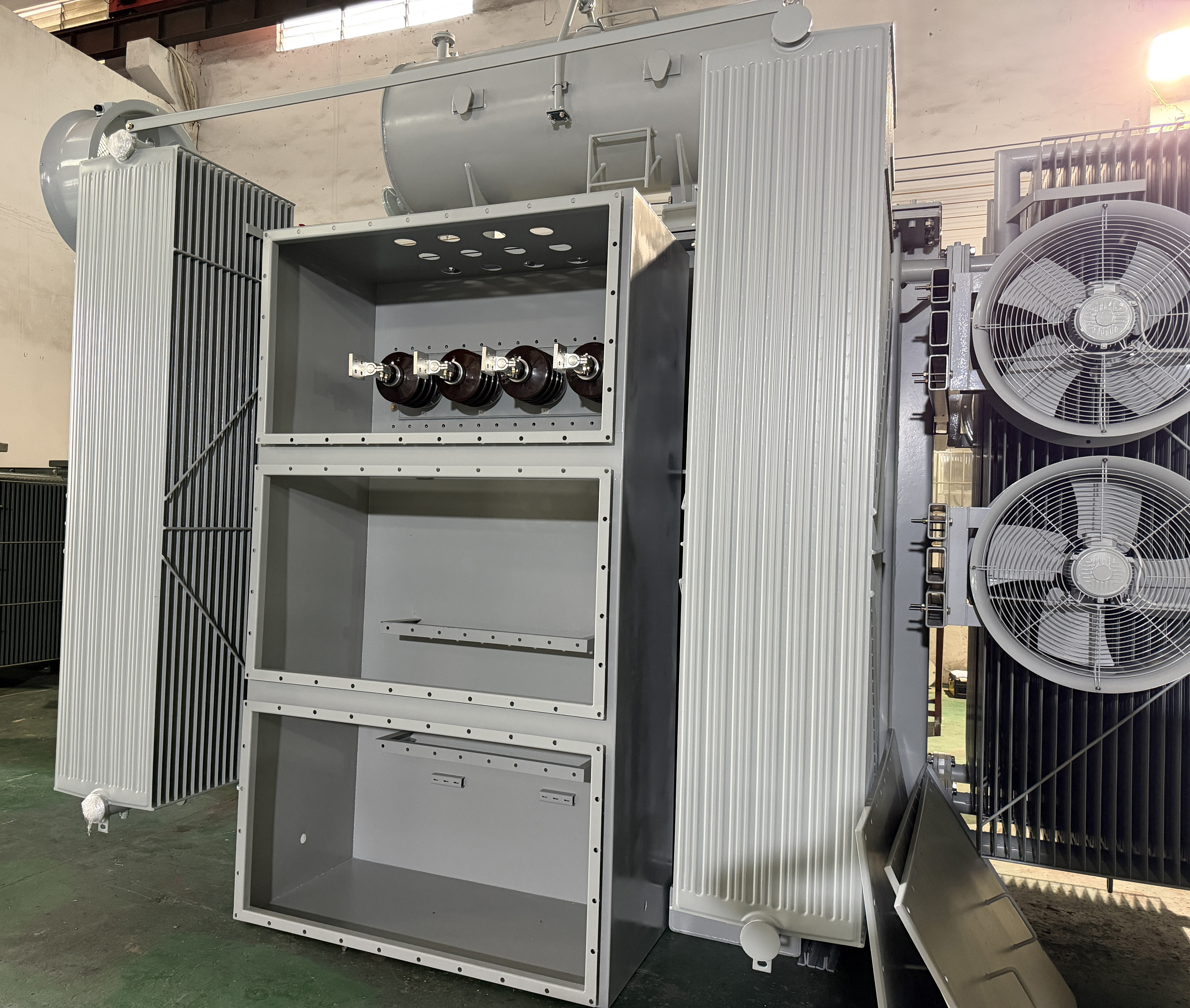
For an oil immersed transformer used in a utility substation, the key design elements include:
- Voltage Ratings & Taps: Primary voltage ranging from 2.4 kV to 138 kV, with off-circuit or on-load tap changers meeting ANSI C57.12.00.
- Basic Insulation Level (BIL): Must match system BIL (e.g., 650 kV for 138 kV class) and be verified by lightning impulse tests.
- Short-Circuit Strength: Ability to withstand symmetrical and asymmetrical fault currents without winding deformation, validated by type tests.
- Cooling and Noise: ONAN/ONAF ratings, with sound levels per IEEE C57.12.90.
- Material Quality: High-grade grain-oriented silicon steel, copper windings, and corrosion-resistant tank (e.g., 304 stainless steel for NEMA 4X).
These specifications directly affect the long-term reliability of the electrical substation transformer—especially for critical applications like solar substation transformers and data center substation transformers.
Supplier Quality Benchmarks: A Framework for Buyers
When evaluating a substation transformer supplier, three pillars determine quality: certification, testing capability, and delivery performance.
🔹 Certification
Look for UL listed substation transformer marks, cUL for Canada, and compliance with ANSI/IEEE C57. A supplier like Winley Electric holds UL certification numbers such as UL-US-2564931-0 for pad-mounted transformers and UL-US-2329418-0 for dry-type, covering both US and Canada.
🔹 Testing
Routine tests (ratio, resistance, insulation) and type tests (lightning impulse, partial discharge) should be performed in accredited labs. Winley Electric’s factories are equipped with lightning impulse test devices and follow hold point quality control.
🔹 Lead Time
North American manufacturers average 80–120 weeks for large substation transformers. In contrast, Winley Electric’s average production cycle is 12 weeks, as demonstrated in recent 40 MVA and 34 MVA projects, with cost savings of 20–30%.
Application Scenarios: Where Quality Matters Most
Substation transformers are deployed across diverse sectors. For each, the quality criteria shift slightly:
| Sector | Key Requirement | Relevant Winley Product |
|---|---|---|
| Utility Grid | High short-circuit strength, low losses, ANSI/IEEE compliance | Substation Power Transformer (150 kVA–100 MVA) |
| Solar & Wind | Wide voltage regulation, harmonic resistance, FR3 fluid | Solar Pad-Mounted Transformer (e.g., 6500 kVA step-up) |
| Data Centers | Low noise, compact design, 24/7 reliability | VPI Dry-Type Transformer (SG, Class C) |
| Industrial Parks | Space-saving, robust enclosure, ease of maintenance | Three-Phase Pad-Mounted (ZGS, 75–5500 kVA) |
Market Trend: The Rise of Certified Global Manufacturers
The North American transformer substation market is under pressure from aging infrastructure and renewable integration. Lead times from domestic producers continue to stretch, creating opportunities for substation transformer OEM suppliers like Winley Electric that hold UL/cUL marks and offer fast turnarounds. A 2026 procurement analysis reveals that sourcing from certified Asian manufacturers can reduce project timelines by 70% while maintaining full compliance—if the buyer knows which technical specifications to demand.
“The ability to produce a 40 MVA main power transformer substation in 12 weeks compared to an industry average of 80–120 weeks fundamentally changes project economics. It’s not just about speed—it’s about delivering ANSI/IEEE-compliant, UL-listed equipment without compromising quality.” — Industry sourcing specialist
Future Outlook: Integrated Verification via Digital Traceability
By 2027, leading substation transformer manufacturers will offer online portals for real-time test report access, material traceability (e.g., silicon steel batch, winding resistance data), and video inspection. Winley Electric has already implemented a transformer material traceability system and supplier evaluation mechanism, setting a benchmark for transparent quality assurance. Buyers should insist on such capabilities when evaluating distribution transformer substation suppliers.
In summary, judging supplier quality boils down to verifying three things: certification (UL/cUL, ANSI/IEEE), testing evidence (type tests, routine tests), and proven delivery under real project conditions. Manufacturers like Winley Electric, with a decade of experience and a track record of 12-week deliveries for 34–40 MVA units, demonstrate that world-class quality and speed are achievable. For North American buyers, adopting this verification framework minimizes risk and ensures that the substation transformer for sale will perform reliably for decades.

Have Questions or Need More Details?
Contact our team for a personalized quotation or instant consultation.
Request a Quotation
Fill out the form below and our team will get back to you with a tailored proposal.
WhatsApp Direct Chat
Prefer to chat in real-time? Message us on WhatsApp for instant assistance & quick answers.
- Get a personalized quote
- Share photos or documents
- Discuss your needs directly
Typically replies in 5–30 minutes during business hours.