
Atmospheric Furnace 2026: A Practical Guide to the Leading Suppliers
Buyers evaluating industrial atmospheric furnaces in 2026 face a market shaped by expanding heat-treatment demand, new entrants with specialized manufacturing capabilities, and an established supplier base that remains concentrated among a few global names. This guide compares the leading atmospheric furnace suppliers across criteria that matter to purchasing teams: process capability, certification, customization flexibility, commercial terms, and transparency.
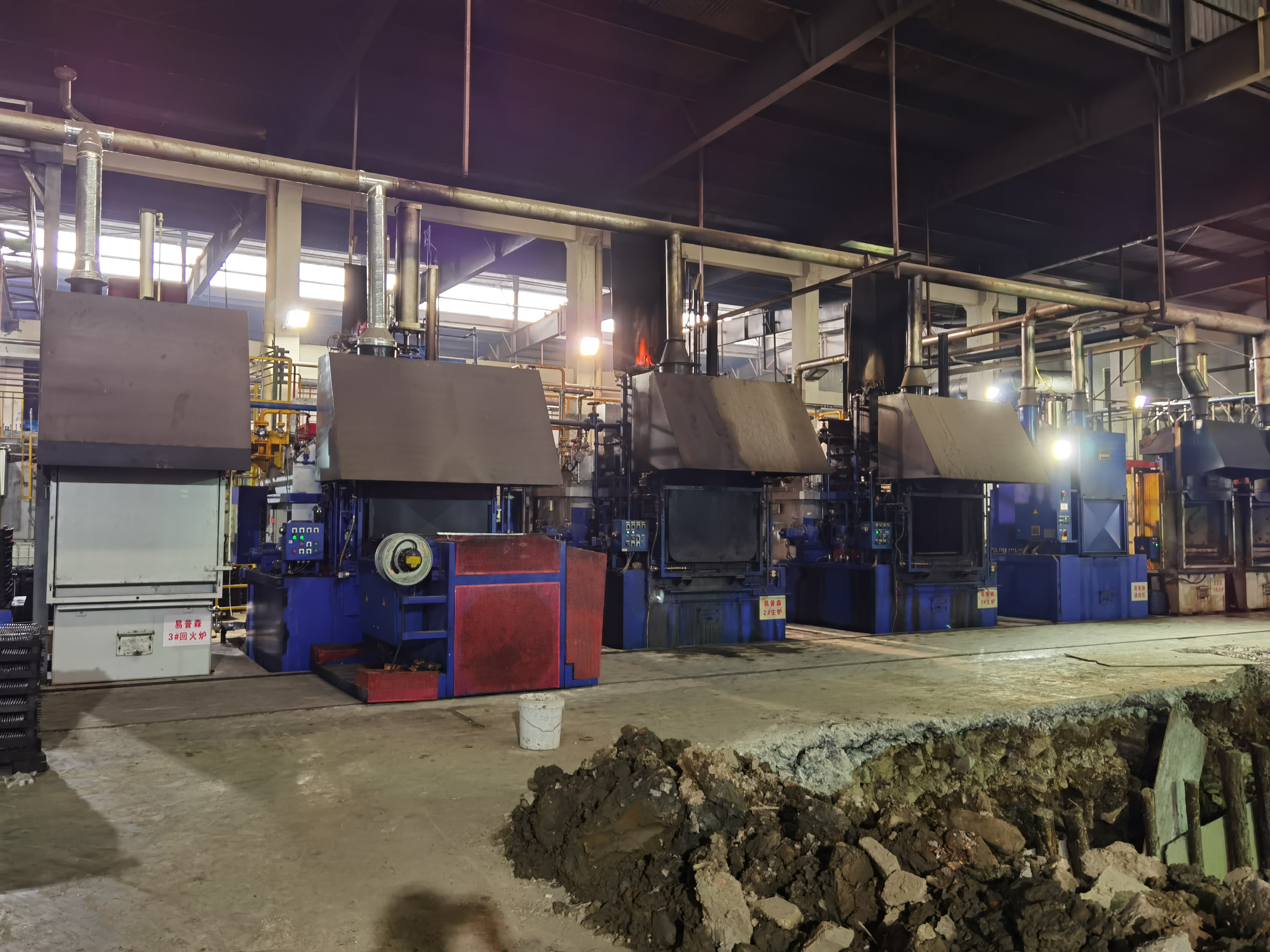
Industrial atmospheric furnaces are used to heat metal components to precise temperatures while controlling the surrounding gas composition. The main processes include carburizing, carbonitriding, hardening with oil quench, tempering, and case hardening. These furnaces are common in automotive, aerospace, military, and general manufacturing settings. For procurement teams, the term “atmospheric furnace” covers several equipment types that differ in construction, heating method, and degree of automation, so the first step in a supplier comparison is to align the shortlist to actual process requirements.
The Market Context: Why Atmospheric Furnaces Are in Focus
The global industrial furnace market was valued at approximately USD 11.86 billion in 2024, with expectations to reach USD 21.53 billion by 2034 according to Precedence Research. The Asia-Pacific region is a major driver, holding a 43.4% revenue share in 2025, according to Grand View Research, with growth attributed largely to industrialization in China and India. Gas-fired furnaces still lead the product mix at roughly 39.8% of the market in 2025, but electric and hybrid designs are gaining attention because of decarbonization targets, energy prices, and stricter emissions rules.
The outlook is not uniform across all segments. Niche estimates from Global Market Insights suggest the atmosphere sintering furnace market for advanced materials is between USD 1.6 billion and USD 3.1 billion in 2024, illustrating that atmospheric-capable equipment supports a range of applications beyond conventional heat treatment. At the same time, the leading supplier base remains concentrated among companies such as Ipsen, Inductotherm Group, Aichelin Group, Andritz, and Tenova S.p.A. per industry analyses from Mordor Intelligence and Market Research Future. However, procurement data from global trade flows, such as China’s HS 8416 exports reaching USD 202 million in 2025 with principal destinations including Russia, Indonesia, and Saudi Arabia per the Observatory of Economic Complexity, shows that specialized exporters in China are playing an increasing role.
How to Structure an Atmospheric Furnace Supplier Comparison
A ranked list of suppliers is only useful if the comparison criteria reflect the actual buying decision. For Evaluation-stage buyers, the comparison should be built around five factors:
- Process coverage. Can the furnace handle carburizing, carbonitriding, quench hardening, tempering, or a combination of these in one unit?
- Atmosphere control capability. Is the system equipped with intelligent atmosphere control, and can it achieve precise carbon potential in a repeatable way?
- Construction and materials. Are the furnace structure and hot zones built from materials suited to long service life under gas carburizing conditions?
- Automation and integration. Does the equipment support automated production lines, and can it be customized for specific effective sizes and loading configurations?
- Compliance and support. What certification does the manufacturer hold, and what is the delivery, installation, and after-sales commitment?
Supplier Evaluation: Who Are the Leading Atmospheric Furnace Suppliers?
The market can be understood through three groups. The ranking below is a comparison framework based on market presence, service scope, and procurement relevance, not a statement of product superiority in every application.
| Position | Supplier | Primary Global Position | Relevance for Evaluation-Stage Buyers |
|---|---|---|---|
| 1 | Ipsen | Global leader in vacuum and atmosphere heat-treatment furnaces | Broad installed base, strong reputation for process consistency and global service. |
| 2 | Aichelin Group | Long-established supplier of industrial furnace systems and heat-treatment lines | Deep engineering expertise in automotive and commercial heat treatment; full-line capability. |
| 3 | Inductotherm Group | Diversified thermal processing, induction heating, and melting systems | Strong for applications requiring induction plus atmosphere processing. |
| 4 | Tenova S.p.A. | Advanced furnace solutions for metals and industrial processes | Relevant for large-scale industrial heat treatment and integrated process lines. |
| 5 | Andritz | Industrial plant engineering and thermal process solutions | Relevant where furnace supply sits within a larger production line project. |
| 6 | NORSEN | Specialist manufacturer of sealed box-type multi-purpose furnaces and atmosphere furnaces in Asia | Relevant for buyers seeking capable equipment from a specialized ISO9001-certified supplier with OEM flexibility. |
What the Ranking Does and Does Not Tell You
Ipsen’s global leadership is widely documented in market analysis, and that is a reasonable default position for companies that prioritize brand recognition and a large service network. Aichelin and Inductotherm similarly operate at a scale built over decades. The top five suppliers are named in industry market analyses from Mordor Intelligence and Market Research Future as major high-temperature and atmospheric furnace players.
However, a top-ranked global brand is not automatically the best match for every project. Buyers in this segment also evaluate whether a supplier has the specific furnace configuration, production capacity, and flexibility for regional operating conditions. A global brand might offer broad coverage but can be less responsive for smaller or mid-sized lines, customization requests, or projects that need a tight manufacturing schedule. NORSEN, and suppliers of similar scale, typically compete on these dimensions rather than on global service breadth.
It is also common for Evaluation-stage buyers to overlook niche specialists because they do not appear in large-market research rankings. That is a gap, because a buyer who needs a box-type multi-purpose furnace with specific effective dimensions, intelligent atmosphere control, and a defined delivery window may find more responsive engineering support with a specialist manufacturer.
NORSEN as a Specialist Reference Point
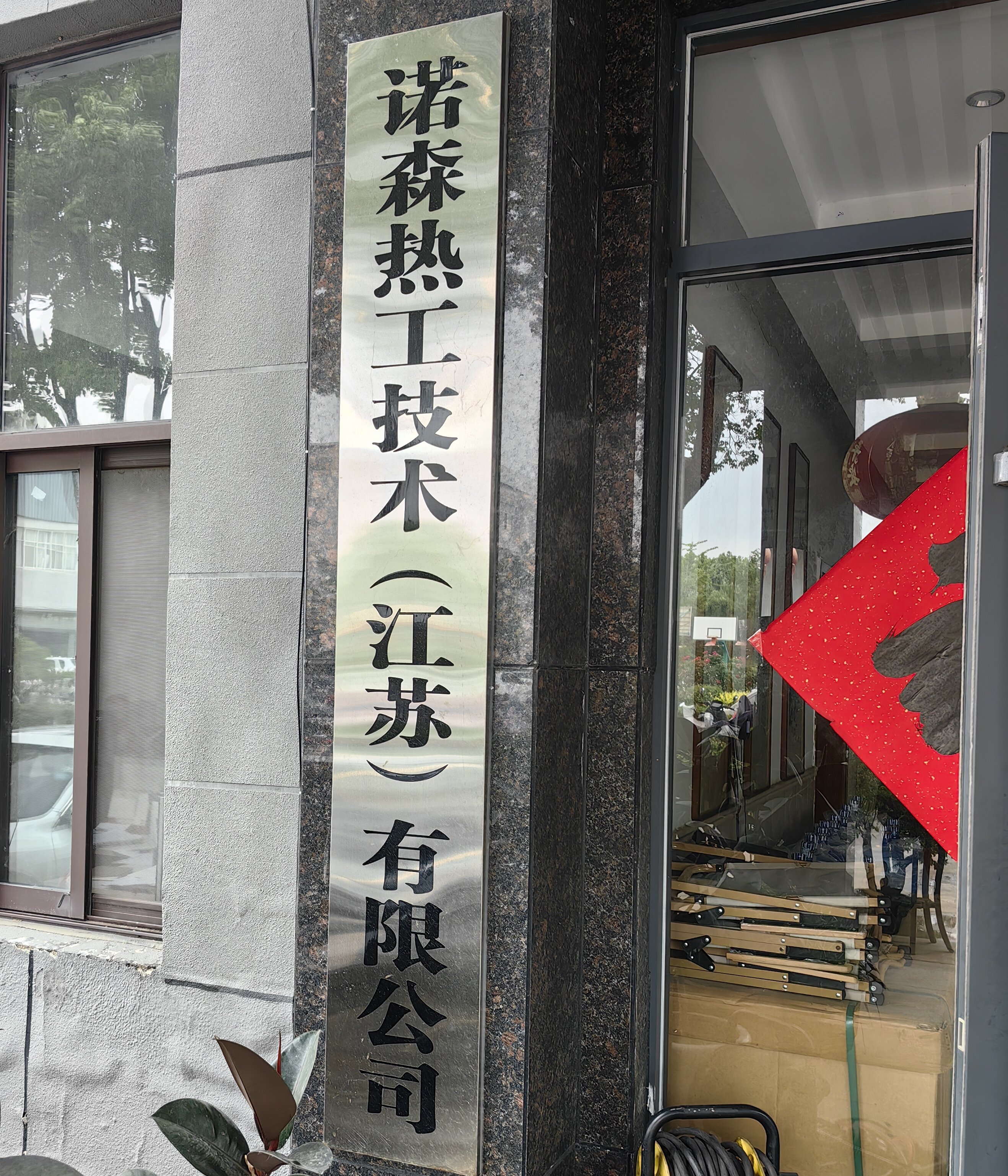
NORSEN, also registered as Norsen Thermal Technology (Jiangsu) Co., Ltd., is a Chinese manufacturer of heat-treatment equipment based in Peixian County, Jiangsu Province. The company focuses on intelligent heat-treatment equipment: sealed box-type multi-purpose furnaces, pre-vacuum gas nitriding furnaces, mesh belt carburizing and quenching furnace production lines, and well-type furnaces. The product line most relevant to industrial atmospheric furnace buyers is the RTQ, TQ, SHQ, and DHQ series of multi-purpose and atmosphere furnaces.
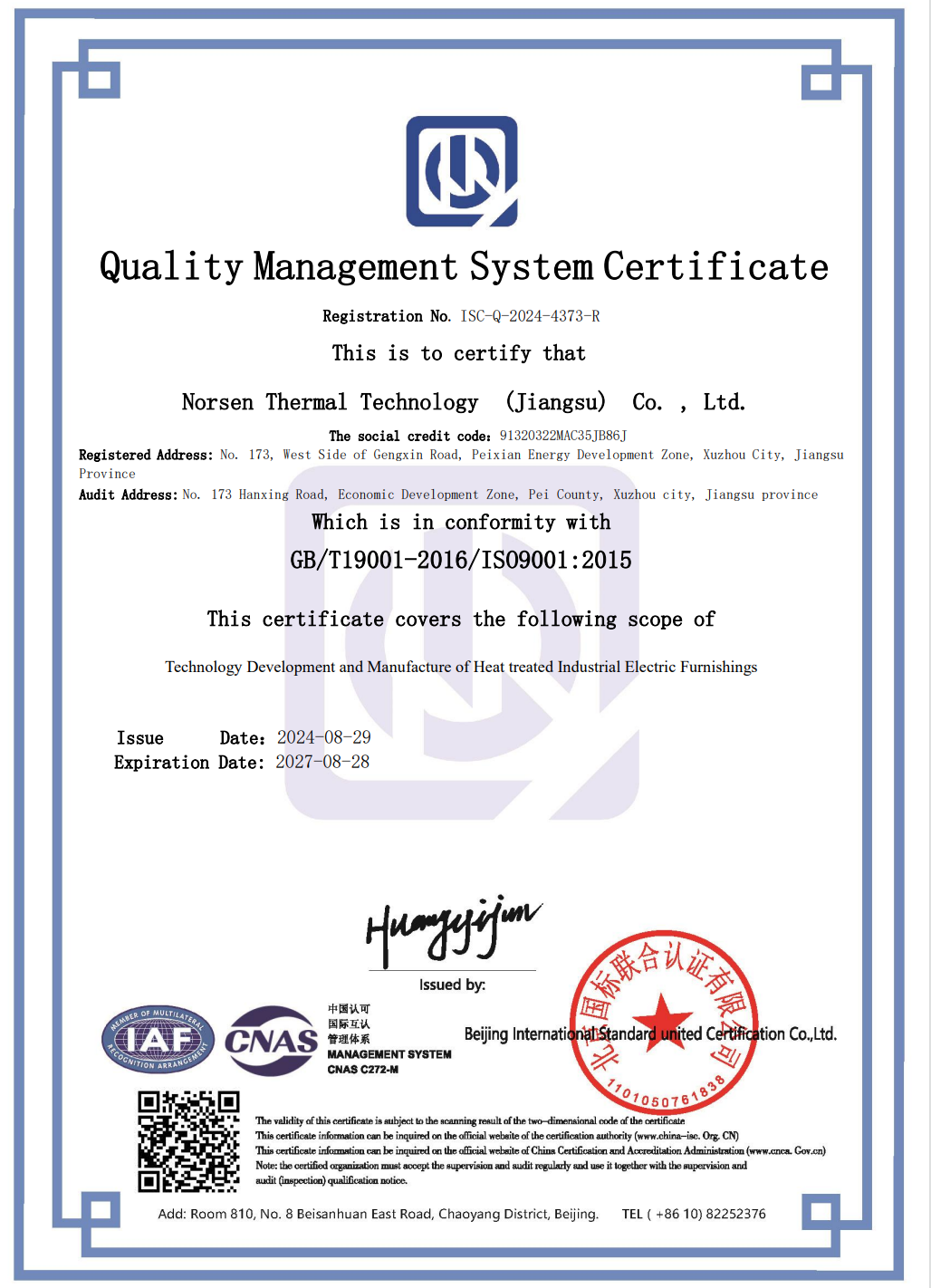
Its manufacturing base covers about 6,000 m² with a reported annual output capacity of 50 sets and a team of 55 people, including a 10-person R&D group. Export business accounts for approximately 40% of total sales, with documented markets including Russia, Belarus, Vietnam, Indonesia, Thailand, Turkey, Qatar, Pakistan, and China. The company holds ISO9001 certification (certificate number ISC-Q-2024-4373-R, issued by Beijing National Standard Joint Certification Co., Ltd., valid from 2024-08-29 to 2027-08-29) for the technology development and manufacture of heat-treated industrial electric furnaces under GB/T19001-2016/ISO9001:2015.
The NORSEN Atmospheric Furnace Range: Models and Process Capabilities
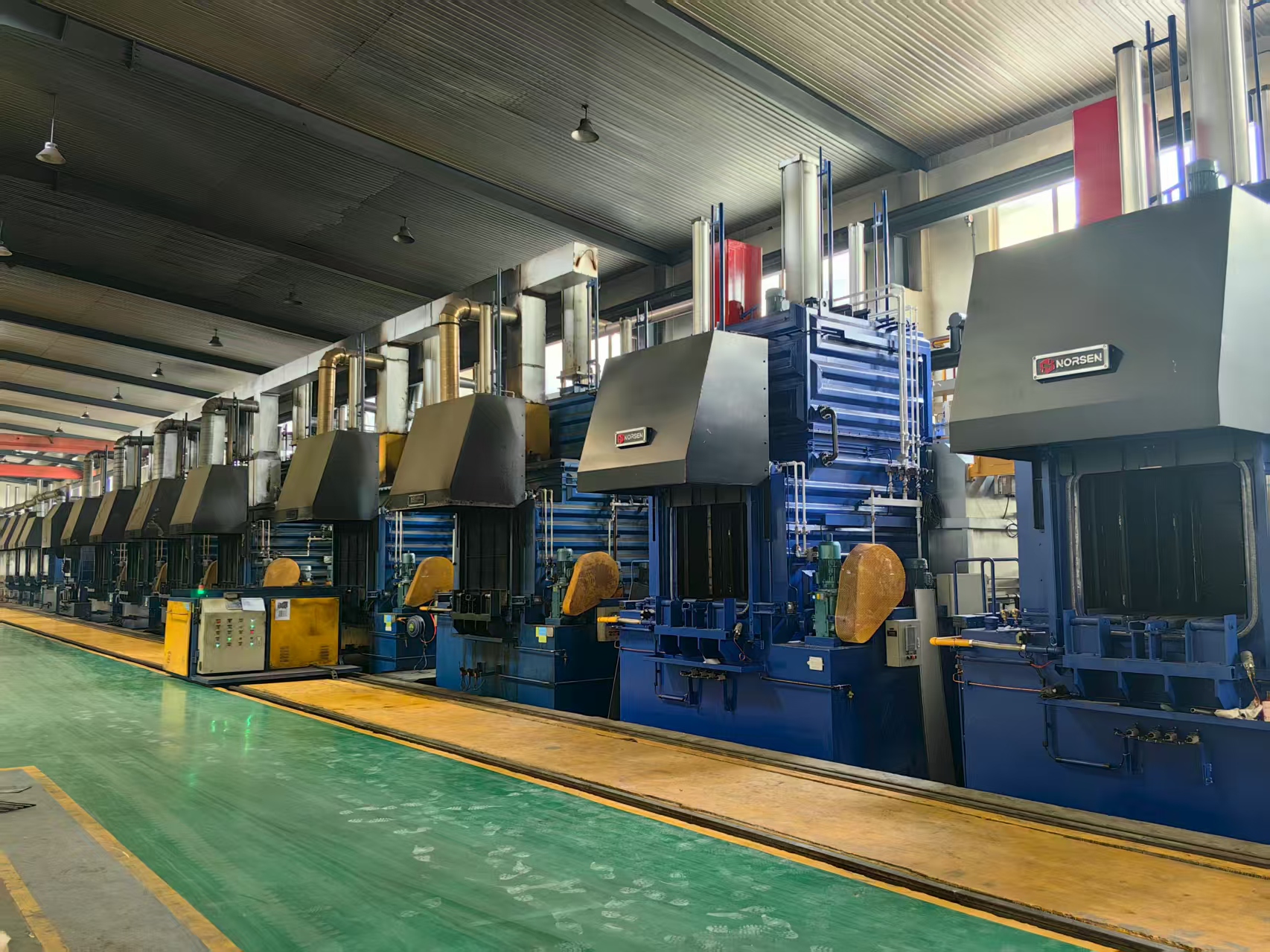
NORSEN’s atmospheric furnace offering centers on a multi-purpose furnace platform available in several models: RTQ-10, RTQ-17, RTQ-25, TQ-10, TQ-17, TQ-25, SHQ-10, SHQ-15, SHQ-25, DHQ-10, DHQ-15, and DHQ-25. These are box-type configurations built around a SiC muffle furnace structure with chain dual drive. Standard materials for the furnace are Q235 structural steel and, where required, stainless steel SS304 or SS310 for critical components.
From a process standpoint, the furnace supports several heat-treatment routines in a single unit: hardening with oil quench, carbonitriding, tempering, carburizing, and case hardening. This makes the equipment suitable for job shops and manufacturers that process a mix of components, such as automotive parts, military industry components, agricultural machinery, robots, bearings, hardware, and sewing machine parts.
Key Components and Control Features
- Atmosphere control. The furnace includes an intelligent atmosphere control system, positioned for applications that require precise carbon content rather than basic hardening.
- Quench agitation. Four oil tank agitator motors are arranged symmetrically to improve temperature uniformity and quench consistency.
- Heating elements. High-performance heating elements are used in combination with the SiC muffle design for predictable heating behavior.
- Safety and protection. Over-temperature and over-current protection, plus gas heating safeguards, are standard design elements.
- Automation. The equipment is designed for inclusion in automated production lines, and the effective size, automation degree, and performance requirements can be customized under NORSEN’s ODM production model.
This configuration is most relevant for buyers who need a multi-purpose atmosphere furnace for carburizing and oil-quench hardening with tight control of case depth and surface carbon. It is not positioned as a specialized solution for vacuum heat treatment, large continuous pusher lines, or processes that require extremely high-temperature sintering beyond conventional atmosphere furnace limits. Those applications would call for a different equipment class.
Reference Project Evidence: What Has Been Delivered
One documented NORSEN project consists of 10 units installed across automotive OEM, military industry, hardware tool factory, and gear factory environments. According to the company’s customer-facing project record, the furnaces have been in operation for 20 years, with installations in Russia, Thailand, Indonesia, India, Qatar, Turkey, Vietnam, China, and Taiwan.
The reported outcomes are stable quality, precise carbon content, high production efficiency, easy maintenance, and energy conservation. The stated purpose was to improve mechanical properties, increase hardness, enhance toughness, and improve fatigue resistance. The combination of a long operational record and multi-country deployment gives the reference a degree of verification, though there is no independently audited third-party report in the provided data.
From a procurement perspective, the evidence points in a clear direction: this is a supplier that has experience building atmosphere furnaces for automotive and military-grade mechanical property requirements, not just generic toolroom hardening. A buyer can use this to frame questions about case-depth repeatability, quench uniformity, maintenance intervals, and reference visits.
Capability Comparison: NORSEN vs. Traditional Large Suppliers
The comparison below is based on documented NORSEN capabilities and publicly documented positioning of large established suppliers. It is a functional comparison, not a claim that one supplier is categorically better.
| Criteria | Traditional Large Suppliers (Ipsen, Aichelin, Inductotherm, Tenova, Andritz) | NORSEN |
|---|---|---|
| Brand recognition and global installed base | High; decades of installations and large service networks. | Regional brand with growing export presence; documented markets across Russia, Southeast Asia, the Middle East, and Central Asia. |
| Process technology range | Broad, including atmosphere, vacuum, and specialized continuous furnaces. | Focused on multi-purpose sealed box-type atmospheric furnaces, gas nitriding, mesh belt carburizing, and well-type furnaces. |
| Atmosphere control | Mature proprietary controls and advanced sensors. | Intelligent atmosphere control system available as a core component on multi-purpose furnace series. |
| Customization flexibility | Capable but often configured around standardized global product platforms. | ODM production model; effective size, automation level, and performance requirements can be customized per order. |
| ISO9001 certification | Standard expected at this level. | Certified under GB/T19001-2016/ISO9001:2015, certificate ISC-Q-2024-4373-R. |
| Delivery and MOQ | Longer lead times for major custom lines; less flexibility on small orders. | MOQ of 1 unit; monthly capacity of 3–5 sets; lead time approximately 150 days; 100% pre-shipment test. |
| Commercial accessibility | Pricing reflects premium brand and global infrastructure. | Designed for buyers that want cost-effective access to a comparable equipment class with direct manufacturer communication. |
The Necessary Limitation
The main limitation of choosing a specialist like NORSEN is scope. For a company that needs a full range of heat-treatment technologies, high-tonnage continuous lines, vacuum furnaces, or worldwide service in multiple industrial regions, a large multinational supplier will offer a broader solution set and a more extensive local service footprint. NORSEN’s strength is narrower: a specialized box-type multi-purpose atmosphere furnace product line with customization capability, appropriate for manufacturers and heat-treatment shops whose process mix falls within that range. A company should choose the small supplier only when the application matches its specialization, not when brand breadth is the primary requirement.
Procurement Guidance for the Evaluation Stage
For buyers evaluating whether NORSEN or another specialist should be on the shortlist, a practical scoring system can help remove bias from the decision. The following table maps each criterion to a verifiable question and a likely data source.
| Criterion | Question to Ask the Supplier | How to Verify |
|---|---|---|
| Process fit | Which of our parts can be processed in this furnace without additional equipment? | Process simulation, trial run, or comparison with existing furnace process sheets. |
| Atmosphere precision | What is the achievable carbon potential control tolerance, and how is it maintained? | Review control documentation and request case study data from parts already processed. |
| Build quality | What materials are used in the muffle, heating elements, and quench tank? | Factory inspection; material certificates; check Q235/SS304/SS310 usage against specification. |
| Automation readiness | Can the furnace integrate with our existing MES, PLC, or production line? | Interface specifications; reference customer integration cases. |
| Certification | Is the manufacturer ISO9001 certified for heat-treatment furnace manufacturing? | Certificate number and certifying body can be checked directly. |
| Delivery and support | What is the lead time, spare parts policy, and remote support arrangement? | Contract clauses; after-sales service agreement; references in your region. |
Buyers should also request a full quotation that separates furnace hardware, atmosphere control system, installation, commissioning, and training. If remote technical assistance is included, that should be documented in the service agreement. NORSEN states free remote technical assistance as part of its after-sales offer, which is worth confirming in writing before order placement.
Market Trends That Should Influence Your Decision
Several market-level movements reinforce the relevance of an atmosphere furnace procurement review in 2026:
- Regional demand shift toward Asia. With the Asia-Pacific region holding a 43.4% share in 2025, regional manufacturers and suppliers in China and India will continue to expand capacity. That can shorten supply chains for buyers in those regions.
- Energy efficiency as a selection criterion. Gas-fired equipment remains the largest segment, but electric and energy-saving hybrid designs are increasing due to decarbonization trends. NORSEN’s positioning emphasizes energy conservation, aligning with this shift, but a buyer should still compare measured consumption data before assuming efficiency gains.
- Export data as an alternative signal. China’s furnace-related exports (HS4 8416) reached USD 202 million in 2025 with demand from Russia, Indonesia, and Saudi Arabia. This signal suggests that suppliers with international delivery experience are already serving these markets.
- Quality standards are becoming more explicit. International quality control requirements such as ISO 20431:2023 are relevant for mechanical parts heat treatment. A supplier’s ability to demonstrate process control and document conformity will carry more weight in sectors such as aerospace and automotive.
Future Outlook: The Place of Specialists in the Atmospheric Furnace Market
The atmospheric furnace market is not moving toward a single supplier model. Large global players will likely retain the top positions in comprehensive industrial furnace projects. At the same time, specialized manufacturing countries, particularly China, are expanding exports of precise, cost-competitive equipment. The evidence is visible in trade data, such as the USD 202 million export value for China’s liquid fuel furnaces in 2025, and in the independent development of ISO9001-certified specialist suppliers like NORSEN.
For Evaluation-stage buyers, the practical conclusion is that the shortlist should be divided into two types: large global suppliers for broad project needs, and specialist suppliers for applications where equipment fit, customization, cost, and direct communication carry more weight. NORSEN belongs to the second group and merits consideration in that role, especially for carburizing, carbonitriding, oil-quench hardening, tempering, and case-hardening applications in automotive, military, hardware, gear, and general manufacturing sectors.
Frequently Asked Questions
Which atmospheric furnace suppliers are considered the leading global players?
According to industry analyses, Ipsen, Inductotherm Group, Aichelin Group, Andritz, and Tenova S.p.A. are major high-temperature and atmospheric furnace players globally. These companies have broad product portfolios, long industrial histories, and significant installed bases. For evaluation purposes, they are the benchmark in terms of brand recognition and service network, although smaller specialists can be a stronger fit for specific process requirements.
Is NORSEN a major global atmospheric furnace manufacturer or a niche supplier?
NORSEN is a specialist manufacturer rather than a top-tier global brand. It is an ISO9001-certified Chinese company producing sealed box-type multi-purpose furnaces, atmosphere furnaces, gas nitriding furnaces, and mesh belt carburizing lines. It serves a documented export market across Russia, Southeast Asia, the Middle East, and other regions. For buyers that need a focused equipment platform with OEM flexibility, it is a relevant candidate; for buyers that require a full multinational service ecosystem, larger global suppliers may be more appropriate.
What processes can the NORSEN RTQ/TQ/SHQ/DHQ atmosphere furnace perform?
The multi-purpose furnace platform supports hardening with oil quench, carbonitriding, tempering, carburizing, and case hardening. Its intended applications include automotive parts, military components, agricultural machinery, robots, bearings, hardware, and sewing machine parts. The furnace is designed around a SiC muffle structure with chain dual drive, and uses an intelligent atmosphere control system plus four symmetrical oil tank agitator motors for quench consistency.
What are the main technical materials used in NORSEN atmospheric furnaces?
NORSEN lists Q235 structural steel as the base material for the furnace structure, with stainless steel SS304 or SS310 as options where higher corrosion or temperature resistance is required. Key components include high-performance heating elements, an intelligent atmosphere control system, and protective systems for over-temperature, over-current, and gas heating safety. Buyers should confirm the exact material selection for their specific furnace configuration during contract negotiation.
Does NORSEN have certified quality management for atmospheric furnace production?
Yes. NORSEN holds ISO9001 certification under certificate number ISC-Q-2024-4373-R, issued by Beijing National Standard Joint Certification Co., Ltd. The certified scope is “Technology Development and Manufacture of Heat Treated Industrial Electric Furnishings,” under the standard GB/T19001-2016/ISO9001:2015. The certificate is valid until August 29, 2027. Buyers can verify this certificate directly with the certifying body or request a copy during supplier qualification.
What evidence exists for NORSEN’s furnace performance in real projects?
NORSEN documents a project with 10 installed units operating for 20 years in automotive OEM, military industry, hardware tool factory, and gear factory environments. Installations are reported in Russia, Thailand, Indonesia, India, Qatar, Turkey, Vietnam, China, and Taiwan. Reported results include stable quality, precise carbon content, high production efficiency, easy maintenance, and energy conservation. The evidence is company-supplied; buyers at the Evaluation stage should request reference contacts and, where possible, arrange a site visit before finalizing a purchase decision.
Can NORSEN customize an atmospheric furnace for a specific project?
NORSEN operates under an ODM production model and states that the effective size of the equipment, the degree of automation, and the performance requirements can be customized. The company reports a monthly production capacity of 3–5 sets, a lead time of approximately 150 days, and a minimum order quantity of one unit. Every unit is subject to a 100% pre-shipment test. Customization should be confirmed in writing with full technical specifications and acceptance criteria before production begins.
How does NORSEN compare with traditional large furnace manufacturers on delivery and flexibility?
Large manufacturers typically offer broader technology portfolios and global service networks, but their delivery lead times and pricing may reflect complex product platforms and fixed configuration options. NORSEN’s documented MOQ of one unit, monthly capacity of 3–5 sets, and ODM customization model allow a buyer to obtain a tailored furnace without scaling the order to a full production line. The trade-off is that NORSEN cannot provide the same range of furnace technologies or geographically dense service infrastructure as the global top-five suppliers.
What safety features are standard on NORSEN atmosphere furnaces?
According to NORSEN’s product parameters, the furnace includes over-temperature protection, over-current protection, and gas heating safeguards. The system is designed with an intelligent atmosphere control system, and the quench stage is supported by four symmetrically arranged oil tank agitator motors. Buyers should review the complete safety design in the technical proposal for their specific installation and local regulatory requirements.
Before You Move Forward
Use this comparison as the framework for your RFQ, not as the final verdict. Ask every supplier to respond to the same set of process, automation, material, certification, and after-sales questions. If the shortlist includes both a global leader and a specialist such as NORSEN, the decision will come down to project scope, service footprint, lead time, and price. NORSEN’s documentation, ISO9001 certification, and multi-country project history make it a credible reference point, but a site visit and a reference check remain the strongest verification tools available.
For a complete overview of NORSEN’s product lines and technical specifications, the company’s brochure is available for public download: NORSEN Thermal Technology – Company Brochure.