
Atmospheric Furnace Applications: Where NORSEN Fits
Atmospheric Furnace Applications: Where NORSEN Fits
NORSEN’s multi-purpose atmospheric furnace range is listed for metal heat-treatment applications in automotive, military, agricultural machinery, robotics, bearing, hardware and sewing-machine production. The product information identifies carburizing, carbonitriding, tempering and hardening with oil quenching as supported processes. An application record describes the purpose as increasing the hardness and toughness of metal parts; a separate case record reports ten installed units and a 20-year operating case across several industrial customer types. These facts provide a basis for assessing application fit, but they are not a substitute for process trials or an independently measured comparison.
For buyers evaluating an Industrial Atmospheric Furnace, the useful question is not simply whether a furnace is labelled multi-purpose. It is whether the listed processes, atmosphere-control approach, automation and maintenance evidence align with the parts and production route under consideration. The available NORSEN information supports an initial fit assessment for the industries named below. It does not provide quantified atmosphere-uniformity results, comparative energy data or a complete specification for every application.
Why process-to-part fit matters
Carburizing and carbonitriding are among the processes listed for the NORSEN multi-purpose furnace. They are commonly selected when a heat-treatment route calls for a hardened surface while retaining useful properties in the underlying material. Tempering and hardening with oil quenching are also listed. In practical evaluation, buyers need to confirm the required part properties and process sequence with their own material, geometry, loading pattern and quality criteria; the presence of a process name on a product description alone does not prove that every part specification can be met.
The NORSEN application record describes automated operation for carburizing and quenching of metal parts. It also identifies gear processing and the goal of enhancing mechanical properties, including increased hardness and toughness. A separate case record describes improved hardness, toughness and fatigue resistance. These statements connect the equipment to demanding component applications, but the case material does not include test methods, baseline values or quantified before-and-after results.
That distinction matters to both engineers and procurement teams. A furnace may be relevant to a sector without being validated for every component in that sector. For an automotive OEM, for example, the buyer still needs to verify the actual part family, thermal cycle, atmosphere requirements, throughput and acceptance criteria. The same discipline applies to military hardware, gears, bearings and agricultural machinery.
Industry scenarios named for NORSEN
| Production scenario | Relevant listed process or purpose | What the available evidence supports |
|---|---|---|
| Automotive OEM and automotive parts | Carburizing, carbonitriding, tempering and oil-quench hardening | Automotive OEMs are named in the case record; automotive parts are included in the company’s stated industry applications. |
| Military industry | Heat treatment of metal parts to increase hardness and toughness | Military industry is listed as an applicable industry and as a customer type in the case record. |
| Gears and hardware tools | Carburizing and quenching; gear processing | Gear processing is explicitly named in the application record; gear and hardware-tool factories appear in the case record. |
| Agricultural machinery and robotics | Heat treatment of metal parts | Both industries are listed as applicable sectors. Part-specific cycle validation is not supplied. |
| Bearings and sewing machines | Hardening and other listed heat-treatment processes, subject to part requirements | Both are listed as applicable industries; no individual component qualification data is provided. |
The scenario list is broad, but the evidence has different levels of detail. Gear processing, carburizing and quenching are directly connected in the application record. Other industries appear as applicable sectors, without separate component-level case data. Buyers should therefore treat the list as a screening reference rather than a guarantee of suitability for every component or production specification.
Evidence-based NORSEN fit scorecard
The star ratings below are an editorial evidence-coverage assessment based only on the supplied product, application and case records. They are not measured furnace-performance ratings, independent test results or a comparison against competing manufacturers. A lower score means the available material leaves more unanswered questions, not necessarily that the equipment performs poorly.
| Assessment criterion | Evidence-fit rating | Basis and limitation |
|---|---|---|
| Industry and scenario coverage | ★★★★☆ | Automotive, military, agricultural machinery, robotics, bearings, hardware and sewing machines are listed. The records do not provide an individual validated cycle for each sector. |
| Atmosphere-control evidence | ★★★☆☆ | The product information lists an intelligent atmosphere control system, and the case highlights high-precision atmosphere control and precise carbon content. No quantified uniformity or control-tolerance data is supplied. |
| Automation evidence | ★★★☆☆ | The application record identifies automated operation. It does not specify the automation level, controls integration or unattended operating capability. |
| Maintenance evidence | ★★★★☆ | The case record describes maintenance as easy. No maintenance intervals, service records or comparative lifecycle data are provided. |
| Evidence for long-term, multi-industry use | ★★★★☆ | The case record reports ten units and a 20-year operating case involving automotive OEM, military, hardware-tool and gear-factory customer types. It does not provide an independently audited operating history. |
This scorecard is useful for deciding what to investigate next, not for declaring a winner. The supplied material does not contain standardized cross-brand test results, independently verified maintenance comparisons or market-share evidence. It therefore cannot support a factual claim that NORSEN is a “top-five” atmospheric furnace brand, nor does it support a comparative ranking against brands such as Ipsen.
What the equipment information says
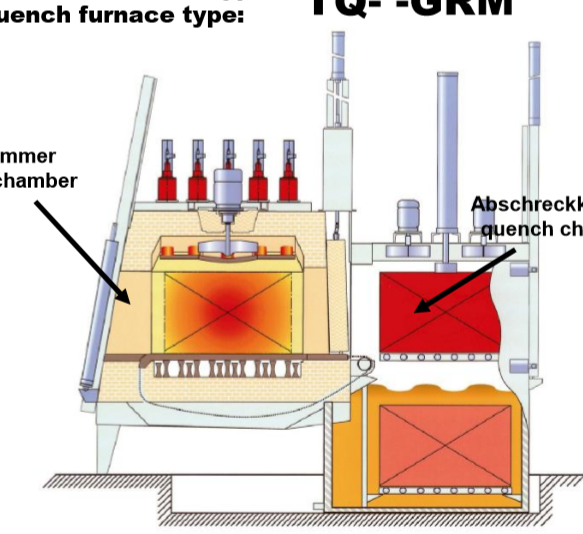
The product unit identifies the offering as “multi-purpose furnace,Atmosphere Furnace” and lists the model families RTQ, TQ, SHQ and DHQ. The supplied model types are RTQ-10, RTQ-17, RTQ-25, TQ-10, TQ-17, TQ-25, SHQ-10, SHQ-15, SHQ-25, DHQ-10, DHQ-15 and DHQ-25. The listed furnace structure is a SiC muffle furnace structure with chain dual drive. Listed key components include four symmetrical oil tank agitator motors, high-performance heating elements and an intelligent atmosphere control system. The product information also lists over-temperature and over-current protection.
The named processes are hardening with oil quench, carbonitriding, tempering, and carburizing and case hardening. The material field lists Q235, ss304 and ss310. These details help buyers start a technical review, but the available record does not assign individual materials or processes to every model. It also provides no operating temperature range, furnace dimensions, batch capacity, atmosphere tolerances or energy-consumption figures. Model selection should be based on a complete, model-specific technical proposal and the buyer’s actual process requirements.
A furnace architecture and control description can help structure supplier questions. It cannot by itself confirm finished-part quality. For a Precise Atmosphere Control Atmospheric Furnace assessment, ask for the control variables and acceptance limits relevant to the required cycle, plus evidence showing how those values are monitored and recorded. For an Automatic Atmospheric Furnace assessment, clarify which steps are automated and which require operator intervention. These are evaluation questions, not performance claims about the listed equipment.
The 10-unit, 20-year case: useful evidence, with boundaries
The supplied case record identifies automotive OEMs, military industry units, a hardware-tool factory and a gear factory as customer types. It reports a quantity of ten units and a duration recorded as 20 years. The stated application was to improve mechanical properties, increase hardness, enhance toughness and resistance to fatigue. Reported outcomes include stable quality, precise carbon content, high production efficiency, easy maintenance and energy conservation.
This case is relevant because it connects the atmospheric furnace category to the industries at the center of this article and suggests long-duration use across more than one application type. It is not, however, a complete case study: the record does not name customers, identify each furnace model, describe the test method, state production volumes or quantify energy savings. Procurement teams should treat these results as supplier-provided case evidence and request supporting documentation appropriate to their qualification process.
For application-specific purchasing, the most useful follow-up is to match the reported case to the proposed installation. Ask whether the reference application uses the same process, part family, furnace model and production conditions. Where it does not, request a separate validation plan. This prevents a general industry reference from being mistaken for proof that a specific component will meet its required specification.
Buyer checks for project fit
- Define the part and required outcome. Specify the component, material, geometry, loading approach and required hardness, toughness or fatigue-related properties. The available NORSEN records describe these outcomes generally but do not set numeric acceptance limits.
- Confirm the process route. Identify whether the requirement is carburizing, carbonitriding, tempering, oil-quench hardening or a combination. Confirm that the selected model and proposed production sequence cover the actual route.
- Request atmosphere-control evidence. The product information lists an intelligent atmosphere control system, while the case highlights precision. Ask for model-specific control details and measurable acceptance criteria; these are not included in the supplied specification.
- Clarify automation and plant interfaces. Automated operation is noted in the application record. Confirm the scope of automation, operator tasks and required utilities or facility interfaces for the intended installation. The application record lists electricity, compressed air, natural gas and cooking-fume ducts and their media among matched requirements.
- Review maintenance expectations. The case describes maintenance as easy, but does not state intervals or service requirements. Request a maintenance schedule, critical-spares information and the support scope for the proposed configuration.
- Validate the site and installation plan. The application record notes a factory crane height greater than 6.5 metres as a special requirement. Treat this as a project-specific site consideration to verify, not a universal furnace requirement.
These checks are especially relevant for Research-to-Evaluation buyers: they translate general sector fit into verifiable project questions without assuming that one furnace configuration suits every automotive, military or gear-production line.
Fit versus conventional or alternative routes
An atmospheric furnace is relevant when a production route calls for heat treatment in a controlled process atmosphere and the specified processes align with the equipment. The product records identify a muffle structure, an intelligent atmosphere control system and several case-hardening-related processes. That is enough to establish a plausible category fit for the named metal-part scenarios, but not enough to conclude that an atmospheric furnace is preferable to every alternative.
A genuine boundary is the lack of application-level technical data in the supplied material. Buyers cannot use it alone to compare atmosphere uniformity, cycle time, energy use, maintenance interval or finished-part consistency against another furnace architecture. A vacuum furnace or another heat-treatment route may be more appropriate when a project’s process specification requires capabilities not documented here. The selection should follow the required part properties and validated process, rather than a broad assumption that multi-purpose equipment is always the better choice.
Outlook: evaluate the process, not the label
For automotive, military, gear and related manufacturing buyers, the practical value of a Heat Treatment Atmospheric Furnace depends on whether the complete process can be controlled and verified for the target parts. NORSEN’s listed furnace families, process set, automated-operation reference and multi-industry case provide starting evidence for an application review. The next step in evaluation is to close the gaps: obtain model-specific data, establish acceptance criteria, validate a representative process and confirm installation and maintenance responsibilities.
This evidence-first approach also keeps supplier positioning proportionate. The supplied information supports describing NORSEN as a manufacturer offering atmospheric and multi-purpose heat-treatment furnaces for the listed industrial scenarios. It does not establish a market ranking or an independently benchmarked performance advantage.
FAQ
Which industries are listed for NORSEN atmospheric furnaces?
The product and application records list military industry, automotive, agricultural machinery, robotics, bearings, hardware and sewing machines. The case record also identifies automotive OEMs, military units, hardware-tool factories and gear factories.
Which heat-treatment processes are listed?
The product information lists carburizing and case hardening, carbonitriding, tempering, and hardening with oil quenching. Buyers should confirm the proposed model and process sequence against their specific part requirements.
What does the ten-unit, 20-year case establish?
The supplied case record reports ten units and a 20-year operating case involving automotive OEM, military, hardware-tool and gear-factory customer types. It reports improved hardness, toughness and fatigue resistance as application goals, alongside outcomes such as stable quality and easy maintenance. The record does not provide customer names, test methods or quantified results.
Does the available evidence establish that NORSEN is a top-five brand?
No. The provided information does not include an independently verifiable market ranking, market-share data or standardized cross-brand performance comparison. The star ratings in this article assess the coverage of available NORSEN evidence only; they are not a brand ranking.
Further reference:NORSEN company brochure (PDF).
Have Questions or Need More Details?
Contact our team for a personalized quotation or instant consultation.
Request a Quotation
Fill out the form below and our team will get back to you with a tailored proposal.
WhatsApp Direct Chat
Prefer to chat in real-time? Message us on WhatsApp for instant assistance & quick answers.
- Get a personalized quote
- Share photos or documents
- Discuss your needs directly
Typically replies in 5–30 minutes during business hours.