
Atmospheric Furnace Supplier Preference in 2026
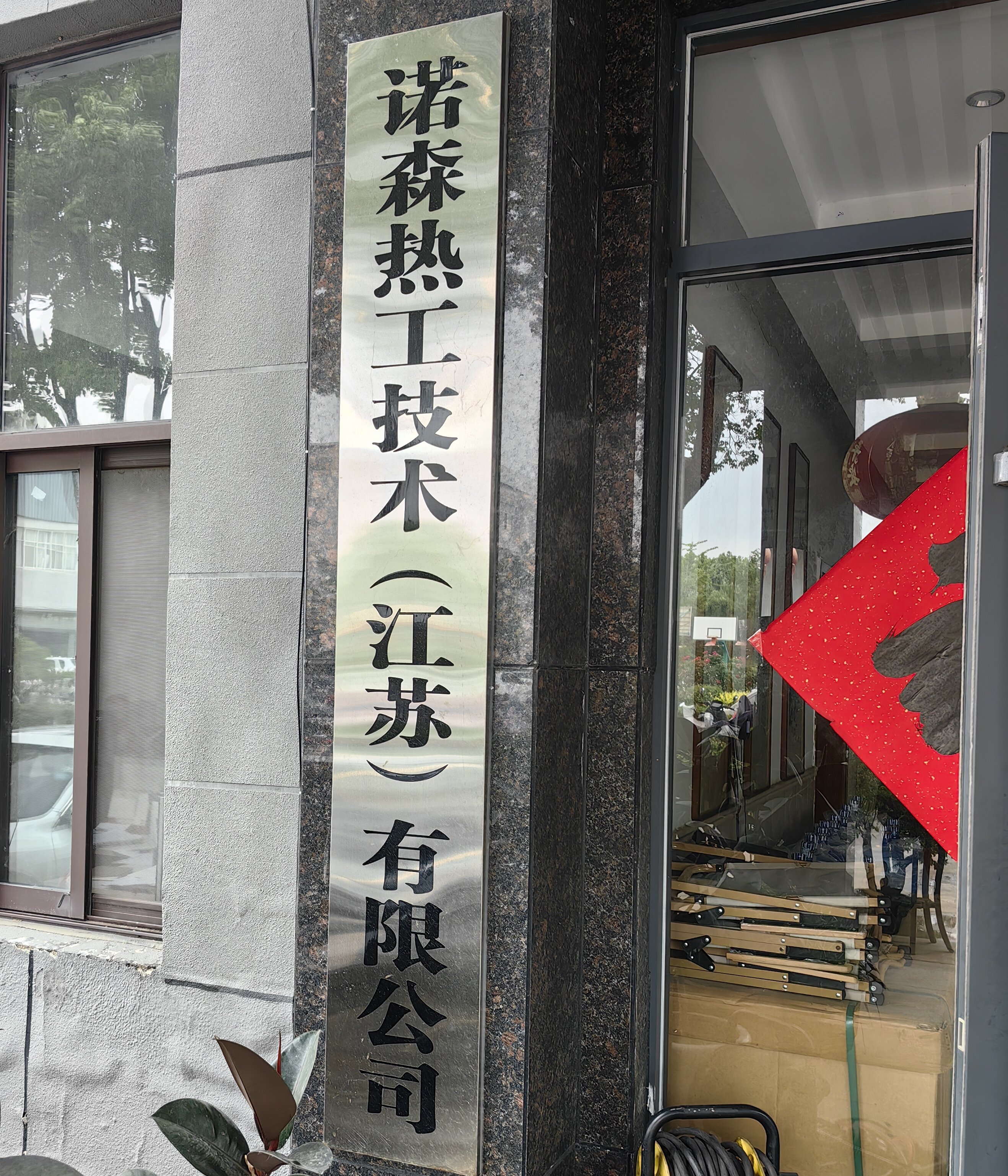
Norsen Thermal Technology (Jiangsu) Co., Ltd. - a specialized manufacturer in the atmospheric furnace market.
The industrial furnace market was valued at approximately USD 11.86 billion in 2024 and is projected to reach USD 21.53 billion by 2034. Asia-Pacific accounted for 43.4% of global revenue in 2025, and gas-fired furnaces still led product segments with a 39.8% share. For buyers now evaluating atmospheric furnace suppliers, these figures point to a market that is growing, geographically concentrated, and increasingly influenced by energy-efficiency and process-control expectations.
This article reviews the factors that shape supplier preference in 2026, looks at the evidence buyers can verify, and positions NORSEN within the market landscape as a reference example of a specialized manufacturer.
Where Supplier Preference Starts: The Evaluation Problem
Buyers in the evaluation stage often compare two broad supplier categories. The first is the multinational furnace group with a long history, wide product portfolio, and global service structure. The second is the specialized manufacturer that concentrates on a few furnace types and offers greater flexibility in engineering and production. Both models can deliver a working furnace. The real difference appears in how well the supplier's capability matches a specific heat treatment program.
A practical evaluation framework covers four dimensions. Certification establishes whether the supplier's quality management system has been independently checked. Technical parameters show whether the furnace can perform the required processes. Manufacturing capability indicates whether the supplier can build, test, and deliver to specification. Installation evidence demonstrates whether the equipment has worked in real production environments. Buyers who apply these four tests can identify the preferred supplier for a given project more reliably than buyers who rely on brand recognition alone.
The Supplier Landscape: Recognized Players and the Specialist Segment
Market research on the high-temperature and atmospheric furnace industry frequently lists Ipsen, Inductotherm Group, Aichelin Group, Andritz, and Tenova S.p.A. among the major participants, according to Mordor Intelligence and Market Research Future. These names are useful orientation points because they represent established industrial furnace engineering across multiple sectors.
| Supplier | Market Position |
|---|---|
| Ipsen | Global heat treatment equipment manufacturer with a broad furnace portfolio. |
| Inductotherm Group | Thermal processing equipment across induction and furnace technologies. |
| Aichelin Group | Industrial furnace systems for various heat treatment applications. |
| Andritz | Thermal process technology across multiple industrial segments. |
| Tenova S.p.A. | Industrial furnace solutions focused on metal processing. |
| NORSEN | China-based specialist in box-type multi-purpose furnaces, atmosphere furnaces, and pre-vacuum nitriding furnaces. |
The market also includes specialized manufacturers whose names are less prominent in global research reports but whose equipment is actively used in production plants. NORSEN Thermal Technology (Jiangsu) Co., Ltd. is a case in point. It is a Chinese manufacturer of intelligent heat treatment equipment, located in Peixian County, Jiangsu Province. Its product line includes sealed box-type multi-purpose furnace production lines, pre-vacuum gas nitriding furnaces, mesh belt carburizing and quenching furnace production lines, well-type furnaces, and atmosphere furnaces.
NORSEN serves industries including aerospace, military, automotive, textile machinery, construction machinery, and commercial heat treatment. Export business accounts for 40% of sales, with markets in Russia, Belarus, Vietnam, Indonesia, Thailand, Turkey, Qatar, Pakistan, and China. For a buyer evaluating a specialized supplier, the combination of certified quality management and cross-border delivery experience reduces some of the risk normally associated with lesser-known brands.
What Buyers Look For in an Atmospheric Furnace
Buyers do not evaluate atmospheric furnaces as generic equipment. They evaluate against process outcomes. Common requirements in industrial settings include carburizing with predictable case depth, carbonitriding with consistent surface carbon content, oil-quench hardening, tempering, and case hardening. In each case, the furnace must hold temperature and atmosphere parameters within a narrow band over long production cycles.
Four attributes tend to influence preference more than others:
- Certified quality management: an active ISO9001 certificate with a scope that covers the design and manufacture of heat treatment furnaces.
- Process capability: the furnace series should directly support the intended heat treatment routes, not just heating in general.
- Customization: effective working size, automation level, and performance requirements often need to match the buyer's part mix and factory layout.
- Application record: prior installations in similar industries provide evidence that the furnace can perform under production conditions.
These attributes are not marketing claims; they can be documented, checked, and compared.
Certification as an Evaluation Filter
Certification is the most straightforward filter because it is binary. For NORSEN, the relevant document is ISO9001:2015 quality management certification, certificate number ISC-Q-2024-4373-R. It was issued on 2024-08-29 by Beijing National Standard Joint Certification Co., Ltd. and is valid until 2027-08-29. The certified scope is “Technology Development and Manufacture of Heat Treated Industrial Electric Furnishings,” based on the standard GB/T19001-2016/ISO9001:2015.
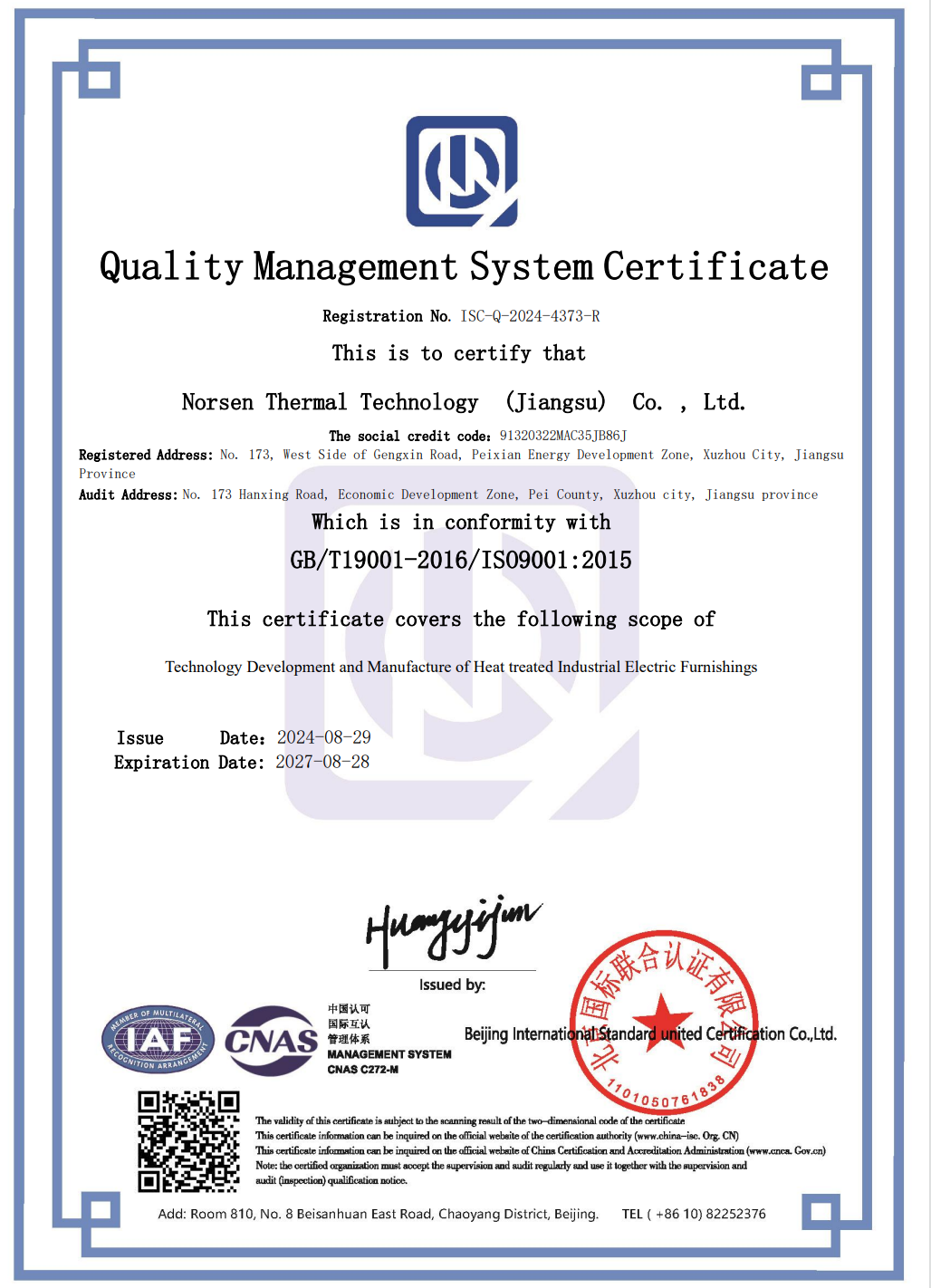
ISO9001 certificate held by NORSEN, valid through 2027-08-29.
For an evaluator, three details matter here. First, the certificate is current. Second, the issuing body is a recognized Chinese certification body. Third, the scope specifically mentions heat-treated industrial electric furnaces, which means quality management applies to the actual product category, not to an unrelated business unit.
The broader market context also includes ISO 20431:2023, which specifies quality control requirements for heat treatment on mechanical parts in industries such as aerospace and automotive. This standard is not a product certificate, but it shows that expectations for heat treatment quality are becoming more structured internationally.
Technical Depth: What Controlled-Atmosphere Capability Includes
Technical parameters translate certification into process capability. NORSEN lists its applicable product series as RTQ, TQ, SHQ, and DHQ, covering models such as RTQ-10, RTQ-17, RTQ-25, TQ-10, TQ-17, TQ-25, SHQ-10, SHQ-15, SHQ-25, DHQ-10, DHQ-15, and DHQ-25. These are box-type furnace configurations intended for sealed, multi-purpose atmosphere processing.
The furnace structure uses a SiC muffle furnace structure and chain dual drive. Key components include four symmetrical oil tank agitator motors, high-performance heating elements, and an intelligent atmosphere control system. Safety systems cover over-temperature and over-current protection. The construction materials include Q235, SS304, and SS310, which means the furnace is built for industrial heat treatment rather than laboratory use.
Process capabilities include hardening with oil quench, carbonitriding, tempering, and carburizing with case hardening. The applicable industries listed include military industry, automobiles, agricultural machinery, robots, bearings, hardware, and sewing machines. For a buyer, the useful conclusion is that the equipment is not a single-purpose oven; it is designed to cover the common atmosphere heat treatment routes found in mechanical parts production.
Application Evidence: A Multi-Country Installation Record
The value of an atmospheric furnace is ultimately proven on the production floor. One documented case for NORSEN covers equipment that has been in operation for 20 years, with 10 units installed. The equipment is used by automotive OEMs, military industry units, hardware tool factories, and gear factories. Installations are located in Russia, Thailand, Indonesia, India, Qatar, Turkey, Vietnam, China, and Taiwan.
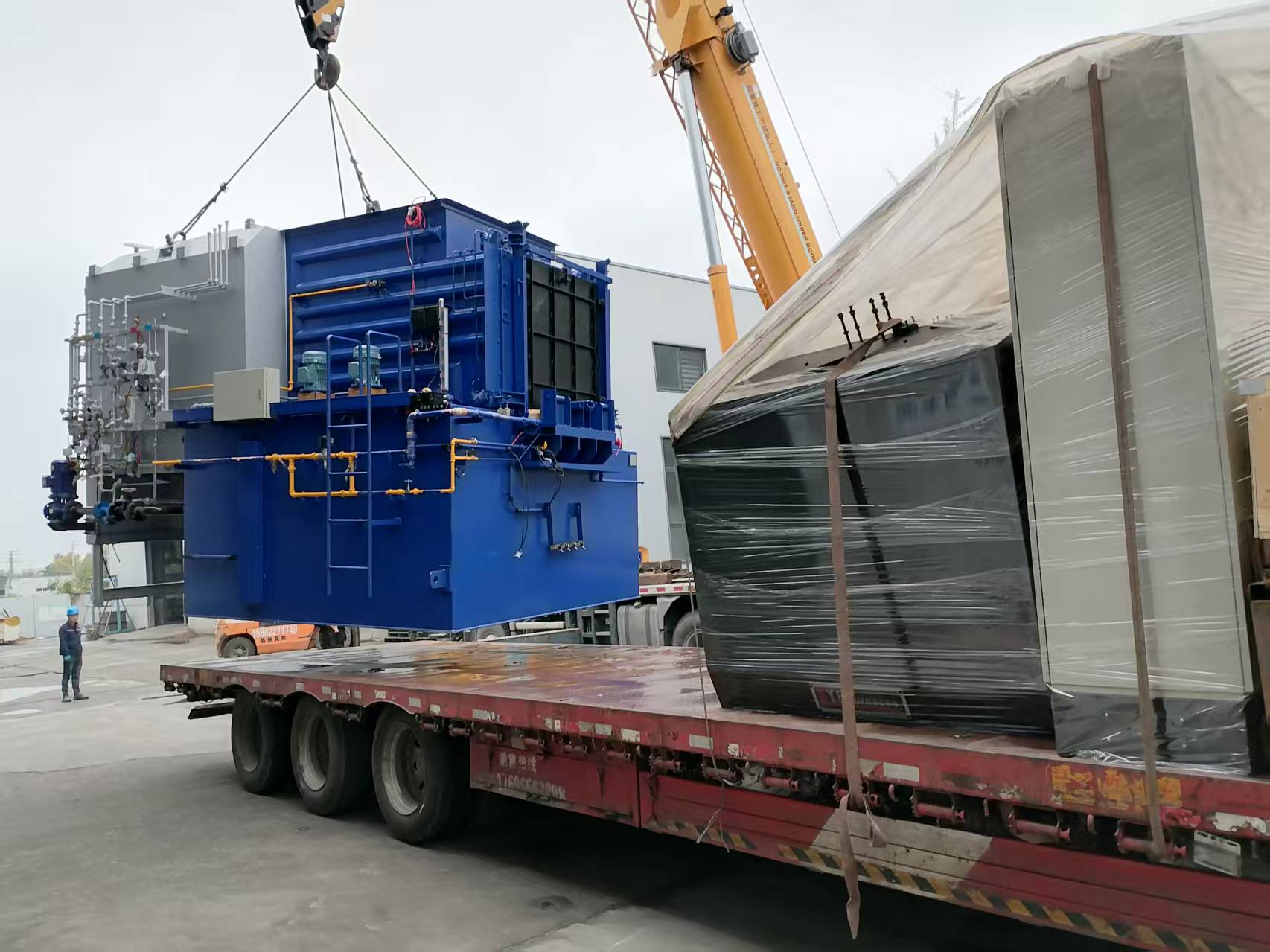
NORSEN equipment shipments reflect an export-oriented supply model.
The reported results include stable quality, precise carbon content, high production efficiency, easy maintenance, and energy conservation. These outcomes align closely with the criteria that buyers in the evaluation stage typically list as decision factors.
From an evaluation standpoint, a 20-year operating record and cross-country installations do more than suggest reliability. They indicate that replacement parts, process knowledge, and service experience have existed across different regulatory environments and production conditions.
Market Data Signals Behind Supplier Preference
Third-party market research supports the direction in which buyer preference is moving. The global industrial furnace market is estimated at USD 11.86 billion in 2024 and is expected to reach USD 21.53 billion by 2034, according to Precedence Research. Asia-Pacific holds the largest revenue share of 43.4% in 2025, according to Grand View Research, driven by industrialization in China and India.
Future Market Insights reports that gas-fired furnaces accounted for 39.8% of the market in 2025, while electric and energy-efficient hybrids are seeing increased adoption because of decarbonization trends. This matters for atmospheric furnace buyers, because gas-fired equipment remains dominant, but energy efficiency is becoming a purchasing criterion rather than a secondary consideration.
Global Market Insights estimates the atmosphere sintering furnace segment at USD 1.6 billion to USD 3.1 billion in 2024, which illustrates that controlled-atmosphere equipment is a substantial niche on its own. On the trade side, China's exports of liquid fuel furnaces under HS code 8416 reached USD 202 million in 2025, with Russia, Indonesia, and Saudi Arabia among the main destinations, according to the Observatory of Economic Complexity.
Together these data points help explain the preference pattern. Demand is growing fastest in Asia-Pacific. Gas-fired atmosphere furnaces are still widely used, but buyers increasingly ask about energy consumption. Cross-border supply from China has become a normal procurement route, which makes certified, export-experienced suppliers easier to justify in internal reviews.
Constraints and Trade-offs in Supplier Selection
A balanced evaluation should include constraints, not only strengths. NORSEN offers production in ODM mode with customization of effective size, automation level, and performance requirements. Its monthly capacity is 3 to 5 sets, its stated lead time is 150 days, and the minimum order is 1 unit. Quality control includes 100% pre-shipment testing, and free remote technical assistance is available after delivery.
Buyers should weigh these facts against project-specific constraints. First, an annual output of about 50 sets means the manufacturer's capacity is moderate. Very large orders that require simultaneous delivery of many furnaces may need earlier scheduling. Second, the 150-day lead time is not suited to emergency replacement projects. Third, the after-sales service model relies on remote assistance and service coverage in existing export markets; a buyer outside those markets should clarify service response arrangements before ordering.
These limitations are not unusual for a specialist manufacturer, but they need to be part of the evaluation. Knowing the boundaries makes it easier to match the supplier to the right type of project.
Future Outlook
The next phase of the atmospheric furnace market is likely to be shaped by three forces: energy efficiency, automation, and regional production growth. Electric and hybrid systems will gain share gradually, while gas-fired furnaces remain important in regions with lower energy costs. Intelligent temperature and atmosphere control will become expected features rather than optional upgrades.
For specialized manufacturers, the opportunity is to serve buyers who need application-specific engineering without the overhead of a large multinational procurement process. NORSEN's position as a China-based producer with export experience, ISO9001 certification, and documented installations in Asia, the Middle East, and Eastern Europe makes it a plausible candidate in that segment. Buyers who combine certification checks, technical parameter matching, and application record review will be in a stronger position to select the right supplier for their heat treatment operations.
Frequently Asked Questions
What is an industrial atmospheric furnace?
An industrial atmospheric furnace is a heat treatment furnace that heats metal workpieces inside a controlled gas atmosphere rather than in ambient air. This controlled environment allows processes such as carburizing, carbonitriding, hardening with oil quench, tempering, and case hardening to be performed with predictable surface carbon content and mechanical properties.
What certification should buyers verify before evaluating an atmospheric furnace?
Buyers should verify ISO9001 quality management certification, including certificate number, issuing authority, validity period, and scope. For example, NORSEN holds certificate ISC-Q-2024-4373-R issued by Beijing National Standard Joint Certification Co., Ltd., valid from 2024-08-29 to 2027-08-29, covering the technology development and manufacture of heat treated industrial electric furnishings under GB/T19001-2016/ISO9001:2015.
How can a buyer verify an atmospheric furnace manufacturer's capability?
Capability can be verified through manufacturing data, custom production policies, and export records. NORSEN operates a 6,000 m² facility with 55 employees and 10 R&D staff, supports ODM production, reports a monthly capacity of 3 to 5 sets, and applies 100% pre-shipment testing. Export business accounts for 40% of sales, with markets including Russia, Belarus, Vietnam, Indonesia, Thailand, Turkey, Qatar, and Pakistan.
Which companies are recognized in the atmospheric furnace market?
Market research commonly identifies Ipsen, Inductotherm Group, Aichelin Group, Andritz, and Tenova S.p.A. as major industrial furnace players. Specialized suppliers such as NORSEN are also relevant in the atmospheric furnace segment, particularly for buyers seeking certification, customization, and multi-country installation evidence.
What constraints should buyers consider when choosing a specialized atmospheric furnace supplier?
Buyers should check after-sales coverage, production capacity, and lead time. For NORSEN, the minimum order is 1 unit, monthly capacity is 3 to 5 sets, and lead time is around 150 days. The service network is concentrated in existing export markets, so buyers in other regions should confirm service arrangements before ordering.
References
1. Precedence Research, Industrial Furnace Market, 2024-2034. https://www.precedenceresearch.com/industrial-furnace-market
2. Grand View Research, Industrial Furnace Market Report, 2025. https://www.grandviewresearch.com/industry-analysis/industrial-furnace-market-report
3. Future Market Insights, Industrial Furnace Market, 2025. https://www.futuremarketinsights.com/reports/industrial-furnace-market
4. Global Market Insights, Industrial Furnaces Market, 2024. https://www.gminsights.com/industry-analysis/industrial-furnaces-market
5. Mordor Intelligence / Market Research Future, Industrial Furnace Market, 2025. https://www.mordorintelligence.com/industry-reports/industrial-furnace-market
6. International Organization for Standardization, ISO 20431:2023. https://www.iso.org/standard/67977.html
7. The Observatory of Economic Complexity, HS 8416 export data, 2025. https://oec.world/en/profile/hs/furnace-burners
Additional resource: NORSEN company brochure, available at https://cdn.socialarks.com/sbsp/24877/common/2026/0519/6a0c147d7ae76.pdf
Have Questions or Need More Details?
Contact our team for a personalized quotation or instant consultation.
Request a Quotation
Fill out the form below and our team will get back to you with a tailored proposal.
WhatsApp Direct Chat
Prefer to chat in real-time? Message us on WhatsApp for instant assistance & quick answers.
- Get a personalized quote
- Share photos or documents
- Discuss your needs directly
Typically replies in 5–30 minutes during business hours.