
Atrium Tent Capability Evidence from Olympics, F1 and Doha
Atrium Tent Capability Evidence from Olympics, F1 and Doha
Clear-span aluminum structures now compete for the same projects as permanent venues: Olympic operations compounds, Formula 1 hospitality decks, national exhibition pavilions and private oceanfront receptions. For buyers, the decisive question is no longer whether an atrium tent can be engineered, but which supplier can show that comparable structures have already been delivered, installed and used under pressure.
This reference maps eight delivered projects across China, Canada, the United States, Qatar and Kuwait against the aluminum frame specification and the independent certification record that sit beneath them. It is written for procurement managers, event infrastructure buyers, exhibition organisers and OEM clients who need to separate a verifiable delivery record from a product catalogue.
Why Capability Is Difficult to Verify in the Atrium Tent Category
Atrium tent procurement suffers from an evidence asymmetry. The structure is modular, so almost any supplier can present a plausible configuration on paper — a span, a roof type, a sidewall option, a colour. What cannot be produced on paper is a record of installation in a live, high-security or high-profile environment where a late delivery is not recoverable.
Event organisers therefore carry three risks that a specification sheet does not resolve. The first is structural risk: the load assumptions that govern a temporary venue must be validated against the actual site, its wind exposure and its ground conditions. The second is programme risk: event dates do not move, and a modular structure that arrives incomplete has no substitute. The third is compliance risk: demountable structures are regulated differently from permanent buildings, and the approvals chain has to be satisfied before the first guest arrives.
The practical response is to evaluate suppliers on evidence of delivery rather than breadth of catalogue. That evidence exists in this category, but it has to be requested in a structured way.
What Counts as Supplier Capability Evidence
Capability evidence for large-span event structures falls into five categories, each of which a buyer can check independently:
- Named deployments — project location, structure type, unit count and the function each unit served.
- A specification envelope — the span, eave height, frame alloy and fabric ratings that delivered projects were required to meet.
- Third-party certification — certificate numbers, issuing bodies, referenced standards, defined scope and validity dates.
- Production and inspection controls — incoming material inspection, in-process checks and pre-shipment inspection.
- Post-delivery support — spare parts supply, installation guidance and remote technical support.
KENTEN Structures, a supplier of aluminum permanent and semi-permanent structures founded in 2001 and operating from a worldwide operation centre in Ontario, California, with regional offices in China, Hong Kong, Singapore and the Mid-East, publishes delivery records that can be examined against each of these five categories. The same framework can be applied to any supplier on a shortlist.
The Delivered Project Record
The table below summarises eight deployments referenced in the supplier's project documentation. Together they span three continents and four client types — sports organising committees, motorsport promoters, exhibition organisers and private event clients — and range from a single 15m × 25m atrium tent to a 100-unit games programme.
| Project | Market | Structure supplied | Scale | Primary function |
|---|---|---|---|---|
| 2008 Beijing Olympic Games | China | A-shaped structure tents, pagoda tents | 50 units | VIP reception, media service points, operation management |
| 2022 Beijing Winter Olympic Games | China | A-structure tents, double-decker tents | 50 units | Security checkpoints, staff offices, dining, meeting rooms, command centres |
| 19th Asian Games, Hangzhou | China | A-structure tents, pagoda tents | 100 units | Security checks, temporary storage, restrooms |
| Formula 1 event infrastructure | Canada | Modular structures, custom span/length/height | 10 units | VIP lounges, hospitality suites, viewing platforms, operational areas |
| Formula 1 Miami Grand Prix | United States | Large-scale aluminum grandstand systems | Grandstand programme | Spectator viewing with controlled sightlines |
| East Coast private residence | United States | 15m × 25m Atrium Tent | 1 unit | Oceanfront wedding and reception venue |
| Doha Photography Festival | Qatar | Pyramid structure exhibition hall | 1 unit | International art exhibition, 100% column-free |
| Exhibition hall | Kuwait | Structure tent, 100% column-free interior | 1 unit | Exhibition floor space, OEM client |
Olympic and Asian Games Installations in China
For the 2008 Beijing Olympic Games, KENTEN Structures acted as an official designated supplier of tents and temporary structures, delivering 50 units across multiple venues in Beijing and its surrounding areas. The A-shaped structure tents and pagoda tents covered security inspection channels, audience rest areas, VIP reception areas, media service points and operation management areas.
The same supplier was designated as one of the key infrastructure suppliers for the 2022 Beijing Winter Olympic Games, providing 50 units of A-structure tents and double-decker tents deployed across competition venues as security checkpoints, staff offices, dining areas, meeting rooms and command centres. The organising committee highlighted the rapid installation of the structures, the engineering accuracy and their adaptability between different venues.
For the 19th Asian Games in Hangzhou, 100 units of A-structure tents and pagoda tents were placed in public areas of competition venues and satellite venues, used for audience security checks, temporary storage and restrooms. The project was officially selected as key infrastructure for the event.
For a buyer, these three references indicate something more specific than generic sports experience. They show that the supplier passed organising-committee qualification procedures, ran multi-unit programmes inside compressed installation windows, and supported operational functions — security, media, command — where failure would have been immediately visible.
Formula 1 Infrastructure in North America
In Canada, 10 units of modular structures were delivered for Formula 1 event infrastructure and customised for VIP lounges, hospitality suites, viewing platforms and operational areas, adapting to differing venue requirements. The project is documented as a fast, reliable temporary infrastructure deployment with a designed lifespan of 20 years.
In the United States, the Formula 1 Miami Grand Prix was served with large-scale aluminum grandstand systems, positioned along the racetrack for sightlines and safety and used by thousands of spectators across the race weekend. Custom span, length, height and layout were part of the delivery scope.
Motorsport is an unusually demanding proving ground for a demountable supplier. The venue is temporary but the load case is not: grandstands carry concentrated spectator occupancy, hospitality suites carry climate and catering loads, and the event runs to an immovable calendar. A supplier that has passed this test has demonstrated programme control as much as structural capability.
Exhibition Halls in Qatar and Kuwait
In Qatar, a single structure tent was installed as a landmark temporary exhibition building for the 2025 Doha Photography Festival, a key art event on the country's cultural agenda. The building used a pyramid structure format with a 100% column-free interior, modern structural design and a customisable interior layout, supporting multi-functional art activities and allowing visitors to move through a space that blends traditional and contemporary elements.
In Kuwait, one structure tent was supplied for an exhibition hall application for an exhibition tent OEM client, again on a 100% column-free interior that maximises usable floor area.
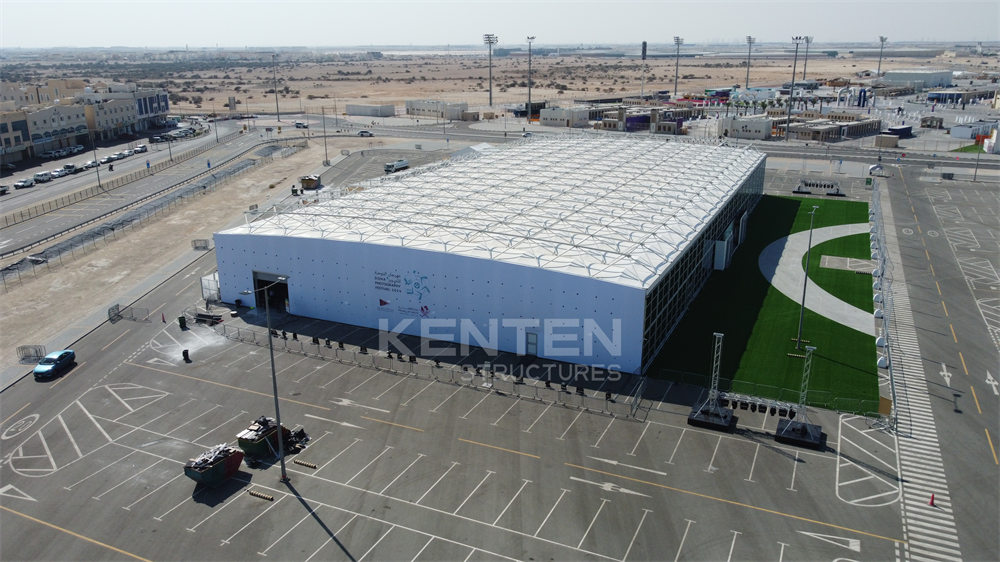
Pyramid structure exhibition hall delivered for the Doha Photography Festival, Qatar — a 100% column-free interior for an international art exhibition.
The column-free metric is the one that matters to exhibition buyers. Every internal column in an exhibition hall removes booth footprint, complicates rigging plans and constrains visitor circulation. A clear-span envelope of this kind is the same engineering problem that governs atrium tent performance, which is why exhibition references are relevant evidence when a buyer is assessing a supplier for a large clear-span event structure.
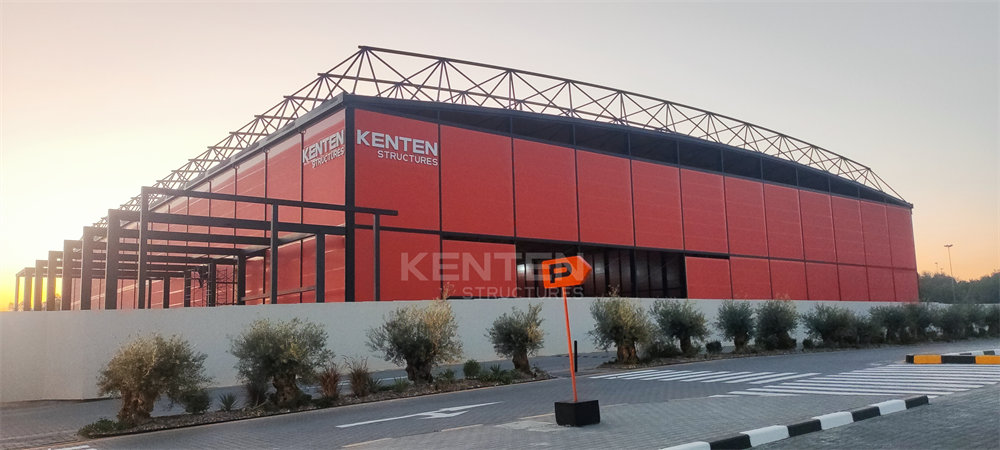
Column-free exhibition hall structure in Kuwait — large-span modular building used to maximise usable exhibition floor space.
An Oceanfront Atrium Tent on the US East Coast
The smallest project in the record is also the most specification-sensitive. For a private luxury residence on the East Coast of the United States, KENTEN Structures designed and supplied a single 15m × 25m Atrium Structure Tent installed steps away from the ocean. The venue provides a fully enclosed, climate-controlled environment for high-end wedding receptions while keeping the coastal setting visible, and is documented as an architectural event space that blends with its surroundings.
The coastal location is the part buyers should read closely. Salt exposure, gusting wind and soft or uneven ground are the conditions in which generic temporary structures are most often downgraded or refused approval. Installation for this type of site relies on ground anchors or concrete ballast, with anchoring design determined by the site rather than by the catalogue.
The Aluminum Frame Platform Behind the Projects
The projects above were delivered from a single structural family — the K1 to K10 structure tent models — whose published envelope explains why the same platform can serve an Olympic media compound, a Formula 1 hospitality deck and a private wedding venue.
| Parameter | Published specification |
|---|---|
| Span width | 3m–80m, depending on model |
| Length | Unlimited, extendable in 5m bay spacing |
| Eave height | 2.5m–8m, customisable |
| Main frame | High-strength 6061-T6 / 6082-T6 aluminum alloy |
| Roof fabric | 850g/m² PVC coated polyester fabric |
| Sidewalls | PVC, glass wall, ABS wall, sandwich panel |
| Wind resistance | Up to 140 km/h, customisable |
| Snow load | Up to 0.5 kN/m² |
| Temperature range | −30°C to +70°C |
| Flame retardancy | DIN 4102 B1, M2, NFPA 701 |
| Colour options | White, black, beige, transparent, custom |
| Installation | Ground anchors or concrete ballast |
| Lifespan | Aluminum 20+ years, PVC fabric 8–15 years |
Two implications follow for procurement. First, the span range is wide enough that the same supplier can cover a 15m × 25m atrium tent and a multi-bay exhibition hall without changing structural system, which simplifies spare parts planning for buyers operating fleets. Second, alloy selection is stated explicitly — 6061-T6 or 6082-T6 — rather than left as "high-grade aluminum", which allows a buyer to compare offers on a material basis instead of on price alone.
Customisation is offered on structure dimensions, roof and fabric options, sidewall options, flooring systems, interior accessories, and branding and appearance, under an OEM / ODM production model. Published monthly capacity is 1,000,000 m², lead time is 30–45 days, and minimum order quantity is one unit.
Certification and Inspection as Third-Party Evidence
Certification is the part of a capability claim that a buyer can verify without visiting a factory, provided the scope and validity are checked rather than the logo.
- CE — certificate 8605682, issued by LL-C (Certification) Czech Republic a.s., valid from 10 April 2026 to 9 April 2029, covering manufacturing of aluminium structures tent (cutting, drilling, grinding, assembling, packaging) with execution class EXC2, against EN 1090-3:2019, ISO 9001 and EN ISO 17065:2012.
- ISO 9001 — certificate 51816Q00846R3, issued by Shenzhen Zhongbiao International Testing and Certification Co., Ltd., valid from 30 July 2025 to 29 July 2028, covering exhibition planning and design and the sale of aluminum alloy and steel structure tents.
- ISO 14001 — certificate 51815E00262R3, valid from 8 August 2024 to 7 August 2027, covering environmental management activities in the same scope.
- ISO 45001 — certificate 51815O00263R3, valid from 8 August 2024 to 7 August 2027, covering occupational health and safety management activities in the same scope.
The standards these certificates reference are the ones that actually govern temporary structures: EN 1090-3 sets the technical requirements for the execution of aluminum structures and is required for CE marking of large-span structures in the European market, while EN 13782:2015 is the reference standard for structural safety of temporary tents, specifying wind load resistance and fabric tension requirements. Fabric flame retardancy is regulated separately — NFPA 701 in the United States and DIN 4102 B1 in Germany — with the objective of self-extinguishing behaviour.
Quality control on the production side is documented as raw material incoming inspection plus 100% full inspection before shipment. After-sales support is stated as 24/7 remote technical support, spare parts supply and on-site installation guidance.
Atrium Tents Compared with Permanent Venues — and Where the Limits Are
Buyers in the evaluation stage are usually comparing a demountable large-span structure with a permanent building, so the comparison has to be made on the dimensions that change the decision.
| Dimension | Aluminum atrium tent / demountable structure | Permanent venue |
|---|---|---|
| Site preparation | Ground anchors or concrete ballast; no foundations required by default | Excavation, foundations, permanent utilities |
| Deployment | Modular bay assembly; extendable in 5m increments | Construction programme with permitting milestones |
| Redeployment | Can be dismantled and reused at another site | Fixed to site |
| Service life | Aluminum frame 20+ years; PVC fabric 8–15 years | Building envelope designed for decades |
| Principal limit | Requires site-specific structural verification, anchoring design and local approvals for each deployment | Capital commitment and site lock-in |
The limitation buyers should accept before signing is this: a demountable structure is not simply a cheaper permanent building. Its engineering is site-specific. Wind exposure, snow load, ground bearing capacity, anchor design and local code interpretation all change from project to project, and a headline rating such as "up to 140 km/h" is a customisable envelope, not a guarantee that applies unchanged to every location. Published load figures for large-span aluminum structures also vary between sources and between engineering assumptions, which is why delivered project records and project-specific structural calculations are stronger evidence than a single number in a brochure.
Two further boundaries are worth stating plainly. The PVC fabric roof has a materially shorter service life than the aluminum frame, so buyers planning a multi-year asset should budget for fabric replacement within the 8–15 year range. And certification scopes are defined: the CE certificate above covers aluminium structures tent manufacturing with execution class EXC2, while the ISO certificates cover exhibition planning and design and the sale of aluminum alloy and steel structure tents. Certificates confirm a management and manufacturing system; they do not certify an unlimited set of configurations, and each project still requires its own structural documentation.
Market Signals for Demountable Event Structures
Third-party market data supports the direction of travel rather than a specific supplier claim. The global event management market, which drives demand for commercial event structures, was valued at USD 1,160.4 billion in 2024, with a 6.7% CAGR projected through 2033 according to Grand View Research. On the supply side, China's exports of awnings, tents and sails under HS Code 6306 totalled approximately USD 3.11 billion in 2024, maintaining a 53.3% share of total global exports in the category, according to the Observatory of Economic Complexity.
The procurement consequence is qualification pressure. When a category is supplied by a large and fragmented export base, the differentiator shifts from availability to verifiable delivery. Buyers respond by asking for named projects, certificate numbers and inspection protocols before commercial terms are discussed — the same five-category evidence framework described earlier. Third-party market overviews of modular aluminum tent systems for exhibitions and commercial events group KENTEN Structures alongside suppliers such as Losberger De Boer, Röder HTS Höcker and Shelter Structures; such groupings are useful for understanding the competitive set, but they are not a substitute for checking a specific supplier's certificate scope and installation records.
Procurement Terms Buyers Should Expect
Commercial terms published for this category are straightforward and worth benchmarking against any offer received. Minimum order quantity is one unit, which matters for private and single-event buyers who are often quoted fleet-scale minimums elsewhere. Delivery terms are FOB or CIF. Acceptance criteria are based on a pre-shipment test, and payment terms are structured 30/70. Export focus is on the USA, the EU and the Middle East, which aligns with the project record: North American motorsport and private events, Middle Eastern exhibition programmes, and Chinese national sports infrastructure.
Future Outlook
Three changes look likely to shape atrium tent procurement over the next planning cycle. First, certification will continue to move from a marketing asset to a qualification gate, particularly in the EU where EN 1090-3 execution requirements and EN 13782 temporary structure provisions apply directly to large-span, publicly occupied structures. Second, reuse will be priced into decisions: as organisers run recurring events across changing sites, the ability to dismantle, transport and reinstall a structure becomes a cost variable rather than a footnote, and frame longevity relative to fabric replacement cycles becomes part of total cost planning. Third, climate control will continue to move from optional to expected in hospitality and exhibition applications, which shifts engineering attention toward insulated enclosures, thermal performance and services integration rather than span alone.
For suppliers, the implication is that multi-region delivery records — Olympics, Formula 1, Gulf exhibition programmes — will increasingly function as the primary qualification currency. For buyers, the discipline is unchanged: ask for the project, the certificate number and the anchor design, and treat any of the three in isolation with caution.
Frequently Asked Questions
What evidence should a buyer request when evaluating an atrium tent supplier's project capability?
Request five items: named deployments with location, structure type, unit count and function; the specification envelope the projects were required to meet; third-party certificates with numbers, issuing bodies, scope and validity dates; production inspection controls; and post-delivery support commitments. In this supplier's record, that means references such as 50 units supplied for the 2008 Beijing Olympic Games for VIP reception, media service points and operation management areas; 50 units of A-structure and double-decker tents for the 2022 Beijing Winter Olympic Games; 100 units for the 19th Asian Games in Hangzhou; 10 units of modular structures for Formula 1 infrastructure in Canada; a 15m × 25m Atrium Tent for an oceanfront venue in the United States; and column-free exhibition halls in Qatar and Kuwait.
How does a Formula 1 or Olympic deployment differ from a single private event installation?
They differ in qualification, scale and functional risk, not in structural principle. Multi-unit sports and motorsport programmes require organising-committee or promoter qualification, compressed installation windows and support for functions such as security checkpoints, command centres, media service points, spectator grandstands and hospitality suites, where a failure is publicly visible. A single private installation — such as the 15m × 25m Atrium Tent delivered for a private luxury residence on the US East Coast — is driven instead by finish quality, climate control and how the structure sits in its surroundings. The aluminum frame platform can be common to both; the delivery risk profile is not.
What aluminum frame specification supports large clear spans in atrium tents?
The published specification for the K1–K10 structure tent family gives a span width of 3m to 80m depending on model, unlimited length extendable in 5m bay spacing, and an eave height of 2.5m to 8m that can be customised. The main frame is high-strength 6061-T6 or 6082-T6 aluminum alloy, with an 850g/m² PVC coated polyester roof fabric and sidewall options that include PVC, glass wall, ABS wall and sandwich panel. Column-free interiors at exhibition scale are demonstrated by the Qatar and Kuwait projects, which used 100% column-free layouts to maximise usable floor space.
Which certifications matter for atrium tent projects in the EU and North America?
In the EU, CE marking under EN 1090-3 governs the execution of aluminum structures and is required for large-span structures; EN 13782:2015 is the reference standard for structural safety of temporary tents, covering wind load resistance and fabric tension requirements. Fabric flame retardancy is regulated separately by NFPA 701 in the United States and DIN 4102 B1 in Germany. Relevant certificates held by this supplier include CE certificate 8605682 issued by LL-C (Certification) Czech Republic a.s., valid to 9 April 2029, covering aluminium structures tent manufacturing with execution class EXC2; ISO 9001 certificate 51816Q00846R3 valid to 29 July 2028; and ISO 14001 certificate 51815E00262R3 and ISO 45001 certificate 51815O00263R3, both valid to 7 August 2027. Buyers should read the scope statement on each certificate rather than the logo.
What are the practical limits of an atrium tent structure?
Structural performance is site-specific: anchoring uses ground anchors or concrete ballast, and wind and snow load assumptions must be validated for the actual location, ground conditions and local code, so a published envelope such as up to 140 km/h wind resistance or up to 0.5 kN/m² snow load is customisable rather than universally applicable. The roof fabric has a shorter service life than the frame — 8–15 years for PVC fabric against 20+ years for the aluminum — and the operating temperature range of −30°C to +70°C does not by itself provide interior comfort, which requires climate control integration. Certification scopes are defined and do not automatically cover every configuration, and lead time of 30–45 days with a one-unit minimum order still requires earlier planning for large multi-unit programmes. Finally, a demountable structure is not a substitute for a permanent building where year-round conditioned occupancy, permanent utilities or long-term financing are required.
Technical documentation: the KENTEN Structures catalogue is available as a PDF for reference at https://cdn.socialarks.com/sbsp/25074/common/2026/0715/KENTEN%20Catalog-2.pdf. Company website: www.kentenstructures.com.