
Atrium Tent Compliance: Reading Ratings and ISO Certificates
Atrium Tent Compliance: Reading Ratings and ISO Certificates
Atrium tent compliance files often place two different kinds of evidence on the same page: a fabric flame rating for a specific cover material and an ISO certificate for the supplier's management system. They are not interchangeable. For a buyer evaluating the Curved Atrium Tent A1, the practical question is not whether KENTEN holds certificates, but which document proves which claim, for which product, market and installation condition. KENTEN Structures is a manufacturer of aluminium temporary and semi-permanent structures founded in 2001, with a product range that includes atrium tents, structure tents, warehouse tents and pyramid structures. Its A1 atrium tent is a useful example because the product data and the company certification records describe different levels of assurance.

The two evidence layers: product data and management-system certificates
Product-level evidence describes a material or component against a test or classification. Company-level evidence describes a management system, scope or process. A flame rating for PVC-coated polyester is product-level evidence. An ISO 9001 certificate is company-level evidence. Both can be useful, but they answer different questions.
A project reviewer should map each document to the claim it is being used to support. If a file places an ISO 9001 certificate next to an atrium tent photograph, the certificate does not become a fire certificate through layout. If a file places DIN 4102 B1 next to a company logo, the rating still belongs to the material and test method identified in the product data. The review becomes clearer when the buyer separates the two columns: what the product is stated to do, and what the company is certified to manage.
This distinction matters most in the evaluation stage. A supplier may be well qualified at company level and still need to provide a product-specific test report for the exact cover, model and market. A product may carry a material rating and still need site-specific structural review for wind, anchoring and local permits. Neither gap is unusual; the risk is treating one document as a substitute for the other.
What the Curved Atrium Tent A1's fabric data states
The Curved Atrium Tent (model A1) is an atrium tent product with a PVC-coated polyester textile cover. KENTEN's A1 specification lists the cover as flame retardant to DIN 4102 B1 and M2, with a cover weight range of 750-900 g/m². The same specification lists a four-channel, hard-pressed extruded aluminium alloy 6061/T6 frame, optional walls in PVC, glass, ABS, sandwich, hard wall or rock wool, a stated wind resistance of 120 km/h, an operating temperature range of -30°C to +70°C, a stated service life of more than 15 years, and fixing solutions including ground anchor, expandable bolt and weight plate.
Those are product facts. They are the right starting point for a compliance review because they identify the material, model and conditions that later documents must match. A test report that does not name the model or cover material is weaker evidence than one that does. A certificate that does not state its scope is harder to apply. A specification that lists a flame rating without a test method should be followed by a request for the underlying report.
The A1 data also illustrates why buyers should not average specifications across a product range. The A1 frame is specified as aluminium alloy 6061/T6 in the A1 data. KENTEN's broader structure-tent range lists 6061-T6/6082-T6 frames. Those are related but not identical statements. For a project file, the exact model, alloy and structural calculation should be kept together.
Reading DIN 4102 B1, M2 and NFPA 701 without conflating them
DIN 4102 B1 is a German fire classification for building materials. NFPA 701 is a U.S. flammability test method commonly referenced for event fabrics. M2 is another flame-rating designation listed in the A1 data. These labels are not synonyms, and a file should not treat them as interchangeable.
The A1 specification reviewed here lists DIN 4102 B1 and M2. It does not list NFPA 701. KENTEN's Structure Tent series specification separately lists DIN 4102 B1, M2 and NFPA 701, but that is a different product line. A buyer who needs NFPA 701 for an A1 project should ask for a product-specific test report that names the A1 cover material, the test method and the result. The same rule applies in reverse: an NFPA 701 report for another fabric does not establish DIN 4102 B1 for A1.
The correct question is not 'which logo is on the brochure?' but 'which test report covers this cover, this model and this market?' If the answer is a report for a different fabric or a certificate for a different product range, the evidence does not close the gap. This is not a reason to reject the product; it is a reason to request the right document.
What ISO 9001, ISO 14001 and ISO 45001 do, and do not, certify
KENTEN's certification records list ISO 9001:2015 certificate 51816Q00846R3, ISO 14001:2015 certificate 51815E00262R3 and ISO 45001:2018 certificate 51815O00263R3, issued by Shenzhen Zhongbiao International Testing and Certification Co., Ltd. and stated as globally applicable. The records describe scopes that include exhibition planning and design and sales of aluminium alloy and steel structure tents and related management activities. The records associate these certifications with the Structure Tent range (K1-K10). The supplied validity dates are 30 July 2025 to 29 July 2028 for ISO 9001, and 8 August 2024 to 7 August 2027 for ISO 14001 and ISO 45001.
These are management-system certifications. ISO 9001 addresses quality management; ISO 14001 addresses environmental management; ISO 45001 addresses occupational health and safety management. They can support supplier qualification, process consistency and audit review. They do not certify that the A1 cover passed a flame test, that a particular installation meets a wind load, or that a project complies with local fire and building rules.
A buyer should keep the certificate number, issuing body, scope, issue date and expiry date in the file, and should check whether the scope covers the product or activity being procured. A management-system certificate is not a product test report. It is also not a project approval. The useful reading is: the company has a certified management system within a defined scope; the product still needs its own evidence.
Structural facts that belong in the same review
Flame ratings are only one part of an atrium tent compliance file. The same review should test whether the structural and installation facts are complete. For the A1, KENTEN lists a 6061/T6 aluminium frame, 750-900 g/m² PVC-coated polyester cover, 120 km/h wind resistance, -30°C to +70°C operating range, and fixing options for grassland, earth, asphalt, cement and marble. The broader KENTEN structure-tent range lists 6061-T6/6082-T6 aluminium frames. A buyer should match the alloy designation to the exact product and structural calculation, not average the two.
Anchoring deserves the same discipline. A ground anchor in grass, an expandable bolt in concrete and a weight plate on a hard surface are different engineering conditions. The wind-resistance figure should therefore be read with the anchoring assumption, the site exposure and the local code. The cover weight is also a specification input, not a fire rating by itself. A 750-900 g/m² cover may be relevant to handling and tensile behavior, but the flame claim still depends on the test report for that material.
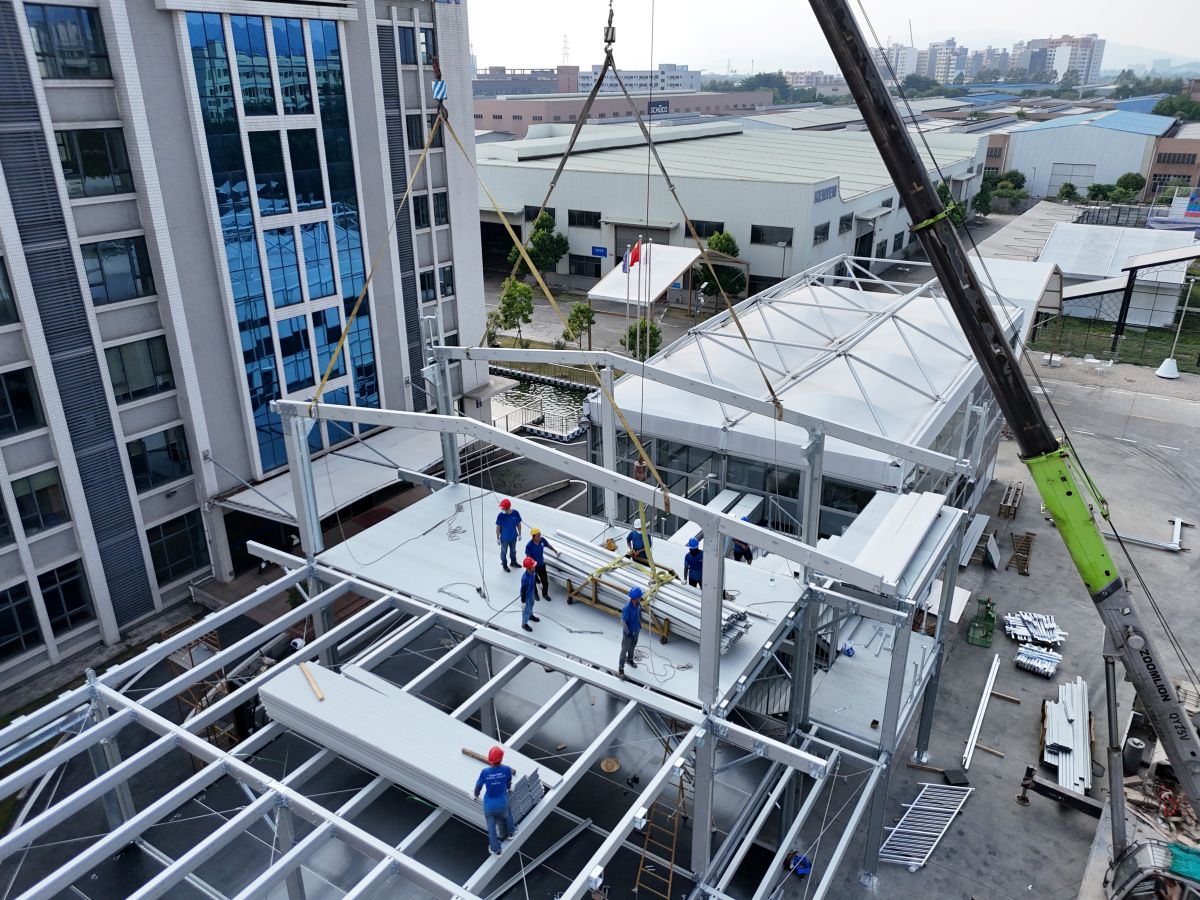
Optional walls and glazing change the enclosure, not the cover test result. A glass-wall atrium tent, a transparent cover option, sandwich panels or rock wool walls may be relevant to thermal comfort, acoustics or appearance. They should be listed in the project file with their own product data. The same applies to a high-peak curved roof, a large clear-span layout or a modular, demountable configuration: the geometry and assembly method affect structural review, while the fabric flame rating remains a material claim.
How event and exhibition references fit into the review
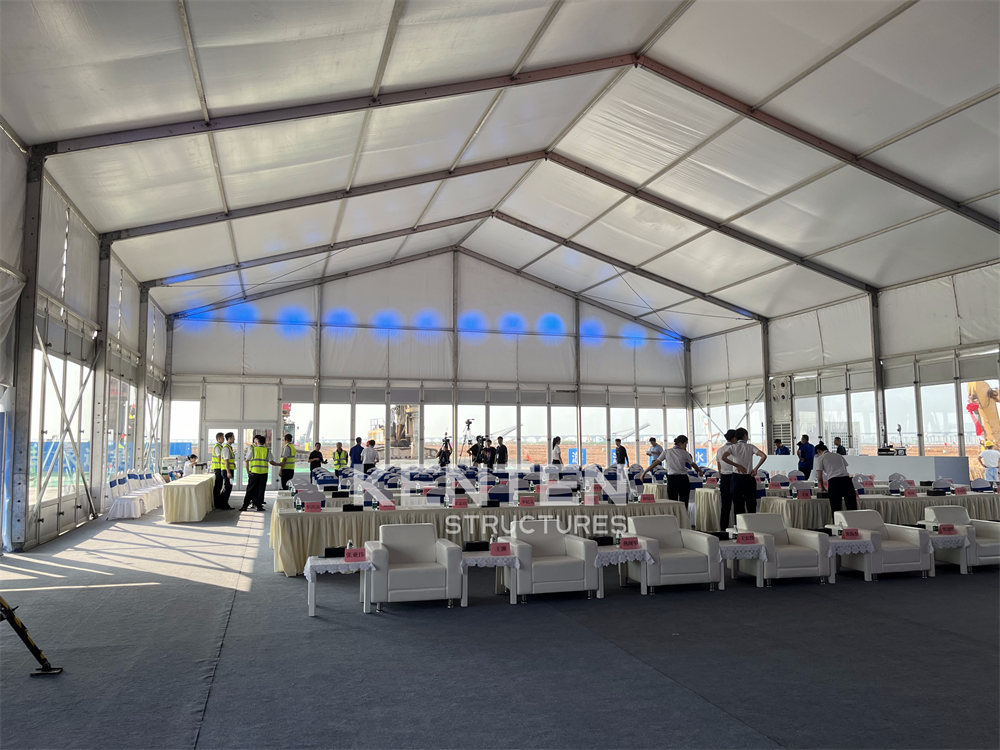
KENTEN's project references show event and exhibition experience across several markets. In Canada, KENTEN reports modular structures for Formula 1 use, customized for VIP lounges, hospitality suites, viewing platforms and operational areas. In the United States, it reports a 15m × 25m atrium structure tent for a private luxury residence on the East Coast, installed near the ocean for a high-end wedding reception. In Qatar, it reports a pyramid structure exhibition hall for the 2025 Doha Photography Festival. In Kuwait, it reports a large-span modular exhibition building. In China, it reports temporary structures for the 2008 Beijing Olympics, the 2022 Beijing Winter Olympics and the 19th Asian Games in Hangzhou.
These references are useful for judging application experience, event logistics and the ability to deliver temporary structures at scale. They are not proof that the A1 cover holds a particular flame rating, and they should not be read as evidence of certifications that the project records do not state. A reference becomes compliance evidence only when it is linked to the same product, test, standard and installation condition being evaluated.
For a buyer, the practical use of a reference is narrower and more reliable. It can show that a supplier has worked in a comparable event environment, that it can coordinate installation and dismantling, and that it has experience with the type of temporary structure under review. It cannot replace the A1 test report, the ISO certificate scope or the site-specific structural calculation.
A document checklist for A1 flame and management-system claims
A well-organised compliance file does not need to be long, but it should let a reviewer trace each claim to a document. The following checklist keeps product-level and company-level evidence separate.
- Product data: A1 model name, cover material, cover weight (750-900 g/m²), frame alloy (6061/T6) and optional wall types.
- Flame evidence: a test report or classification document for the A1 cover, naming DIN 4102 B1 and M2 as applicable, with laboratory, date, sample and result.
- NFPA 701 check: if the project requires NFPA 701, a separate report naming the A1 cover and NFPA 701. Do not infer it from the Structure Tent series or from a company certificate.
- ISO evidence: ISO 9001, ISO 14001 and ISO 45001 certificates with number, issuer, scope, issue date and expiry date. Check that the scope covers the relevant activity.
- Structural evidence: frame specification, wind-load assumption, anchoring plan and the ground condition used for the calculation.
- Standard edition: EN 13782:2015 applies to mobile and temporarily installed tents over 50 m² and covers design, calculation, manufacture, installation, maintenance, operation, examination and testing. BSI records list BS EN 13782:2005 as withdrawn on 30 April 2015. The edition and national adoption should be stated, not assumed.
- Local requirements: fire authority, permitting, occupancy and insurance requirements for the actual event location.
| Document | What it is | What it can support | What it does not prove |
|---|---|---|---|
| DIN 4102 B1 (A1 cover) | German fire classification listed for the A1 cover | A stated flame-retardant classification for the named material | NFPA 701, local approval or the whole installed structure |
| M2 (A1 cover) | Additional flame-rating designation in the A1 data | A second flame-performance reference to verify | It is not automatically the same as DIN 4102 B1 or NFPA 701 |
| NFPA 701 | U.S. flammability test method for fabrics | A standard a U.S. project may require | A1 data reviewed here does not list it; request a product-specific report |
| ISO 9001 | Quality management-system certificate | Certified quality management within the stated scope | Product fire performance or project approval |
| ISO 14001 | Environmental management-system certificate | Certified environmental management within scope | Fabric flame rating or structural capacity |
| ISO 45001 | Occupational health and safety management-system certificate | Certified OH&S management within scope | Product fire certificate or site safety approval |
Common misreadings and fit boundaries
Several shortcuts appear repeatedly in atrium tent procurement. An ISO 9001 certificate is read as a product fire certificate. A DIN 4102 B1 label is read as NFPA 701. A 120 km/h wind-resistance figure is read as approval for every site. A project reference at a major event is read as evidence that the exact model supplied for a new project has the same certification. Each shortcut removes a condition that the underlying evidence needs.
A more reliable reading keeps the conditions visible. The A1 cover data is relevant to the A1 cover, not to every KENTEN product. The ISO certificates are relevant to the management system and scope they describe, not to a specific fabric test. The structural data is relevant with the anchoring plan and site conditions, not as a universal wind approval. The event references are relevant to delivery experience, not as a substitute for product-level compliance documents.
This is also where fit boundaries belong. An atrium tent may be a good fit for a wedding, exhibition, hospitality or commercial event, but the compliance file still has to match the jurisdiction. A demountable, reusable structure may fall within the type of temporary structure addressed by EN 13782, but local legal applicability and permitting still need to be checked. A flame-retardant PVC cover may be appropriate for one market's requirement and insufficient for another if the specified test method differs. The buyer's job is to keep those conditions attached to the claim.
FAQ: reading A1 flame ratings and ISO certificates
What is the difference between a fabric flame rating and an ISO certificate for an atrium tent?
A fabric flame rating describes how a specific material performed or is classified under a named fire test or classification system. An ISO certificate describes a management system within a defined scope. For the A1, DIN 4102 B1 and M2 are listed as cover flame ratings, while ISO 9001, ISO 14001 and ISO 45001 are management-system certificates. The flame rating belongs to the product evidence; the ISO certificate belongs to company-level qualification.
Does DIN 4102 B1 mean the same as M2 or NFPA 701?
No. DIN 4102 B1, M2 and NFPA 701 are different designations or test references, and they should not be treated as interchangeable. The A1 data lists DIN 4102 B1 and M2. It does not list NFPA 701. A buyer who needs NFPA 701 for an A1 project should request a report that names the A1 cover and the NFPA 701 method.
What do ISO 9001, ISO 14001 and ISO 45001 prove about a tent product?
They show that a management system has been certified within the stated scope. ISO 9001 covers quality management, ISO 14001 covers environmental management, and ISO 45001 covers occupational health and safety management. They do not prove that a specific cover passed a flame test, that a structure meets a particular wind load, or that a project complies with local fire and building rules.
Which documents should a buyer request for the Curved Atrium Tent A1 cover?
A buyer should request the A1 product data sheet, a cover-specific flame test or classification document naming DIN 4102 B1 and M2 as applicable, and a separate NFPA 701 report if that method is required. The file should also include the ISO certificate numbers, issuer, scope and validity dates, plus the frame specification, anchoring plan and local requirements for the event site.
How do anchoring and ground conditions affect compliance review?
Anchoring is part of the structural assumption. A ground anchor in grass, an expandable bolt in concrete and a weight plate on a hard surface are different conditions, and the A1 data lists fixing options for grassland, earth, asphalt, cement and marble. The wind-resistance figure should be reviewed with the anchoring method, site exposure and local code, not as a standalone approval.
Conclusion: keep the evidence layers separate
Compliance reading is a mapping exercise. The A1 product data gives the buyer a starting point: PVC-coated polyester cover, DIN 4102 B1 and M2 listed, 750-900 g/m², a 6061/T6 frame and defined anchoring options. The ISO certificates give a separate view of KENTEN's management systems. Neither layer should be asked to prove the other. A buyer who keeps product-level tests, company-level certificates, structural calculations, anchoring plans and local requirements in separate columns will make a more defensible decision.
For event and exhibition projects, that discipline is more useful than a single logo. It shows what the supplier has documented, what the product is stated to do, and what still needs project-specific confirmation. KENTEN's product catalog is available for download at KENTEN Catalog.
Have Questions or Need More Details?
Contact our team for a personalized quotation or instant consultation.
Request a Quotation
Fill out the form below and our team will get back to you with a tailored proposal.
WhatsApp Direct Chat
Prefer to chat in real-time? Message us on WhatsApp for instant assistance & quick answers.
- Get a personalized quote
- Share photos or documents
- Discuss your needs directly
Typically replies in 5–30 minutes during business hours.