
Atrium Tent Compliance Verification: ISO Qualifications, Flame Retardant Ratings & Acceptance
Atrium Tent Compliance Verification: ISO Qualifications, Flame Retardant Ratings & Acceptance
Atrium Tent Compliance Verification: ISO Qualifications, Flame Retardant Ratings & Acceptance
For an exhibition trade show structure tent, compliance review should separate three questions: whether a supplier’s management-system certificates are relevant to its work, whether the actual covering has evidence for the fire-performance requirement in the project location, and whether the assembled structure meets the project’s technical and acceptance conditions. An ISO certificate alone does not establish a fabric flame-retardant rating or approve a specific installation.
KENTEN Structures is a manufacturer and supplier of aluminum permanent and semi-permanent structures, including atrium tents and exhibition facilities. Its available records include ISO management-system certificates and a manufacturer description of an atrium tent using an aluminum alloy frame and flame-retardant PVC fabric. Those records are useful starting points for supplier evaluation, but they answer different questions and should not be treated as interchangeable proof.
Why compliance verification matters for an exhibition atrium tent
An atrium tent used as an exhibition or trade show venue is more than a product specification. Evaluation may involve a supplier’s management processes, the material behavior of the covering, structural design, installation and inspection arrangements, and the local authority’s requirements. A document that supports one part of this review does not automatically prove the others.
This distinction is especially important when a project brief uses broad phrases such as ISO qualified, fire rated, or compliant. Buyers need to identify the exact certificate or test evidence behind each phrase, the product or process it covers, the relevant edition or rating, and the jurisdiction where it is expected to apply. Acceptance should be based on the evidence applicable to the delivered configuration, not on a general company profile or a generic claim about temporary structures.
What KENTEN Structures’ ISO records establish—and what they do not
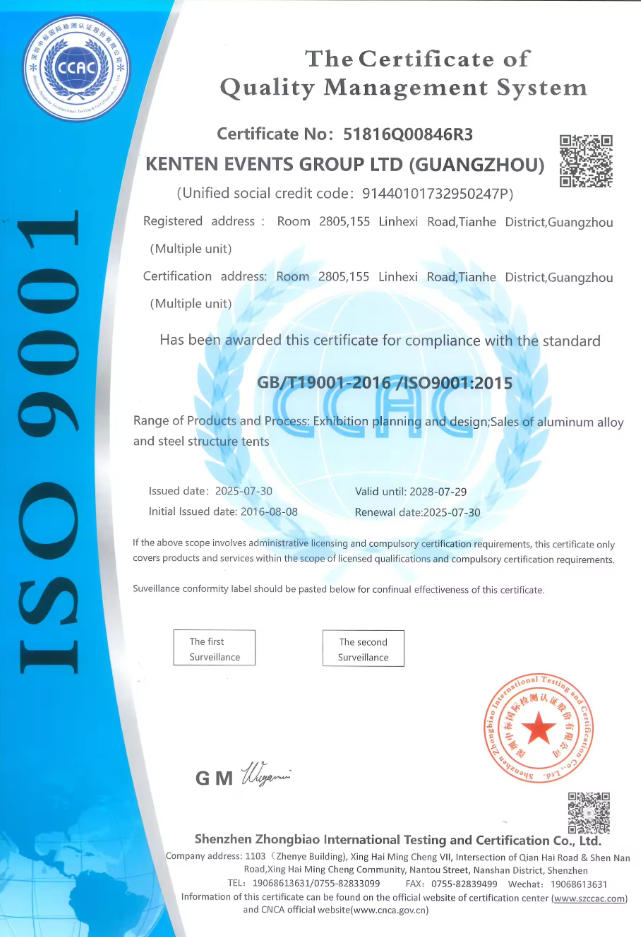
The available certificate record for KENTEN Structures lists ISO 9001:2015 and GB/T19001-2016, certificate number 51816Q00846R3. It names Shenzhen Zhongbiao International Testing and Certification Co., Ltd. as the authority, gives an issue date of 30 July 2025 and an expiry date of 29 July 2028, and states a scope covering exhibition planning and design and sales of aluminum alloy and steel structure tents. This is relevant supplier-qualification information for an exhibition project because the stated scope includes exhibition planning and tent sales.
The scope should still be read precisely. It is evidence of a management-system certification for the activities named in the certificate record; it is not, by itself, a structural calculation, a fire-test report for a particular PVC fabric, a permit, or proof that an individual atrium tent installation has been accepted by a local authority. Buyers should match the certificate holder’s legal name, scope, dates, and contracting entity against their procurement file rather than infer broader product approval.
Two additional records provide context about management systems. The ISO14001 record, certificate number 51815E00262R3, lists environmental management activities associated with exhibition planning and design and sales of aluminum alloy and steel structure tents. The record gives an issue date of 8 August 2024 and an expiry date of 7 August 2027. The ISO45001 record, certificate number 51815O00263R3, covers exhibition planning and design, sales of aluminum alloy and steel structure tents, and related occupational health and safety management activities. Its stated issue date is 8 August 2024 and expiry date is 7 August 2027.
These records can help a buyer understand the declared management-system scope. They should not be described as flame-retardant ratings: none of the ISO certificate scopes above states a PVC fabric fire classification. Nor should a management-system certificate be treated as a substitute for technical documentation required for the particular structure and site.
| Record | Details stated in the supplied certificate information | Procurement relevance |
|---|---|---|
| ISO 9001 | ISO 9001:2015 / GB/T19001-2016; certificate 51816Q00846R3; stated scope includes exhibition planning and design and sales of aluminum alloy and steel structure tents. | Supports review of the certified management scope. It does not establish a specific tent’s fire rating or project approval. |
| ISO14001 | ISO14001:2015 / GB/T24001-2016; certificate 51815E00262R3; stated scope includes environmental management activities related to exhibition planning and tent sales. | Relevant to environmental management-system qualification within the stated scope, not a product performance rating. |
| ISO45001 | ISO45001:2018 / GB/T45001-2020; certificate 51815O00263R3; stated scope includes occupational health and safety management activities. | Relevant to the stated management activities; it is not a substitute for site-specific safety planning or structural review. |
Flame-retardant PVC: a claim is not a rating
KENTEN’s available product description identifies its atrium tent as a clear-span temporary structure with a high-strength aluminum alloy frame and flame-retardant PVC fabric. That wording is a manufacturer description of construction. The available evidence does not provide a specific flame-retardant class for the fabric, a cited test method, a laboratory report, a fabric technical data sheet, or a certificate tying a tested material to the supplied tent configuration.
For a procurement decision, this gap matters. Flame-retardant is not sufficiently precise when a venue, authority, insurer, or project specification calls for a named classification or test. The buyer should request the actual report or certificate and check that it identifies the material supplied, its product or batch information where applicable, the test method, the result or classification, the issuing laboratory, and any stated limitations. If a document covers a sample or material variant, confirm that the installed covering matches it.
The verified industry information identifies NFPA 701 for the United States and DIN 4102 B1 for Germany as flame-retardancy references for PVC fabrics used in temporary structures. These references should be treated as jurisdiction-specific screening points, not as universal interchangeable ratings. The actual requirement depends on the destination, project specification, and applicable authority. A buyer should not assume that evidence for one named test or classification satisfies another jurisdiction’s requirement unless the responsible authority or qualified project professional confirms that equivalence.
Accordingly, the available KENTEN information supports saying that the manufacturer describes the atrium tent fabric as flame-retardant PVC. It does not establish that the fabric has passed NFPA 701, DIN 4102 B1, or another specified test. For an exhibition show atrium tent, the correct next step in evaluation is to make the required rating explicit in the tender and verify it against product-specific documentation before acceptance.
Structural standards and edition control
Fire documentation is only one part of a temporary tent compliance file. EN 13782:2015 addresses safety requirements for mobile and temporarily installed tents with a ground area greater than 50 m². The verified standard-scope information describes coverage that includes design, calculation, manufacture, installation, maintenance, operation, examination, and testing. AFNOR’s record describes the French adoption as applying to temporary covered structures and tents installed temporarily and dismantled for reuse elsewhere, including structures above that area threshold.
For buyers, the practical value is not to assume that a standard name on a supplier document proves project conformity. Instead, ask which edition and national adoption are being applied, what design and installation documents support the proposed structure, and how inspection and maintenance are handled. Local legal applicability and permitting requirements still need to be checked for the project location. A standards-body listing does not itself establish that a particular supplier’s structure complies.
Edition control is part of verification. The supplied BSI record identifies BS EN 13782:2005 as withdrawn on 30 April 2015, while records for the 2015 edition and national adoptions are available. A buyer reviewing an older document should therefore check the edition, status, and national adoption rather than treating an accessible historical copy as the current project basis.
A practical acceptance sequence for an exhibition trade show structure tent
Acceptance works best as a sequence of documentary and physical checks tied to the purchase specification. The following framework organizes the review without assuming that a certificate alone resolves every local or project-specific requirement.
- Define the project basis. Record the intended use as an exhibition or trade show structure, the site and jurisdiction, the proposed configuration, and the compliance documents requested by the buyer, venue, or authority. Identify which requirements are mandatory and who is responsible for confirming them.
- Qualify the supplier’s certificates. Check the certificate holder, certificate number, issuing authority, stated scope, issue and expiry dates, and the relationship between the certificate holder and the contracting entity. For KENTEN Structures, the supplied ISO 9001 record states a scope that includes exhibition planning and design and sales of aluminum alloy and steel structure tents. Keep that scope distinct from product-specific approvals.
- Verify the covering documentation. Request the flame-retardancy test evidence required for the destination and contract. Match the material description in the evidence to the PVC covering proposed for delivery. Do not convert a general manufacturer statement into a named flame rating without supporting documentation.
- Review structure-specific technical files. Ask for the design and calculation documents applicable to the selected structure and site, together with installation, examination, and testing information required by the project. Where EN 13782 or a national adoption is relevant, confirm the edition and applicability with the responsible project professional or authority.
- Confirm configuration and installation responsibilities. Make clear which structure, covering, and site arrangements are covered by each submitted document. Identify who provides installation guidance, who performs inspections, and what records are required at handover. The available KENTEN press-release corpus states that the manufacturer provides 24/7 remote technical support, spare parts supply, and on-site installation guidance; buyers should confirm the services and responsibilities included in their own contract.
- Record acceptance and unresolved items. Create a document register with each requirement, its evidence, its status, and the party responsible for closure. Hold acceptance of any requirement that depends on missing or mismatched evidence until it is resolved by the supplier, project engineer, venue, or authority as appropriate.
Inspection evidence and the limits of factory quality checks
The available manufacturer corpus states that KENTEN Structures performs incoming inspection of raw materials and 100% full inspection before shipment. This is useful information about the stated factory quality-control process. It can inform a buyer’s supplier assessment, but it does not independently prove that a particular flame-retardant classification has been achieved or that a tent is suitable for a specific site.
Acceptance documentation should connect factory checks with the project’s actual requirements. Buyers can ask which components and characteristics are covered by the pre-shipment inspection, how nonconforming items are recorded, and which delivery documents identify the supplied structure and covering. These questions are procurement checks, not claims that the available material includes a particular inspection checklist or test result.
For an exhibition project, a clean evidence trail is more useful than a collection of disconnected certificates. The file should make it possible to distinguish management-system qualifications, material test evidence, structural design records, installation documentation, and project acceptance records. If one item is unavailable, it should be listed as an open verification point rather than silently treated as satisfied.
How to interpret acceptance without overstating compliance
Acceptance is project-specific. It depends on the requirements actually imposed for the event and location, the technical documents submitted, and the checks carried out by the parties responsible for design, installation, inspection, or approval. No supplied evidence here establishes a blanket acceptance for every atrium tent, exhibition hall, or jurisdiction.
That boundary is important when evaluating product options described with terms such as Aluminum Frame Atrium Tent, Transparent Atrium Tent, Glass Wall Atrium Tent, or Flame Retardant PVC Atrium Tent. These labels describe possible search or configuration categories, not verified compliance outcomes for a specific KENTEN configuration. The available KENTEN evidence supports the aluminum-frame and flame-retardant PVC description, but does not substantiate a specific glass-wall configuration or a named fire classification.
The same evidence discipline applies to performance and event use. The supplied content identifies commercial events, sports facilities, industrial storage, government and public projects, tourism and hospitality, and retail and exhibition scenarios for a structure tent. That scenario information can help define the intended application, but it does not remove the need to verify local fire, structural, occupancy, and permitting requirements for a particular exhibition installation.
Buyer checklist: evidence to request before sign-off
| Review area | Check | Acceptance question |
|---|---|---|
| ISO qualifications | Certificate identity, scope, dates, authority, and contracting-entity match. | Does the certificate cover the supplier activity being evaluated, without being mistaken for product approval? |
| Flame retardancy | Named test or classification, test report or certificate, material identity, and applicability. | Does the document demonstrate the requirement specified for the project location and supplied PVC covering? |
| Structural safety | Applicable standard edition and national adoption, design calculations, installation and inspection records. | Are the documents for this structure and project basis, and has local applicability been checked? |
| Factory checks | Supplier description of incoming-material and pre-shipment inspection. | What does the stated inspection cover, and how is the delivered configuration identified? |
| Project handover | Open-item register, assigned responsibilities, and acceptance records. | Are missing documents or approvals clearly recorded rather than assumed? |
What this means for procurement
For an atrium tent compliance review, ISO qualifications, flame-retardant ratings, and acceptance evidence belong in separate lines of the evaluation. KENTEN Structures’ supplied ISO records offer identifiable management-system information, including an ISO 9001 scope related to exhibition planning and design and tent sales. The product description identifies flame-retardant PVC, but the available evidence does not state a specific PVC fire rating or provide a fabric test report. EN 13782:2015 provides a relevant safety-standard reference for certain mobile and temporarily installed tents, while the project’s jurisdiction and local requirements remain decisive.
The balanced conclusion is therefore specific: the supplied information supports initial supplier qualification and a request for the relevant technical file; it does not, by itself, prove a named flame-retardant classification or final approval for a particular exhibition installation. A buyer can make the decision more reliable by matching each requirement to the exact document, edition, material, configuration, and project responsibility it is meant to verify.
Editorial note: This article is an industry procurement reference based on the supplied company records and verified standard information. It is not a project-specific compliance determination.
Have Questions or Need More Details?
Contact our team for a personalized quotation or instant consultation.
Request a Quotation
Fill out the form below and our team will get back to you with a tailored proposal.
WhatsApp Direct Chat
Prefer to chat in real-time? Message us on WhatsApp for instant assistance & quick answers.
- Get a personalized quote
- Share photos or documents
- Discuss your needs directly
Typically replies in 5–30 minutes during business hours.