
Auditing Capability Evidence in Home Medical Health Devices
Auditing Capability Evidence in Home Medical Health Devices
A supplier's capability becomes decision-grade only when a buyer can reconcile three things without help: the document, the model number it names, and the unit in the box. Everything else — the catalogue, the factory tour, the reference list — is context. For procurement teams moving from evaluation into execution on a home medical health devices line, the real work is building an evidence trail that survives the first purchase order and the fifth reorder.
This review sets out that trail. It uses Guangdong Genial Technology Co., Ltd. — the Guangzhou manufacturer trading as GENIAL, founded in 2001 — as a worked example, because the published record covers several device families at once: ventilators, mesh nebulizers, finger pulse oximeters, digital thermometers including a wearable Bluetooth model, and upper arm digital blood pressure monitors. The purpose is not to treat that record as a verdict on quality. It is to show what a buyer can request, what each document actually establishes, and where the boundaries sit.
Why a capability claim is not yet capability evidence
Answer-first: a capability claim describes what a supplier says it can do; capability evidence lets a buyer test that description against a named model, a stated market and a physical sample.
The gap between the two is widest in categories where one product family is sold under several regulatory routes and several model suffixes. A buyer who accepts "we are certified for thermometers" has learned almost nothing that can be written into an acceptance clause. A buyer who holds a certificate naming model T31, a market-specific registration covering reusable wireless thermometers, and a sample carrying that model number on its label has something that can be reconciled, disputed and, if necessary, enforced.
Three attributes of GENIAL's disclosed position are useful as anchors rather than as selling points: manufacturing space of 45,000 m², an annual output figure of 15,000,000 units, and a workforce of 251, of whom 29 are R&D engineers. An export ratio of 80%, products sold to 117 countries and regions, and product and trademark registration completed in 29 countries explain why the documentation set is broad. None of those figures tells a buyer whether a specific blood pressure monitor cuff will meet a declared circumference range on the fifth shipment. Only model-level evidence does that.
The product footprint is the first thing to verify
A capability claim becomes checkable once it resolves to model numbers, because certificates, clearances and test reports are issued against models — not against product categories. Requesting the model list is therefore the cheapest audit step available, and it should happen before a sample is booked.
| Device family | Model designations in the supplied record | Where the family appears in compliance records |
|---|---|---|
| Ventilator | GH-B20V, GH-B25V, GH-B20T, GH-B20, GH-B25, GH-A20A, GH-A20 | Listed in the product portfolio and in related-product fields; the market-specific scope statements reviewed here name other families, so request the scope document that names the GH- models explicitly |
| Mesh nebulizer | N11, N21; N12, N22, N12C, N22C, N12L, N22L | Named inside the ISO 13485 certificate scope (design, development and manufacture of mesh nebulizers) |
| Finger pulse oximeter | GX3, GX5, GX7, GX8, GX12, GX13, GX14 | US FDA 510(k) K231243 (which also names GX6, GX9, GX10, GX11); CE MDR quality-system certificate 195/MDR covering full-series fingertip oximeters; ISO 13485 |
| Digital thermometer (rigid tip, flexible tip, ear and forehead infrared, continuous reading) | T11/T12, T14/T14SL/T14Y, T15S/T15SL/T15SC, T19C/T19D, T23/T24, T28, T80/T81, T86/T87, T90/T92, T94 | US FDA 510(k) 3016670149 (clinical electronic thermometers), K232678 (continuous reading models T23–T28P), K210014 (T80–T87 infrared forehead); ISO 13485; CE 1639 MDR |
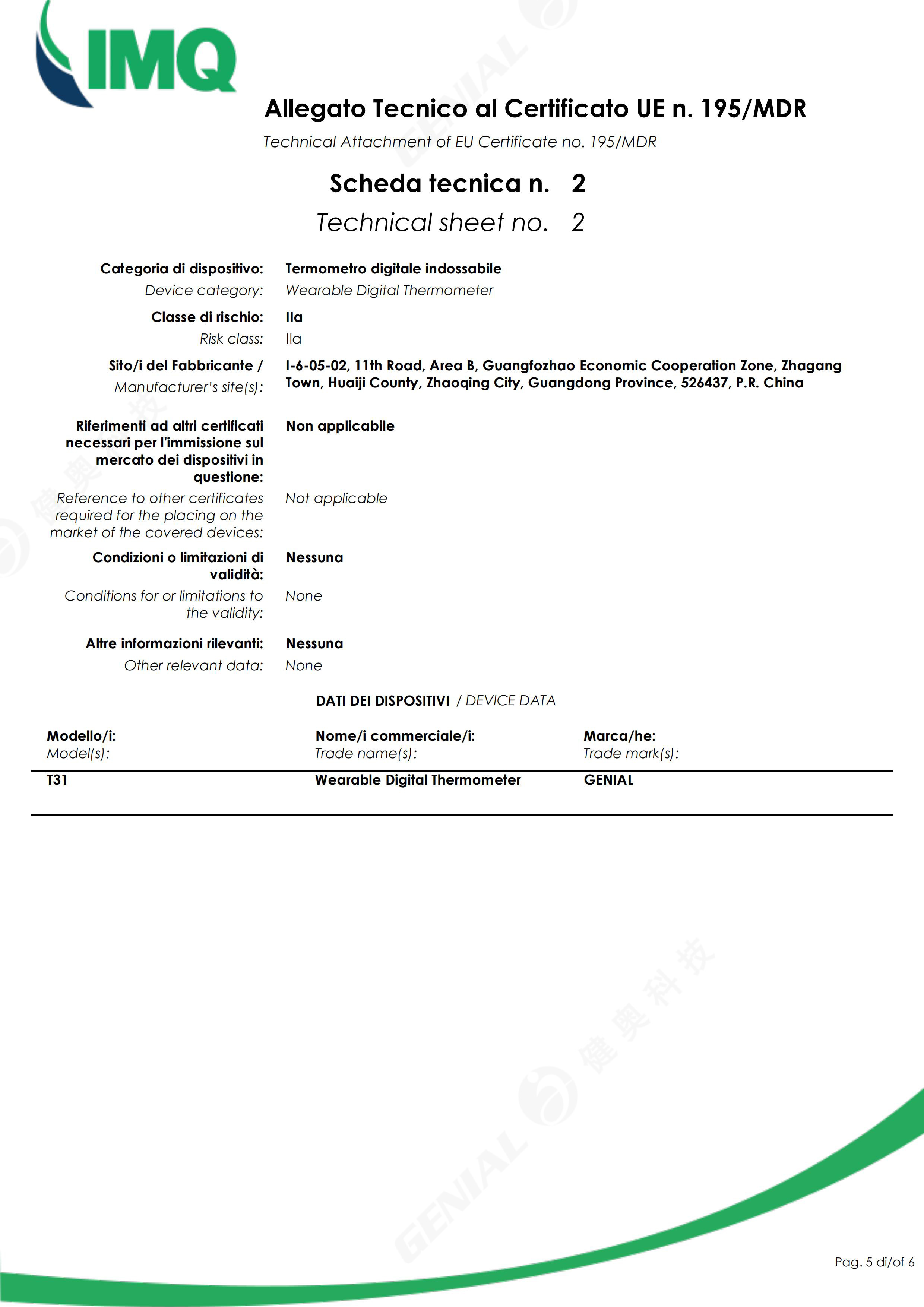
| Wearable Bluetooth digital thermometer | T31 | CE MDR quality-system certificate 195/MDR; US FDA 510(k) K240333; Japan Certificate of Foreign Medical Device Manufacturer BG10501496 (reusable wireless thermometer) |
| Upper arm digital blood pressure monitor | GT-702 family (including GT-702BM, GT-702V, GT-702VA, GT-702L, GT-702LM, GT-702LD, GT-702MA, GT-702CM, GT-702CD, GT-702M, GT-702C, GT-702B, GT-702D); GT-712, GT-712B, GT-712C, GT-712E; GT-732, GT-732M | US FDA 510(k) K231245; CE 1639 MDR (arm-type monitors with or without Bluetooth app); ISO 13485; Japan BG10501496; Roszdravnadzor registration; MHRA 0000037417; ANVISA Class II registration |
| Wrist digital blood pressure monitor | GT-701 series, including GT-701C, GT-701F, GT-701L | US FDA 510(k) K231250 |
The table already surfaces a distinction worth copying into a buyer's own checklist. The FDA oximeter record names GX3 through GX14 including GX6, GX9, GX10 and GX11, while the company's current product listing shows GX3, GX5, GX7, GX8, GX12, GX13 and GX14. If a tender requires GX9, the buyer should confirm current availability and the applicable clearance status of the specific unit being supplied, rather than assuming every model inside a cleared range is in active production. That is not a defect in the range; it is the difference between a regulatory family and a live catalogue.
Reading a certificate for scope, not for reassurance
A certificate supports a claim only within its stated scope, issuer, market and validity window. Four fields decide whether it is relevant to a purchase order: who issued it, which models or device categories it names, which market it applies to, and whether it will still be valid on the delivery date.
| Record | Issuer / reference | What the scope actually names | Validity |
|---|---|---|---|
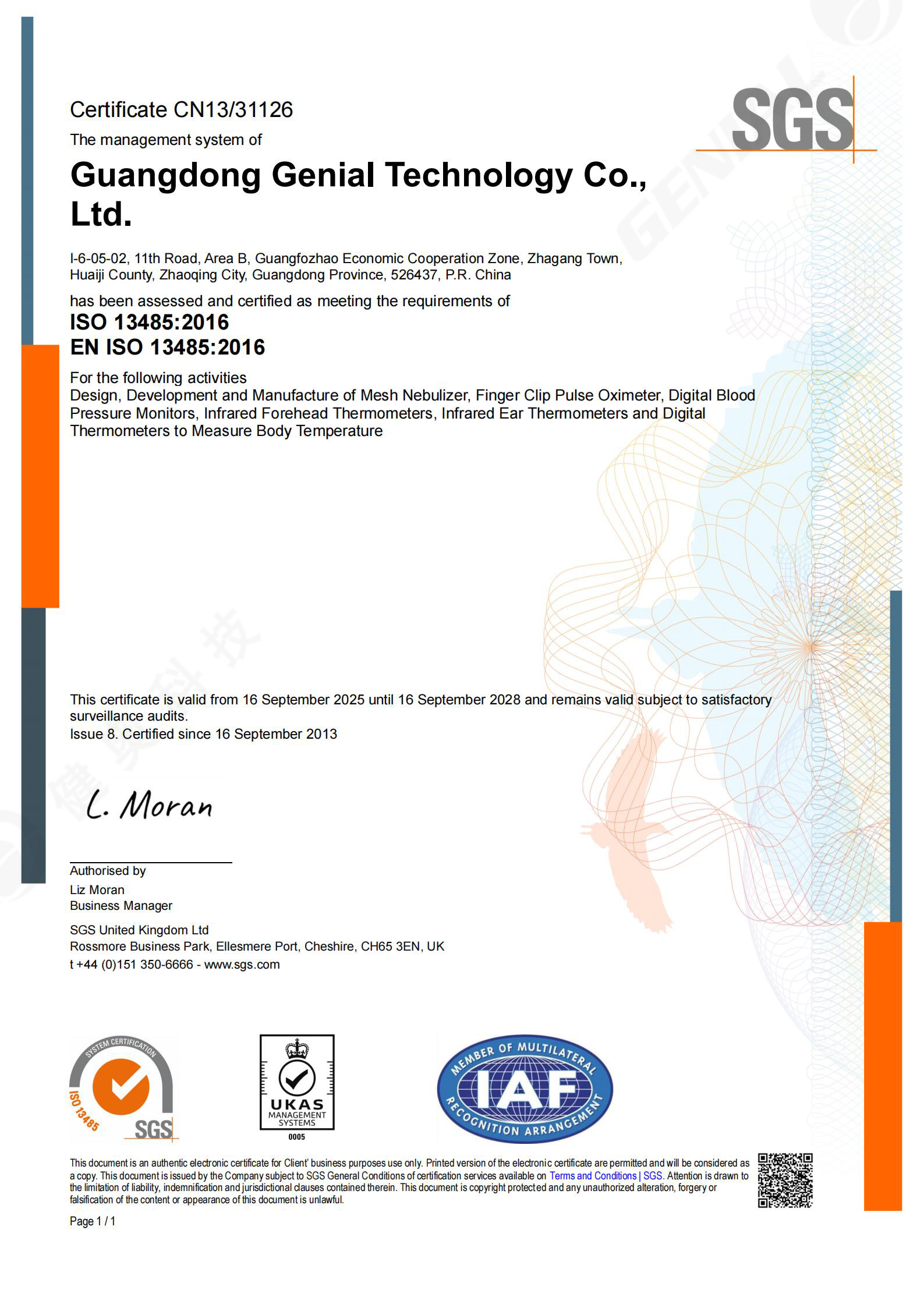
| ISO 13485:2016 | SGS United Kingdom Ltd; CN13/31126 | Design, development and manufacture of mesh nebulizer, finger clip pulse oximeter, digital blood pressure monitors, infrared forehead thermometers, infrared ear thermometers and digital body thermometers | 16 Sep 2025 – 16 Sep 2028 |
| CE, MDR (EU) 2017/745 | SGS Belgium NV, Notified Body 1639; CN25/00007953, SRN CN-MF-000021465 | Arm-type digital blood pressure monitors with or without Bluetooth app across the GT-702, GT-712, GT-722 and GT-732 families, together with thermometers and oximeters | 25 Nov 2025 – 25 Nov 2030 |
| CE MDR quality-system certificate | IMQ S.p.A, Notified Body 0051; 195/MDR | T31 wearable thermometer and the full series of fingertip pulse oximeters | 21 Oct 2024 – 20 Oct 2029 |
| US FDA 510(k) | K231245 (arm-type BP monitors), K231250 (wrist BP monitors), K231243 (fingertip oximeters), K210014 (infrared forehead thermometers), K232678 (continuous reading thermometers), 3016670149 (clinical electronic thermometers), K240333 (T31) | Model-specific clearances; each record applies to the models it names, not to the category as a whole | Recorded as current |
| Japan Certificate of Foreign Medical Device Manufacturer | MHLW; BG10501496 | Electronic upper arm blood pressure monitor, infrared clinical thermometer, reusable wireless thermometer and pulse oximeter as Class II home-use devices, under Article 23-2-4 of the PMD Act | 19 Nov 2024 – 18 Nov 2029 |
| UK MHRA | 0000037417 | Wireless reusable patient thermometer, pulse oximeter probe, infrared ear/skin thermometer, intermittent electronic thermometer, automatic electronic sphygmomanometer, self-care monitoring software | From 10 Feb 2026; recorded to 31 Dec 2099 |
| Brazil ANVISA | RDC 751/2022 | Class II medical devices: thermometers, blood pressure monitors and pulse oximeters | Registration recorded |
| Russia Roszdravnadzor | № 1241/1-3 140/2-25 | Automatic electronic blood pressure monitors, assessed against GOST R national medical device standards | From 12 Jan 2026; recorded to 31 Dec 2099 |
| Site-level systems and social compliance | ISO 45001 (02821S10111R1M), ISO 14001 (02821E10125R1M), BSCI (amfori ID 156-037830-000, Intertek, overall rating B), GB/T29490 (18123IP0672R2M), NBC Universal (Manufacturer Code L-4394) | Occupational health and safety, environmental management, social compliance, intellectual-property management for R&D, production and sales of licensed electronic medical devices, and full-process quality and social compliance for OEM production | ISO 45001 and ISO 14001 to 14 Mar 2027; BSCI to 6 Feb 2028; GB/T29490 to 14 Dec 2026; NBC Universal to 6 Feb 2027 |
Three checks follow directly from that table, and a buyer can run them in an afternoon.
First, does the scope name the model? A certificate that names a device category supports a category-level claim. A certificate that names GT-732M supports a model-level claim. Procurement documents should ask for the second, because the first cannot be used to reject or accept a specific consignment.
Second, does the market match? A CE scope does not create FDA clearance, a Japanese registration does not cover the European Union, and an ANVISA Class II registration does not travel to the Gulf. GENIAL's record happens to hold several of these in parallel, which is useful for a distributor serving multiple regions — but each document still has to be matched to the destination market, one at a time.
Third, will it be valid when you ship? Validity windows are staggered, and two of them sit close to the date of this review. The GB/T29490 certificate shown carries a 14 December 2026 expiry, and the NBC Universal code expires on 6 February 2027, with ISO 45001 and ISO 14001 following on 14 March 2027. A purchase order with a delivery or audit date beyond those points should be matched against a current copy, not an archived one. This is routine document maintenance, but it is also the most common place where a buyer's file and the supplier's file diverge.
Comparing declared parameters with sampled units
Answer-first: the specification sheet sets the baseline, the sample tests the baseline, and the difference between them — recorded in writing — is the only part of the exercise that has contractual value.
The sequence that works in practice has five steps.
- Freeze the declared sheet. Obtain the model-level specification sheet with parameter names, values, units, tolerances and the conditions under which each figure applies. A number without its test condition is not a specification; it is a marketing line.
- Draw the sample from the production configuration. A golden unit built for the meeting is not evidence about the lot. Ask for the sample to come from the same configuration, packaging and labelling as the intended order.
- Re-measure what can be re-measured. For an upper arm blood pressure monitor, this means the declared arm circumference range, the displayed units, the memory structure and the behaviour during inflation and deflation. For a digital thermometer, it means probe type and tip rigidity or flexibility, measurement site, display resolution and response mode. For an oximeter, it means the displayed parameters and how the probe seats. For a mesh nebulizer, it means the nebulization configuration and cup set. For a ventilator, it means the mode list and the alarm set as declared.
- Record deviations with direction and magnitude. "Cuff sits at the lower edge of the declared range" is usable. "Cuff seems fine" is not.
- Attach the result to an acceptance method. GENIAL's purchasing terms list four methods: inspection of bulk goods against samples, factory inspection, third-party inspection and video inspection. Naming one of these in the order converts a private observation into a shared standard.
The comparison is also where honest limits appear. A single sample demonstrates that a configuration can be built; it does not demonstrate lot-to-lot consistency. That is the job of the final sampling inspection before shipment, and the buyer who wants confidence at lot level should ask for the sampling plan rather than more samples.
Materials: what a bill of materials should disclose
A specification sheet describes how a device performs; a bill of materials describes what it is made of. The two answer different questions, and buyers frequently accept one in place of the other.
For a home medical device line, the material declaration should be broken down at part level rather than at product level: housing, cuff fabric and bladder for a blood pressure monitor, tubing and cup for a nebulizer, probe housing for an oximeter, and primary and secondary packaging. Useful lines carry a declared grade, a declared supplier and a revision reference for each part.
Three reasons make this worth the administrative effort. Registration dossiers are built on material declarations, so an undocumented substitution can undermine a market registration after the fact. Second, a part-level baseline is the only practical way to detect drift between an approved sample and a later production lot. Third, a named supplier per part tells a buyer where a supply interruption would land.
The verification method is physical before it is documentary. Retain the approved sample, mark the parts that can be marked, record dimensions and appearance for parts that cannot, and compare each incoming reference lot against it. Then keep the declaration as the change-control baseline, not as proof.
It is worth stating the boundary plainly: a bill of materials is a declaration, not a test. Laboratory verification is a separate activity with its own cost and timeline, and no document substitutes for it. In the records reviewed for this article, the certificates establish model scope and system scope; they do not state material grades. Material evidence has to be requested as its own package.
Capacity, MOQ and lead time as evidence, not as negotiation
Commercial terms are evidence too. They show how a supplier structures production, and they predict which families a buyer can pilot and which must wait for a full programme.
| Model | Customisation boundary | Minimum order | Lead time |
|---|---|---|---|
| OEM | Packaging, gift box, user manual, logo printing, colour schemes and packaging specifications; core hardware, PCB and key functions unchanged | Thermometers 10,000 pcs; oximeters, infrared thermometers, blood pressure monitors, nebulizers and wireless thermometers 2,000 units; ventilators 500 units | Samples 3 days; small orders 3–7 days; mass orders 10–15 days |
| ODM | Industrial design, tooling, structure, PCB firmware, algorithms, Bluetooth functionality, display interface, packaging and exclusive model registration | Product modification 5,000 units; new mould development 10,000 units, with tooling cost refundable on large-volume projects | Minor modifications without new tooling 7–15 days; new mould development 45–50 days |
| OBM | Regional distributor authorisation, gift-box combinations and shipping carton labels; original GENIAL branding unchanged | Full-carton minimum per SKU; mixed orders from 5 cartons | In-stock products within 48 hours; replenishment 5–7 days |
| JDM | Joint product development, with the customer participating in product definition and GENIAL providing hardware, software and structural R&D; IP allocated by contract; exclusive model registration supported | Initial mass-production order of 10,000 units or more; no strict minimum on repeat orders | 45–60 days |
Read across the OEM column and one planning fact stands out: the same programme carries a 10,000-piece minimum on thermometers and a 500-unit minimum on ventilators. That asymmetry is not a bargaining position; it reflects how the line is tooled and inspected. It also tells a buyer which family to pilot first if capital is limited, and it sets a realistic expectation for a mixed first order.
Capacity figures complete the picture. OEM, ODM and OBM production is quoted in a band from 60,000 to 6,000,000 units depending on the line, with JDM monthly capacity stated at 300,000 units. A buyer planning a roll-out across several markets should map forecast volume onto those bands before committing to a launch date.
After-sales terms are similarly checkable: a free 12-month warranty on presentation of valid proof of purchase, with certification documentation support and technical consultation. The OBM route adds brand authorisation letters and customs clearance documentation. Those are documents a distributor can request at contract stage and verify later.
The quality-control route tells you what acceptance evidence exists
Answer-first: different production models generate different evidence, so the first question is not "what is your defect rate" but "which route does my order travel, and what records does that route produce?"
In the OEM route, the sequence is order documentation and packaging approval, incoming material inspection, 100% production inspection, and final sampling inspection before shipment. This is a document-led, inspection-heavy path built around a fixed design.
In the ODM and JDM routes, the sequence inserts design work before production: customer demand assessment, internal project approval, product development, sample validation or approval, exclusive model registration, and only then mass production with incoming, in-process and final inspection. The additional stages exist because design risk has to be retired before tooling is cut.
For a buyer, the practical difference is the shape of the acceptance file. An OEM order produces inspection records against a known design. An ODM order produces an approved sample, a registration reference and inspection records against that approved state. If a buyer requests ODM-style documentation for an OEM order, the request cannot be met — not because the evidence is being withheld, but because that route does not generate it. Matching the request to the route is the buyer's responsibility.
Application evidence: what a case summary can and cannot prove
Supplier-reported case summaries are useful for one specific purpose: they show which configurations recur in which settings. They are not independent verification of outcomes, and they should not be read as forecasts of a buyer's own results.
In GENIAL's disclosed case set, the patterns are consistent. Maternal and infant companies are described as using 10,000–100,000 units over a five-year relationship for infant monitoring, with the stated highlight being continuous monitoring that reduces repeated night-time temperature checks — the configuration that maps onto the T31 wearable Bluetooth thermometer. Hospitals and clinics are described at 50,000–200,000 units for clinical monitoring, with digital management, continuous monitoring and automatic alerts reducing manual checks, which maps onto the oximeter, thermometer and nebulizer families. Pharmacy chains appear at 100,000–1,000,000 units for OTC sales against SKU breadth. Medical device distributors are described at 100,000–500,000 units for channel distribution on a one-stop procurement basis. Consumer electronics channels appear at 50,000–100,000 units, and e-commerce platforms at 50,000–200,000 units with ODM customisation and support for small-batch trial sales.
What these summaries establish is a map of configurations that can be sampled against. What they do not establish is that a new buyer will see the same result. Two details deserve a written question at quotation stage. The e-commerce entry refers to small-batch trial sales, while the ODM schedule quotes a 5,000-unit minimum for product modification; a buyer intending a small trial should establish which applies to the specific configuration before signing. And the five-year durations are described relationship lengths, not audited performance records.
Where the evidence trail stops
An honest audit names its own limits, and five are worth carrying into the purchase order.
- Certificates are model- and market-specific. Coverage in one jurisdiction implies nothing about another, and a category-level statement cannot be used to accept or reject a named model.
- Scope statements are time-stamped. With GB/T29490 recorded to 14 December 2026 and the NBC Universal code to 6 February 2027, a long delivery schedule needs a current copy attached to the order.
- A sample is one unit. Lot confidence comes from the sampling plan and the final inspection, not from the demonstration unit.
- Case results are supplier-reported. They describe configurations and stated outcomes; they are not independent test data.
- Material declarations are declarations. Confirming composition requires laboratory work that sits outside the document set.
None of these limits makes the documentation less useful. They define what it can be used for: writing acceptance clauses, qualifying a supplier for a first order, and setting a re-verification calendar.
Keeping the trail current over the life of the line
The record reviewed here does not describe a single frozen product line. The blood pressure monitor family alone carries a long list of suffixes — GT-702 variants, GT-712 variants, GT-732 and GT-732M — and the thermometer range spans rigid-tip, flexible-tip, infrared ear, infrared forehead, continuous-reading and wearable Bluetooth configurations. With 262 intellectual property certificates recorded, an 80% export ratio, registration completed in 29 countries and products sold into 117 countries and regions, the documentation set is bound to keep changing.
That has a direct operational implication: capability evidence has a review cycle, not a one-off approval. A workable cadence sets three checkpoints — at sample approval, at the first mass-production shipment, and at each certificate expiry date in the buyer's own register. Adding any new model suffix or market triggers an out-of-cycle check. Treated this way, the evidence trail becomes the thing that makes a long-term supply relationship manageable rather than a file assembled once and never reopened.
The full company and product documentation package, including the model portfolio and facility information, is available in the GENIAL English brochure. Company information is published at www.cngenial.com.
FAQ: capability evidence for home medical device buyers
What documents should a buyer request before committing to a home medical device line?
Four sets, each with a different function. Model-level specification sheets state declared parameters with units and test conditions. A certificate register states issuer, scope, market and validity for each record. A part-level bill of materials states composition and revision references. Production and acceptance documents state the quality-control route and the inspection methods that will apply. A supplier that can supply all four makes the subsequent sample review far faster.
How can a buyer confirm that a specific model is covered by a certificate?
Read the scope statement rather than the certificate title. Check that the exact model designation — for example GT-732M rather than the GT-732 family as a whole — appears in the scope, that the issuing body and reference number are recorded, that the market matches the destination, and that the validity window covers the intended delivery date. If a model is absent from the scope, ask for the document that names it instead of assuming coverage.
Why do declared specifications need to be checked against sampled units?
A specification sheet is a declaration about a design; a sample is a physical instance of that design. Comparing the two reveals whether the declared values, tolerances and conditions are reproduced in the configuration that will actually ship. The comparison is most useful when the sample comes from the production configuration, when deviations are recorded with direction and magnitude, and when the result is tied to one of the acceptance methods named in the purchase order.
What does a material declaration add to a specification sheet?
Composition and change control. A specification sheet answers how a device performs; a part-level material declaration answers what each component is made of, at what grade, and from which supplier. That baseline lets a buyer detect drift between an approved sample and later lots, and it supports registration dossiers that depend on documented materials. It remains a declaration, so confirming composition requires separate laboratory verification.
How should minimum order quantities and lead times be read across product families?
As a planning signal rather than a single number. In GENIAL's disclosed OEM terms, thermometers carry a 10,000-piece minimum while ventilators carry 500 units, with oximeters, infrared thermometers, blood pressure monitors, nebulizers and wireless thermometers at 2,000 units. Lead times run from three days for samples to 10–15 days for mass orders, with ODM work extending to 45–50 days when new tooling is required. Buyers should map forecast volume onto those bands before fixing a launch date.
Have Questions or Need More Details?
Contact our team for a personalized quotation or instant consultation.
Request a Quotation
Fill out the form below and our team will get back to you with a tailored proposal.
WhatsApp Direct Chat
Prefer to chat in real-time? Message us on WhatsApp for instant assistance & quick answers.
- Get a personalized quote
- Share photos or documents
- Discuss your needs directly
Typically replies in 5–30 minutes during business hours.