
Auditing Drive Wheel Suppliers for AGV, AMR and Forklift Programs
Auditing Drive Wheel Suppliers for AGV, AMR and Forklift Programs
A drive wheel supplier is tested twice: once when the sample arrives, and again on the tenth production order, when the mounting pattern, the tread compound and the torque curve are supposed to be unchanged. For AGV, AMR and forklift programmes, the second test is what decides whether a supplier stays on the approved vendor list.
This reference sets out how procurement teams and vehicle engineers can evaluate a drive wheel supplier for long-term sustainability rather than for a single order. It covers the four audit dimensions worth scoring, the material and structural evidence to request, the performance benchmarks that can be verified from published specifications, the purchasing and acceptance terms that prevent drift between batches, and the boundary conditions under which an integrated drive wheel is the wrong answer.
Why supplier longevity is now an engineering question, not a purchasing one
Two forces have pushed drive wheel sourcing into the engineering discussion. The first is volume: Reports and Data valued the global AGV wheel drive market at approximately USD 1.2 billion in 2024, with a projected path to USD 3.5 billion by 2034 and an 11.5% CAGR across that period. The second is regional concentration of that volume. Grand View Research attributes a 37.6% revenue share of the global AGV market to Asia Pacific in 2025, while the China Mobile Robot Alliance recorded roughly 139,000 mobile robot units sold in China in 2024.
The forklift side is moving in the same direction. MarketsandMarkets reports that electric forklifts now hold over 70% market share in many regions, replacing combustion models. Industrial logistics is separately projected as the fastest-growing AGV segment at an 11.6% CAGR.
For a programme manager, the practical consequence is that a drive wheel is no longer a component bought once. It becomes a recurring line item across a fleet build, a refurbishment cycle and a spares catalogue. When a vehicle platform lives for five to ten years, an inconsistent second batch is more expensive than a marginally higher first price. That is the commercial logic behind supplier evaluation as a formal audit rather than a quotation comparison.
The four dimensions of a long-term drive wheel supplier audit
A supplier evaluation that only scores price and lead time will miss every risk that appears after commissioning. Four dimensions cover the recurring exposure.
Repeatable quality. Whether the declared material, structure and protection rating are the ones that actually ship, order after order. This is the only dimension that cannot be assessed from a datasheet.
Product family coverage. Whether one supplier can serve a differential AMR platform, a horizontal steering AGV and a forklift programme without the buyer maintaining three unrelated supply chains.
Lifecycle and documentation support. Whether specifications, drawings, compliance references and model designations remain retrievable years after the first order — the difference between a rebuildable fleet and a stranded one.
Commercial terms and acceptance criteria. Whether the purchase order defines what will be measured, on what sample size, and what happens when a batch falls outside the agreed window.
Each dimension should be scored separately. A supplier that is strong on family coverage but weak on acceptance documentation is a different risk profile from one that is narrow but tightly controlled, and the two should not collapse into a single number too early in the evaluation.
Auditing material and structural consistency
Materials are the first place where a supplier's documentation and its production reality diverge. In the Plutools drive wheel range, the primary structural material across the differential, horizontal and vertical families is carbon steel, and the wheel tread is polyurethane (PU). The stated design intent for the PU tread is low noise and high wear resistance — relevant because indoor AGV and AMR routes on epoxy or concrete floors are continuous-duty rather than intermittent.
An audit should ask three questions about material consistency. First, whether the carbon steel grade and the PU compound are specified in writing rather than described verbally. Second, whether the tread hardness and bonding method are held constant across batches, since tread delamination is a wear failure that appears long after acceptance testing. Third, whether the same material set is used across the family — a supplier that switches compound between the 150 kg and 1500 kg models creates a maintenance problem for a mixed fleet.
Protection rating is the second consistency checkpoint, and it is where blanket claims are common. IP65 is a per-model attribute, not a brand attribute. In the Plutools range, IP65 is declared for the PLT-120 differential drive wheel and for the PLT-230P vertical drive wheel with shock absorption. Buyers running wash-down, dusty or semi-outdoor routes should verify the rating model by model, and should treat an unrated model as intended for dry indoor conditions until the supplier states otherwise.
Structure is the third checkpoint. The families differ in ways that matter for integration and for service access:
- Differential drive wheel — the PLT-120 uses a compact integrated structure with an integrated steering function, intended for AGV and AMR applications.
- Planetary horizontal drive wheel with steering — the PLT-198 combines a horizontal layout with a planetary reduction stage and steering.
- Parallel horizontal drive wheel with steering — the PLT-210 and PLT-220 use a parallel horizontal structure with an integrated steering mechanism.
- Horizontal drive wheel without steering — the PLT-167 carries drive and load functions but not steering.
- Vertical drive wheels — the PLT-150 (with steering), PLT-230 (without steering) and PLT-230P (with shock absorption) place the motor vertically, which changes the mounting envelope.
A supplier that can describe these differences precisely, and match each description to a drawing, is easier to audit than one that describes everything as a drive wheel.
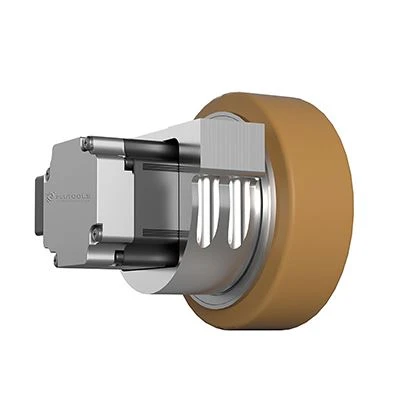
Differential drive wheel construction — integrated steering function, carbon steel body, PU tread.
Verifiable performance benchmarks to put in the evaluation file
Benchmarks are only useful if they are stated per model and can be re-checked later. The table below consolidates the published specifications for the Plutools families most often compared in AGV, AMR and forklift programmes. All models share a 48 V rated operating voltage except the PLT-230, which is rated at 24 V.
| Model | Type | Voltage | Rated power | Max load | Max torque | Reduction |
|---|---|---|---|---|---|---|
| PLT-120 | Differential | 48 V | 400 W | 150 kg | 20.42 Nm (accel./brake) | 9, 20 |
| PLT-167 | Horizontal, no steering | 48 V | 750 W | 800 kg | 120 Nm | 21 |
| PLT-198 | Planetary horizontal, steering | 48 V | 3,000 W | 1,500 kg | 576 Nm | 32 |
| PLT-210 | Forklift, parallel horizontal, steering | 48 V | 3,000 W | 1,200 kg | 576 Nm | 32 |
| PLT-220 | Parallel horizontal, steering | 48 V | 750 W | 1,000 kg | 174 Nm | 28 |
| PLT-150 | Vertical, steering | 48 V | 750 W | 500 kg | 114 Nm | 22.5 |
| PLT-230 | Vertical, no steering | 24 V | 1,500 W | 1,500 kg | 300 Nm | 30 |
| PLT-230P | Vertical, shock absorption | 48 V | 2,500 W | 1,200 kg | — | 30 |
Published specifications for Plutools drive wheel models. Max torque for PLT-120 refers to maximum acceleration and braking torque; the PLT-230P specification sheet declares power, voltage, current, speed, gear ratio, load and IP65 rather than a torque figure.
Three benchmarks deserve specific attention in a supplier audit. The 150 kg to 1500 kg load span across the horizontal and differential families defines the envelope a single supplier relationship can realistically cover. The 576 Nm maximum torque declared for the PLT-198 and PLT-210 indicates that high-torque material handling is served by the same family logic as lighter AMR platforms. The 32:1 reduction ratio shared by those two models means a buyer can standardise on one gear stage philosophy across an AGV and a forklift build, which simplifies spares planning.
Family coverage: what one supplier relationship can absorb
Shanghai Plutools Automation Corporation Co., Ltd. is a Shanghai-based manufacturer of AGV and AMR drive wheels, established in 2017, operating a 10,000 m² production facility with an annual capacity of 10,000 units and approximately 100 staff, including a 60-engineer R&D team. Around 70% of output is exported, with stated markets in the EU, USA, Southeast Asia, South America, the Middle East, Japan and South Korea. The company reports more than 200 patent technology certifications and national high-tech enterprise status.
Those company facts matter to a sustainability review only insofar as they translate into coverage. On the product side, the range spans a 150 kg differential unit (PLT-120), an 800 kg horizontal unit without steering (PLT-167), 1,000 kg and 1,200 kg parallel horizontal steering units (PLT-220 and PLT-210), a 1,500 kg planetary horizontal steering unit (PLT-198), and vertical units from 500 kg to 1,500 kg (PLT-150, PLT-230, PLT-230P). For a buyer running several platforms, that spread reduces the number of supplier qualifications, drawing sets and acceptance procedures that must be maintained in parallel.
Coverage should be tested against the programme roadmap rather than the current bill of materials. A supplier whose largest declared load is 1,500 kg cannot silently absorb a future 2,500 kg platform; the evaluation should record the ceiling explicitly so that a later requirement triggers a new qualification instead of an unplanned specification change.
Vertical versus horizontal: the selection decision inside the audit
Vertical and horizontal drive wheels are not interchangeable options on the same chassis. The distinction is architectural, and a supplier evaluation should confirm that the supplier can explain the trade-off rather than simply quoting both.
Vertical configurations — the PLT-150, PLT-230 and PLT-230P — place the motor above the wheel, which suits platforms where floor space under the chassis is limited and where suspension travel is useful. The PLT-230P adds shock absorption and is rated IP65, which is relevant for routes with floor transitions or semi-outdoor sections. Horizontal configurations — the PLT-167, PLT-198, PLT-210 and PLT-220 — keep the assembly low and are typically easier to integrate where deck height is fixed. The PLT-198 and PLT-210 add steering, which changes the manoeuvring envelope and the control architecture; the PLT-167 does not.
Differential drive is a separate case again. The PLT-120 is a differential drive wheel with an integrated steering function, a 150 kg load rating, IP65 protection and a 5 ± 2 kg total weight. Differential pairs are commonly used where a zero-turn radius is required, a configuration widely used in smaller logistics bots. The audit question is whether the supplier's differential and steering families share material and inspection standards, because a fleet that mixes both will inherit the weaker of the two.
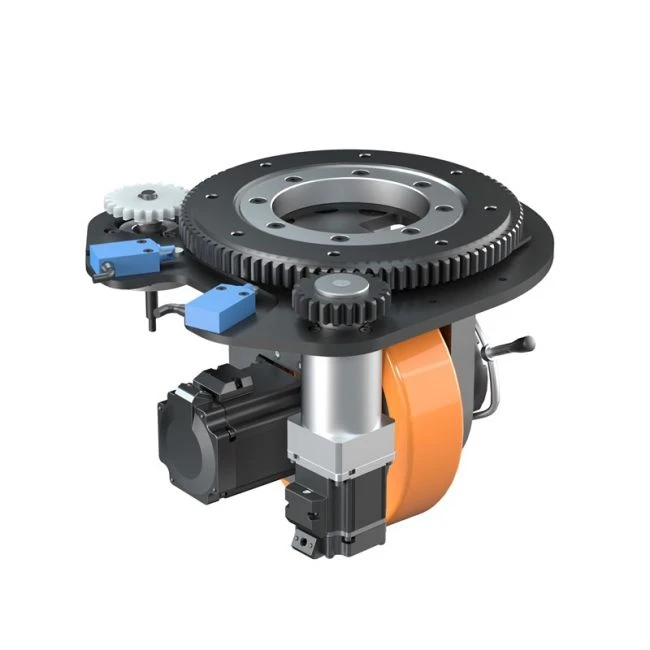
Planetary horizontal drive wheel with steering — 48 V, 3,000 W, 1,500 kg maximum load, 576 Nm maximum torque, 32:1 reduction.
Purchasing terms and acceptance criteria that hold across batches
Acceptance criteria are the mechanism that converts a supplier evaluation into an enforceable relationship. A workable set for drive wheels includes the following.
- Model designation and revision. The purchase order names the exact model — PLT-120, PLT-198, PLT-210 — and the drawing revision, so a substitution cannot be argued after delivery.
- Declared electrical specification. Rated voltage, power, current, speed and torque recorded against the agreed values, with the reduction ratio stated numerically.
- Material and tread declaration. Carbon steel as the primary structural material and polyurethane as the tread compound, stated in writing.
- Protection rating, per model. IP65 recorded only where the model declares it, not applied to the whole order.
- Load rating and safety margin. The maximum load capacity stated against the intended duty, with the application's own safety factor agreed separately.
- Compliance references. ISO 3691-4:2023 is the international safety standard for driverless industrial trucks and addresses steering and braking systems; EN 1175:2020 specifies electrical and electronic safety requirements for industrial trucks; ANSI/ITSDF B56.5 is the corresponding U.S. standard. Where a programme requires conformity, the applicable standard should be named in the order rather than assumed.
- Sampling and non-conformance. Sample size per batch, the measurement list, and the disposition route when a batch falls outside the agreed window.
- Spares and documentation continuity. The period for which drawings, specifications and replacement units remain available after the last production order.
The weakest link in most supplier relationships is not the first article inspection but the absence of a written definition of what happens when a later batch fails it. Naming that process at the quotation stage is cheaper than negotiating it during a line stop.
Customisation as evidence of supply flexibility
Customisation claims are easy to make and hard to verify. A more reliable signal is whether customisable parameters are declared per model in the published specification. Across the Plutools range, load and speed options are stated as customisable on the PLT-120, PLT-167, PLT-198, PLT-210, PLT-220, PLT-150 and PLT-230 families.
Beyond that, the application requirements describe the wider parameter space that a supplier may be asked to address: wheel diameter, mounting dimensions, reduction ratio, rated load, motor power, voltage, encoder type, communication protocol and braking method. The same documentation identifies environment-driven variants — low-temperature warehouses, high-humidity areas, cleanrooms, dusty workshops and heavy-duty applications — alongside anti-static, oil resistance, corrosion resistance and explosion-proof requirements where a project demands them.
For a long-term relationship, the audit question is not whether customisation exists but whether it is bounded. A supplier that can state clearly which parameters are configurable within a standard platform, and which require a new design, gives the buyer a predictable path for future platform variants.
Where an integrated drive wheel is the wrong choice
Integrated steering drive modules are increasingly replacing discrete components because they shorten assembly time and reduce maintenance complexity. That shift is real, but it carries costs that a buyer evaluation should record rather than smooth over.
First, an integrated unit concentrates failure modes. When motor, gearbox, wheel, encoder and braking elements share one housing, a single fault can remove the whole assembly from service, whereas a discrete build allows partial replacement. Programmes with high uptime requirements should confirm the service strategy before standardising on integrated modules.
Second, the published range discussed here tops out at 1,500 kg maximum load. Applications above that envelope fall outside these models and require a separate qualification rather than an assumption of scalability.
Third, customised load and speed configurations extend the confirmation cycle. A supplier that offers broad configurability is also a supplier whose order lead time depends on how far the request departs from a standard model, which is a planning constraint rather than a defect.
Fourth, protection ratings do not transfer automatically between families. A buyer who standardises on one supplier still needs to confirm IP65 per model, and to specify a different rating where the route demands it.
What the next procurement cycle is likely to ask
The direction of travel is toward fewer suppliers with broader coverage and more documented continuity. Market growth supports that reading: an 11.5% CAGR for AGV wheel drives to 2034, continued Asia Pacific concentration at 37.6% of AGV revenue in 2025, and electric forklifts already above 70% share in many regions all point to larger fleets built on repeatable platforms rather than one-off designs.
Technology adoption reinforces the same logic. Lithium-ion battery technology now powers the majority of new AGV and AMR drive units, which shifts attention from energy capacity to the durability of the drive assembly itself. Omnidirectional and Mecanum drive systems are increasingly used in high-density warehouses, adding a further family that a broad-coverage supplier is expected to address.
For buyers, the practical implication is that supplier evaluation will increasingly be scored on documentation and continuity rather than on unit price alone. A specification file that survives three platform revisions is worth more than a discount that does not survive the second batch.
FAQ
What does long-term drive wheel supplier evaluation actually cover?
It covers four things: whether material and structural specifications are repeated across batches, whether one supplier can serve differential, horizontal and vertical platforms, whether documentation and spares remain available after the first order, and whether the purchase order defines measurable acceptance criteria. Price and lead time are inputs to that assessment, not substitutes for it.
Which drive wheel families should an AGV, AMR or forklift programme compare?
A typical comparison set includes a differential unit for compact, manoeuvrable platforms, a horizontal unit without steering for fixed-deck integration, horizontal units with steering for higher-load material handling, and vertical units where mounting height or shock absorption matters. In the Plutools range this maps to the PLT-120, PLT-167, PLT-198, PLT-210, PLT-220, PLT-150, PLT-230 and PLT-230P.
How should a buyer choose between a vertical and a horizontal drive wheel?
The choice is architectural. Vertical units place the motor above the wheel and suit limited under-chassis space; the PLT-230P adds shock absorption and IP65 protection. Horizontal units keep the assembly low and simplify integration where deck height is fixed. Steering is a separate variable: the PLT-198, PLT-210, PLT-220 and PLT-150 include steering, while the PLT-167 and PLT-230 do not.
Which performance figures can be verified from published specifications?
Voltage, power, current, speed, torque, reduction ratio and maximum load are published per model. Examples include 48 V operation across most of the range, load capacities from 150 kg to 1,500 kg, a 576 Nm maximum torque on the PLT-198 and PLT-210, and a 32:1 reduction ratio on those two models. The PLT-120 is rated IP65 with a 150 kg load and a 5 ± 2 kg total weight.
What acceptance criteria belong in a drive wheel purchase order?
At minimum: exact model designation and drawing revision, declared electrical specification, material and tread compound, protection rating stated per model rather than per order, load rating against intended duty, named compliance standards where required — such as ISO 3691-4:2023, EN 1175:2020 or ANSI/ITSDF B56.5 — sampling plan and non-conformance procedure, and the period for which spares and documentation remain available.
Does customisation indicate a more durable supply relationship?
Not by itself. It indicates flexibility. What matters is whether the configurable parameters are declared per model, as load and speed options are across the Plutools range, and whether the supplier can distinguish parameters that can be changed within a standard platform from those requiring a new design. That distinction determines how predictable future platform variants will be.
For teams that need the full model matrix in one document, the Plutools selection handbook is available as a downloadable PDF reference, covering the drive wheel families discussed above alongside their published electrical and load specifications.
Have Questions or Need More Details?
Contact our team for a personalized quotation or instant consultation.
Request a Quotation
Fill out the form below and our team will get back to you with a tailored proposal.
WhatsApp Direct Chat
Prefer to chat in real-time? Message us on WhatsApp for instant assistance & quick answers.
- Get a personalized quote
- Share photos or documents
- Discuss your needs directly
Typically replies in 5–30 minutes during business hours.