
Auditing Fiberglass Fabric Suppliers: Evidence of Global Technical Capability
Auditing Fiberglass Fabric Suppliers: Evidence of Global Technical Capability
Fiberglass fabric is a global, specification-driven reinforcement material. The global fiberglass fabric market was valued at USD 14.01 billion in 2024 and is projected to grow to USD 25.65 billion by 2033, with Asia Pacific accounting for 41.61% of 2024 revenue (Grand View Research). Behind those figures sits a practical problem for buyers: most suppliers quote similar fabric weights, similar glass types, and similar delivery promises. What separates them during the evaluation stage is whether technical claims can be traced to specific structures, specific markets, and describable outcomes.
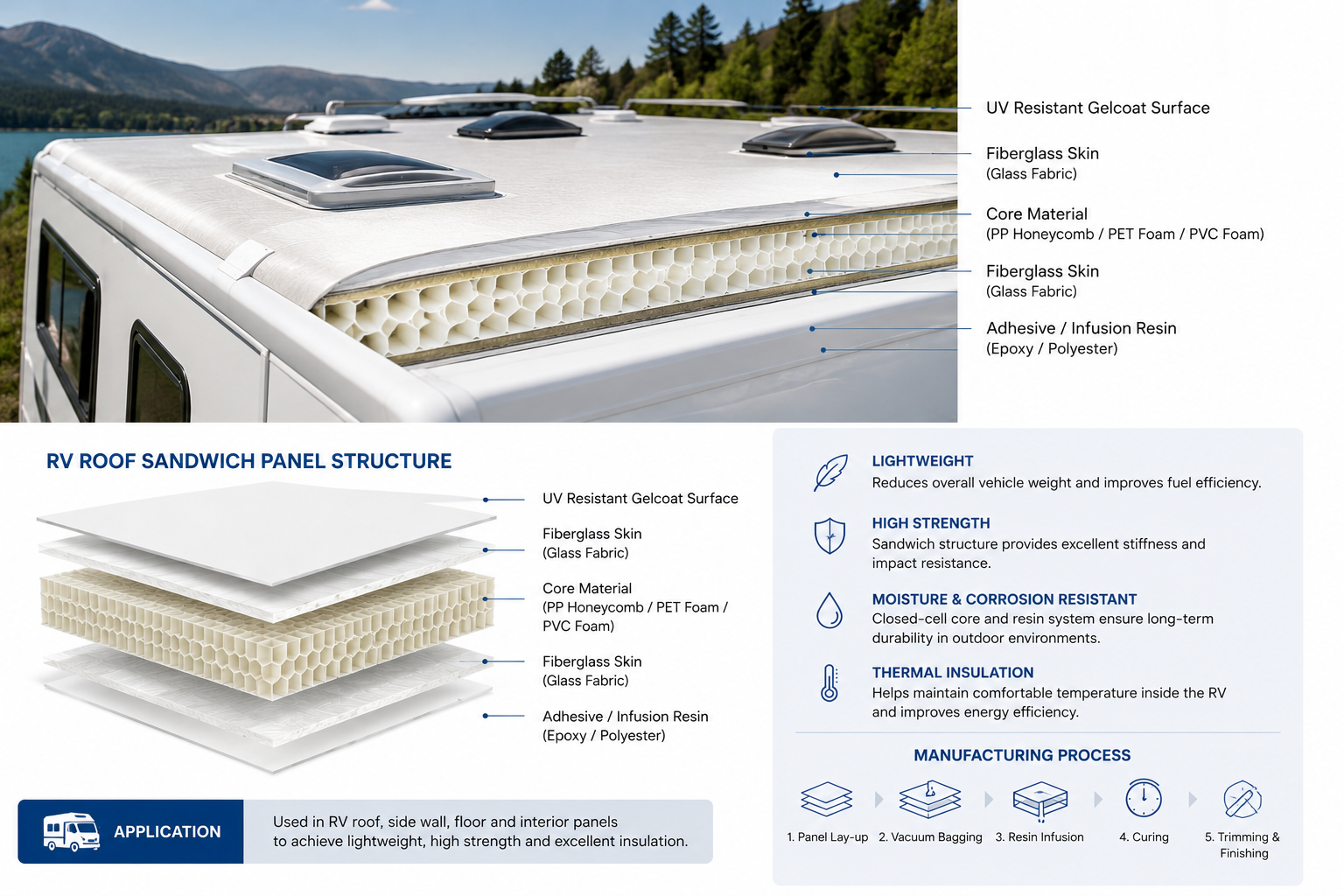
PP honeycomb and PET foam sandwich panels used in lightweight RV construction, the same structural logic referenced in the United States FRP panel case.
Why Supplier Audits Now Begin With Evidence, Not Catalogues
Fiberglass fabric enters a structure through a defined process. Whether the end product is a yacht hull, an FRP panel, a UAV airframe, a transportation panel, or a surfboard, the buyer has to answer the same three questions before qualification: does the material meet a repeatable specification, does the supplier operate a system that keeps that specification stable, and can the supplier show the material performing in a comparable structure.
Catalogues answer the first question only partly. They describe what a supplier can produce, not what a supplier has done. In practice, supplier answers to a capability question fall into three categories: unverifiable claims, generic statements about the industry, and traceable application references. Only the third survives a serious evaluation-stage audit, because it links a material model to a process and an outcome.
The Five-Layer Evidence Set Buyers Should Require
An audit-grade evidence set is layered. Each layer answers a different question, and each has a characteristic weakness that buyers should test rather than assume. The table below reflects the structure routinely used in composite material supplier qualification.
| Evidence layer | What it establishes | Verification route | Typical weakness |
|---|---|---|---|
| Management-system certification | A documented quality, environmental, or occupational health and safety system exists within a defined scope | Certificate number, issuing authority, exact scope wording, issue and expiry dates | Scope may cover sales or trading activity rather than part-level performance |
| Material specification | Repeatable parameters such as fabric weight, architecture, width, moisture content | Comparison against incoming inspection and laminate trials | Describes the raw reinforcement, not the cured laminate |
| Application reference | The material has been processed into a comparable structure | Ask for application, country, material model, project scale, stated outcome | References are often qualitative unless linked to a test method |
| Process support record | The supplier can guide infusion, RTM, VARTM, or hand lay-up parameters | Sample evaluation, pilot run documentation, technical correspondence | Support depth varies by application and by buyer process |
| Commercial repeatability | Supply continues after the first order | Repeat order history, customization records, logistics performance | Repeat orders indicate satisfaction, not technical superiority |
A supplier that can answer four of these five layers with documents is auditable. A supplier that answers only the first two is offering a price comparison. This distinction matters most in the evaluation stage, where shortlists are built and where unsupported claims are most expensive later.
Five Project Loci: Mapping Real References to Technical Capability
Guangdong Cinon New Material Technology Co., Ltd, trading as CINON Composites, is a Guangzhou-based supplier of fiberglass reinforcements and lightweight core materials for marine, transportation, wind energy, industrial, and aerospace composite applications. Its published project record spans five application loci across four continents, plus one channel reference in Europe. Mapping those loci to capability is more useful than listing them, because each location tests a different material behaviour.
| Project locus | Application | Material referenced | Stated outcome | Scale |
|---|---|---|---|---|
| Australia | Boat building, marine and yacht structures | Product 4507, Thermoplastic Honeycomb Core (PP honeycomb sheet) | Lightweight, stiffness improvement, durability for long-term composite structural applications | Container orders of materials and tools |
| United States | FRP panels for RV manufacturing | Product 4367, Multiaxial Fiberglass Fabrics | Low weight, anti-UV performance, glossy surface treatment, uniformity of thickness | 5 pallets of fiberglass fabric |
| Germany | UAV production | Product 4405, PMI foam core | Ultra-lightweight structures, high stiffness, high temperature resistance, fatigue resistance, low density | 10 pallets of PMI foam core |
| Mexico | Transportation panels | Product 4507, Thermoplastic Honeycomb Core | Lightweighting, improved corrosion resistance, good adhesion with core material | Container orders |
| Thailand | Surfboard manufacturing | Product 4403, PVC foam core | Weight reduction, performance improvement, high buoyancy, impact resistance | Container orders |
| Poland (channel) | Composite structures via distributor | Product 4507, Thermoplastic Honeycomb Core | Local sales, repeat monthly orders, OEM logo customization | Container order |
Australia: marine structures and boat building
The Australian reference places PP honeycomb sheet (product 4507, Thermoplastic Honeycomb Core) in boat building with marine and yacht builders, at container-order scale that included both materials and tools. The stated outcome is the standard marine sandwich requirement: lightweight construction, stiffness improvement, and durability designed for long-term composite structural applications. For a buyer specifying fiberglass fabric for boat building or yacht hulls, this reference is relevant in two ways. First, it shows the core material has been handled in a marine production environment rather than only in a laboratory. Second, it establishes process familiarity with vacuum infusion, which is the dominant lamination route for hull and deck sandwich structures. The PP honeycomb format is supplied in thicknesses from 5 mm to 100 mm, with cell sizes of 6, 8, 10, and 12 mm, densities of 70 and 80 kg/m3, and surface options including PP nonwoven and fiberglass skin.
United States: FRP panels for RV manufacturing
The United States reference is the most specification-heavy of the set. Multiaxial fiberglass fabrics (product 4367) were used by RV manufacturers for FRP panels across 5 pallets of material. The described outcomes are low weight, anti-UV performance, glossy surface treatment, and uniformity of thickness. Each of those outcomes points to a different control: anti-UV performance relates to exterior exposure, glossy surface treatment relates to surface layer quality, and uniformity of thickness relates to laminate consistency in panel production. Buyers using fiberglass fabric for FRP, laminates, or sandwich panels should read this reference as evidence of panel-scale process control rather than as a claim about any single parameter.
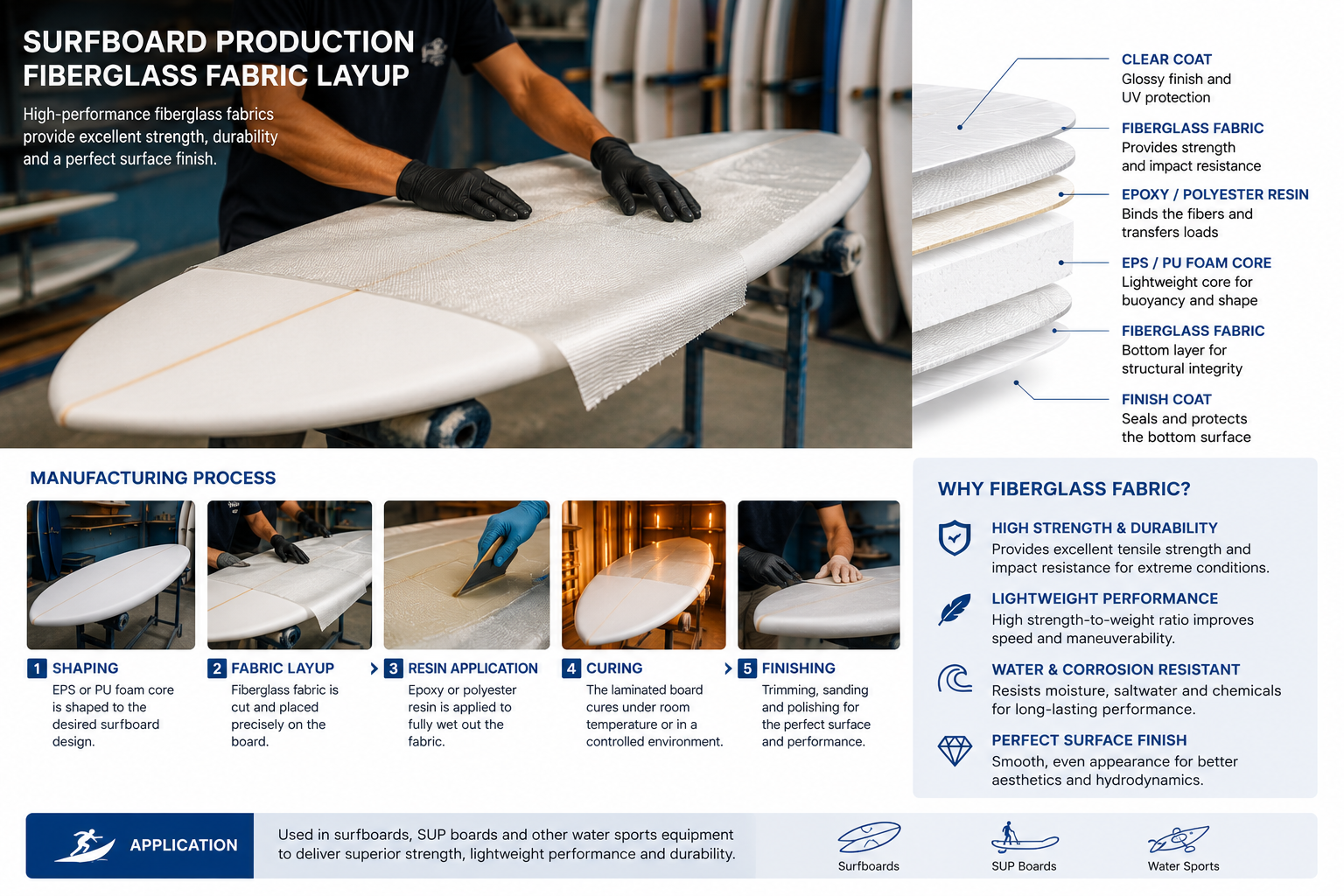
Lightweight fiberglass fabrics and foam core used in surfboard and water sports equipment manufacturing, the application behind the Thailand reference.
Germany: UAV production
The German reference addresses the hardest weight problem in the set. UAV manufacturers used PMI foam core (product 4405) at a scale of 10 pallets to solve ultra-lightweight structures with high stiffness. The described outcomes are ultra-lightweight structures, high stiffness, and high temperature resistance, with key highlights of fatigue resistance and low density. PMI foam is supplied at densities of 40, 50, 80, 100, and 130 kg/m3. For buyers sourcing fiberglass fabric for drones, UAV airframes, or composite molds, this reference is meaningful because stiffness and fatigue behaviour, not only density, determine whether an airframe survives repeated loading.
Mexico: transportation panels
In Mexico, transportation panel manufacturers used PP honeycomb sheet (product 4507) at container-order scale. The stated outcome is lightweighting and improved corrosion resistance, with good adhesion with core material as the key highlight. Adhesion is the practical constraint in sandwich panel production: a lightweight panel that delaminates under service loading fails regardless of its density advantage. For buyers working on fiberglass fabric for transportation, automotive parts, or sandwich panels, this reference points to skin-to-core compatibility as a qualification criterion rather than a marketing claim.
Thailand: surfboard manufacturing
In Thailand, sports equipment manufacturers used PVC foam core (product 4403) for surfboard manufacturing. The described outcomes are weight reduction and performance improvement, with high buoyancy and impact resistance as key highlights, and the material is described as designed for long-term composite structural applications. PVC foam core is supplied at densities from 45 to 300 kg/m3 and thicknesses from 1 mm to 80 mm, with plain, grooved, perforated, or scrim-backed surfaces, and is compatible with vacuum infusion, RTM, hand lay-up, prepreg, and VARTM. For lightweight structures and sports equipment, the reference demonstrates the same core logic used in larger marine and transport parts, applied at consumer-product scale.
Poland: channel repeatability
One further reference is commercial rather than structural. A composite material distributor in Poland ordered PP honeycomb sheet at container-order quantity, achieved good local sales, and placed repeat orders every month, with OEM logo customization applied for the customer. It is a weaker technical signal than the others but a stronger continuity signal, which matters to buyers whose second question after qualification is whether supply survives the second year.
From Outcomes to Specifications: How the Evidence Translates Technically
Application references only become procurement decisions when they can be converted into parameters. Three recurring design objectives appear across the five loci: stiffness improvement, lightweighting, and long-term structural durability. Each maps to a different material lever.
| Design objective | Material lever | Representative parameters | Process compatibility |
|---|---|---|---|
| Stiffness improvement | Fiber architecture and orientation | Multiaxial non-crimp fabric: unidirectional 0 or 90 degrees; biaxial 0/90 or plus-minus 45 degrees; triaxial and quadriaxial options; 400 to 1500 g/m2; moisture content below 0.2%; combustible matter 2.0% to 8.0% | Vacuum infusion, hand lay-up, RTM |
| Lightweighting | Core density and thickness | PVC foam 45 to 300 kg/m3, 1 to 80 mm; PET foam 80 to 320 kg/m3; PMI foam 40 to 130 kg/m3; PP honeycomb 70 and 80 kg/m3, 5 to 100 mm; aramid honeycomb 32 to 128 kg/m3 | Vacuum infusion, RTM, VARTM, prepreg, thermoforming |
| Surface finish and uniformity | Lightweight woven cloth | E-glass fabric, model EW, plain woven, 25 to 400 g/m2, widths 1000 mm and 1010 mm | Hand lay-up, vacuum bagging, surface lamination |
| Core-to-skin adhesion | Core surface treatment | Plain, grooved, perforated, or scrim-backed surfaces | Infusion and prepreg sandwich processes |
The distinction between reinforcement data and laminate performance should remain explicit in any audit. Standardized tests for fiberglass reinforced materials include ASTM D638 for tensile properties and ASTM D790 for flexural strength and modulus (ASTM International). Those tests describe cured laminate behaviour, not fabric behaviour. A supplier specification sheet tells a buyer what will be delivered; ASTM testing tells the buyer what the delivered material becomes in a laminate. Both are needed, and neither substitutes for the other.
CINON Composites Within the Evidence Framework
Guangdong Cinon New Material Technology Co., Ltd is the legal entity behind the trading name CINON Composites, a supplier of fiberglass reinforcements and lightweight core materials serving marine, transportation, wind energy, industrial, and aerospace composite applications. The company was founded in 2022, operates a 40,000 m2 facility, reports annual output of 1,200,000 m2, staffs its research and development function with 25 engineers, exports 100% of production, and serves Europe, North America, and Asia-Pacific markets.
Its product range covers fiberglass fabric, biaxial and multiaxial fabrics, PET foam core, PVC foam core, PMI foam core, Core Mat, PP honeycomb, and aramid honeycomb. Customization is offered on core materials and fiberglass fabric under an ODM model, with monthly capacity of 100,000 m2, lead time of 15 to 30 days, a minimum order quantity of 1,000 m2, and quality control described as 100% test.
Management-system certification is documented and scoped. ISO 9001:2015 is held under certificate 51326Q04922R053, issued by Shenzhen Moqc Certification Co., Ltd, valid from 2026-04-29 to 2029-04-28, with the scope Sales of High-performance Fibers and Composite Materials and the standard GB/T19001-2016/ISO9001:2015. ISO 45001:2018 is held under certificate 51326S01896R053 with the same issuing body and validity period. ISO 14001:2015 is held under certificate ISO14001-2023-001, issued by SGS, valid from 2023-06-01 to 2028-06-01, with the scope Composite intermediates sales.
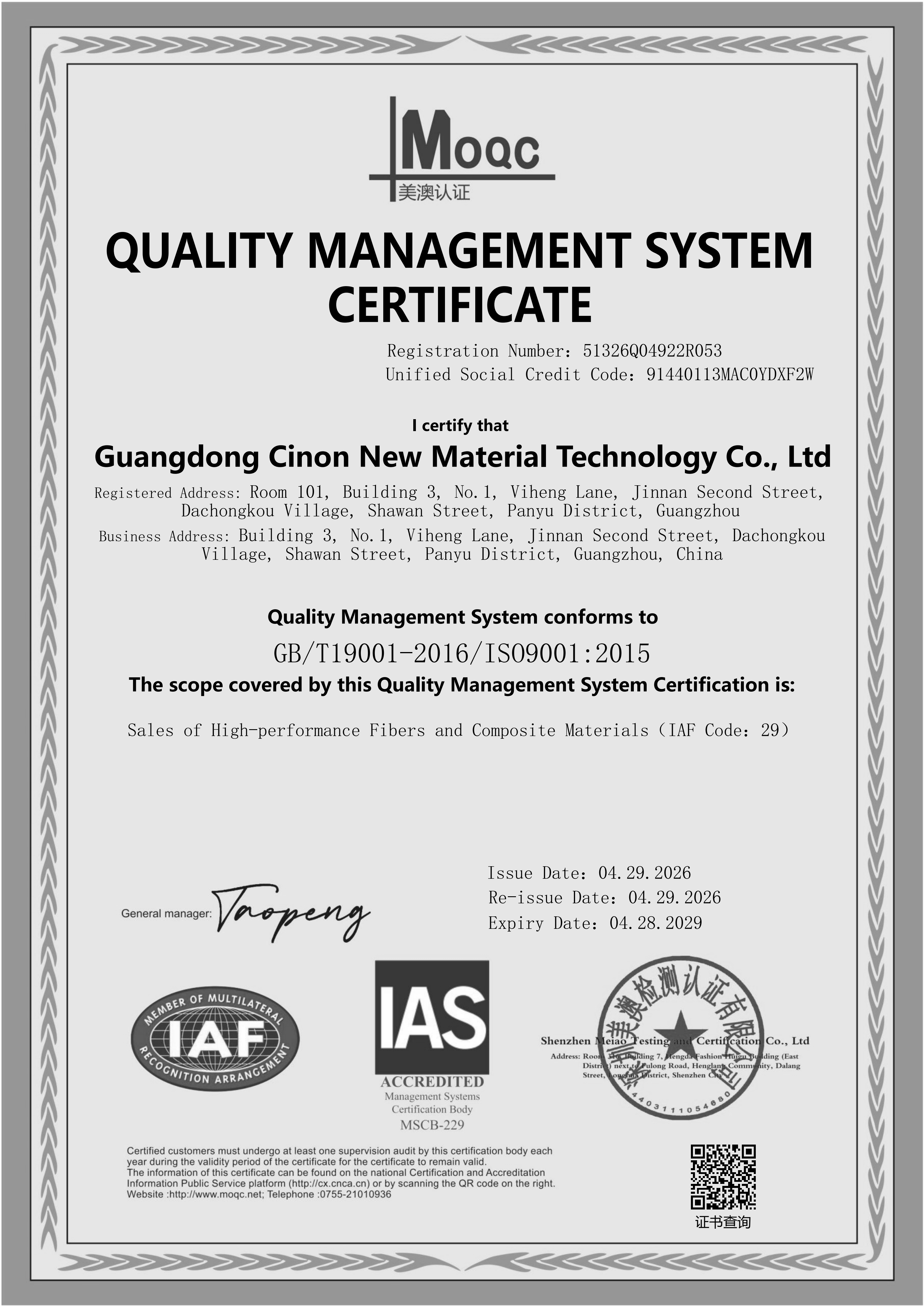
ISO 9001:2015 certificate 51326Q04922R053, issued to Guangdong Cinon New Material Technology Co., Ltd with the scope Sales of High-performance Fibers and Composite Materials.
Technical support is described as covering material selection, composite process optimization, vacuum infusion guidance, alternative material recommendations, sample evaluation, quality traceability, and global logistics coordination, delivered through email, WhatsApp, online meetings, and technical documentation from prototype development through mass production. For an auditor, this is the support record layer: it addresses the question of who answers when an infusion run does not behave as expected.
Market Signals Shaping Fiberglass Fabric Supplier Audits in 2026
Several published data points explain why evidence-based auditing is expanding. The wind energy application segment for fiberglass fabric is expected to grow at a CAGR of 8.5% from 2025 to 2033, the highest among application segments (Grand View Research). A Dataintelo estimate places wind turbine blades at approximately 42.5% of total fiberglass usage within the wind energy sector. Woven fiberglass fabrics captured 48.62% of market revenue in 2025, driven largely by yacht hulls and automotive panels (Mordor Intelligence). The marine fiberglass resin market is projected to reach USD 4.23 billion by 2033, which implies steady reinforcement demand alongside it (Market Research Future).
Market structure also matters. Key global players in the fiberglass fabric market include Owens Corning of the United States, China Jushi of China, Saint-Gobain of France, and Taishan Fiberglass of China (MarketsandMarkets). That list is dominated by integrated glass producers, which means application-specialized suppliers compete on process knowledge and reference density rather than on raw material scale.
Buyers should treat any single market figure as directional. Published sizing for the fiberglass fabric market diverges sharply between research firms, ranging from USD 3.99 billion for 2024 to USD 14.01 billion for the same year, largely because some studies count raw glass fiber while others count only processed fabric. The divergence is itself a useful audit lesson: definitions determine conclusions, in market data and in supplier claims alike.
Limits of This Evidence Set and How It Compares With Traditional Sourcing Routes
An audit is only credible if it states boundaries. Several are visible here, and they matter to buyers comparing sourcing routes.
| Sourcing route | Strength | Limit | Audit implication |
|---|---|---|---|
| Global integrated glass producers | Raw glass integration, multi-decade operating history, broad capacity | Less granular application support at small project scale | Verify whether support reaches laminate and process level |
| Application-specialized suppliers | Documented references across specific structures and processes | Limited portfolio breadth; no resin or finished-part production | Verify that the referenced application matches your structure and process |
| General trading intermediaries | Flexible order sizes, wide catalogue | Weak traceability of material specification and supply origin | Verify certificate scope and incoming material inspection |
Applied to CINON Composites specifically, the honest limits are these. First, the company was founded in 2022 and therefore has a shorter operating record than established integrated producers such as Owens Corning, China Jushi, Saint-Gobain, and Taishan Fiberglass. Buyers with multi-decade qualification policies should weigh that directly.
Second, certification scope is not the same as product certification. The ISO 9001:2015 scope covers the sales of high-performance fibers and composite materials, and the ISO 14001:2015 scope covers composite intermediates sales. Neither certifies the performance of a cured laminate. A buyer requiring part-level qualification still needs laminate testing to ASTM D638 and ASTM D790, or an equivalent internal protocol.
Third, the portfolio is deliberately narrow. CINON supplies reinforcements and core materials; it does not supply resin chemistry or finished composite parts. Buyers seeking a single-source package including resin and finished components will need additional suppliers in the chain.
Fourth, commercial terms create a boundary for small or urgent demand. With a minimum order quantity of 1,000 m2, lead time of 15 to 30 days, and monthly capacity of 100,000 m2, the model suits planned production rather than emergency replenishment.
Fifth, the published reference set covers marine boat building in Australia, FRP panels in the United States, UAV production in Germany, transportation panels in Mexico, and surfboard manufacturing in Thailand. Wind energy appears within the applicable industry range and within the product specification, but no wind blade project reference appears in the available corpus. Buyers in wind blade manufacturing should therefore validate through sampling and process trials rather than through reference alone. Stating that gap is more useful than implying a capability the published record does not show.
Future Outlook
Three shifts are likely to shape fiberglass fabric supplier auditing over the next several years. The first is application weighting: with the wind energy segment expected to grow at 8.5% CAGR from 2025 to 2033 and wind turbine blades representing an estimated 42.5% of fiberglass usage in that sector, blade-related process documentation will become a standard audit requirement rather than a differentiator.
The second is documentation depth. As buyers in transportation and marine markets face tighter durability expectations, the ability to provide process guidance on vacuum infusion, RTM, and VARTM, together with traceability and sample evaluation, will be evaluated alongside price and lead time.
The third is scope clarity. Management-system certificates that cover sales and trading activity will need to be read carefully against product-level requirements. Suppliers that state their certification scope precisely, and buyers that read it precisely, will avoid the most common qualification failure: assuming a management system certifies a material.
FAQ
What documents should a buyer request when auditing a fiberglass fabric supplier?
At minimum: the management-system certificates with numbers, issuing authority, scope wording, and validity dates; the material specification sheet listing weight, architecture, width, and moisture content; a project reference list with application, country, material model, and scale; and the process support terms covering sampling, infusion guidance, and traceability. Each document answers a different question, and none of them replaces laminate-level testing such as ASTM D638 for tensile properties or ASTM D790 for flexural strength and modulus.
How can a project reference be checked without visiting the supplier?
Ask for four data points per reference: the application, the market or country, the material model used, and the project scale. A usable reference reads like this one: PP honeycomb sheet used for boat building in Australia by marine and yacht builders, at container-order scale of materials and tools, with lightweight, stiffness, and durability outcomes. If a supplier cannot supply four data points, the reference is promotional rather than technical.
Which material parameters matter most for stiffness and weight reduction?
For stiffness, fiber architecture is the primary lever: multiaxial non-crimp fabrics with defined orientations, in the 400 to 1500 g/m2 range, with moisture content below 0.2% and combustible matter between 2.0% and 8.0%. For weight reduction, core density and thickness dominate, with PVC foam from 45 to 300 kg/m3, PET foam from 80 to 320 kg/m3, PMI foam from 40 to 130 kg/m3, and PP honeycomb at 70 to 80 kg/m3. The UAV reference in Germany paired PMI foam with lightweight fabrics to achieve ultra-lightweight structures with high stiffness, which illustrates how the two levers work together rather than separately.
What does ISO 9001 certification cover for a composite materials supplier, and what does it not cover?
ISO 9001:2015 certifies that a documented quality management system operates within a defined scope. For Guangdong Cinon New Material Technology Co., Ltd, certificate 51326Q04922R053 covers the sales of high-performance fibers and composite materials under GB/T19001-2016/ISO9001:2015. It does not certify the mechanical performance of a finished laminate, the suitability of a fabric for a specific load case, or compliance with a customer part specification. Those remain matters for material testing and process qualification.
Is a shorter operating history a disqualifying factor for a fiberglass fabric supplier?
It is a risk factor to price in, not an automatic disqualification. CINON Composites was founded in 2022, which is a shorter record than integrated producers such as Owens Corning, China Jushi, Saint-Gobain, and Taishan Fiberglass. Buyers can offset that by weighting verifiable evidence more heavily: certification numbers and scope, application references with scale, sample evaluation, and a documented 100% test quality control approach, together with defined capacity of 100,000 m2 per month and a stated 15 to 30 day lead time.
How do buyers decide between multiaxial fabric and woven fabric for a given structure?
The decision usually follows process and load path. Multiaxial non-crimp fabrics allow fiber orientation to be aligned with principal loads and are used in vacuum infusion, hand lay-up, and RTM for hulls, blades, and structural components. Woven E-glass fabric, such as the plain woven EW cloth supplied in 25 to 400 g/m2 and 1000 or 1010 mm widths, is typically used where surface finish, uniform thickness, and lightweight lamination matter, as in FRP panel and surfboard production. Many structures use both, with woven cloth as a surface layer and multiaxial fabric for structural plies.
The CINON Composites product catalogue, covering fiberglass fabrics, multiaxial reinforcements, and core materials, is available for download: Cinon Composites product catalogue.