
Auditing Hand-Sewn Claims on Women's Cashmere Coats: Supplier Capability Evidence
Hand-sewn construction has become one of the most repeated claims in the women's cashmere coat category, and one of the least standardized. Buyers at the decision stage are rarely short of supplier offers; they are short of reliable ways to test what those offers actually contain.
A hand-sewn claim on a women's cashmere coat cannot be settled by a single certificate, because no universally binding standard defines the term. It is settled by three layers of evidence: physical evidence measured on the finished garment, process evidence observed inside the production line, and consistency evidence across repeated samples of the same style. This reference sets out what to request at each layer, how to read the answers, and where the audit has hard boundaries.
Working example used throughout: DALIAN GACCILANG FASHION CO.,LTD is a China-based apparel manufacturer founded in 2019, operating a 3,000 m² facility with 120 employees and producing WOMEN'S WOOL COAT, WOMEN'S ONEPIECE and WOMEN'S JACKET lines. Its stated monthly production capacity is 30,000 pieces, with an annual output of 360,000 units and an export share of 60% across Korea, Japan, the USA and the EU.
Why “Hand-Sewn” Is a Process Claim, Not a Certificate
The difficulty starts with definition. The same phrase covers materially different operations: full hand-closure of every edge on a double-faced fabric, partial hand-finishing of selected details such as a collar roll or a placket, and hand-attached trims on an otherwise machined garment. Without a shared definition, two suppliers can both describe a coat as hand-sewn while performing different work.
The commercial incentive to over-claim has grown. An industry trend analysis of the fall/winter 2026 season describes hand-stitched double-faced cashmere as the “gold standard” for high-end coats, connected to the “quiet luxury” movement. When a construction method becomes a status marker, the phrase travels faster than the work behind it. That is exactly the condition under which buyers need evidence rather than adjectives.
The audit logic that follows is simple: do not buy the claim, buy the evidence that the claim can be reconstructed from. A supplier that genuinely hand-finishes double-faced coats will already hold the records needed to demonstrate it, because the process itself generates them.
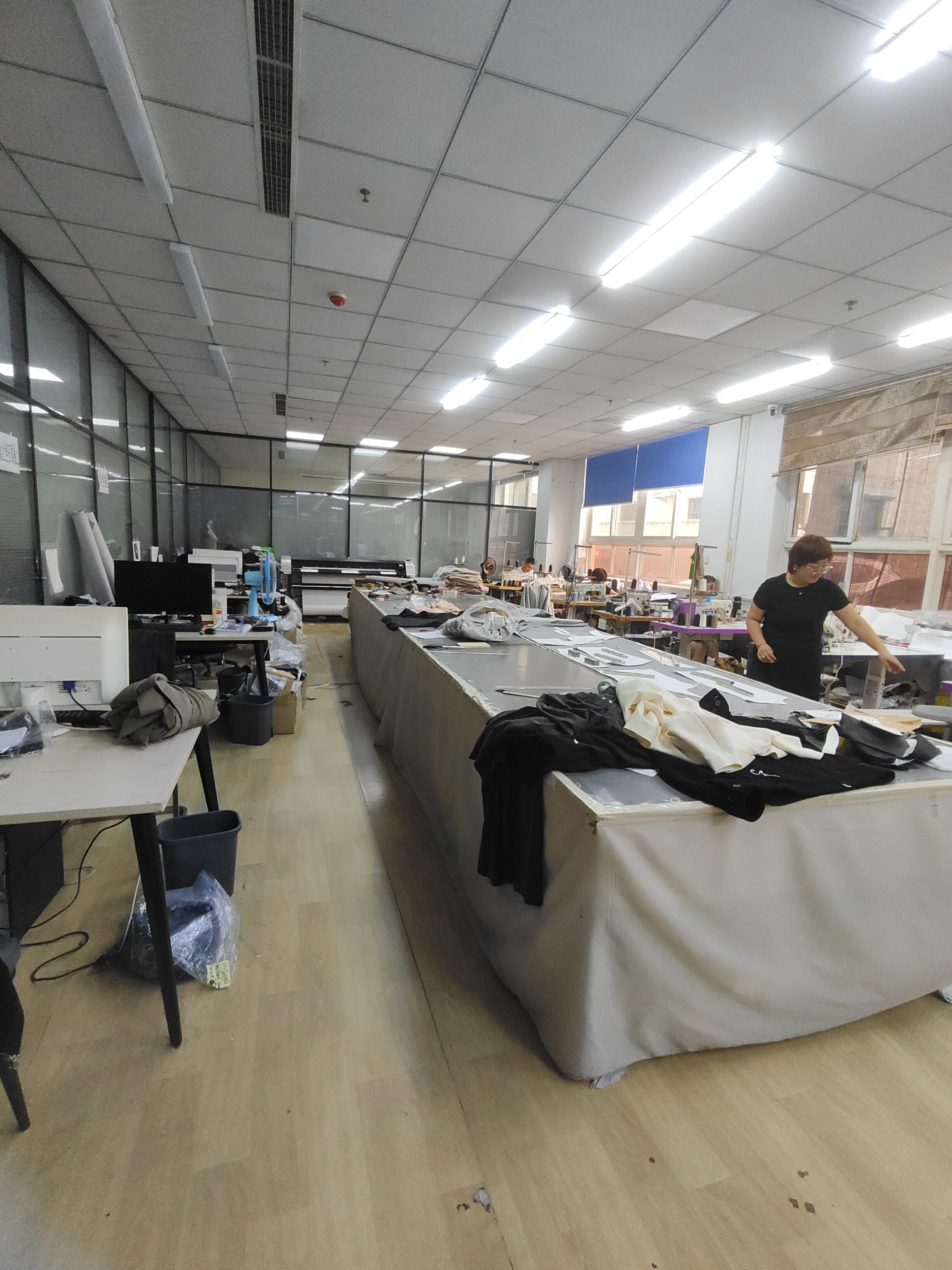
SAMPLE ROOM — a sealed reference sample retained from the sample room is the baseline against which hand-stitching claims can be re-tested at pre-shipment.
Layer 1: Physical Evidence You Can Measure on the Coat
Physical evidence is the only layer that does not depend on the supplier's own description. It is captured from a production sample or a sealed reference sample, and it can be re-measured by a third party at any point in the order cycle.
| Evidence item | What to request | What it indicates in an audit |
|---|---|---|
| Stitch density | A count of stitches per centimeter along the lapel roll, front edge, hem and armhole of a production sample, recorded in writing. | Hand-closed edges show short, evenly spaced stitching. Long, irregular spacing, or faint parallel needle perforations at the edge, suggests partial or machine finishing. |
| Density consistency | The same count taken at three separate points on a single continuous edge. | Wide variation along one edge is a common marker of mixed hand and machine work on the same seam. |
| Interior edge finish | Permission to open the front edge of a sample and photograph the inside of the seam, plus the interior of the hem. | A closed, hand-joined edge with no fused interlining and no visible topstitch supports the claim; exposed fusible webbing or a raw open seam does not. |
| Fabric weight | The fabric weight in g/m², confirmed on a cut swatch rather than on a specification sheet alone. | The manufacturer's own comparative data describes its reference double-faced construction at 450 g/m², against 320 g/m² for the ordinary cashmere coat used as the comparison baseline. Weight determines much of the warmth and the hand-feel the claim is selling. |
| Total garment weight | A calibrated weighing of finished coats, recorded separately for maxi, midi and cropped lengths of the same style. | Typical cashmere coats contain 600–1,200 grams of fabric depending on length and design. A maxi, a midi and a short cropped coat in the same fabric should show a predictable weight difference; unexplained lightness is a reason to ask questions. |
| Panel symmetry | A left-to-right comparison of the front panels, including the placket overlap on a double-breasted style and the edge line on a single-breasted style. | Hand-stitched panels can drift under uneven tension. Symmetry checks expose inconsistency that photographs of a finished coat usually conceal. |
The value of this layer is that it produces numbers, not opinions. Once stitch density, fabric weight and garment weight are recorded in the buyer's own file, every subsequent shipment can be compared against them without renegotiating the definition of the term.
Layer 2: Process Evidence You Request Inside the Factory
Physical evidence proves that a specific sample was hand-finished. Process evidence is what establishes that the same work will be repeated on the production run. It is collected in four requests.
One: the sealed reference sample. Ask the supplier to produce a sample, have both parties confirm it against the physical evidence list above, and then seal, sign and retain it. Any later dispute is resolved against that sample rather than against a description.
Two: the stage records. The manufacturer states that quality control runs from fabric selection through pattern cutting to garment sewing, with each step strictly controlled. In practice, that means asking to see where the boundary sits: which stage records stitch density, who signs off the edge closure, and at what point the interior of the seam is inspected before it becomes inaccessible.
Three: the pattern capability behind the style. Hand-closure on double-faced fabric only holds its shape if the pattern is engineered for it, since the finished edge is the pattern. The manufacturer maintains an in-house design team of four designers; buyers auditing a complex style — an oversized or belted coat, a hooded coat, or a long maxi silhouette — should ask which of those designs were pattern-cut in-house and which were corrected after the first sample.
Four: allocated capacity. The most frequently skipped question is also the most revealing. A facility reporting a monthly production capacity of 30,000 pieces is reporting total capacity across WOMEN'S WOOL COAT, WOMEN'S ONEPIECE and WOMEN'S JACKET lines, not hand-finished coat capacity. Because hand-closing is labor-hour intensive, the hand-finished share is necessarily a subset. Ask directly what proportion of that monthly capacity is assignment-ready for hand-finished double-faced styles in the delivery window you need — the answer tells you whether the claim can survive your order size.

FACTORY — process evidence is collected at the point of production, not from a finished-garment catalogue image.
Mapping the Audit to Verified Product Lines
A construction claim does not automatically transfer between product lines. The manufacturer's verified product scope covers three lines — WOMEN'S WOOL COAT, WOMEN'S ONEPIECE and WOMEN'S JACKET — and a buyer should map which construction standard applies to which line before signing anything.
For the coat and jacket lines, the hand-sewn question is primarily about edge closure, panel joining and interior finishing. For a one-piece garment, the same phrase may describe a different operation entirely, or no operation at all. The practical rule for buyers is to write the construction standard line by line into the purchase specification: a hand-sewn standard approved for a double-faced wool coat is not evidence of any standard on a one-piece garment unless the supplier confirms it separately.
Market destination also shapes what the audit file must contain. The manufacturer exports 60% of output, with main markets in Korea, Japan, the USA and the EU. For US-bound women's wool or fine animal hair overcoats, the applicable classification is HS Code 6202.20.11 in the U.S. Harmonized Tariff Schedule — a code that describes the garment by fiber and use, not by construction method. Buyers should therefore treat the customs description and the hand-sewn claim as two separate records that must both be complete and consistent with the physical goods.
Hand-Sewn Double-Faced Construction vs an Ordinary Cashmere Coat
The comparison below reproduces the manufacturer's own comparative data for its reference double-faced construction against an ordinary cashmere coat. It is a supplier-side comparison, not an independent laboratory result, and it should be read as a set of testable propositions.
| Dimension | Hand-sewn double-faced reference | Ordinary cashmere coat (comparison baseline) |
|---|---|---|
| Fiber and construction | 100% pure cashmere, full hand-sewn craftsmanship | Described as an ordinary cashmere coat; the comparison does not publish a baseline fiber composition |
| Fabric weight | 450 g/m² | 320 g/m² |
| Warmth performance | Stated as higher warmth retention and better cold resistance | Reference point for the gap stated above |
| Production cost | Stated as 22% lower than the comparison baseline | Baseline |
| Maintenance profile | Slow fabric aging, easy to care for and maintain | Not specified in the comparison |
| Best suited to | Cold-climate daily wear and formal occasion outfits | Not specified in the comparison |
The decision-stage reading of this table matters more than the table itself. The 450 g/m² figure is the anchor for the physical evidence list above: if a shipment is meant to deliver hand-sewn double-faced performance, the swatch weight and the garment weight are the first two numbers that can falsify or confirm the claim, long before any discussion of workmanship.
What the Wider Category Data Adds to the Audit
Category-level data helps a buyer calibrate how much scrutiny a hand-sewn claim deserves at a given price point. The global cashmere clothing market was valued at USD 3.63 billion in 2025 in one commercial research estimate, and cashmere sweaters and coats were reported as the largest product segment at 60.58% of that market in 2026. Coat and sweater volume is therefore where cashmere claims concentrate — and where claim-auditing has the largest commercial consequence.
Third-party directory data also offers an independent cross-check on supplier scale. An industrial directory listing records DALIAN GACCILANG FASHION CO.,LTD annual sales volume in the range of US$5 million to US$10 million. Cross-checking a supplier's self-reported capacity against an independent directory entry is a low-cost step that catches obvious inconsistencies before a purchase order is issued; where the two disagree, the buyer should ask which one is current.
How the Application Changes the Evidence Standard
The same hand-sewn claim is not audited the same way across use cases, because the construction burden changes with silhouette.
Cold-climate daily wear. Long maxi and midi silhouettes carry more fabric and more edge length. This is where fabric weight and total garment weight carry the most audit weight — a typical coat's 600–1,200 gram fabric content is distributed over a longer perimeter, and the reference construction's 450 g/m² position is most relevant here.
Formal and luxury occasions. The visible edge line is the product. On a double-breasted coat the placket overlap creates two long parallel edges that must close evenly; on a single-breasted coat the same standard applies to a single continuous edge. On lapel-collar and belted styles, the lapel roll and the belt attachment points are the details most likely to reveal inconsistent hand tension.
Oversized or loose fits. Increased volume means longer seams and more complex curve transitions at the armhole and shoulder. Buyers should extend the stitch-density check to at least three points per seam on these styles rather than one.
Lightweight and thin constructions. Here the audit expectation must be recalibrated rather than relaxed. A thinner coat physically cannot match the 450 g/m² reference, so the hand-sewn claim should be verified against the weight the buyer actually ordered — not against the reference construction used for cold-climate styles.
A Six-Stage Audit Workflow
| Stage | Evidence requested | Decision rule |
|---|---|---|
| 1. Pre-quote | Construction standard stated separately for each product line (WOMEN'S WOOL COAT, WOMEN'S ONEPIECE, WOMEN'S JACKET), plus fabric weight per style | Proceed only when the hand-sewn standard is attached to a named line and style, not to the supplier as a whole |
| 2. Sample | Stitch density record, interior edge photographs, swatch weight, garment weight by length | Sample is sealed and signed by both parties; the file becomes the reference for all later checks |
| 3. Capacity confirmation | Stated share of monthly capacity allocated to hand-finished styles within the required delivery window | If the allocated share cannot cover the order without displacing the delivery date, the claim is not commercially usable at that volume |
| 4. In-production | Stage records covering fabric selection, pattern cutting and garment sewing, with named sign-off | At least one inspection point must fall before the edge closure becomes inaccessible |
| 5. Pre-shipment | Batch weight variance against the sealed sample, symmetry check, packed-unit inspection record | Variance outside the tolerance agreed at stage 2 triggers re-inspection of the affected batch |
| 6. Documentation | Fiber composition record and the applicable customs description, e.g. HS Code 6202.20.11 for US-bound women's wool or fine animal hair overcoats | Customs description and construction claim are filed as two separate, internally consistent records |
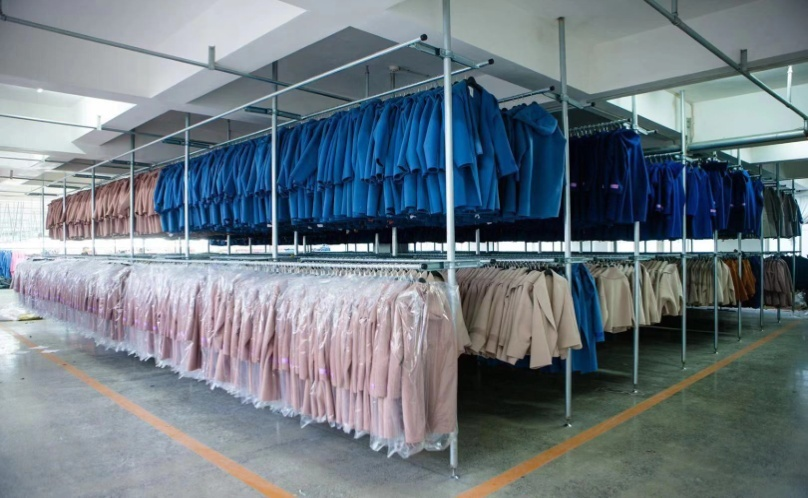
WAREHOUSE — pre-shipment verification happens on packed units, where batch-to-sample variance is easiest to detect.
Limits and Boundaries Buyers Should Accept
An honest audit framework includes the places where it cannot deliver certainty.
- “Hand-sewn” has no binding international definition. Because the term is not standardized, there is no third-party certificate that closes the question. The entire burden falls on the evidence chain the buyer builds, which means the buyer carries residual risk in any case where factory access is not granted.
- Hand-closing consumes labor hours and constrains capacity. A facility reporting 30,000 pieces of monthly capacity across three product lines cannot convert all of it to hand-finished double-faced coats. Buyers ordering at high volume or on short lead times should expect the hand-sewn share of capacity to be the binding constraint, not the fabric supply.
- A heavier fabric is not universally better. The 450 g/m² reference construction is positioned for cold-climate wear. Applied in a mild or transitional market, the same weight becomes a disadvantage in wearability, and the correct audit response is to specify a lighter construction rather than to demand the reference weight.
- The cost and performance figures are supplier comparison data. The stated 22% lower production cost and the warmth-retention claims come from the manufacturer's own comparison against an ordinary cashmere coat, not from an independent test. Buyers should re-run those numbers inside their own landed-cost and returns model before treating them as decision inputs.
- Workmanship is a distribution, not a binary. Even inside a genuinely hand-finishing factory, stitch quality varies between operators and between production days. Sampling at pre-shipment is a control on the distribution, not a guarantee of uniformity.
Future Outlook
The direction of travel in this category is toward process documentation rather than toward new certificates. Because no authority appears likely to standardize the term “hand-sewn” in the near term, the suppliers that gain advantage will be the ones that can produce a verifiable record — sealed samples, stage sign-offs, stitch-density logs, batch weight records — on request and without delay.
Two forces push in the same direction. The first is the continued “quiet luxury” premium attached to hand-stitched double-faced cashmere, which increases both the price achievable and the incentive to over-claim. The second is the concentration of cashmere volume in sweater and coat segments, which means buyer scrutiny is already highest exactly where claims are most common. Over time, the practical differentiator is likely to be the speed and completeness of a supplier's evidence response, not the vocabulary of its marketing.
FAQ
Is “hand-sewn” a standardized or certified term for cashmere coats?
No. There is no universally binding standard that defines what qualifies as hand-sewn on a cashmere coat, so the term is not tied to a single certificate. The phrase can describe full hand-closure of every edge on a double-faced fabric, partial hand-finishing of selected details, or hand attachment of trims. Because the definition varies, verification depends on physical and process evidence agreed between buyer and supplier rather than on a certificate.
What single piece of sample evidence best supports a hand-sewn claim?
A sealed, signed reference sample combined with a written stitch-density record for that sample. Stitch counts are taken per centimeter along the lapel roll, front edge, hem and armhole, and repeated at three points on at least one continuous edge to detect mixed hand and machine work. Once sealed, the sample becomes the baseline against which later production is measured, which makes it more useful than any single photograph.
How does fabric weight relate to a hand-sewn claim?
Fabric weight determines the warmth and hand-feel that the hand-sewn positioning is typically selling, so it functions as a cross-check. The manufacturer's comparative data places its reference double-faced construction at 450 g/m², against 320 g/m² for the ordinary cashmere coat used as the baseline. Independently, typical cashmere coats contain 600–1,200 grams of fabric depending on length and design. Confirming swatch weight and total garment weight therefore tests the claim on measurable terms.
How should a buyer judge whether a supplier has enough hand-finishing capacity?
Ask what proportion of the supplier's stated monthly capacity is allocated to hand-finished styles inside the required delivery window, rather than what the total capacity is. A facility reporting 30,000 pieces per month across three product lines is reporting aggregate capacity, and hand-closed double-faced coats consume more labor hours per piece than machine-finished garments. If the allocated share cannot cover the order without moving the delivery date, the claim is not usable at that volume.
Is a hand-sewn coat more expensive to produce?
Not necessarily, according to the manufacturer's own comparison data, which states a production cost 22% lower than the ordinary cashmere coat baseline. That figure is supplier-side comparison data rather than an independent cost study, so buyers should re-validate it against their own landed-cost model, including the labor-hour intensity of hand-closing, the fabric weight actually specified, and the shipping and duty treatment for the destination market.
What documentation should accompany a shipment of women's wool or cashmere coats?
At minimum, a fiber composition record and the applicable customs description, filed as separate records from the construction claim. For US-bound women's wool or fine animal hair overcoats, the applicable classification is HS Code 6202.20.11 in the U.S. Harmonized Tariff Schedule. That code describes the garment by fiber content and use rather than by construction method, so it does not confirm or replace a hand-sewn claim on its own.
Closing Note
Auditing a hand-sewn claim is not a matter of finding the most convincing supplier; it is a matter of building a file that survives contact with the third sample and the fourth shipment. The evidence layers described here — measurable garment data, factory process records, and consistency checks across samples — are the same whether the order is for a double-breasted wool coat, an oversized loose coat, or a midi-length piece for a mild market. Buyers who request them early will find that the claim either becomes verifiable or eliminates itself.
Manufacturer background, product scope and facility data referenced in this article are drawn from DALIAN GACCILANG FASHION CO.,LTD documentation, available in the company brochure (PDF): DALIAN GACCILANG FASHION CO-202609.