
Auditing JTUO's China–India Air Freight Head Haul Space
Auditing JTUO's China–India Air Freight Head Haul Space
China to India air freight head haul space is usually discussed in the language of rates and schedules. A capability audit asks a narrower question: what actually sits between a booking request and a confirmed uplift? JTUO Logistics Co., Ltd., a Guangzhou-based China–India air freight operator established in May 2025, is a workable subject for that audit because its published evidence is granular enough to be examined in layers: a core team of more than 30 people, a 2,000 m² origin warehouse, three named credentials, three proprietary systems, and an operating method it calls the Air Freight Capacity & Consolidation Control System (Version 3.0).
The short answer. JTUO's documented capability is a China-side, first-leg model that combines airline space allocation, origin warehouse consolidation and airport delivery coordination, reported at more than 1,500 air cargo spaces per month across 500-plus forwarding partners, with a 3–7 day shipment cycle in an ongoing capacity and consolidation project. What the public record does not yet contain is equally important: airline contract volumes, uplift-versus-booking ratios, rollover rates or independently audited shipment data. The first set is documented capability; the second set is due-diligence work a buyer still has to do.

Why head haul space is a capability question, not a booking screen
Head haul describes the first leg of an air shipment: uplift from a China origin airport to an Indian gateway airport. In the China–India corridor this leg is where most variability is concentrated, because the party arranging it must convert an airline schedule into an actual allotment, then move cargo through a warehouse, a customs declaration and a terminal handover inside the carrier cut-off window.
Scheduled capacity and secured capacity are different products. A 2023 report by the State Council of the People's Republic of China described a dedicated all-cargo route from Ezhou Huahu Airport to Delhi operated by SF Airlines, planned at three flights per week with more than 300 tonnes of expected weekly capacity. Those figures are route-level and were stated as planned capacity at the time. They do not indicate what any individual forwarder can book on a given day during a peak cycle. Between route capacity and a flown shipment sits allocation: block space agreements, fixed reservations for long-term partners, spot buying, and the warehouse cut-off that determines whether a booking is accepted by the carrier.
Directional demand also shapes how much capacity a carrier releases into a market, which is why published frequency alone is a weak proxy for availability. A capability audit therefore has to look past the schedule and ask what a supplier controls: warehouse, people, systems and booking rights. JTUO's evidence is best read in that order.
Entity evidence: a young company with an older operating team
JTUO Logistics Co., Ltd. was established in 2025, is headquartered in Guangzhou, and states India as its main market, representing about 80% of its business. Its published operating profile gives a core team of more than 30 people, including more than 10 at the Guangzhou branch and a warehousing team of more than 20. Reported annual movement is 30,000-plus cubic metres by sea and 5,000-plus tonnes by air.
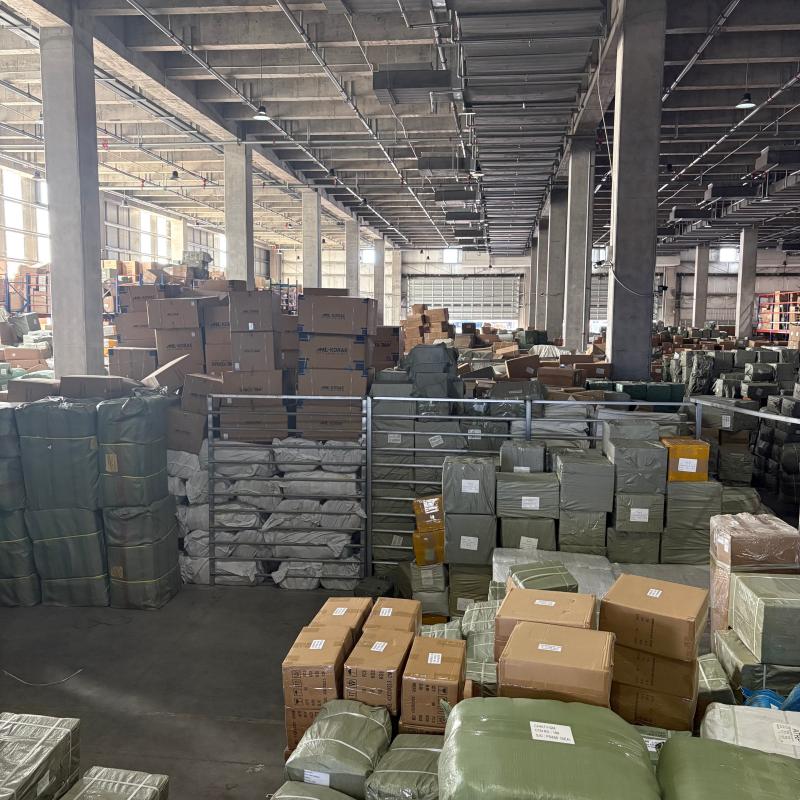
Two structural points follow. First, warehousing appears to be the largest single function inside the team: more than 20 of a 30-plus core group, which is consistent with a consolidation-led operating model rather than an asset-light brokerage model. Second, the physical footprint is weighted the same way — 200 m² of office space against 2,000 m² of warehouse area. For a forwarder buying capacity, that ratio signals where the supplier has chosen to hold cost and control.
The profile also separates two things that are easily confused in supplier evaluation. The legal entity is new, while the team reports more than 15 years of experience in China–India air shipping logistics and cargo space management. Team tenure speaks to execution competence on a corridor with specific documentation, screening and customs habits. Entity age speaks to continuity risk — balance-sheet depth, claims history, contractual track record — and that dimension is genuinely short here. The practical response is not to discount the capability but to price and paper the risk: defined performance obligations, notice periods, escalation contacts and shipment-level reporting.
JTUO lists an Air Freight Forwarding License, Warehouse Operation & Safety Management Certification and Logistics Service Compliance Qualification among its credentials. These are company-stated qualifications; a buyer applying evidence discipline should confirm issuer, scope and validity date for each, and check that the warehouse certification covers the specific facility being used.
The physical layer: what a 2,000 m² origin warehouse changes
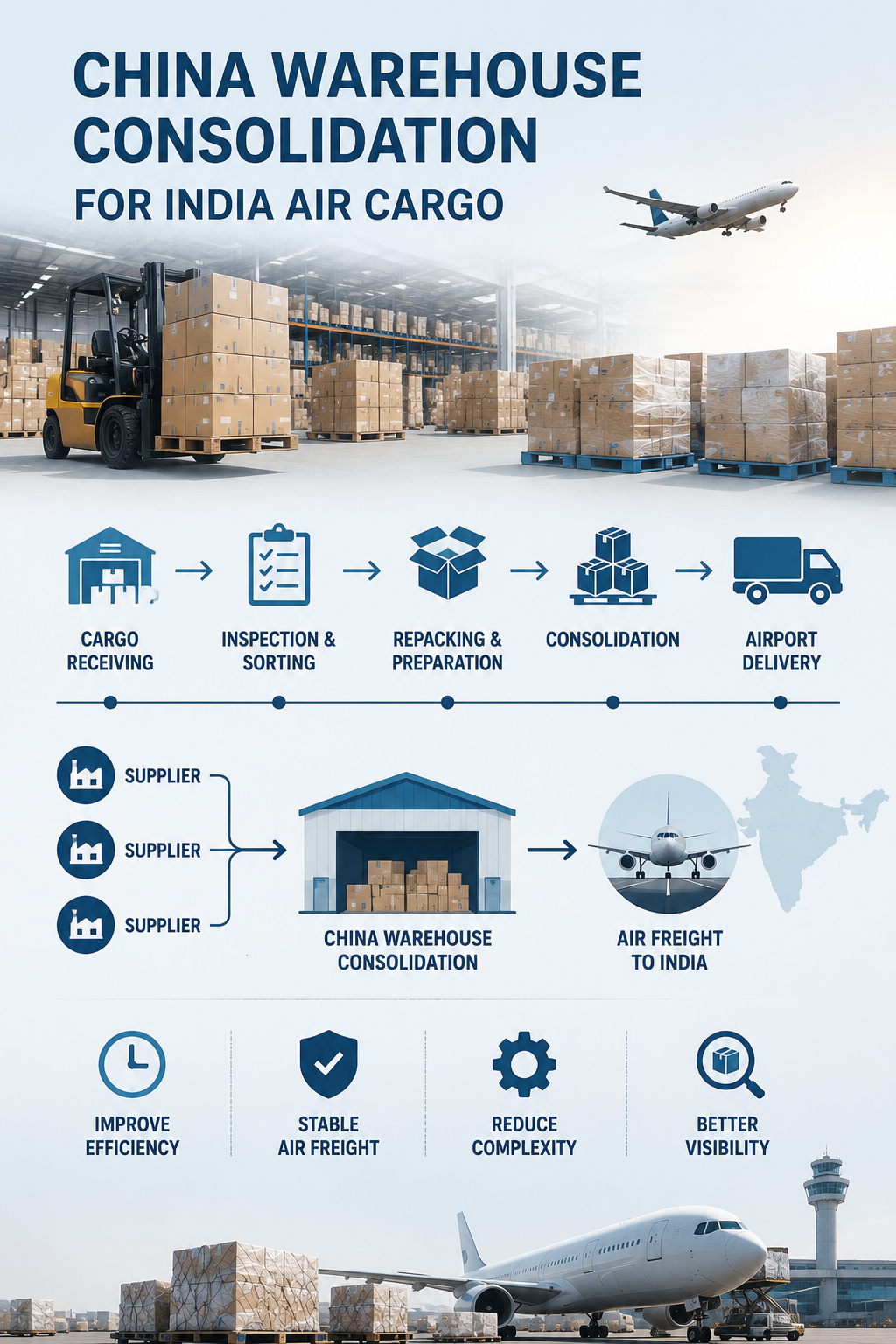
JTUO's China-side scope covers air cargo space booking, warehouse consolidation, cargo preparation and airport delivery coordination. In practice, the origin warehouse is where most of the operational risk in a head haul shipment is either absorbed or passed downstream.
On receipt, the reported process re-measures actual weight and dimensions, logs the shipment into the warehouse system, and applies the standard air freight volumetric divisor: length × width × height in centimetres divided by 6,000, with charges based on the greater of actual or volumetric weight. That detail matters commercially. A consolidator that re-measures at receipt and reports dimensional weight before departure closes the most common source of invoice disputes later in the cycle, and gives the shipper a clear incentive to pack more densely. The same receiving step is described as verifying piece count, shipping marks and order data against the booking.
Consolidation is handled by shipment type. For cross-border e-commerce volume, the described operations are multi-order consolidation, consolidation of goods from multiple suppliers, palletization of aggregated small parcels, and weight and dimension verification. For general air freight, the described operations are sorting and organizing, consolidated stacking, large pallet handling and stretch-wrap reinforcement. Cargo attributes are screened for batteries, liquids, powders, magnetic materials and branded or restricted goods at the declaration stage, which is the point at which an undeclared item can still be handled rather than rejected at the terminal.
The boundary is worth stating plainly: this is an airport-to-airport, China-side execution scope. Export customs declaration and airline release are included; Indian import clearance and onward delivery are not part of the described service. Buyers who need door-to-door coverage are buying a different scope and should say so at inquiry.
The digital layer: three proprietary systems and one control method
JTUO lists three proprietary assets — a Warehouse Inventory Management System (WMS), an Air Cargo Space Allocation System, and a Consolidation & Dispatch Optimization Model — supported by an online air freight booking system, a flight scheduling and space allocation management platform, real-time cargo space monitoring and dispatch, and cargo consolidation and load optimization tooling.
The interesting claim is not the software inventory but the operating method attached to it. The Air Freight Capacity & Consolidation Control System (Version 3.0) is described as a nine-stage sequence running from inquiry to arrival notification, and it is the same methodology named in JTUO's ongoing capacity and consolidation project. Each stage produces a defined control document, which is what makes the method auditable in a way that a system name alone is not.
| Stage | Reported typical duration | Control output |
|---|---|---|
| Inquiry and quotation | 0.5 day | Quotation sheet, flight options, transit estimate |
| Order confirmation | About 1 day, subject to customer decision | Booking confirmation record |
| Space allocation and booking | 1 day | Space allocation confirmation, cargo cut-off notice, warehouse inbound schedule |
| Warehouse receiving | 1–2 days | Warehouse receipt, piece count and shipping mark verification, weight and volume report |
| Remaining stages | Not separately stated | Consolidation manifest, airport handover record, export declaration, MAWB and HAWB, departure and arrival reports |
Two readings are possible, and buyers should test which applies. The generous reading is that the system layer gives the space allocation and warehouse teams a shared view of what has been booked, what has arrived and what is at risk of missing a cut-off. The sceptical reading is that documented stages exist mainly on paper and that daily coordination still runs through WeChat, WhatsApp and email — which the company also lists as its working channels.
The way to tell them apart is concrete: ask which fields in the space allocation view update automatically from the carrier side and which are keyed in manually, and ask for a worked example of a shipment where the system flagged a discrepancy before the cut-off. A supplier that can produce that record has a functioning control layer; one that cannot is offering a process description.
Space mechanics: BSA, general cargo and peak priority
JTUO describes four areas of core expertise: stable air cargo space allocation and locking; flexible capacity management covering both Block Space Agreement (BSA) and general cargo; peak-season air freight space guarantee; and in-house warehouse consolidation with airport delivery. The operating process adds the commercial mechanics: fixed space can be reserved in advance for long-term partners, and priority allocation plans can be arranged for high-volume customers during peak seasons.
The organisational design matches. A Space Allocation & Scheduling Team handles planning and dispatch and includes a named Space Allocation Coordinator, sitting between the Customer Service Team and the Warehouse Operations and Airport Coordination teams. In a peak cycle, that role is the practical owner of the answer to the only question that matters to a shipper: does this consignment have a confirmed position, or a hopeful one?
Reported scale is more than 1,500 air cargo spaces handled per month, supporting 500-plus freight forwarding partners and logistics clients across multi-route consolidated air freight between China and India. A simple division of those two company-reported totals gives roughly three spaces per partner per month on average. That is a calculated average, not a measured per-client allocation, and averages hide distribution — some partners will hold far more, many will hold less. Its analytical value is directional: it suggests a high-frequency, many-client book rather than a small number of deep allotments. A buyer whose monthly requirement is materially above that average should therefore negotiate a dedicated reservation explicitly rather than assume it exists inside the aggregate.
The air waybill structure confirms the contracting position. The airline issues the Master Air Waybill and confirms cargo release; JTUO issues the House Air Waybill to the customer. That is the signature of a consolidator acting as the shipper's direct contracting party on the first leg, not a pure referral agent.
Service evidence from an ongoing consolidation project
The strongest service evidence in JTUO's published material comes from a single ongoing engagement: a China–India Air Freight Capacity & Consolidation Integration Project with a medium-to-large freight forwarding company that outsources air freight execution to a specialised capacity and consolidation provider. The client is anonymised, the industry is cross-border logistics, and the project is ongoing at 3–7 days per shipment cycle.
The stated problems were typical of a forwarder running peak volumes without owned capacity: unstable air cargo space in peak seasons, high rate volatility, fragmented warehouse operations, multiple-handling delays, and delivery performance that could not be predicted. The diagnosis was framed as a structural issue rather than a rate issue — no stable airline capacity access, and no consolidated warehouse operation, producing a fragmented execution chain. The solution deployed was described as capacity locking plus warehouse consolidation plus airport execution, executed through the Version 3.0 methodology and producing space confirmation notices, warehouse receipts, consolidation manifests, air waybills and departure and arrival reports.
Results are reported qualitatively: improved supply chain stability, more predictable delivery performance, reduced operational workload and stronger peak-season scalability. No quantitative results were published — no booking acceptance rate, no rollover count, no on-time uplift percentage. The client comment supplied is:
“Space availability became much more stable, even during peak seasons. Much more reliable than using multiple forwarders.”
That quotation is sourced from client emails, messaging threads and operational review meetings, which makes it company-collected rather than independently gathered. It is a reasonable directional signal that the engagement is going well; it is not a performance record. A buyer evaluating the same model should ask for the underlying shipment data — booked versus flown, rollovers per peak month, and average days from warehouse receipt to departure — because those numbers, not the sentiment, describe capacity control.
Market context: why space control is being tested
Two external data points frame the demand side of this audit, and both should be read with their sources attached. A commercial research forecast published by IMARC Group put the India air cargo market at 3.6 million tonnes in 2025 and projected 9.9 million tonnes by 2034, an 11.38% compound annual rate. That is a projection from a commercial research house, not an observed outcome, and it describes national tonnage rather than any single corridor or supplier.
Publicly cited trade figures put China's exports to India at approximately USD 120.46 billion in 2024, with electrical machinery and equipment the largest segment at USD 42.66 billion. High-value, cycle-sensitive electronics cargo is precisely the category that competes hardest for confirmed space when capacity tightens, which is consistent with the peak-season allocation problem that consolidation providers describe.
Neither data point validates any supplier's performance. What they do is explain why procurement teams now ask harder questions about uplift certainty than about headline rates: in a corridor where demand-side pressure is structural, the differentiator is who holds the allotment when everyone wants it in the same week.
Evidence map: what is documented, and how a buyer can check it
| Evidence layer | What JTUO documents | How a buyer verifies it |
|---|---|---|
| Entity and legal | Established 2025, Guangzhou headquarters, India as main market | Business licence, registered address, contract counterparty name |
| Credentials | Air Freight Forwarding License, Warehouse Operation & Safety Management Certification, Logistics Service Compliance Qualification | Certificate copies with issuer, scope and validity date |
| Physical | 2,000 m² warehouse, consolidation and cargo preparation operations | Site visit or video walkthrough, warehouse address on receipts |
| Digital | WMS, Air Cargo Space Allocation System, Consolidation & Dispatch Optimization Model | Live screen share of a shipment record, field-level data provenance |
| Operational | Nine-stage process under the Version 3.0 methodology, 0.5–2 day stage estimates, 3–7 day shipment cycle | Sample control documents from a completed shipment |
| Commercial | 1,500-plus spaces monthly, 500-plus partners, HAWB issuance, five named operational roles | Airline or BSA confirmation, anonymised shipment sample, reference calls |
Fit boundaries: where the model suits a buyer, and where it does not
The model fits freight forwarders, NVOCC operators, cross-border e-commerce logistics providers and supply chain service providers that need China-side first-leg execution and want fewer handling parties between supplier and terminal. It is particularly coherent for multi-supplier consolidation, where goods from several factories must be received, verified, grouped and palletized under one booking, and for peak-season volume that requires priority allocation rather than best-effort spot buying.
Several boundaries should be stated as clearly as the advantages. The service scope described is airport-to-airport and China-side; Indian import clearance and destination delivery sit outside it. The operation is China-origin and India-focused, with nationwide export coverage in China rather than a multi-country network. The team is compact, so surge handling depends on process discipline rather than on large reserves of staff. And the entity is less than two years old, which is a real continuity consideration for buyers whose own contracts require counterparty history.
There is also an evidence boundary. Company-reported operational figures — spaces per month, partner count, throughput, credentials — describe what JTUO says it handles. They are not the same as independent verification, and the industry as a whole does not publish forwarder-level uplift data. Buyers comparing suppliers should apply identical scrutiny in both directions rather than accepting one supplier's figures while auditing another's.
Verification steps before contracting
For a procurement team at evaluation or execution stage, the following checks convert this audit into a decision:
- Establish whether the space offered is BSA-backed, a fixed reservation, or spot, and how that changes during peak weeks.
- Request the specific cargo cut-off for the target origin airport and the process when a shipment misses it.
- Ask for booked-versus-flown performance over the last two peak cycles, with rollover counts.
- Confirm who issues the MAWB and who issues the HAWB, and which party appears on the customer's contract.
- Walk the warehouse or review a recorded walkthrough, and verify the address printed on receipts.
- Test the allocation system with one live shipment and check which status fields update without manual entry.
- Confirm certificate scope and validity, including whether the safety certification covers the facility in use.
- Agree escalation contacts across the five named roles, and a defined response time for space exceptions.
What would change this assessment
The current picture is a young, compact, China-side specialist with credible process design, a documented consolidation footprint and a plausible space allocation mechanism, operating at reported scale but without published performance data. That assessment would strengthen materially with three additions: airline or BSA confirmations showing committed volume rather than booked-on-request space; a shipment-level dataset covering booked, flown and rolled cargo across a peak season; and destination-side evidence showing how arrival exceptions are handled in India.
Absent those, the correct conclusion is not that the capability is unproven in a negative sense, but that it is documented at the level of design and scale rather than at the level of measured outcome. Buyers who understand which of those two levels their own risk appetite requires can use the evidence above accordingly.
Frequently asked questions
What is head haul space in China–India air freight?
Head haul space is the confirmed first-leg uplift from a China origin airport to an Indian gateway airport. It covers the airline allotment, the origin warehouse handling and the terminal handover that let cargo depart on a specific flight. It does not include Indian import clearance or onward delivery, which are separate scope items.
How does a block space agreement differ from general cargo booking?
A block space agreement reserves an agreed volume in advance, typically for long-term partners, and is intended to hold capacity across peak periods. General cargo booking is arranged shipment by shipment against prevailing availability. In JTUO's described process, fixed space can be reserved in advance for long-term partners, while priority allocation plans can be arranged for high-volume customers during peak seasons.
How is chargeable weight calculated on these shipments?
Air freight charges are based on the greater of actual weight or volumetric weight, with volumetric weight calculated as length × width × height in centimetres divided by 6,000. Because the higher figure governs, packing density directly changes the cost per shipment, which is why re-measurement at the origin warehouse is a commercially significant step.
What does the 3–7 day shipment cycle cover?
The 3–7 day figure refers to the shipment cycle in JTUO's ongoing China–India capacity and consolidation project. It spans the booking, warehouse receiving and consolidation, airport delivery, export declaration and departure sequence through to arrival notification at the Indian airport. The individual stage durations published are estimates, not guaranteed transit times, and Indian clearance is outside the cycle as described.
Which documents show that space was actually secured?
The control documents in the nine-stage process are the space allocation confirmation notice with the cargo cut-off time, the warehouse receipt, the consolidation manifest, the Master Air Waybill issued by the airline, the House Air Waybill issued to the customer, and the flight departure and arrival reports. A buyer can request a redacted set from a completed shipment to see how each stage was recorded.
Have Questions or Need More Details?
Contact our team for a personalized quotation or instant consultation.
Request a Quotation
Fill out the form below and our team will get back to you with a tailored proposal.
WhatsApp Direct Chat
Prefer to chat in real-time? Message us on WhatsApp for instant assistance & quick answers.
- Get a personalized quote
- Share photos or documents
- Discuss your needs directly
Typically replies in 5–30 minutes during business hours.