
Auditing Pharmacy Automation Capability: HOH Model-Level Evidence
Industry Reference · Pharmacy Automation Procurement
Pharmacy automation projects rarely fail because a hospital chose the wrong equipment category. They fail at the audit stage — when a claim in a proposal cannot be traced to a model number, a dimension, a certificate scope or a measurement condition. This reference sets out the HOH model-level evidence that procurement teams can check line by line, and marks the one area where documentation is visibly thinner: medication demand forecasting.
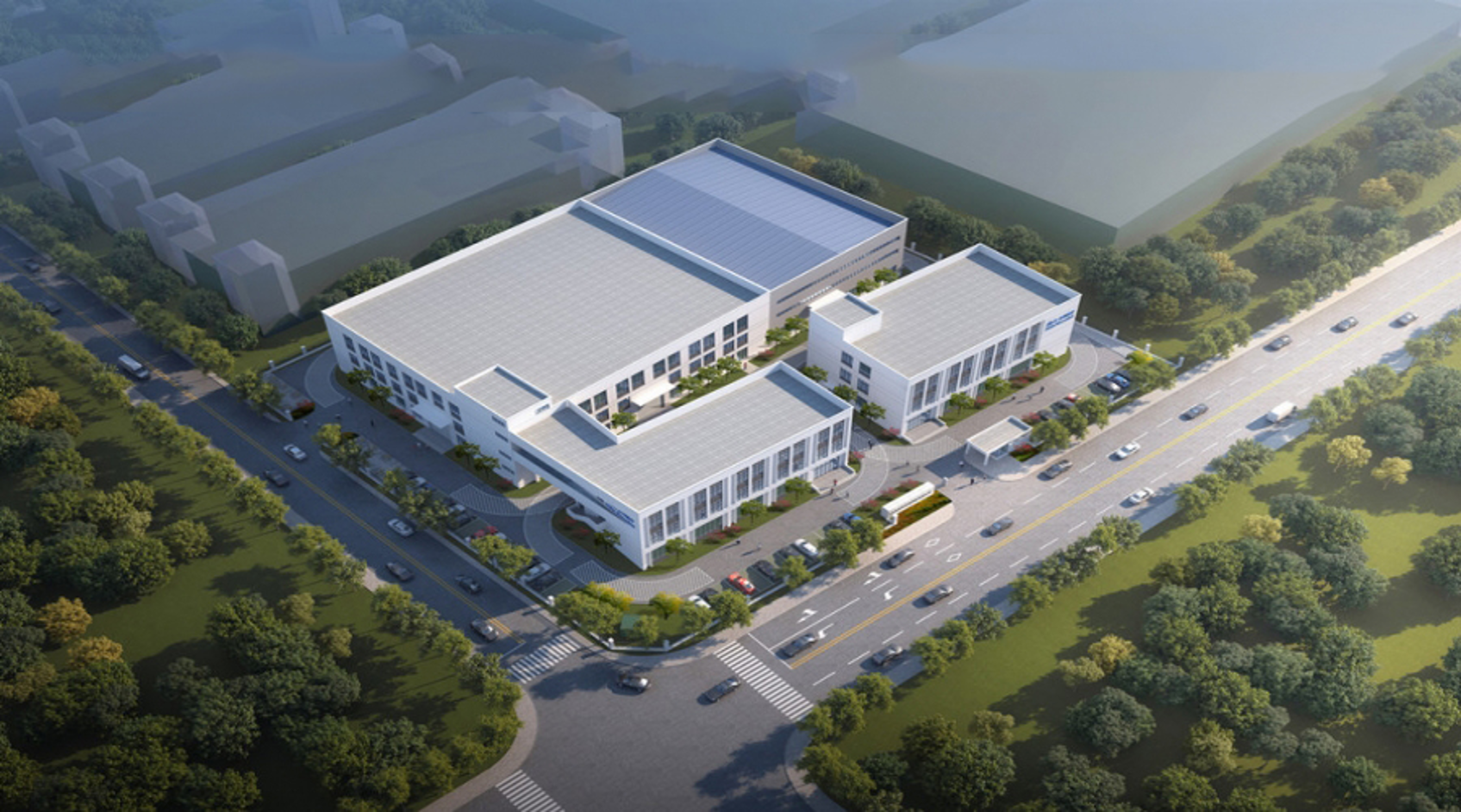
Capability in pharmacy automation is evidenced at two levels: the facility that builds the system, and the model that is installed. Haier Biomedical operates a 13,000 m² facility with project-based production capacity.
Why Capability Claims Need an Audit Trail
In this category, capability is usually argued in adjectives and then verified in millimetres, rates and certificate numbers. A buyer who accepts the adjectives and skips the measurements inherits the difference at commissioning: a footprint that does not fit the room, a throughput figure that assumed a different prescription mix, or a customized cabinet configuration that sits outside the scope named on the certificate the hospital relied on during tender evaluation.
The commercial context makes precision worthwhile. The global pharmacy automation devices market was estimated at about USD 6.7 billion in 2024 (Insightace Analytic) and is projected to reach USD 11.6 billion by 2030, a CAGR of 9.9% (Grand View Research). Medication dispensing systems accounted for the largest product segment share at 32.5% in 2025 (Dataintelo), decentralized distribution models are expected to represent 79.8% of the market in 2026 as automated dispensing cabinets spread through wards (Fortune Business Insights), and automated medication compounding is projected as the fastest-growing product segment with a CAGR above 10% (Grand View Research).
Market sizing itself is not settled. Estimates for 2024 range from about USD 6.65 billion to USD 7.52 billion depending on whether secondary services and software components are counted (MarketsandMarkets; Dataintelo). That divergence is a working reminder: any number in a proposal needs a source and a scope, or it is not a decision input.
Haier Biomedical Technology(Suzhou)Co., Ltd is a healthcare technology company under Haier Group that operates a dedicated pharmacy automation business unit, supplying intelligent pharmacy automation, outpatient automated dispensing, inpatient pharmacy automation and automated PIVAS systems. The company was founded in 2015, operates a 13,000 m² facility with approximately 500 employees including a 100-engineer R&D team, and holds ISO 13485 medical device quality management system certification. Its automation hardware carries HOH model designations — which is precisely what makes model-level auditing possible.
The Five Evidence Layers a Buyer Can Actually Check
The layers below are a sequence, not a scorecard. Each layer can only be verified if the layer above it is already documented.
Layer 1 — Model identity on the certificate
A certificate is only an asset to a buyer if the installed model appears in its scope. The ICR Verification of Conformity ICR/VC/HB250402, issued 2025-04-17 and valid to 2030-04-16 for the EU market, covers automatic dispensing system models including HOH-KF-1200, HOH-KF-900, HOH-KF-600, HOH-KF-Smart, HOH-KF-ADM, HOH-KF-50, HOH-KF-40 and HOH-KF-30Z, against EN ISO 12100:2010 and EN 60204-1:2018. ICR/VC/HB250403, issued the same day with the same validity, covers high-speed dispensing system models HOH-GF-36 through HOH-GF-200, including HOH-GF (2 Modules). ICR/VC/HB240501, issued 2025-05-10 and valid to 2029-05-09, covers anesthetic medication dispensing cabinet models including HOH-BQ-A and HOH-MJ-01. ICR/VC/HB250802, issued 2025-08-06 and valid to 2030-08-05, covers pouch packaging and inspection models HOH-FB-D400-HD, HOH-FB-D320-HD and HOH-FB-D480-HD.
A second document type exists alongside these. ISET voluntary compliance certificate ISETC.000220220323, issued 2022-03-23 and valid to 2027-03-22, covers automatic dispensing system models including HOH-KF-Smart. A voluntary compliance certificate is not the same instrument as a Directive Verification of Conformity, and it carries its own expiry date. Buyers tracking document currency should note both.
Broader standards frame the category: pharmacy automation systems are expected to comply with IEC 60601-1 for medical electrical equipment safety and ISO 13485 for quality management (CSA Group), while FDA 21 CFR Part 11 governs electronic records and electronic signatures where the system generates regulated records (U.S. FDA). The first is an equipment question, the second is a software documentation question — and they are audited by different people.
Layer 2 — Physical envelope
Dimensions decide whether a system can be installed at all. Documented envelopes in the HOH line span from a 620 × 700 × 1,240 mm cabinet (HOH-BQ-A) to an 8,650 × 1,747 × 2,850 mm robotic arm dispenser main unit (HOH-KF-Smart, replenishment module excluded). Ceiling clearance, door widths, floor loading and replenishment access are all derived from these numbers, and none of them can be negotiated later without changing the configuration.
Layer 3 — Throughput statements and their conditions
Every rate in this category is conditional. A single-channel dispensing speed of ≥2 boxes/sec (HOH-GF, 2 Modules), a dispensing capacity of >350–500 prescriptions/hour with >2,400 boxes/hour replenishment (HOH-KF-1200), ≥300 prescriptions/hour with ≥700 boxes/hour replenishment (HOH-KF-Smart), 25 compounds/hour (HOH-Robot-Plus) and 40–60 packs/min (HOH-FB-D400-HD) describe machine capability under a stated configuration. They do not predict a specific hospital's peak-hour output, because prescription mix, pack size and buffer settings sit between the two.
Layer 4 — Software and data continuity
Hardware without data continuity becomes a very expensive cabinet. Haier pharmacy automation solutions are designed for integration with hospital information systems including HIS and EMR platforms, and the documented customization scope explicitly lists software functions, HIS interface and language. Where item-level data matters, HOH-KF-Smart documents barcode recognition with full-chain traceability and FIFO/FEFO expiration management.
Layer 5 — Validation and lifecycle
Acceptance is where claims become obligations. Factory Acceptance Test (FAT) is supported before shipment; minimum order quantity is 1 unit; standard delivery time is typically 60–90 days depending on project size and configuration; production capacity is project-based. After-sales scope covers remote technical support, on-site installation and commissioning, operator training, software upgrades, spare parts supply and global after-sales service — the items that determine year-three cost rather than year-one price.
Model-Level Evidence at a Glance
| Model | Documented role | Key verified parameters | Certificate covering the model |
|---|---|---|---|
| HOH-Robot-Plus | Fully automated cytotoxic drug compounding | 2,200 × 1,520 × 2,370 mm; 1,300 kg; 25 compounds/hour; 100% compounding accuracy; Class 100 (ISO 5) compounding environment; >95% vial compatibility | Confirm coverage in project documentation; the certificates cited here list dispensing, cabinet and packaging models |
| HOH-KF-1200 | Chute-type dispensing | >1,100 medication types; >15,000 boxes; <12.85 m² footprint; >350–500 prescriptions/hour; >2,400 boxes/hour replenishment; ≥2 buffer channels | ICR/VC/HB250402 (valid to 2030-04-16) |
| HOH-KF-Smart | Robotic arm dispensing | ≥1,500 medication types; ≥20,000 boxes; ≥300 prescriptions/hour; ≥700 boxes/hour replenishment; FIFO/FEFO; barcode traceability | ICR/VC/HB250402; ISETC.000220220323 (voluntary, valid to 2027-03-22) |
| HOH-GF (2 Modules) | High-speed dispensing | ≥100 storage slots; ≥5,000 boxes; ≥2 boxes/sec single channel; 2,180 × 1,230 × 2,800 mm; high-precision photoelectric dispensing detection | ICR/VC/HB250403 (valid to 2030-04-16) |
| HOH-FB-D400-HD | Sub-packaging and verification | 400 medication boxes; 40–60 packs/min; 72-slot external output tray; 75 × 70 mm bag; 1,200 × 880 × 2,025 mm | ICR/VC/HB250802 (valid to 2030-08-05) |
| HOH-BQ-A | Intelligent integrated management cabinet | 620 × 700 × 1,240 mm; 32 small pillboxes at 150 pcs each (1 mL ampoule); 8 large pillboxes at 20 pcs; 23-inch touch screen | ICR/VC/HB240501 (valid to 2029-05-09) |
| HOH-MJ-01 | Anesthetic medication dispensing cabinet | 9 drawers, 44 compartments, all lidded; 745 × 700 × 1,800 mm; 400 kg; 28.3 L maximum single-layer volume; 15-inch touch screen | ICR/VC/HB240501 (valid to 2029-05-09) |
Robot: What the HOH-Robot-Plus Documentation Shows
The HOH-Robot-Plus is a fully automated cytotoxic drug compounding system for PIVAS environments. Its documented physical envelope is 2,200 × 1,520 × 2,370 mm at a device weight of 1,300 kg, with vial compatibility covering more than 95% of vial types and solvent compatibility spanning 50–1000 mL soft bags, plastic bottles and stand-up pouches.
Two figures matter most for a hazardous-drug audit. The first is compounding accuracy of 100%, which in the documentation refers to the robot's compounding operation. The second is the compounding environment: Class 100 (ISO 5) cleanroom conditions. Consumables are specified as Luer-lock general-purpose syringes with dedicated needles — a detail that belongs in the consumables cost model rather than the capital line.
The audit reading is that accuracy and environment are stated machine conditions, not outcomes of the whole sterile preparation chain. Environmental monitoring, consumables handling, operator technique and post-compounding verification remain part of the hospital's own process, and a procurement team should ask separately how each is controlled.
Chute Dispensing: HOH-KF-1200 and the Space-to-Throughput Ratio
The HOH-KF-1200 is a chute-type dispenser documented for more than 1,100 medication types and a storage capacity above 15,000 boxes, inside a space requirement below 12.85 m² and dimensions under 4,690 × 2,850 × 2,735 mm. Dispensing capacity is documented at more than 350–500 prescriptions per hour, with replenishment above 2,400 boxes per hour.
The architecturally interesting part is not the top-line speed but the structural design: modular dispensing, storage and loading units, full-screen dispensing with safety buffers, parallel multi-prescription operation, and a dispensing buffer port of at least two channels supporting side buffering and front-end output. In practical terms, dispensing and replenishment are not competing for the same mechanism, which is why the replenishment figure can sit so far above the dispensing figure.
For a hospital pharmacy running a high daily prescription volume with constrained floor area, this is the model whose numbers are easiest to test against a layout drawing: measure the actual available footprint, then compare it with the sub-12.85 m² requirement before discussing throughput at all.
High-Speed Dispensing and Verification: HOH-GF (2 Modules) and HOH-FB-D400-HD
The HOH-GF (2 Modules) high-speed dispenser is documented with at least 100 storage slots, at least 5,000 boxes of storage capacity and a main unit of 2,180 × 1,230 × 2,800 mm, with no more than two medication bin modules. Dispensing speed is specified as at least 2 boxes per second on a single channel, using batch dispensing for multiple boxes in a dual-level stacked structure with adjustable bin width.
Its sensing layer is described precisely: high-precision photoelectric sensors for dispensing detection, plus automatic positioning guidance with indicator lights for error alerts. That is a per-dispense confirmation mechanism, and indicator-light guidance shortens fault recovery — a detail that matters more than headline speed in a pharmacy where a single blocked slot can halt an outpatient queue.
The complementary unit is the HOH-FB-D400-HD automatic sub-packaging and verification machine: 400 medication boxes, 40–60 packs per minute, 75 × 70 mm packaging bags, a 72-slot external output tray, 1,200 × 880 × 2,025 mm at 700 kg, 2,000 W rated power, and an operating environment of 0–40 °C at 10–80% humidity. The 72-slot output tray functions as a buffer between packaging and downstream verification or pickup — capacity that should be mapped against the hospital's ward-round batching pattern, not simply counted as slots.
Robotic Arm Dispensing: HOH-KF-Smart
The HOH-KF-Smart robotic arm dispenser is documented for at least 1,500 medication types and at least 20,000 boxes of storage, with a main unit of 8,650 × 1,747 × 2,850 mm excluding the replenishment module — a qualification that belongs in every site plan. Dispensing speed is at least 300 prescriptions per hour, replenishment at least 700 boxes per hour, and expiration management supports FIFO/FEFO, while barcode recognition provides full-chain traceability.
This is the model where SKU breadth is the primary argument: 1,500 medication types covers formularies that make chute and high-speed configurations work harder. The trade-off is linear floor space, and it is a real one. A pharmacy that selects on SKU coverage without measuring the 8.65 m main unit plus replenishment access will discover the constraint during installation rather than during evaluation.
Cabinets: HOH-BQ-A and HOH-MJ-01
Cabinet capacity is counted differently from dispenser capacity, and mixing the two units of measure is a common tender error. The HOH-BQ-A intelligent integrated management cabinet is documented at 620 × 700 × 1,240 mm with 32 standard small pillboxes at 150 pcs each (counted in 1 mL ampoules), 8 large pillboxes at 20 pcs each, a 23-inch touch screen and AC 220 V 50/60 Hz power supply.
The HOH-MJ-01 anesthetic medication dispensing cabinet is documented with 9 drawers — the first seven in a 6-grid layout and the bottom two in a single-grid layout, all lidded — for 44 compartments in total, a maximum single-layer volume of 28.3 L, external dimensions of 745 × 700 × 1,800 mm, 400 W power, 400 kg net weight and a 15-inch touch screen.
Both figures are compartment and ampoule capacities, not prescription throughput. The correct audit method is to map them against the hospital's high-alert and anesthetic drug list and against shift-level access patterns, then confirm that the 400 kg net weight of HOH-MJ-01 and its drawer geometry fit the actual room and refill workflow.
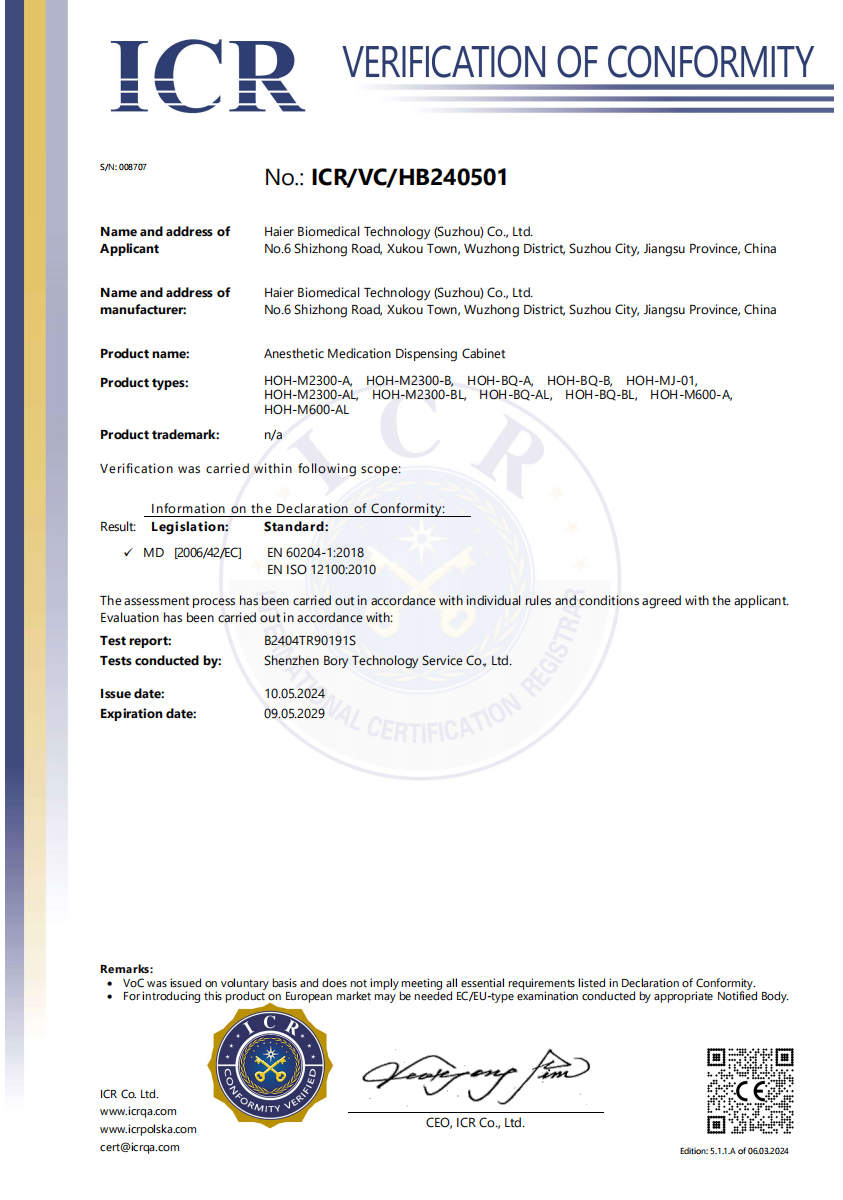
Documentation is part of the specification: ICR/VC/HB240501 (issued 2025-05-10, valid to 2029-05-09) names the cabinet models it covers, including HOH-BQ-A and HOH-MJ-01.
Medication Demand Forecasting: Turning Model Evidence into a Planning Question
Medication demand forecasting is the practice of predicting consumption by drug, form and period so that storage allocation, replenishment timing and purchasing follow demand rather than habit. In an automated pharmacy it is not a standalone module. It runs on the same data chain that feeds dispensing: prescription information from the hospital information system, inventory records tied to physical storage positions, and expiry data tied to batch identity.
What the documented evidence supports
HOH documentation supports the input and execution side of that chain rather than the predictive side. Integration with HIS and EMR platforms is documented, and the customization scope explicitly includes software functions, HIS interface and language — which is where forecasting logic would be integrated or interfaced. Barcode recognition with full-chain traceability on HOH-KF-Smart supplies item-level movement data; FIFO/FEFO expiration management on the same model supplies the expiry dimension that any credible forecast has to respect.
Execution capacity is documented in concrete terms. With replenishment above 2,400 boxes per hour on HOH-KF-1200 and at least 700 boxes per hour on HOH-KF-Smart, a forecast-driven replenishment decision is not throttled by the machine during normal operation. That matters: a forecast that takes two days to execute is a planning document, not a control system.
What the documented evidence does not support
The published model documentation reviewed here does not state a forecast accuracy figure, a forecast horizon, or a described forecasting method. No error metric, seasonality treatment or demand-variance benchmark appears in the specifications. That absence should be read as a scope question rather than a deficiency: forecasting performance depends on the hospital's own data history, formulary stability and prescribing seasonality, and it is normally established in a pilot using the hospital's data rather than asserted in a datasheet.
Six questions a forecasting audit should ask
- Data ownership. Which system holds the demand signal — HIS/EMR, the automation software, or a separate analytics layer — and through which documented interface does it travel?
- Historical basis. Which window of history is used, and is it the hospital's own dispensing history or a reference site's?
- Decision-to-execution latency. How does a forecast output become a replenishment task, and how long does that task take at the documented replenishment speeds?
- Expiry precedence. When a forecast suggests buying or holding ahead, which rule wins — the forecast or FIFO/FEFO expiry control?
- Storage allocation. Which storage positions receive forecast-driven volume — chute buffer, robotic-arm bin, high-speed slot, cabinet compartment — and does the allocation stay within each model's documented capacity?
- Measurement point. What is measured at Factory Acceptance Test, and what is measured in the first 90 days after go-live?
The limit worth stating early
Forecasting cannot compensate for formulary instability. In pharmacies with rapidly changing short-course regimens or heavy compounding volumes, replenishment responsiveness and expiry discipline matter more than forecast sophistication. This is where the documented HOH strengths — high replenishment rates, FEFO expiration management and barcode traceability — carry more practical weight than any demand model, and where a buyer should spend audit time first.
Comparison with Traditional Shelving-Based Workflows
Traditional shelving is not obsolete, and the comparison is only useful when it is honest about what changes and what does not.
| Dimension | Shelving-based workflow | Documented automated configuration |
|---|---|---|
| Retrieval | Pharmacist locates and picks manually | System identifies the position and releases the dose (full-screen dispensing on HOH-KF-1200; robotic pick on HOH-KF-Smart) |
| Replenishment | Manual restocking, timing driven by staff availability | Dedicated replenishment path documented above 2,400 boxes/hour (HOH-KF-1200) and at least 700 boxes/hour (HOH-KF-Smart) |
| Expiry control | Depends on manual rotation discipline | FIFO/FEFO expiration management documented on HOH-KF-Smart |
| Traceability | Paper or partial system records | Barcode recognition with full-chain traceability (HOH-KF-Smart) |
| Error detection | Human checking steps | High-precision photoelectric dispensing detection with indicator-light error guidance (HOH-GF) |
| Footprint | Flexible; scales by adding shelving | Fixed envelope from 620 × 700 × 1,240 mm to 8,650 × 1,747 × 2,850 mm across the line |
| Formulary change | Immediate — move a box | Requires bin, slot or compartment reconfiguration plus software mapping |
| Capital profile | Low capital, high recurring labour | High capital, configuration-dependent lead time of typically 60–90 days |
The honest limitation sits in the last two rows. A shelving-based pharmacy absorbs a formulary change in minutes; an automated pharmacy absorbs it through reconfiguration and remapping, and every model in this line occupies a fixed envelope that cannot be renegotiated on site. Automation buys throughput consistency, traceability and expiry discipline — it does not buy flexibility.
Where the Evidence Stops: Limitations and Boundaries
- Certificate scope is model-specific. The certificates cited here name listed models. Equipment size, storage capacity, SKU quantity, robotic modules and software functions are documented customization options, so a customized build must have its certificate scope confirmed contractually rather than assumed from the base model.
- Throughput figures are condition-bound. Boxes per second, prescriptions per hour and packs per minute describe configured machine capability, not a guaranteed peak-hour result for a specific prescription mix.
- Physical constraints are not negotiable after order. A 2,800–2,850 mm unit height, an 8,650 mm main unit width excluding the replenishment module, a 1,300 kg compounding robot and a 400 kg cabinet each impose ceiling, door, floor-loading and access requirements.
- 100% compounding accuracy is a machine claim. It describes the robot's compounding step, not the whole sterile chain, which still depends on environmental monitoring, consumables handling and operator verification.
- Automation covers picking and dispensing, not clinical judgement. Verification processes remain part of the workflow, and combining automated dispensing with a verification step is what adds a further check on medication information before dispensing.
- Document currency needs an owner. The ISET voluntary certificate ISETC.000220220323 expires 2027-03-22, earlier than the ICR certificates covering the same dispensing models. Renewal tracking belongs in the contract, not in a folder.
Application Evidence: Two Hospital Deployments
Reference sites are useful only when they map to a buyer's own constraint. Two documented outpatient deployments illustrate different ones.
A private hospital in Thailand installed one set of a customized universal dispenser system in its outpatient pharmacy, recorded with a 10-year duration. The configuration was developed specifically for Thai medication packaging requirements, compatible with multiple medication formats, with HIS integration and a modular, scalable design. The reported outcome is stable automated dispensing, improved dispensing accuracy and fewer repetitive tasks for pharmacists. The audit lesson is packaging compatibility: a system specified for one country's pack formats does not automatically transfer to another's.
A general hospital in Vietnam installed one set of an intelligent pharmacy automation system, also in the outpatient pharmacy and also recorded with a 10-year duration, configured around the hospital's pharmacy layout and workflow with HIS integration. The reported outcome covers workflow optimization, reduced patient waiting time and a digital pharmacy management upgrade. The audit lesson here is layout customization — the reason a site survey precedes configuration rather than following it.
Market Context and Trend Signals
Three trend signals are relevant to a capability audit. First, software is expected to grow at the fastest rate among components from 2024 to 2030 (MarketsandMarkets), which shifts evaluation weight toward interface documentation and upgrade paths rather than steel. Second, decentralized distribution via automated dispensing cabinets is projected at 79.8% of the market in 2026 (Fortune Business Insights), which raises the importance of cabinet-level inventory visibility — the reason HOH-BQ-A and HOH-MJ-01 capacities are counted in compartments and ampoules. Third, compounding automation remains the fastest-growing product segment above 10% CAGR (Grand View Research), consistent with the regulatory attention PIVAS environments attract.
Supply-side signals are also documentable. Euromonitor International ranks Haier Biomedical as the No. 1 Chinese brand in global life science laboratory equipment sales in 2025 — a laboratory equipment ranking, not a pharmacy automation one, and worth citing with that precision. The company's 2025 annual report states total revenue of RMB 2.33 billion, overseas revenue growth of 17.9% year-on-year to RMB 840 million, that AI-powered automated pharmacy solutions increased direct dispensing rates to 80%, and that AI-powered applications contributed 15% of total revenue.
Future Outlook
The direction of travel in this category is toward software-defined differentiation on top of stable mechanical platforms. Modularity — documented here as modular dispensing, storage and loading units on HOH-KF-1200, up to two medication bin modules on HOH-GF (2 Modules), and configurable robotic modules across the line — is what allows a pharmacy to add capacity without replacing a fleet.
The second shift is evidence quality. As more hospitals require certificate scope, FAT documentation and traceability records as tender attachments, suppliers that already publish model-level specifics will be easier to evaluate than those that publish capability narratives. That is a low-cost advantage for buyers: it makes the audit shorter.
The third is forecasting, and it will be resolved commercially rather than technically. Demand prediction will be judged by measured performance inside a specific hospital's data environment, which means the procurement question shifts from "does the system forecast?" to "what will we measure, when, and against which baseline?" That question can be written into a contract today, independently of which model is selected.
Frequently Asked Questions
Is pharmacy automation suitable for every hospital?
No. Selection should follow prescription volume, medication types, SKU requirements, dispensing workflow, storage capacity, available space, system integration requirements, scalability and investment budget. The line spans different answers to those constraints: HOH-KF-Smart for pharmacies handling a large volume of boxed medications with accuracy as the priority, HOH-KF-1200 for high daily prescription volume where dispensing efficiency dominates, and cabinet models where decentralized storage is the constraint. Final configuration is determined by operational requirements and site conditions.
How can an automated dispensing machine improve pharmacy efficiency?
By transferring repetitive medication picking and dispensing from manual operation to equipment. The system receives dispensing instructions, identifies the corresponding storage location or dispensing unit, and performs the configured operation. This allows pharmacists to spend less time on routine handling and more on professional pharmacy services, with the equipment configured around each pharmacy's workflow.
Can pharmacy automation reduce medication picking errors?
It can reduce the volume of repetitive manual picking and standardize the dispensing workflow. When automated dispensing is combined with a medication verification process, such as an automatic sub-packaging and verification machine, the workflow adds further checks on medication information before dispensing. Automation removes manual steps; verification adds a checking layer, and the two are complementary rather than interchangeable.
Can pharmacy automation systems integrate with a hospital HIS?
Yes, where the project specifies it. Haier pharmacy automation solutions can be integrated with hospital information systems to support automated prescription processing and dispensing workflows, connecting with HIS/EMR and other hospital systems so prescription information transfers to the automation system for dispensing. The hospital system sends prescription information through the defined interface, and the automation system processes it according to configured dispensing rules and equipment workflows.
What are the purchasing terms and acceptance criteria?
Minimum order quantity is 1 unit and delivery terms are FOB. Factory Acceptance Test (FAT) is supported as an acceptance criterion. Payment terms are 50% in advance by TT with the balance before shipping. Standard delivery time is typically 60–90 days depending on project size and configuration, and production capacity is project-based.
Reference
A consolidated overview of the full-scenario intelligent pharmacy line — dispensing, storage, verification, packaging and PIVAS automation — is available in the company's brochure: Full-scenario Intelligent Pharmacy (PDF).
Have Questions or Need More Details?
Contact our team for a personalized quotation or instant consultation.
Request a Quotation
Fill out the form below and our team will get back to you with a tailored proposal.
WhatsApp Direct Chat
Prefer to chat in real-time? Message us on WhatsApp for instant assistance & quick answers.
- Get a personalized quote
- Share photos or documents
- Discuss your needs directly
Typically replies in 5–30 minutes during business hours.