
Auditing a Diamond Flap Disc Supplier: 5 R&D Engineers and 100% Testing
Auditing a Diamond Flap Disc Supplier: 5 R&D Engineers and 100% Testing

A diamond flap disc buyer screening a new supplier usually receives the same package: a catalogue, a price list and a page of capability claims. The more useful question is narrower. Which of those claims can be tied to an operating fact that can be checked before a purchase order is issued? Zhengzhou Ruite Diamond Belts Co., Ltd. (RUITE) is a Zhengzhou-based manufacturer of superhard coated abrasives, established in 2003, whose range covers diamond belts, diamond flap discs, diamond flap wheels, diamond velcro discs, diamond hand pads and diamond quick change discs. RUITE's published operating data — a 500 m² plant, approximately 45 staff, five R&D engineers, 100,000 units of annual output and 10,000 units of monthly capacity — is specific enough to support a structured audit instead of an impression-based one.
This review works through that data point by point. For each disclosure it asks three things: what the figure establishes, what it does not establish, and which document or answer a procurement team should request before moving from evaluation into execution. The same method applies to any supplier; the RUITE disclosures are used here because they are concrete enough to test.
Why a Capability Audit Beats a Brochure Claim
Capability language is inexpensive to produce and difficult to disprove. Operating facts behave differently, because each one creates a constraint the supplier has to live with. A stated floor area limits how much equipment and inventory can sit in one building. A stated headcount limits how many orders can be engineered, produced and inspected in parallel. A stated engineering headcount limits how much application support is available when a buyer changes material, grit or backing.
That is why an audit should convert every claim into a question with a documentary answer. "We have strong technical support" is not a finding. "Five engineers work on superhard coated abrasives, and specification changes are signed off through a documented change-control step" is a finding, and it can be checked. The discipline is to accept a claim as a starting point, not as a conclusion, and to keep the check proportional to the value of the order.
For a 50-unit trial, a light document review is usually enough. For a repeat OEM programme running into thousands of units a year, the same disclosures should be confirmed in writing, tied to a specific product reference and, where the order justifies it, verified on site.
The Operating Footprint: 500 m² and About 45 Staff
RUITE reports a factory of 500 m² and approximately 45 employees. Read plainly, that describes a compact specialist operation rather than a high-volume plant, and the distinction matters more to a buyer than the absolute numbers.
A compact plant is usually organised around a narrow product family, which fits buyers sourcing coated superhard abrasives rather than a broad tooling catalogue. It also fits mixed-SKU orders: diamond flap discs in several diameters and grits, ordered in modest quantities, are easier to schedule in a focused plant than in a line optimised for one high-volume specification. RUITE lists diamond flap disc models Φ100×16 mm, Φ115×22 mm and Φ125×22 mm, and its EU certification scope extends to φ150 mm and φ180 mm.
The same figures set a ceiling. Forty-five people cannot absorb unlimited concurrent custom projects, and 500 m² cannot hold unlimited finished stock. A buyer planning a launch with several new SKUs at once should therefore ask how many active projects the engineering and production teams can run in parallel — a question the published data cannot answer on its own.
One calculated ratio is worth noting, because it tells a buyer how labour-intensive the operation is likely to be. On the stated figures, 100,000 units of annual output across roughly 45 staff works out to about 2,200 units per employee per year. This is arithmetic on the supplier's own disclosures, not a benchmark, and it should not be compared against other suppliers without their equivalent figures.
Five R&D Engineers in Superhard Coated Abrasives
Five engineers out of a workforce of about 45 means roughly one in nine staff sits in engineering rather than production. For a plant of this size, that is a meaningful allocation, and it is the disclosure most directly relevant to OEM work.
RUITE states that its technical team developed its diamond sanding belts, diamond flap discs, diamond spiral bands and diamond hand pads with independent intellectual property rights, and that it subsequently developed CBN (cubic boron nitride) belts, CBN flap discs, CBN spiral bands and CBN hand pads. The company also describes the underlying product logic: superhard coated abrasives combine the flexibility of traditional coated abrasives with the hardness of superhard materials.
For a buyer, this matters in practical rather than promotional terms, because coated abrasive problems are usually application problems. A disc that loads on engineered stone, a backing that fails at an edge, a grit sequence that leaves visible scratch patterns — these are resolved by someone who can reason about abrasive concentration, backing behaviour and machine conditions, not by a catalogue. An engineering team of five is the resource that answers those questions and, importantly, that can agree a written specification before a run starts.
What the figure does not establish is equally important. It does not prove that laboratory performance data exists for every application, that comparative grinding tests have been run against alternative products, or that engineering capacity is available on the buyer's timeline. Buyers should ask which engineer is assigned to the account, how specification changes are documented and approved, and what evidence the supplier can provide for the specific material the buyer is grinding. Where a claim rests on a supplier's own application description, it is still a supplier statement and should be treated as one until a sample has been run on the buyer's own equipment.
Capacity: 100,000 Units a Year and 10,000 Units a Month
RUITE states annual output of 100,000 units and monthly capacity of 10,000 units. These are not the same measure, and a buyer should read them as two different commitments rather than one figure expressed twice.
Sustained across twelve months, a monthly capacity of 10,000 units would equal 120,000 units a year, while stated annual output is 100,000 units. The difference is modest — around 17% — but it is precisely the kind of gap that should be reconciled before a large annual schedule is agreed. The question to put to the supplier is direct: which figure governs a specific delivery window, and does monthly capacity include or exclude changeover time between diameters and grits?
Scale context helps here. RUITE's published OEM reference is a ceramic grinding customer in Italy that has taken 20,000 units over eight years. Spread evenly, that is roughly 2,500 units a year, or a little over 200 units a month — comfortably inside the stated monthly capacity, and typical of a stable OEM relationship rather than a spike order. A buyer forecasting 10,000 units a month from a standing start is asking for the plant's full stated monthly ceiling and should plan a capacity conversation, not just a price conversation.
The minimum order quantity is 50 units. That is low enough for a genuine trial, which is useful: a 50-unit batch in the intended diameter and grit lets a buyer test the disc on their own material, on their own grinder, and confirm the specification before scaling. It also means small buyers are not forced into a volume commitment to obtain a sample production run.
What "100% Testing" Should Mean in Your Audit
RUITE lists its quality control as 100% testing, and its stated acceptance criterion is a pre-shipment test. The label is a reasonable starting point; the audit value comes from unpacking it.
"100% testing" describes coverage, not method. Before treating it as a quality assurance, a buyer should establish four things:
- Which characteristics are checked. Dimensional checks on diameter, bore and backing are different from checks on abrasive coating weight, flap adhesion or balance at operating speed.
- What the pass and fail limits are. A stated inspection without a stated tolerance is not verifiable; the limits should be written into the purchase specification.
- What the record looks like. Batch-level records that can be produced on request — and that carry a batch identifier matching the delivered cartons — turn an inspection claim into a traceable one.
- What happens to a failure. Segregation, rework policy and the treatment of a rejected batch belong in the agreement, not in a conversation after delivery.
One boundary is worth stating plainly. Inspecting every unit does not by itself demonstrate grinding performance. Coverage-type inspection confirms that each disc meets defined characteristics; whether a specification suits a particular ceramic, marble or hard-metal job is a question answered by a trial on the buyer's own equipment. The two forms of evidence are complementary, and a supplier that treats them as interchangeable has not understood the question.
After-sales terms should be read alongside the testing claim. RUITE states a 12-month shelf-life quality warranty, free technical consultation, and replacement for defective batches. Buyers should confirm the trigger for a defective-batch claim, the evidence required, and how the warranty interacts with a shelf-life limit when stock is held in a distributor warehouse for several months.
OEM Service and the Boundary of Customization
RUITE provides OEM production services and exports to the EU, US and Middle East markets, with a reported export share of 70%. For private-label buyers, that combination is the relevant one: OEM production plus an established export flow to the markets where the label will be sold.
The customization scope is stated narrowly, and buyers should respect the boundary. RUITE lists customization as packing and logo. That covers branded boxes, labels and product marking. It does not, on the published information, extend to changes in abrasive formulation, backing material, flap geometry or disc profile. A buyer who needs an altered backing or a non-standard grit progression is asking a different question and should raise it explicitly in the RFQ rather than assume it falls under "OEM".
Where customization is limited to packaging, the audit question becomes document control: who approves artwork, what proof is issued before a print run, how mixed or incorrectly labelled cartons are prevented, and what the minimum print quantity is per label. These are mundane points that cause a disproportionate share of private-label disputes, and they are easy to verify before the first production order.
Lead Time, MOQ and Payment Terms as Audit Inputs
RUITE states a 30-day lead time, a 50-unit minimum order quantity, delivery terms of FOB, CIF or DDP, and payment terms of 100% prepayment. Each of these is a commercial fact that changes how a buyer plans, rather than a quality signal in itself.
The lead-time question is where the 30 days starts. If it runs from receipt of prepayment and confirmed artwork, a first private-label order effectively takes longer than 30 days end to end, because artwork approval sits in front of it. Buyers running a launch schedule should map the sequence — specification sign-off, artwork proof, prepayment, production, pre-shipment test, shipment — and confirm which steps are inside the 30 days.
Prepayment of 100% shifts working capital to the buyer and should be matched with an inspection right. The pre-shipment test acceptance criterion gives the buyer a defined point at which conformity is confirmed before goods leave; buyers should confirm how that test is evidenced, who signs the report, and whether a third-party inspection can be arranged at their cost. Delivery terms also need to be aligned with the prepayment position: on FOB, risk and cost transfer at the port of loading, so the buyer carries freight and insurance from that point, while DDP places delivery obligations on the supplier. The choice affects landed cost as much as the unit price does.
The Compliance File: Certificate, Scope and Dates
This is where an audit earns its keep, because a compliance document has a scope and an expiry, and both can be checked in minutes.
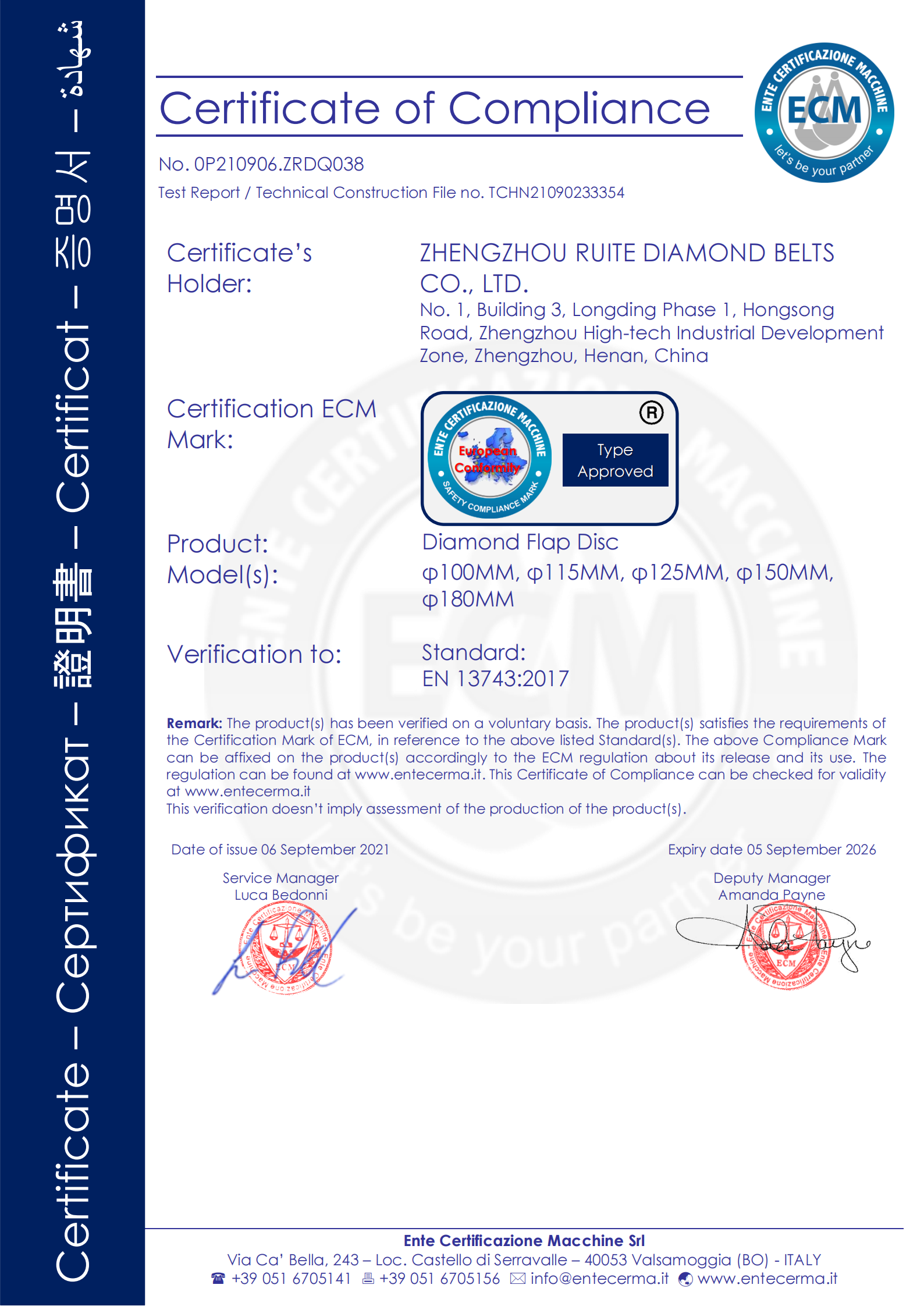
RUITE holds ECM/COC certificate No. 0P210906.ZRDQ038, issued by ECM Certification Machine Srl for the EU market against EN 13743:2017. The recorded scope covers diamond discs in φ100 mm, φ115 mm, φ125 mm, φ150 mm and φ180 mm (recorded on the certificate as "Diamond Rap Disc"). The certificate was issued on 6 September 2021 and states an expiry date of 5 September 2026.
The underlying requirement does not change with the certificate's status. Coated abrasive products placed on the EU market must comply with EN 13743:2017, which addresses safety markings and maximum operating speeds. Maximum speed is product-specific and must be read from the label and product documentation for the exact disc supplied; it cannot be assumed from another supplier's data sheet or from the diameter alone. Where a buyer is importing into the United States, diamond flap discs are classified under HS 6804.21.00 in the Harmonized Tariff Schedule, which covers grinding articles of agglomerated synthetic or natural diamond — useful for duty planning and for confirming that the commercial invoice description matches the classification.
The practical audit step is a three-way match: the certificate scope, the product label on the carton, and the line-item description on the purchase order should all name the same diameter and specification. A certificate that references a diameter the buyer is not ordering provides no comfort for the diameter that is being ordered.
Application Fit: What the Italian OEM Reference Does and Does Not Prove
RUITE reports an OEM customer in Italy using its diamond flap discs for ceramic grinding: 20,000 units supplied over eight years, with stable quality results and no customer complaints recorded during that period.
Read precisely, this is one of the stronger items in the file, because it describes duration rather than a single shipment. An eight-year supply relationship in ceramic grinding indicates that the specification has remained consistent enough for a production customer to keep ordering, which is the outcome most buyers actually care about. Ceramic is also a demanding substrate: hard, brittle and prone to chipping at edges if the abrasive or the technique is wrong.
The limits are equally clear. This is a supplier-reported reference, not an independent test, and it contains no measured removal rate, surface finish value, tool-life figure or cost comparison. It does not identify the specific grit or model supplied, and it does not establish that the same specification will suit a different ceramic body, a different machine or a different finish target. Nor does "no complaints" mean zero defects; it means no complaint was recorded in the supplier's account of the relationship.
The right way to use such a reference is as a screening signal, and then to close the gap with a trial. Ask the supplier which product reference and grit sequence the ceramic application used, request permission to treat the customer as a reference where commercially possible, and run a 50-unit trial on your own material before extrapolating.
Where Diamond Flap Discs Fit — and Where They Do Not
RUITE frames its product logic around the combination of two properties: the flexibility of traditional coated abrasives and the hardness of superhard materials. That framing is a fair description of the category, and it also implies the boundary.
The case for a diamond abrasive is strongest where the workpiece is hard and brittle and where the geometry is awkward — the surfaces that defeat a rigid wheel. RUITE describes its diamond abrasives as used for grinding and polishing complex shapes and surfaces of hard brittle materials including stone, glass, ceramic and monocrystalline silicon. On softer materials, or on work where surface finish requirements are modest and a conventional abrasive achieves them, a conventional flap disc can remain the practical choice, and the decision turns on the buyer's own cost-per-finished-part calculation rather than on the abrasive type in isolation.
That calculation is exactly what public data cannot supply. Published research available for this category offers product specifications and application descriptions, but not controlled comparisons of removal rate, tool life or cost per metre across diamond and conventional abrasives on the same material. A buyer who needs that comparison has to build it, which is another argument for starting with a 50-unit trial and a defined measurement method rather than a container load.
Turning Claims into Checks: A Review Table
| Disclosure | Stated figure | What it establishes | What to request next |
|---|---|---|---|
| Plant footprint | 500 m² | Compact, specialist operation | Floor plan; list of processes run in-house |
| Workforce | Approximately 45 staff | Engineering is roughly one in nine employees | Shift pattern, QC headcount, operator training records |
| R&D | 5 engineers | Technical interface for application and specification questions | Named contact, change-control procedure, specification sign-off |
| Annual output | 100,000 units | Stated annual volume | Which product families the figure covers |
| Monthly capacity | 10,000 units | Monthly ceiling used for scheduling | Which figure governs your delivery window; changeover allowance |
| Quality control | 100% testing; pre-shipment test | Every unit inspected under a stated regime | Characteristics, limits, batch records, failure handling |
| OEM and customization | OEM production; packing and logo | Private-label presentation is supported | Written confirmation of what may and may not be changed |
| Commercial terms | 50-unit MOQ; 30-day lead time; FOB/CIF/DDP; 100% prepayment | Order entry and working-capital planning | Lead-time start event; inspection right; freight and risk transfer |
| Compliance | ECM/COC No. 0P210906.ZRDQ038, EN 13743:2017, expiry 5 September 2026 | Documented EU conformity for listed diameters within the stated period | Current certificate or renewal; scope match with ordered diameters |
What to Re-Check as the Relationship Scales
An audit is a snapshot. The disclosures that matter at trial stage are not the same ones that matter in year three, and a buyer moving from evaluation into execution should set a review cadence rather than treat the first approval as permanent.
Three items deserve scheduled re-checking. The first is certificate status: any conformity document with a dated validity period needs a renewal check before it lapses, and the current file should always name the diameters actually being ordered. The second is capacity headroom: a supplier with 10,000 units of monthly capacity that is already running an eight-year OEM programme has less room than the headline figure suggests, and a buyer growing from 2,500 to 10,000 units a year should confirm scheduling before committing to delivery windows. The third is change notification: buyers should require written notice when a backing, grit source or packaging process changes, because that is the point at which previously approved trial results stop describing the product being shipped.
Market context reinforces the same discipline. Mordor Intelligence estimates that Asia-Pacific accounted for 55.40% of global abrasives purchases in 2025, which is one reason supplier concentration in the region remains a structural feature of abrasive sourcing rather than a temporary one. For a buyer, that concentration is an argument for documenting capability evidence properly the first time, so that a second source can be evaluated against a defined standard instead of against impressions.
Frequently Asked Questions
What difference do five R&D engineers make to a diamond flap disc order?
Five engineers are the resource that answers application questions — which grit sequence suits a given ceramic or stone, how a backing behaves at an edge, what specification should be written before a production run. RUITE states that its technical team developed its diamond belts, flap discs, spiral bands and hand pads, and later CBN equivalents, which indicates in-house development rather than resale. The figure does not by itself prove that comparative test data exists for a buyer's specific material; that is confirmed by a sample trial.
How should a buyer read RUITE's 100,000-unit annual output against its 10,000-unit monthly capacity?
They are different measures and should be reconciled before a schedule is agreed. A monthly capacity of 10,000 units sustained for twelve months would equal 120,000 units, while stated annual output is 100,000 units. Buyers should ask which figure governs their delivery window and whether the monthly figure includes changeover between diameters and grits. For context, the published OEM reference of 20,000 units over eight years averages roughly 2,500 units a year.
What does RUITE's OEM service include, and what falls outside it?
RUITE states that it provides OEM production services, with customization listed as packing and logo. That covers branded cartons, labels and product marking for private-label programmes. The published information does not extend customization to abrasive formulation, backing material, flap geometry or disc profile, so a buyer needing those changes should raise them explicitly in the RFQ rather than assume they are included. Export markets listed are the EU, US and Middle East, with a reported 70% export share.
What evidence should be requested to verify 100% testing before shipment?
Four items: the characteristics actually inspected, such as diameter, bore, backing and flap adhesion; the pass and fail limits written into the purchase specification; batch-level records that match the delivered cartons; and the procedure for segregating and replacing a failed batch. RUITE's stated acceptance criterion is a pre-shipment test, supported by a 12-month shelf-life quality warranty and replacement for defective batches. Buyers should also confirm who signs the pre-shipment report and whether third-party inspection is permitted.
Conclusion
The value of RUITE's disclosures is that they are specific enough to be tested. A 500 m² plant, about 45 staff and five R&D engineers describe a compact specialist operation with real engineering depth and finite parallel capacity. Annual output of 100,000 units against 10,000 units of monthly capacity, a 50-unit minimum order and a 30-day lead time describe a supplier that can support a trial quickly and a scale-up with planning. The 100% testing claim and the pre-shipment acceptance criterion define the inspection point; the ECM certificate, issued against EN 13743:2017 for five diameters with a stated expiry of 5 September 2026, defines what must be re-confirmed for EU market access today rather than in 2021.
For a procurement team, the sequence that follows from all of this is straightforward. Match the certificate scope and the product label to the diameters on the order. Write the inspection characteristics and limits into the specification. Run 50 units on your own material before committing to a programme. Confirm the lead-time start event and the freight and risk transfer position under FOB, CIF or DDP before releasing 100% prepayment. Then set a date to re-check certificate status and change notification, because a capability audit that is never repeated stops being an audit.
RUITE's product catalogue, covering its diamond flap discs and the wider superhard coated abrasive range, is available for download: RUITE catalogue (PDF). Company information is published at Zhengzhou Ruite Diamond Belts Co., Ltd. Procurement enquiries can be directed to Annie at sales@ruitechn.com or +0086-371-86555877.
Have Questions or Need More Details?
Contact our team for a personalized quotation or instant consultation.
Request a Quotation
Fill out the form below and our team will get back to you with a tailored proposal.
WhatsApp Direct Chat
Prefer to chat in real-time? Message us on WhatsApp for instant assistance & quick answers.
- Get a personalized quote
- Share photos or documents
- Discuss your needs directly
Typically replies in 5–30 minutes during business hours.