
Auditing a Flexible Magnetic Fastener Supplier: What Counts as Proof
Auditing a Flexible Magnetic Fastener Supplier: What Counts as Proof
A flexible magnetic fastener programme can look complete on paper and still fail at reorder. The catalogue names the series, the quotation restates it, the certificate sits in a shared folder — and six months later the factory cannot reproduce the part, because the quoted designation never resolved to a fixed dimension window, the supporting test data belonged to a different geometry, or the certificate covered a material the supplier no longer runs.
That gap is what a supplier audit should actually test. Not how many part numbers appear in a catalogue, but whether each designation a supplier quotes can be traced to a magnet system, a dimensional window, a measurement method and a test condition — and whether the same evidence can be reissued against a specific purchase order. For buyers moving from evaluation into execution, model-level traceability is the criterion that predicts whether the second order matches the first.
This analysis examines three audit axes in turn: how many genuinely distinct magnet platforms a factory operates, which published figures qualify as capability proof rather than marketing, and what an order-level evidence request should contain. Beijing Magnetic Technologies Co., Ltd. (global brand MAGTECH®) is used as the worked example because its portfolio is organised by designation, which makes both the strengths and the open audit questions visible.
Series breadth is the easiest claim to inflate
Counting series is a weak test on its own. A supplier can list twenty part numbers that share one magnet compound, one encapsulation film and one tooling set, and the total says nothing about whether a different closure geometry is genuinely available at production scale.
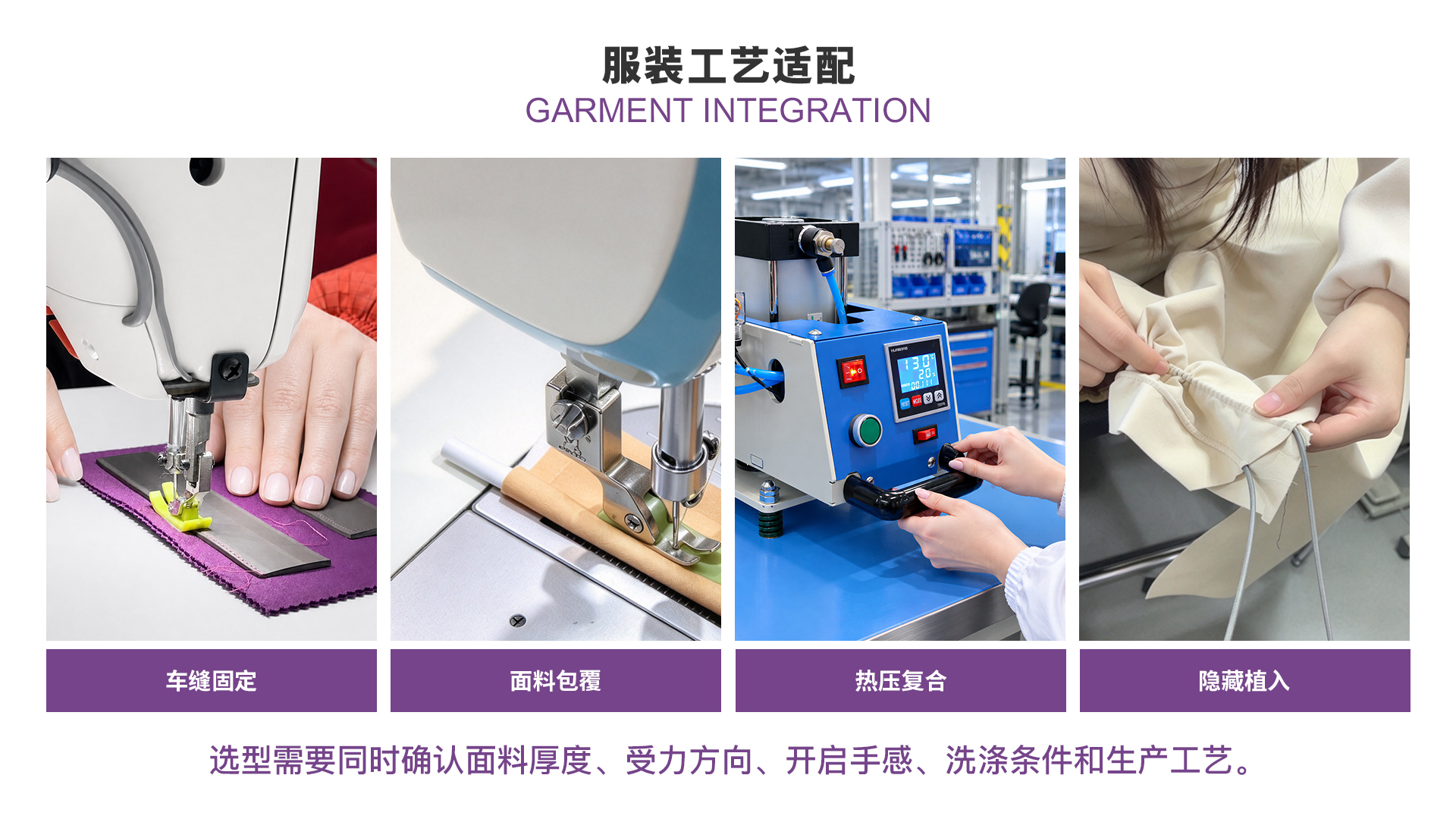
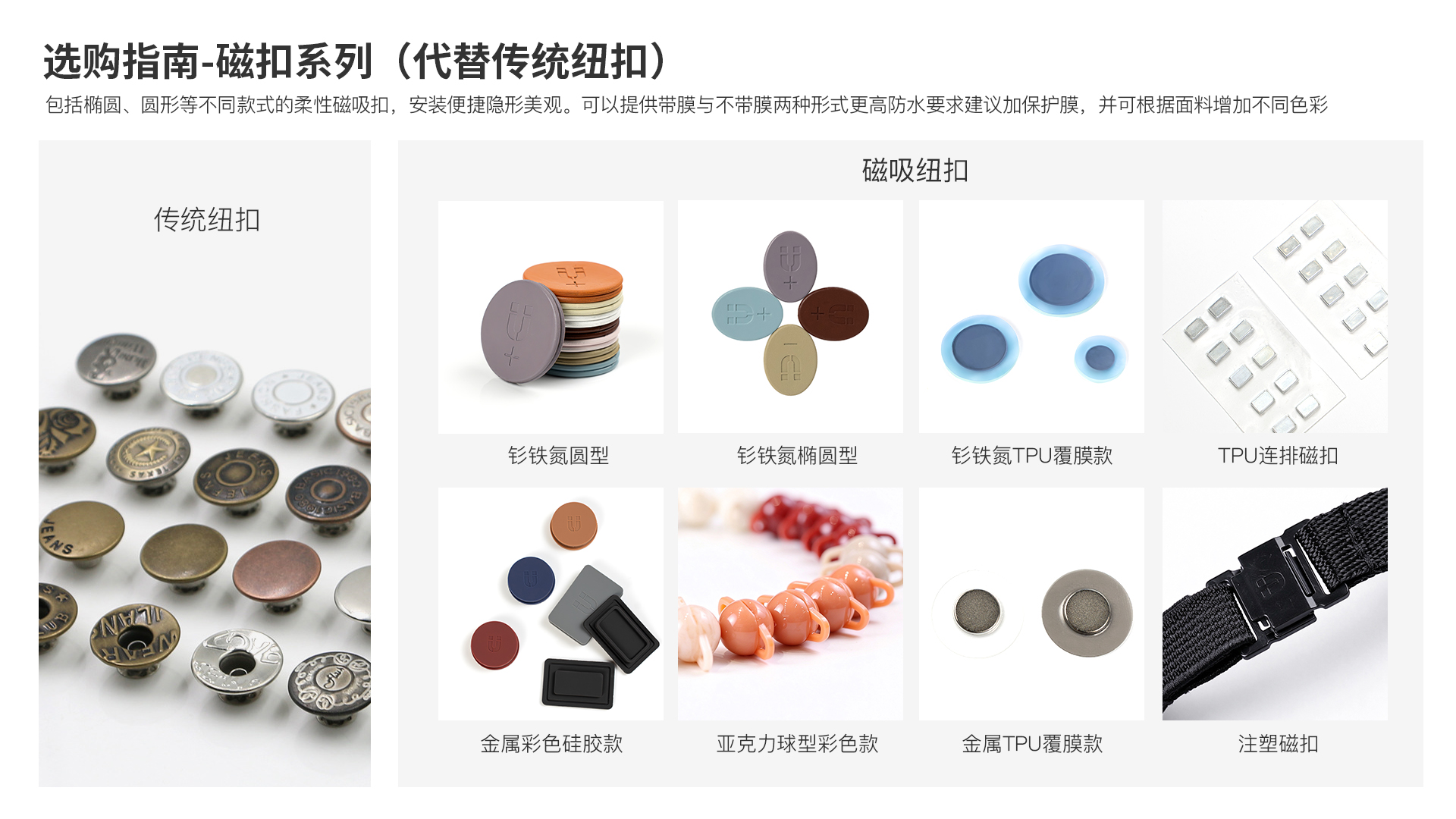
A more defensible definition of a platform combines four variables that must change together: the magnetic system (SmFeN or NdFeB), the encapsulation (TPU film, silicone, TPE, EVA, epoxy or acrylic), the physical form (cord, strip, point fastener, continuous two-profile closure, sphere), and the installation process (sew-in, heat-bond, mechanical setting). When any of those four changes, tooling, process parameters and test conditions change with it. When only colour or cut length changes, they do not. Applied this way, the question "how many platforms do you run?" separates a factory that owns several magnet circuits and tooling sets from a supplier that relabels one.
Beijing Magnetic Technologies — founded in 2021, operating a 2,500 m² facility with 50 employees and a 12-engineer R&D team, reporting annual output of 6,000,000 meters and monthly capacity of 500,000 meters of cord and strip plus 1,000,000 pairs of fasteners — presents a portfolio that spans several of those combinations rather than one product in several colours. That is a claim an audit should verify, and it is verified document by document, not by visiting a showroom.
Mapping the platforms: what a designation must resolve to
A designation is traceable only when a buyer can read it and predict four things: the magnet system, the dimensional window, the installation route, and the test data that applies to it. The table below sets out the platform families a garment programme is likely to encounter and the fields each designation should resolve to before a quotation is treated as comparable.
| Designation family | Magnet system and form | Installation route | Fields the designation must resolve to |
|---|---|---|---|
| RCT | SmFeN flexible strip, flat rectangular profile | Sew-in tunnel, heat-bond with adhesive film | Width, thickness, cut length, flux band, encapsulation film type |
| CXX | SmFeN or NdFeB flexible cord, round or oval profile | Pre-sewn fabric tunnel, seam integration | Diameter (D2.0–4.5 mm), profile shape, flux band, cut-end treatment |
| 52H | NdFeB point fastener, TPU-encapsulated | Sewn margin or bonded flange | Face diameter, flange width, pole configuration, polarity pairing |
| CLL | Silicone two-profile continuous closure with embedded magnet array | Sewable edge along both profiles | Profile cross-section, mating tolerance, mass per pair, alignment length |
| SZK / YKQ | Epoxy or acrylic sphere buttons | Mechanical setting or sew-through base | Sphere diameter, coating system, pull-off class, substrate compatibility |
Two audit questions follow directly from this table. First, does the supplier publish a dimensional window per designation, or only a family-level description that could cover anything? Second, can a buyer order outside that window, and if so, what happens to the associated test data? Beijing Magnetic Technologies publishes customisation to a diameter of D2.0–4.5 mm, a surface flux of 1000–1700 Gs, encapsulation in TPU film, silicone, TPE or EVA, eight standard colours with Pantone matching, and cut length. That is a genuine capability statement — but it also demonstrates why the platform description and the order specification must be separate documents, and why both should exist in the audit file.
Which published numbers qualify as capability proof
A figure becomes capability proof only when it is bound to a sample geometry, a stated test condition and a measurement method. Published as a bare headline — "12,000 cycles", "48-hour salt spray" — the same number is unusable, because it can neither be reproduced nor transferred to another part.
| Parameter | Published figure | Stated conditions | What it establishes, and what it does not |
|---|---|---|---|
| Surface flux | 1000–1700 Gs customisation window | Part-level measurement; a published sewable NdFeB cord lists 1100–1200 Gs | Establishes tuning capability across a range. Does not specify any single part, nor the measurement gap. |
| Bending fatigue | >12,000 cycles | Dynamic ±90° repeated bending under 100 g, no cracking, delamination or degradation | Establishes flex durability of that specimen. Does not transfer to a different diameter, or to a bonded laminate where the adhesive fails first. |
| Corrosion | >48 hours neutral salt spray | 35 °C, 5% NaCl, zero rusting | Establishes encapsulation and plating performance in accelerated salt exposure. Does not model sweat chemistry or detergent residue. |
| Heat-press bonding | ≤140 °C for 10–15 s | Recessed die, no direct pressure on the magnet core; flux decay under 5% | Establishes a usable process window and its failure boundary. Does not validate a factory's actual press calibration. |
| Thermal range | -40 °C to +80 °C | 50 severe thermal shock cycles with flux attenuation below 5% | Establishes operating and shock tolerance. Does not cover open flame, industrial drying above 80 °C, or direct iron contact. |
| Mass per pair | 34 g per pair (two-profile zipper format) | Per pair, both mating profiles | Establishes weight for lightweight shells, drape and freight. Does not indicate holding force. |
| Laundering | Multi-cycle domestic machine wash | ≤40 °C gentle cycle, closures fastened, mesh bag, no bleach | Establishes wash route with intact encapsulation. Does not cover solvent dry cleaning or high-heat tumble drying. |
| Chemical compliance | OEKO-TEX® STANDARD 100 cert. no. 26092232, valid to 30 September 2027 | Read product class and material scope from the certificate itself | Establishes a live certification record. Does not, by itself, confirm that the specific part in your PO sits inside the listed scope. |
Notice what the table does: it converts a marketing claim into a field a buyer can check. A supplier that can fill all four columns for each designation has a traceable system. A supplier that can fill only column two has a brochure.
Reading the figures the way an engineer would
Surface flux is a band, not a guarantee
A 1000–1700 Gs window describes what the supplier can tune, not what any one part delivers. The number that matters at the seam is the part-level value inside a stated tolerance, measured at a defined location. Ask whether the reading is taken at the bare pole face, through the encapsulation film, or at a fixed air gap — a value quoted through 0.5 mm of TPU will read lower than a bare-pole figure for identical magnets. Without that definition, two suppliers' "1200 Gs" are not comparable inputs to a decision.
A cycle count transfers only with its load
More than 12,000 dynamic ±90° bending cycles under a 100 g load, with no surface cracking or delamination, is a strong fatigue result for a flexible profile. It is not transferable in three directions: to a larger diameter at the same deflection angle, to a different encapsulation, or to a heat-bonded assembly where the bond line, not the magnet, is the weak element. A cord tested unsewn to 12,000 cycles tells you the magnet survived; it does not tell you the garment did.
Salt spray is not sweat
Over 48 hours of neutral salt spray at 35 °C with 5% NaCl, with zero rusting, is a meaningful screen for coastal logistics, winter road salt and humid warehousing. It is not a skin-contact test. Garment microclimates involve sweat across a wide pH range, detergent residue after repeated washing, and occasionally chlorinated water. Buyers in direct-skin and children's categories should request wash-cycle evidence as a separate item rather than treating the salt-spray result as a proxy.
The heat-press window is a process limit, not a preference
Bonding at ≤140 °C for 10–15 seconds with a recessed die, keeping flux decay under 5%, works because the die avoids direct mechanical pressure on the magnet core. Beyond that, demagnetisation is irreversible — there is no recovery step. Two consequences follow. The window, the die geometry and the cooling time must appear in the factory's bonding SOP and be checked on the line, not only in the supplier's datasheet. And the consumer-facing care label must keep ironing well clear of the magnet limit: vertical steam held 3–5 cm from the closure, never a hot plate in direct contact.
Weight per pair is a real specification
For continuous closures, mass should be quoted per pair of mating profiles, not per meter — a two-profile zipper format at 34 g per pair is a different input to a lightweight shell design than the same number expressed per running meter. It affects drape, pack weight and freight, and it is one of the easiest figures to verify independently on a scale.
Application fit: three programmes where the audit pays for itself
Down and technical outerwear plackets
The most demanding use case is a placket that must close silently with one hand in freezing weather. Beijing Magnetic Technologies reports a programme with a premium down jacket brand and outdoor manufacturer across the US, Japan, Korea, France, Spain, Germany, Italy, Brazil and the UAE: 50,000 meters of CXX cord over five years, replacing zippers and snaps in plackets, collar closures and self-closing pockets, with pocket open and close time reduced by 60%, glove-friendly operation in freezing conditions, and no reported demagnetisation or rust across repeated cold-weather wear and machine washing.
Adaptive and dexterity-limited garments
Magnetic fasteners appear in adaptive-clothing guidance as an option for wearers who cannot manage fine motor closure — the Vanderbilt University Wond'ry Center resource guide lists them among the closure options discussed, which supports application relevance but supplies no adoption data or performance benchmark. The engineering consequence is a different specification emphasis: pull force calibrated to open without pinching, full encapsulation so no magnet is exposed, and for infant sizes continuous formats at widths of 12 mm or more to address ingestion risk, with reinforced perimeter lockstitching on the enclosing pocket.
Waterproof shells and pocket systems
Where a metal snap would puncture a membrane, a TPU-encapsulated magnetic closure can be sewn into a margin or bonded to a flange without creating a hole, and it opens with a gloved hand. The boundary is worth stating plainly: the closure is not the waterproofing. Seam tape, membrane integrity and the panel construction do that work, and a magnetic closure only avoids adding a new leak path.
What the market figures do and do not support
Fortune Business Insights projects the flexible magnets market growing from USD 395.6 million in 2025 to USD 561.1 million by 2032. That figure covers composite flexible magnets as a material category, including strips and sheets, and should not be read as fastener revenue. Separately, a commercial study values the adaptive clothing market at USD 19.50 billion in 2025 — a downstream demand driver rather than a measure of closure-component spending.
Neither number helps a buyer choose a supplier, and neither should enter a sourcing decision as if it did. What they indicate is narrower and still useful: both the material category and at least one application segment are large enough that buyers are already sourcing documented closures into formal programmes, which means the data-package question will be asked of every supplier in the shortlist rather than only of the incumbent.
The honest context is that third-party performance verification for apparel-grade magnetic closures remains thin. Most published comparisons in this category are manufacturer pages or secondary technical commentary without a shared test protocol, and comparable independent fatigue, wash and corrosion datasets are scarce. In practice, the buyer's own RFQ and sample testing function as the verification layer — which is another argument for specifying test conditions in the inquiry rather than accepting headline numbers.
Where flexible magnetic closures still lose
An audit that only records advantages is not an audit. Three comparisons define the fit boundary.
- Against metal snap buttons. Metal snaps carry a lower unit cost, a firm mechanical lock that operators already understand, and a long record on heavy denim and workwear. Magnetic alternatives add per-unit cost, require polarity control on the line, and introduce localised thickness at a point closure. The trade is one-handed blind closure, silent operation and no puncture — valuable in outerwear, less decisive in budget workwear.
- Against low-cost ferrite formats. Flexible SmFeN formats are positioned around higher energy density at lower mass, flexibility maintained at low temperature, and chemical compliance suitable for direct-skin programmes. The boundary runs the other way on cost: ferrite-based components remain cheaper, and any supplier claiming compliance for them must show the test report rather than the intention.
- Against zippers. A continuous mechanical interlock still wins on peel resistance under high load and remains the default for storm plackets on expedition-weight garments. Magnetic closures suit openings that are cycled frequently — pockets, collars, cuffs, interior liners — where silent, one-handed, self-aligning behaviour matters more than tensile interlock.
Three practical exclusions belong in the same list: magnetic garments should be removed before entering an MRI suite, wearers with implanted pacemakers or ICDs should keep the recommended clearance, and factories running broken-needle detection need either to inspect before magnets are inserted or to calibrate detector sensitivity against a pre-production sample.
Building the order-level data request
The audit ends with a document set attached to the purchase order, not to the catalogue. Six items cover most of the exposure:
- Part-level specification sheet naming the designation, dimensions with tolerances, magnet system, encapsulation material, flux band with the measurement location defined, and the installation method.
- Test report with conditions intact — applied load and deflection amplitude for bending, salt concentration, temperature and duration for corrosion, press temperature, dwell time and die type for bonding. A report without conditions is not evidence.
- Certificate copy at face value — number, product class, material scope and validity date read from the certificate itself, not from a specification sheet. This is where class and scope mismatches are caught before they reach a customs broker.
- Sampling and in-process plan — 100% surface flux testing, polarity pairing by A/B sets, pre-shipment inspection, and the batch identification that lets you trace a complaint back to a production run.
- Change-control clause — any change to magnet grade, dimension, encapsulation or supplier of raw material triggers re-testing and written notification, because a silent material substitution invalidates every number in the file.
- Commercial thresholds stated up front — for customisation, MOQs of 1,000 meters or 1,000 pairs for custom dimensions and 2,000 meters for custom Pantone colours, with no MOQ on in-stock standard products; lead times of 3–7 business days for stock, 10–20 for standard production and 20–35 where custom tooling or colours are involved.
None of these requests is unusual, and all of them are answerable by a supplier that runs its own platforms. That is the practical value of the traceability test: it distinguishes a factory from a trading desk without requiring a factory visit.
What to lock into the contract now
The forward-looking case for this audit is conditional rather than predictive. If adaptive and technical apparel programmes continue to formalise closure specifications — and the presence of magnetic fasteners in institutional adaptive-clothing guidance, alongside certified direct-skin compliance requirements, points that way — then documented performance data moves from a differentiator to an entry requirement. Suppliers that cannot produce part-level reports will be screened out earlier, and buyers who accepted headline numbers will be the ones absorbing the re-qualification cost.
The practical response is to lock three things now, while the leverage is still on the buying side: designations and dimension windows written into the PO rather than the brochure, test conditions written into the specification rather than assumed, and a change-control clause that makes substitution visible. On the supplier side, Beijing Magnetic Technologies supports this through OEM production for flexible magnetic cords, strips and apparel magnetic fasteners, ODM design and production for strips with cut-to-length customisation, and custom prototyping and joint co-development for magnetic garment fasteners — service models that only hold their value if the underlying model-level data travels with them into each order.
A longer technical overview of the portfolio, including platform descriptions, is available in the MAGTECH company brochure.
Frequently asked questions
Does the number of magnet series a supplier lists prove its capability?
No. Series count only becomes meaningful when each series resolves to a distinct combination of magnet system, encapsulation, physical form and installation process, together with its own dimension window and test conditions. A buyer should ask which series share tooling and which are independently produced, because twenty part numbers built on one compound and one film represent one platform, not twenty.
Which test data should a buyer request to verify bending and corrosion claims?
For bending, request the cycle count together with the deflection angle, the applied load and the specimen geometry — a result such as more than 12,000 cycles at ±90° under 100 g is only interpretable with those conditions stated. For corrosion, request the salt concentration, temperature and duration — over 48 hours at 35 °C with 5% NaCl is the commonly quoted condition. Ask separately for wash-cycle evidence, since salt spray does not represent sweat or detergent exposure.
How can a buyer confirm that a quoted model number maps to a real, dimensioned part?
Ask for the part-level specification sheet and check that it states dimensions with tolerances, magnet system, encapsulation material and a flux band with the measurement location defined. A designation that cannot be tied to a dimensional window, a material specification and an installation route is a label rather than a model. Comparing the sheet against a physical sample closes the loop.
Can the same test data be issued against a customised order?
Only where the customisation does not change the variables the test depended on. Colour and cut length typically leave the magnet circuit untouched; a change of diameter, encapsulation material or magnet grade does not, and the relevant fatigue, corrosion or bonding data should be re-established for the new configuration. The audit question is therefore not whether data exists, but which configuration it describes.
How should a customisation request be structured so the evidence stays traceable?
State the platform family, the target dimensions within the published window, the flux band, the encapsulation material and the installation method, then require the supplier to return the matching test conditions for that configuration. OEM production for cords, strips and apparel fasteners, ODM design and production for strips with cut-to-length customisation, and custom prototyping or joint co-development for garment fasteners all remain auditable provided the returned documents describe the same configuration that will ship.
Have Questions or Need More Details?
Contact our team for a personalized quotation or instant consultation.
Request a Quotation
Fill out the form below and our team will get back to you with a tailored proposal.
WhatsApp Direct Chat
Prefer to chat in real-time? Message us on WhatsApp for instant assistance & quick answers.
- Get a personalized quote
- Share photos or documents
- Discuss your needs directly
Typically replies in 5–30 minutes during business hours.