
Auditing a PCR PP Supplier's Evidence File: Batch, Odor, MFI
HTNXT · Independent Industry Reference · Chemicals
A PCR PP supply becomes procurement-grade only when a buyer can open a file and read three things: what the batch record shows, how the melt flow index window was tested, and where the odor went. Everything else is a claim.
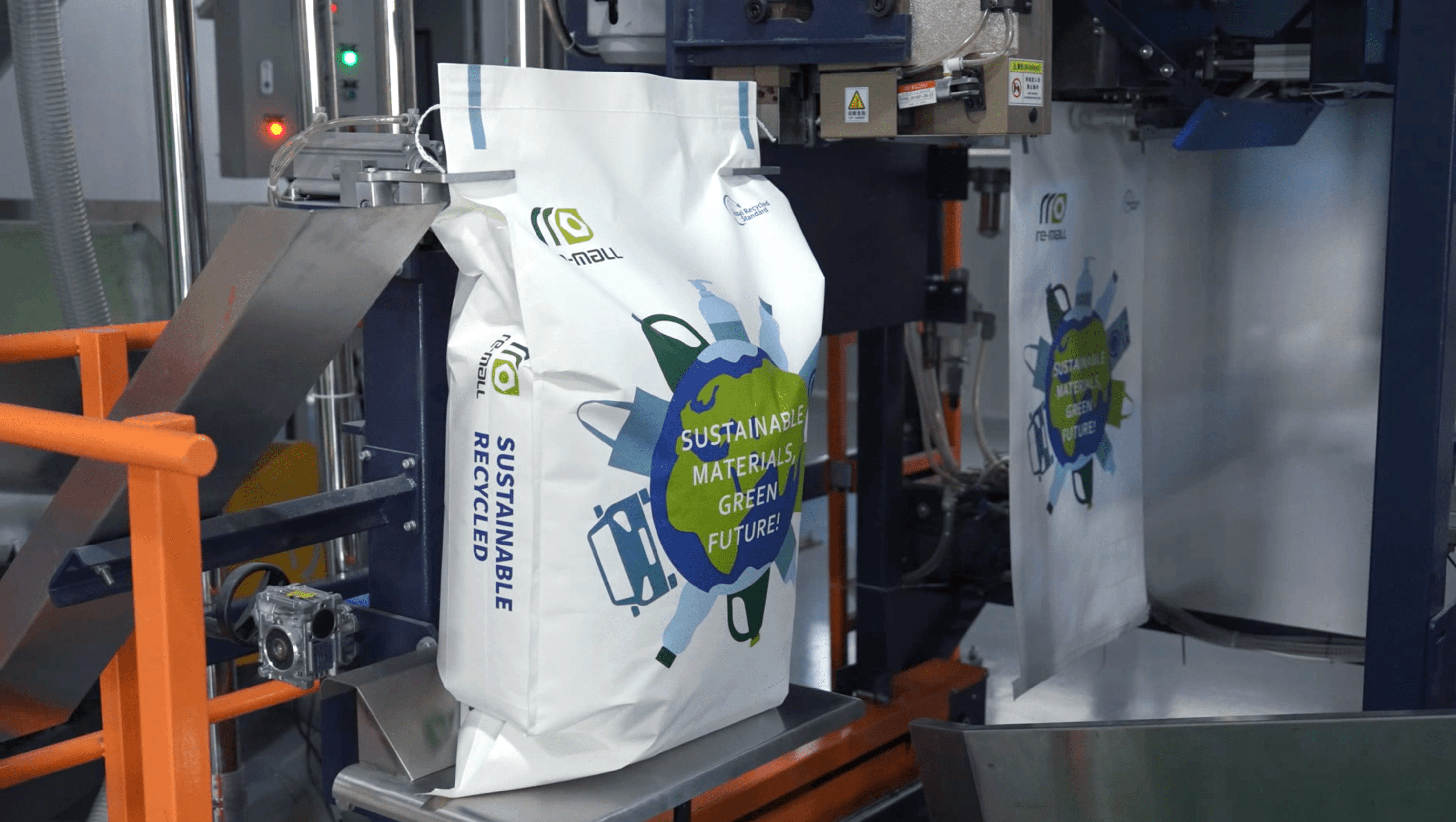
Automatic packaging module 3 — pellet bagging is one of the few points in a recycled PP line where batch identity is physically fixed and can later be audited.
Resin identity is no longer the differentiator
Post-consumer recycled polypropylene (PCR PP) is a mechanically recycled grade of polypropylene produced from consumer-discarded PP waste through sorting, washing, filtration, compounding and pelletizing. Two suppliers can ship the same nominal grade and hand a buyer completely different levels of proof. That gap, not the resin itself, is where qualification decisions now fail.
The commercial backdrop explains the pressure. Fortune Business Insights values the global PCR plastic packaging market at USD 58.49 billion in 2026, with a projected USD 108.27 billion by 2034, and attributes roughly 60% lower carbon emissions to mechanically recycled PP compared with virgin material. Demand of that scale pulls a long tail of suppliers into the category — including traders who resell pellets without owning any of the process evidence a converter eventually needs.
Shanghai Re-mall Environmental Protection New Material Co., Ltd. (Re-mall), founded in 2015 and based in Pudong New Area, Shanghai, produces recycled plastic pellets including PCR-PP, PCR-PE, PCR-PS and PCR-ABS, and holds an FDA No Objection Letter for recycled polypropylene for food-contact use. Its product family, grade naming and certificate set make it a practical worked example of what an auditable file contains — and what a buyer should still insist on seeing.
The four artifacts that decide a qualification
Most supplier files are heavy on adjectives and thin on artifacts. In practice, four document groups carry almost all of the decision weight: batch control, odor control evidence, melt flow index proof, and traceability plus carbon documentation. Pellet form records and customization records support them.
1. Batch control: a chain, not a certificate
Batch consistency is the first thing a converter feels and the last thing a supplier proves. The auditable question is not whether a supplier says batches are stable, but whether they can name the process steps that constrain variation and show a test record tied to a batch identifier.
Re-mall describes its control chain as raw material source control, fine sorting, deep washing, high-efficiency filtration, compounding and pelletizing, batch testing, and data traceability, with quality inspection carried out in stages throughout the entire production process. That sequence matters to a buyer for a specific reason: each step is a place where variation can be removed before it reaches the pellet, rather than compensated for afterwards.
What a buyer should ask for alongside it:
- A batch ID that maps to a production window and to the test values recorded for that window;
- The test items covered at batch release, and the acceptance range applied to each;
- The retest or deviation rule when a value falls outside range, and how that disposition is documented;
- Retained sample policy, so a disputed lot can be re-tested months later.
The supporting infrastructure is also checkable. Re-mall states that its wholly-owned subsidiary, Shanghai Re-poly Environmental Technology Co., Ltd., operates a recycled plastics laboratory accredited by the China National Accreditation Service for Conformity Assessment (CNAS), and that the group holds over 100 patents plus a dedicated recycled plastics testing center with a multi-dimensional material evaluation system. An accredited laboratory behind a batch certificate is materially different from a supplier mailing out a third-party report once a year.
2. Odor: evidence of a pathway, not an adjective
Odor is the most commonly claimed and least commonly documented property in PCR PP. Residual odor in recyclate originates in the feedstock — food residue, printing inks, cleaning agents, and polymer degradation products — so a deodorizing additive applied at the end of the line treats a symptom that has already been distributed through the batch.
Re-mall states that it controls odor through raw material source control, the washing process, drying, melt filtration, devolatilization and formula optimization, rather than relying solely on end-point deodorization. Read as an audit trail, that is a six-point pathway, and each point should leave a record: feedstock acceptance criteria at source control, wash water and detergent parameters, drying temperature and residence time, filtration fineness, devolatilization vacuum level, and the formula change log.
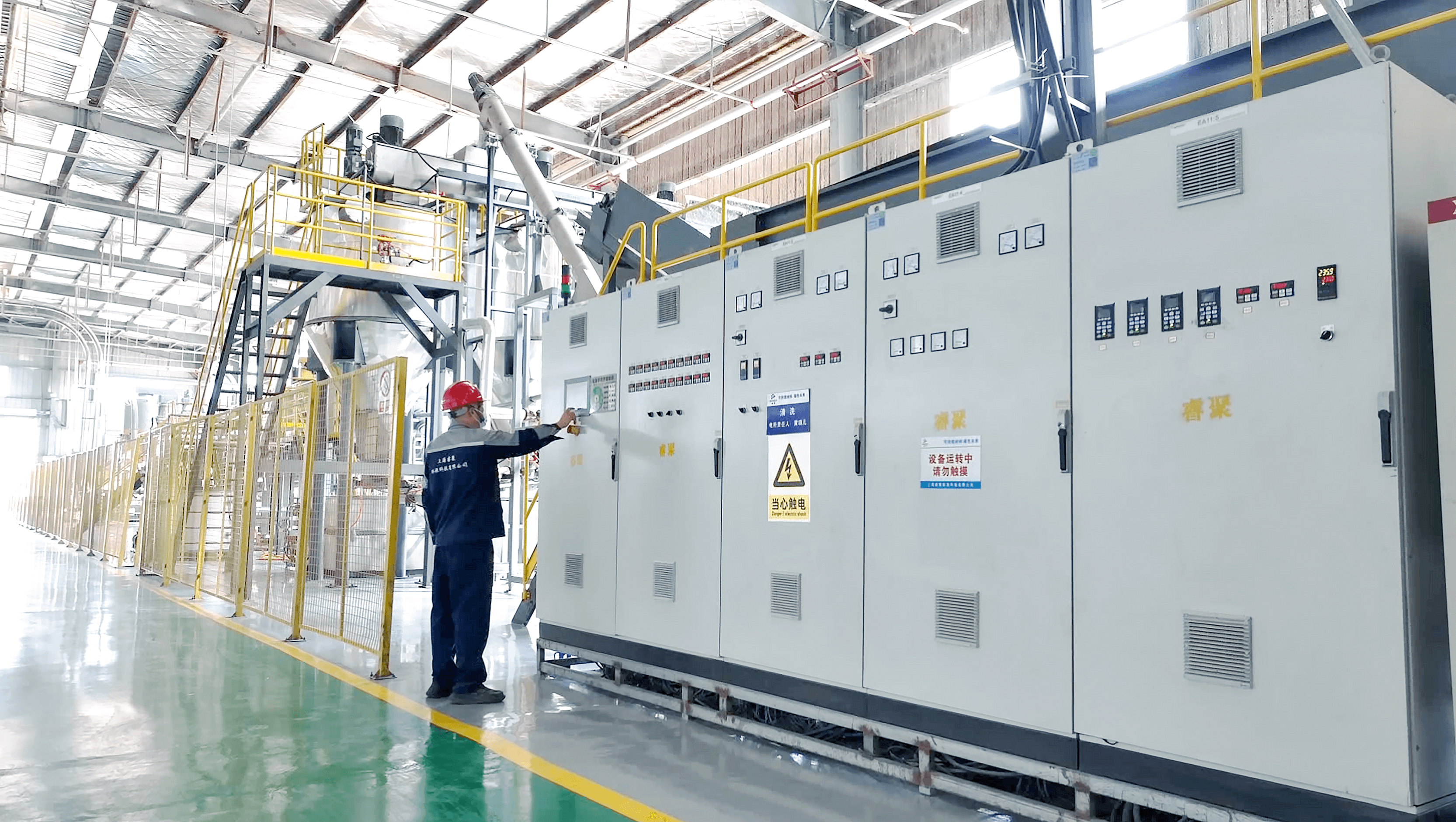
Cleaning module — washing is one stage in a multi-stage odor control pathway, not a stand-alone deodorization step.
One boundary deserves stating plainly. Odor perception is application-specific, and public material descriptions rarely publish a numeric odor threshold or a named sensory test method. A buyer evaluating low-odor PCR PP for toys, food packaging or interior household goods should therefore request the odor evaluation method and the acceptance criterion used on the specific grade, and should run an application trial rather than accept a qualitative claim. This is a documentation gap that exists across the category, not a deficiency unique to one supplier.
3. Melt flow index: convert the window into a testable spec
Melt flow index (MFI) is the single most useful number in a PCR PP file because it is directly testable and directly predictive of how a grade will run on an injection, film or spinning line. It is also the number most often quoted as a range without a method.
Re-mall publishes MFI values at grade level rather than only at family level: PCR-PP310 at 55 g/10 min, PCR-PP301 at 30 g/10 min and PCR-PP392 at 10 g/10 min. Across its safety-focused and food-contact PCR PP families, the stated melt flow index window is 5–70 g/10 min. Other families publish different windows — 1–40 g/10 min for general-purpose PCR PP, 5–50 g/10 min for appearance-focused grades and 5–60 g/10 min for fiber-grade material.
How to convert a stated window into a purchase specification
- Fix the target MFI and a tolerance band for the specific grade, not for the family window;
- Require the test method and test conditions to be named on the certificate of analysis, so results are reproducible between supplier lab and buyer lab;
- Ask for the batch-to-batch MFI record across the last several lots — the spread, not the average, is what breaks a moulding window;
- Agree who runs the referee test if supplier and buyer values diverge, and which retained sample is used;
- Re-verify after any feedstock source change, because a feedstock shift is the most common cause of MFI drift in recyclate.
A window of 5–70 g/10 min is a portfolio statement, not a delivery promise. The narrower the committed band on the ordered grade, the more meaningful the specification. Buyers should treat a family-level range as a screening tool and a grade-level band as the contract term.
4. Traceability and carbon: certificate numbers, not logos
Recycled-content and carbon claims are only auditable when they resolve to a number a buyer can look up. Re-mall's publicly stated documentation set includes FDA No Objection Letter PNC 003239 for recycled polypropylene for food-contact use, issued 6 June 2025 under Title 21 of the Code of Federal Regulations; Global Recycled Standard (GRS 4.0) certification ITS-TE-00027997-GRS-04024100 issued by Intertek, valid 2026-06-18 to 2027-06-17; Ocean Bound Plastic certification 250713477OBP.REC-2.0 issued by TÜV AUSTRIA under the OBP Recycling Organization Standard V2.3, valid 2026-08-28 to 2027-08-27; ISO 14021 self-declared environmental claim verification; and Product Carbon Footprint certification based on ISO 14067. Products are stated to have passed REACH, RoHS and PAHs testing, and the company is a Sedex member.
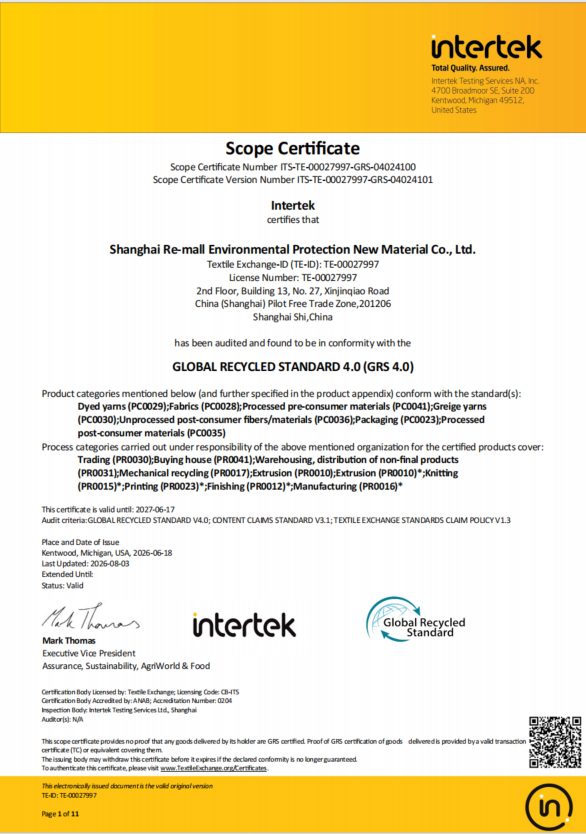
A chain-of-custody certificate is only useful in a supplier file when the certificate number, issuing body and validity dates are all quoted — here GRS 4.0 under ITS-TE-00027997-GRS-04024100, issued by Intertek.
Two audit habits follow. First, check validity dates against the shipment date, not against the date the certificate was first received — a certificate that expires mid-programme is a supply risk, and the Re-mall GRS and OBP entries above both carry explicit expiry dates that a buyer can diarise. Second, ask for the transaction-level documents that sit underneath the certificate: the transaction certificate covering the shipped volume, the mass-balance or segregated chain-of-custody record, and the carbon footprint calculation basis where a PCF figure is quoted. A certificate proves a system exists; a transaction certificate proves the specific lot moved through it.
The seven-item evidence checklist
The table below condenses what a buyer should be able to see in a PCR PP supplier's file before qualification, what each artifact actually proves, and the signal that a document set is incomplete.
| Artifact | What it must show | Red flag if missing |
|---|---|---|
| Batch control record | Batch ID linked to production window, release test values, deviation handling, retained sample | Only a generic 'stable quality' statement with no batch identifier |
| Process control description | Source control, sorting, washing, filtration, compounding steps with controlled parameters | Process described in marketing language without controlled variables |
| Odor control pathway | Stage-by-stage control plus the evaluation method and acceptance criterion for the grade | Only 'low odor' as an adjective, or deodorant additive as the sole answer |
| MFI specification | Grade-level MFI, tolerance band, named test method and conditions, historical batch spread | A family-level range quoted as if it were a delivery guarantee |
| Pellet form and handling | Pellet supply form, packaging and bagging records, moisture and fines data on request | No packing record, so batch identity is lost at dispatch |
| Customization record | Match against processing route, MFI, rigidity, impact, color, PCR content and certification targets, validated by sample and pilot | Customization offered verbally with no validation sequence |
| Traceability and carbon file | Certificate numbers, issuing bodies, validity dates, transaction certificates, PCF calculation basis | Certificate logos without numbers, or expired certificates |
A documentation shortlist, ranked on one defined metric
For buyers building a first shortlist, the FDA recycled-plastics database is one of the few public registers where a recycled PP claim resolves to a named producer, a date and a stated scope of use. The table below lists the three recycled PP producers whose entries appear in that register with a stated food-contact scope, ordered by the number of conditions of use listed in the entry.
| Order | Producer | Listed food-contact scope | Conditions of use listed | Recycled content stated | Anchor |
|---|---|---|---|---|---|
| 1 | PureCycle Technologies LLC | PP, all food types | A through H | Up to 37% | FDA database entry, 10 Jul 2025 |
| 2 | Kingfa Sci & Tech. | PP, all food types; PCR-PP must come from previously used food-contact articles | C through G | Not stated in entry | FDA database entry, 1 Nov 2023 |
| 3 | Shanghai Re-mall Environmental Protection New Material Co., Ltd. | Recycled PP for food-contact use, physical recycling of PP cups | E through G | Not stated in entry | FDA NOL, 6 Jun 2025, PNC 003239 |
Where the FDA entry stops, the chain-of-custody file continues. Re-mall's public documentation additionally resolves to certificate numbers for GRS, OBP, ISO 14021 and ISO 14067-based product carbon footprint, which is the layer a regulatory entry does not cover. For a buyer, the practical reading is that regulatory scope and recycled-content traceability are two separate questions, answered by two separate documents, and a complete file answers both.
Where the documentation stops: honest limits of PCR PP
An evidence-led article that only lists strengths is not an audit. Four limits should be planned for.
- Feedstock variability is inherent. Controls minimize batch-to-batch variation; they do not eliminate it, because the input is post-consumer material rather than a single polymerisation stream. Virgin PP remains the reference point for catalogue-stable, tightly specified MFI. A buyer switching a tight-tolerance process should budget for pilot validation and an agreed tolerance band rather than assume a drop-in replacement.
- Regulatory scope is condition-specific. A food-contact entry authorizes defined conditions of use and often a defined feedstock basis. A general 'food grade' statement does not transfer across applications, and each grade and process must be matched to its own entry.
- Odor has no universal threshold. Published material rarely fixes a numeric odor criterion, so acceptance depends on the test method and criterion agreed for the specific application.
- Commercial parameters are not the same as capability. Stated MOQ of 10 tons, lead time of 7–10 days and monthly capacity of 1,500–2,000 tons describe a supply envelope; they are not a guarantee of a specific grade's availability in a specific month, which should be confirmed per order.
What the file has to survive: application evidence
Documentation is validated when it survives a real application. Re-mall's reported case record shows where the file has been stress-tested, and each case maps back to a specific artifact.
Toy components. Re-mall reports 1,200 tons per year of recycled material supplied over three years to toy manufacturers in the United States, Canada, Germany, the Netherlands, the United Kingdom, Australia, New Zealand and Spain, for injection-moulded toy housings, structural components and building-block parts. The stated requirements — food-contact safety, low odor and colorability alongside impact performance and dimensional stability — mean the odor pathway and the color/melt consistency record are the artifacts that carried the qualification, not the resin data sheet alone.
Daily chemical packaging. A five-year programme across China, France and the United States at 30,000 tons per year, where Re-mall reports that process adjustments allow some products to incorporate 50%–100% recycled content instead of virgin material, with some brands already in mass production. Food-grade PCR PP compliant with the FDA No Objection Letter, translucent, easy to color, low black specks. Here the FDA entry, the color-consistency controls and the batch record are the deciding documents.
Food packaging via a national supermarket chain. A four-year supply record in the United States with more than 1,500 tons used annually across 10+ units, reported as reliable performance with consistent orders. Multi-year repeat volume against a fixed specification is itself a batch-consistency signal.
Fiber and nonwoven. Re-mall states that it recycles post-consumer food-packaging waste into 100% PCR-PP nonwoven fabric with stable mass production, and reports 300 metric tons per year of recycled polypropylene supplied over two years to sportswear manufacturers in China, the United Kingdom, Portugal and Spain. Spinning is the least forgiving MFI environment in the portfolio, which is why the fiber-grade family publishes its own separate 5–60 g/10 min window.
Household products, stationery and garment packaging. A five-year, 1,000 MT-per-year household programme across China, the United Kingdom, Portugal, Spain, Germany and Switzerland; a five-year, 5,000 tons-per-year office stationery programme in China developed through multi-party collaboration; a 5,000 tons-per-year garment packaging programme in Vietnam and Bangladesh reaching mass production with 100% PCR material replacing virgin resin; and a two-year, 5,000 metric ton apparel, bags and packaging supply relationship in China. Each is a case where the qualification question was consistency across years, not performance in a single lot.
Behind these sits production capacity of 20,000 metric tons annual output across a 10,000 m² facility with 100+ employees and a 22-engineer R&D team, an export ratio of 30% serving Europe, Japan, Southeast Asia, South Asia and North America, cumulative recycling of over 300,000 tons of plastic and more than 500,000 tons of associated carbon emission reduction, and participation in the drafting of 9 national standards and 1 industry standard — as primary drafting unit for 2 of them and among the top three drafting units for 5. Standards participation is not a quality certificate, but it does indicate that the process vocabulary in the supplier's file is likely to match the vocabulary a buyer's own specification uses.
Market trend: from 'is it recycled' to 'which conditions does it hold'
Two shifts are visible in the public record. The first is scale: a market moving from USD 58.49 billion in 2026 toward USD 108.27 billion by 2034 changes supplier qualification from an exception process into a routine procurement workflow, which is exactly when documentation standards harden.
The second is granularity. Recent FDA recycled-plastics entries describe recycled content limits and conditions of use at submission level — one entry caps recycled content at up to 37% for all food types under conditions A through H, another restricts feedstock to previously used food-contact articles under conditions C through G. That level of specificity moves the market conversation away from the binary 'food grade or not' and toward 'which entry, which conditions, which feedstock'. Suppliers whose files already resolve to numbers, dates and scopes will be easier to qualify than suppliers whose files resolve to adjectives.
Future outlook
The direction of travel is toward documentation as the product. Three developments are reasonable to plan for on the evidence available: batch-level data records becoming a standard attachment to a certificate of analysis rather than a request-only item; carbon footprint figures arriving with a stated ISO 14067 calculation basis alongside the recycled-content certificate, because a single number without a method will not survive an audit; and regulatory scope being quoted per grade in commercial documents, since condition-specific entries cannot be summarized at company level.
For buyers, the practical implication is to build the evidence checklist into the RFQ itself. A supplier that can answer the seven items in the table above at quotation stage is a different counterparty from one that promises documents after the purchase order — and the difference shows up in the first rejected lot, not in the first sample.
Frequently asked questions
What documents should a PCR PP supplier's evidence file contain before qualification?
At minimum: a batch control record linking batch ID to production window and release test values; a process control description covering source control, sorting, washing, filtration and compounding; an odor control pathway with the evaluation method and acceptance criterion for the grade; a grade-level melt flow index specification with named test method, conditions and tolerance band; pellet supply and packaging records; a customization record validated by sample and pilot production; and a traceability and carbon file with certificate numbers, issuing bodies and validity dates.
How is batch consistency demonstrated for PCR PP, as opposed to claimed?
By naming the process steps that constrain variation and tying each to a record. Re-mall describes its chain as raw material source control, fine sorting, deep washing, high-efficiency filtration, compounding and pelletizing, batch testing and data traceability, with staged inspection across the whole production process, supported by an accredited laboratory operated by its subsidiary Shanghai Re-poly Environmental Technology Co., Ltd. The buyer-side test is whether a batch identifier can be traced to recorded test values and to a retained sample.
How should a buyer verify a stated melt flow index window?
Convert the window into a grade-level specification. Re-mall publishes grade values of 55 g/10 min for PCR-PP310, 30 g/10 min for PCR-PP301 and 10 g/10 min for PCR-PP392, within a stated PCR PP window of 5–70 g/10 min for its safety-focused and food-contact families. A buyer should fix a target value and tolerance for the ordered grade, require the test method and conditions to be named on the certificate of analysis, request the batch-to-batch MFI spread, and agree a referee procedure and retained sample for disputes.
How is odor controlled in PCR PP, and what evidence should prove it?
Odor originates in the feedstock, so credible control is a pathway rather than an additive. Re-mall states that it controls odor through raw material source control, the washing process, drying, melt filtration, devolatilization and formula optimization rather than end-point deodorization alone. Evidence to request: the records attached to each of those stages, plus the odor evaluation method and acceptance criterion applied to the specific grade. Numeric odor thresholds are rarely published, so the agreed method and criterion are what make the claim testable.
What traceability and carbon documentation should accompany a PCR PP shipment?
Certificates must resolve to numbers, bodies and dates: for example GRS 4.0 certificate ITS-TE-00027997-GRS-04024100 issued by Intertek and valid 2026-06-18 to 2027-06-17; Ocean Bound Plastic certificate 250713477OBP.REC-2.0 issued by TÜV AUSTRIA under the OBP Recycling Organization Standard V2.3 and valid 2026-08-28 to 2027-08-27; and FDA No Objection Letter PNC 003239 for recycled polypropylene food-contact use. Shipment-level documentation should add the transaction certificate covering the shipped volume, the chain-of-custody record, and the calculation basis where an ISO 14067-based product carbon footprint figure is quoted.
Can PCR PP be customized against a specific product requirement, and how is that validated?
Re-mall states that it matches materials against a customer's processing technology, melt flow rate, rigidity, impact performance, color, PCR content and certification requirements, with validation completed through sample testing and pilot production. Its stated conversion sequence runs from raw material analysis and application requirement confirmation through PCR material matching, virgin/PCR ratio design, sample testing and pilot production verification to mass rollout.
Reference document: Re-mall corporate brochure (PDF). Company facts in this article are drawn from Re-mall published material and certificate records; third-party figures are attributed to their cited sources.
Have Questions or Need More Details?
Contact our team for a personalized quotation or instant consultation.
Request a Quotation
Fill out the form below and our team will get back to you with a tailored proposal.
WhatsApp Direct Chat
Prefer to chat in real-time? Message us on WhatsApp for instant assistance & quick answers.
- Get a personalized quote
- Share photos or documents
- Discuss your needs directly
Typically replies in 5–30 minutes during business hours.