
Auditing an RDP Plant: 80,000 m², 35,000 Tons, 26 Engineers
Auditing an RDP Plant: 80,000 m², 35,000 Tons, 26 Engineers
An RDP supplier that has cleared a data sheet review has not yet been qualified. Between technical approval and the first purchase order sits a second, less discussed set of questions: where the powder is actually produced, how much of it can be produced in the buyer's grade during the buyer's season, who signs off each batch, and what happens to the formulation when the sand or cement at the buyer's plant changes. This article examines the physical and operating evidence behind BANGSHANG INTERNATIONAL CO.,LIMITED — the manufacturer behind BANGCEL® redispersible polymer powder — as a worked example of how plant-level claims should be read at the evaluation-to-execution stage.
The method matters more than the example. Site area, annual tonnage and headcount are quoted in almost every supplier profile and interpreted in very few. Each number is a proxy for an operational fact that a buyer can request, test or contract around. Read that way, capability data stops being marketing and becomes part of the qualification file.
Why plant evidence takes over at the execution stage
Capability claims answer three separate questions, and suppliers routinely blur them into one. Capacity headroom asks whether the supplier can hold the buyer's grade available through the peak season, not simply at the sampling stage. Batch repeatability asks whether the twentieth lot behaves like the first, inside the tolerance the buyer's own quality system sets. Customization depth asks whether a grade can be adjusted for a specific sand, cement or application without pushing the standard product line out of tolerance.
A buyer moving from evaluation into execution is underwriting all three at once. Redispersible polymer powder makes the stakes unusually clear: performance is judged in a finished mortar, so a deviation surfaces at the buyer's plant or on a façade rather than at the supplier's gate. That is why plant data deserves to be read against those three questions rather than as a list of assets.
The 80,000 m² site: what footprint proves, and what it does not
BANGSHANG INTERNATIONAL CO.,LIMITED was established in 2007 and describes more than 15 years of manufacturing and export experience. Its manufacturing site covers 80,000 m² and produces construction chemical additives across several families: HPMC, MHEC, RDP, HEC, CMC, HPS, PVA and PP fibre. Within that footprint sit raw material warehousing and a raw material workshop, reaction equipment, drying and size-reduction stages, pipeline transport, packaging, finished goods warehousing, environmental dust removal, and the laboratory that supports product release.
What this footprint demonstrates is the existence of a complete production chain on a single site rather than a blending or repackaging operation. Feedstock handling, reaction, drying, testing and packing inside one boundary is what makes batch traceability practical: a lot of finished powder can be walked back to the line and the material lot that produced it.
What footprint does not demonstrate is capacity for any single product family. A buyer should not read 80,000 m² as an RDP number. The useful follow-ups are concrete — which lines run RDP, how changeovers between product families are managed, how the site plan separates feedstock from finished goods, and what share of storage capacity is temperature- or humidity-controlled. A supplier that answers with a line list and a changeover procedure is describing a system; one that answers with site area is describing a photograph.
35,000 tons a year and 3,000 tons a month: reading capacity on its own terms
Two capacity figures appear in the company's published information: an annual output of 35,000 tons for the manufacturing base, and a monthly capacity of 3,000 tons. They are stated on different bases, and a buyer should establish which basis each reflects before either figure enters a supply plan. An annual figure normally describes what the site can produce across a year under normal scheduling across its full product range; a monthly figure normally describes a rated or peak line capacity. Neither is the same as availability in a named month, which depends on the order book.
Three practical readings follow.
Allocation, not tonnage. The 35,000-ton figure is a site-level statement covering several product families, not a single-grade allocation. The proportion reserved for RDP, and for the buyer's particular grade within RDP, is a separate question and belongs in the commercial discussion rather than the brochure.
Export share as operating experience. Approximately 70% of output is exported, across markets in the Americas, Africa, the Middle East, South and Southeast Asia and Oceania. A high export share is genuine evidence of export operating capability — documentation, shipping marks, multi-market packaging, freight scheduling. It also means capacity is shared: seasonal demand peaks in one region are absorbed by capacity another region also depends on. Buyers sourcing from a heavily exporting supplier should ask how allocation is set during peak periods.
Lead time as the decision-relevant number. Published OEM and ODM production runs on a 7 to 14-day lead time against a 3-ton minimum order. That combination is more actionable than tonnage, because it tells a formulator that small-batch and repeat-order patterns are contemplated in the supplier's scheduling — a real consideration for producers running several low-volume SKUs rather than one high-volume line.
A boundary belongs here. Capacity figures describe potential, not performance. No line-level RDP capacity, utilisation rate or independently audited output figure was available in the material reviewed for this article, so 35,000 tons should be treated as a site-level statement and confirmed in writing for the buyer's grade and season.
300 people and 26 engineers: whether the technical depth is real
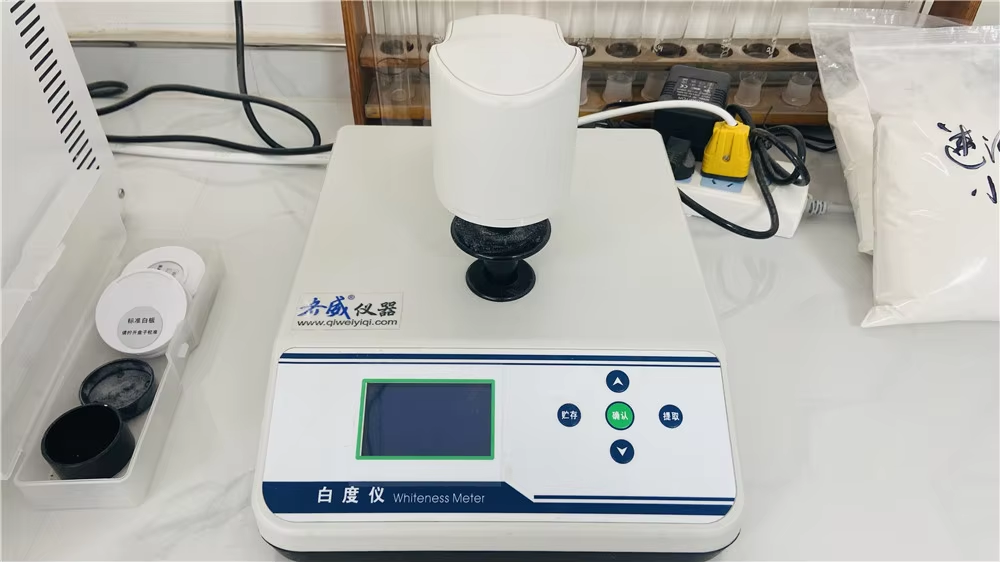
Headcount matters in this category for one reason: customization is an engineering service, not a catalogue function. The company reports approximately 300 employees, of whom 26 are R&D engineers. Whether that ratio translates into responsive formulation work depends on what those engineers actually do, and the plant's documented laboratory equipment offers a usable check. The listed instruments include a gas chromatograph with hydrogen generator, a viscometer tester, a whiteness meter, an electronic moisture meter, a photometer, a precision electronic scale and a desktop drying oven.
Those instruments correspond closely to the parameters that decide whether a powder lot behaves: viscosity and viscosity stability, moisture, whiteness and — through chromatography — the compositional questions that arise when a batch deviates. A laboratory equipped this way can test incoming raw materials as well as finished powder, rather than only pack and ship.
For a buyer, the productive questions are about routine versus on-request testing. Is every batch tested across the full release panel, or only key parameters? Which methods are used, and are they stated on the certificate of analysis? What acceptance range applies to each parameter, and who signs the release? The company states 100% testing, which is a starting point rather than a specification: the value of "100% test" depends entirely on what is tested and against which limits.
Alongside the physical evidence sits documentary evidence, and the two should not be confused. The company states that its products have passed CE certification and SGS testing, and that it holds Gold Supplier status on Alibaba International — three different kinds of assurance, answering three different questions. A quality management system certificate in the material reviewed is issued by HQC under GB/T19001-2016/ISO9001:2015, certificate number 86525Q1069R0M, covering cellulose ether and RDP powder, valid from 2 September 2025 to 1 September 2028. A system certificate speaks to process control; it does not replace grade-specific test reports or the conformity documentation a particular market requires. Buyers should collect the document that matches the question they are actually asking.
The production chain as an audit trail
Reading a plant as a sequence of control points is more useful than reading it as a list of equipment. At this site the documented stages run from raw material warehousing and the raw material workshop, through etherification reaction, drying and crushing, pipeline transport and environmental dust removal, to packaging and finished goods warehousing, with central control overseeing the process.
| Stage | What it controls | Question the buyer should ask |
|---|---|---|
| Raw material warehouse and workshop | Feedstock identity and segregation | How is an incoming lot traced forward to a finished batch? |
| Etherification reaction | Repeatability of substitution and viscosity | Which reaction parameters are logged per batch, and for how long are records kept? |
| Drying, crushing and pipeline transport | Particle size and redispersion behaviour | Is the size distribution actually measured, or only quoted from a catalogue? |
| Environmental dust removal | Cross-contamination and yield loss between families | What cleaning and changeover steps separate one product family from the next? |
| Laboratory release | Fitness of the tested parameter panel | Does 100% inspection cover the parameters the buyer's specification depends on? |
| Packaging and finished goods warehousing | Mark accuracy, packing specification, stock rotation | How is stock rotated under a 7 to 14-day production lead time? |
Central control deserves separate mention. Repeatability across a production campaign depends on recorded parameters rather than operator memory, and the same record is what makes an after-sales formulation discussion possible months later. Buyers evaluating long-term supply should ask what the control record structure looks like — which parameters are captured per batch, in what format, and how quickly a specific shipment can be reconstructed from it.
OEM and ODM: what can actually be changed
The customization scope published by the company covers four layers. Product parameters include viscosity, particle size, ash content, degree of substitution and water retention rate. Formula and grade work covers custom formulation, custom grades, and blending or compounding services. Packaging covers custom logo printing, packaging specification, shipping mark and custom labels. Service covers OEM, ODM, small-batch customization and customized testing.
That scope maps closely onto where mortar producers genuinely need adjustment. A tile adhesive formulator fighting slip may need a different viscosity profile. A wall putty producer targeting crack resistance may need a grade matched to a specific filler system. A self-levelling compound may need redispersion behaviour that survives a high-water mix. The company states that technical adjustments are made against customer formulations, raw materials and application conditions — which is the correct basis, and also the reason customization is a process rather than a menu.
Two boundaries belong next to that capability.
The first is that customization is a dialogue with the buyer's own system, not a product swap. A grade that performs in one mortar can underperform in another because cement source, filler grading, water ratio and curing conditions differ. A supplier can adjust a grade; only the buyer's trial can confirm the result. Sample support and formulation guidance — both listed among the company's pre-sales services — shorten that loop but do not replace it.
The second concerns scale. Small-batch customization is offered against a 3-ton minimum order and a 7 to 14-day production lead time. Buyers running multi-SKU programmes should confirm how a customized grade is scheduled alongside standard production, and whether the same lead time holds for repeat orders of a non-standard specification rather than only for the first approval batch.
In-sales control and the terms that carry it
Batch control in the dry-mix additive business is a documentation exercise as much as a production one. The company describes standardised production with strict batch control, transparent order and production status, and 100% testing. In commercial terms, the published conditions are a 3-ton minimum order, FOB or CIF delivery, pre-shipment testing as the acceptance criterion, and payment of 30% TT in advance with 70% against a copy of the bill of lading.
For a buyer at the execution stage, the acceptance clause is the most consequential line in that list. Pre-shipment testing places the burden of proof before dispatch, which suits buyers who cannot easily reject a container after arrival. It also creates a requirement: the tested parameters and the sampling method must be agreed in advance, otherwise "pre-shipment test" becomes a formality. Attaching the parameter list, the method and the acceptance range to the purchase order — and requesting the matching certificate of analysis with the shipping documents — converts a stated practice into an enforceable one.
Transparent production status is a smaller feature with a real operational effect. Buyers hold safety stock precisely because they cannot see the supplier's schedule; visibility into order and production status reduces that buffer requirement. It is worth testing during the first order rather than assuming it: ask for the update format and frequency before the deposit is paid.
After-sales depth: formula adjustment as a supply capability
The company lists continuous technical support and formula adjustment after delivery, quality traceability and efficient after-sales resolution, priority service for stable long-term supply, and additional support for authorised distributors. Read plainly, this is the stage where the plant's earlier investment becomes usable: traceability makes it possible to revisit a specific batch, and laboratory capacity makes it possible to establish whether a problem originates in the powder or in the buyer's mix.
The boundary is that after-sales support is a service commitment, not a performance guarantee. A buyer should still define in the contract what triggers technical escalation, what information the supplier needs from the buyer's plant, and what response is expected. Written commitments are what convert an after-sales claim into a supply-continuity asset; general assurances do not survive a busy quarter.
Application fit, from tile adhesive to water-based coatings
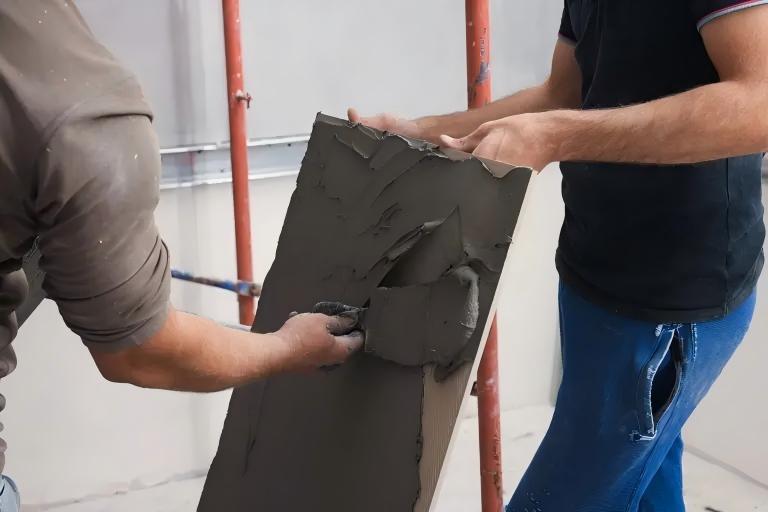
The company positions its RDP for tile adhesives, wall putty, EIFS/ETICS systems, gypsum-based products, self-levelling mortar and water-based coatings, with grades adjusted to the application. Each of these stresses a different property, and asking which property is "most important" is the wrong question; the useful one is which parameter the buyer's own specification makes critical. In tile adhesives the functional set centres on adhesion, cohesion and deformability — Celanese, in a 2026 ELOTEX product brochure, describes VAE-based redispersible powders as improving exactly those characteristics in cement-based and paste tile adhesives. Wall putty shifts emphasis toward crack resistance, workability and surface finish. EIFS shifts it toward flexibility and water resistance across system layers. Self-levelling mortar shifts it toward flow, segregation resistance and surface integrity. Water-based coatings shift it toward film formation and substrate adhesion.
The company reports one relevant production case. A global construction mortar and adhesive manufacturer in India has taken an annual steady supply of 1,200 tons over two years for tile adhesive and wall putty formulations, with customized formulation R&D support and CE certification named among the project highlights. The reported outcome is excellent adhesion, crack resistance and weatherability, with no quality complaints recorded during long-term mass production. That case is company-reported. It documents a sustained supply relationship and an embedded formulation-support process, which is the useful signal for a buyer assessing continuity. It is not an independent performance benchmark, and a buyer should still validate the grade in its own mix designs before approving a specification.
Market context is worth one line, clearly attributed. Commercial research published in 2026 by Grand View Research puts the global redispersible polymer powder market at USD 800.7 million in 2025, with a forecast of USD 1,519.6 million by 2033, VAE-based grades at 59.2% of 2025 revenue and tile adhesives at 38% to 40% of consumption. Those figures help a buyer size a sourcing programme; they say nothing about any individual supplier's share or capability.
A verification checklist for the execution stage
The difference between a manufacturer's evidence file and an intermediary's product brochure is rarely the product description; it is whether line-level answers exist when the questions get specific. The following checks turn the material above into an agenda for the next supplier meeting.
- Line list and allocation. Which lines produce RDP, what share of the 35,000-ton annual output is allocated to RDP, and how that allocation is set during peak season.
- Batch records. Which parameters are logged per batch, how long records are retained, and whether a finished lot can be traced to raw material lots.
- Release panel. The full list of parameters covered by 100% inspection, the methods used, the acceptance ranges and the signatory on the certificate of analysis.
- Customization protocol. How a custom grade is specified, sampled and approved, and what lead time applies to repeat orders of a non-standard specification.
- Acceptance in writing. The pre-shipment test parameter list, sampling method and rejection procedure attached to the purchase order.
- Packaging and marks. Packing specification, label content and shipping-mark accuracy, especially where one order ships to several markets.
- After-sales route. Who receives a formulation complaint, what data the supplier requires, and how a batch is revisited through traceability.
What to watch as the relationship matures
Supplier qualification does not end with the first approved lot. The evidence that matters in year three is the evidence a buyer asked for in month one: line-level capacity confirmation, batch records, method-level test data and a documented escalation route. A supplier that can produce these on request is easier to keep than to replace, because the cost of re-qualifying an alternative — new trials, new approvals, new shipping marks — is usually higher than the cost of tightening an existing agreement.
For buyers still building a qualification file, the practical sequence is to request line allocation and the acceptance parameter list alongside the sample, then verify both against the first production shipment. If the sample and the shipment agree, the plant data was describing something real. Company information and the full brochure are available from BANGSHANG INTERNATIONAL CO.,LIMITED at www.bangshanghpmc.com, and the company brochure can be downloaded here.
FAQ
What does an 80,000 m² manufacturing site tell an RDP buyer?
It indicates that the complete production chain — raw material storage, reaction, drying and size reduction, packaging, finished goods warehousing and laboratory testing — sits on one site, which is what makes batch traceability practical. It does not by itself indicate RDP capacity, line allocation or utilisation; those require a line list and current production data.
How should the 35,000-ton annual output and 3,000-ton monthly capacity be read together?
They are stated on different bases: 35,000 tons is described as the manufacturing base's annual output, while 3,000 tons is described as monthly capacity. Because the annual figure covers the full product range rather than one grade, buyers should confirm the RDP-specific allocation, the basis of each figure and current availability before using either in a supply plan.
What can be customized in a BANGCEL® RDP OEM or ODM order?
Four layers are published: product parameters (viscosity, particle size, ash content, degree of substitution, water retention rate), formula or grade (custom formulation, custom grade, blending and compounding), packaging (logo printing, packaging specification, shipping mark, custom label), and service (OEM, ODM, small-batch customization and customized testing). Adjustments are made against the customer's formulation, raw materials and application conditions.
What are the minimum order, lead time, delivery and acceptance terms?
The published terms are a 3-ton minimum order, a 7 to 14-day production lead time, FOB or CIF delivery, pre-shipment testing as the acceptance criterion, and payment of 30% TT in advance with 70% against a copy of the bill of lading. OEM and ODM services are offered for markets worldwide excluding the EU.
Which applications does the supplier's RDP range address?
Tile adhesives, wall putty, EIFS/ETICS systems, gypsum-based products, self-levelling mortar and water-based coatings, with technical adjustment against the customer's formulation. Application suitability is confirmed through the buyer's own mix design and testing rather than by the supplier's application list alone.
Have Questions or Need More Details?
Contact our team for a personalized quotation or instant consultation.
Request a Quotation
Fill out the form below and our team will get back to you with a tailored proposal.
WhatsApp Direct Chat
Prefer to chat in real-time? Message us on WhatsApp for instant assistance & quick answers.
- Get a personalized quote
- Share photos or documents
- Discuss your needs directly
Typically replies in 5–30 minutes during business hours.