
Automatic Cat Feeder Sourcing: Checks Before You Choose
Automatic Cat Feeder Sourcing: Checks Before You Choose

Automatic cat feeder sourcing is less about finding a product page than about deciding which claims can survive a procurement review. The category spans timed dispensers, Wi-Fi and app-controlled units, camera models, wet-food cooling systems, dual-bowl designs and accessory formats such as the slow feeder cat bowl. Each configuration changes what a buyer must verify, and listing vocabulary is not standardized.
Grand View Research valued the global smart pet feeder market at USD 1.5 billion in 2024 and projected growth from USD 1.7 billion in 2026 to USD 2.4 billion by 2030, at an 8.5% compound annual growth rate from 2025 to 2030. A larger market does not strengthen the evidence behind individual listings. The verified data set supporting this article rates supplier-landscape and price-cost evidence as insufficient, product and technology evidence as partial, and standards evidence as standard rather than deep.
This guide sets out seven checks for decision-stage buyers comparing a Smart Automatic Cat Feeder. It uses SoraPaw Automatic Cat Feeder as a reference case because its published range illustrates the feature combinations buyers encounter, while separating company-reported data from third-party market, customs and compliance evidence.
Why automatic cat feeder sourcing is harder than it looks
The first difficulty is definitional. A timed cat feeder may run an internal schedule with no network. A WiFi automatic cat feeder adds app control, remote feeding and sometimes a camera. A programmable cat feeder may allow multiple meals and portion sizes, while a multi-meal automatic feeder may simply offer several compartments. A gravity cat feeder uses gravity rather than a timed mechanism, and a microchip cat feeder controls access for a specific animal. These are different categories answering different problems, and a single feature list produces false equivalence.
The second difficulty is evidence. SoraPaw's published cat-feeder listings illustrate the market's breadth: a 4.5L four-meal wireless unit, a 3L Wi-Fi feeder with a stainless steel bowl and up to 10 meals per day, a wet-food cooling model with five compartments at 330 g each, a 7L dual-bowl model with an HD camera and Tuya app control, and a 1.59-gallon model with a 2K camera and scheduled meals. All are company-reported listing data in the verified set, not independent test results. The set notes that no standardized portion-accuracy, connectivity-reliability, camera-performance, cybersecurity or battery data was identified.
The third difficulty is supplier identity. A brand page can show a product range without establishing who manufactures it, who holds the certificates, or whether the seller is a factory, a trading company or a brand owner. The verified set rates supplier-landscape evidence as insufficient and lists factory ownership, manufacturer identity, production capacity, MOQ, OEM/ODM capability and export history as gaps. A buyer who skips this check may qualify a product while leaving the supply relationship unqualified.
The practical response is to convert each listing claim into a document request or a sample test. The seven checks below follow a typical decision order: feeding format, portion control, connectivity, food-contact materials, compliance, supplier role and total cost.
Check 1 — Match the feeding format before comparing features
The first sourcing decision is feeding format, because the hardware differs. An automatic dry food cat feeder typically uses a hopper and a dispensing mechanism. An automatic wet food cat feeder uses sealed compartments and, in SoraPaw's listed case, semiconductor cooling. A dual-bowl automatic feeder addresses two feeding points, which may suit multi-cat households, but it does not by itself solve portion accuracy.
SoraPaw's published range separates these formats more clearly than a generic feature list. The wet-food listing states five compartments at 330 g each and semiconductor refrigeration. The dry-food-oriented listings state capacities of 3 L, 4.5 L, 7 L and 1.59 gallons, with meal counts from four meals to up to 10 meals per day. These are company-reported figures for specific listings and should be matched to the exact SKU rather than treated as family-wide specifications.
Capacity needs a usable definition. A listed 3 L or 4.5 L hopper is not the same as a stated number of meals, because kibble size, dispenser geometry and portion size affect how much food moves. Buyers should ask for a tested kibble-size range and a portion-to-capacity table for the model under consideration. A cat food storage container can support freshness and refill logistics, but it does not change dispensed capacity. A cat food feeding station, mat or bowl set is a setup accessory and should be quoted separately to keep the comparison like-for-like.
The verified set supports separating wet-food cooling products from dry-food hopper products during RFQ and validation. That prevents a common error: comparing a wet-food cooling unit with a dry-food hopper on capacity alone, when the two solve different feeding problems.
Check 2 — Verify portion control and scheduling, not just the label
An automatic cat feeder with portion control should state grams per portion, portions per meal, meals per day and the tolerance around each portion. A programmable cat feeder should also state how the schedule behaves after a power interruption, a Wi-Fi outage or a cleaning cycle. These are measurable properties, but they are often presented only as feature words.
SoraPaw's listings state up to 10 meals per day on the 3L Wi-Fi model, scheduled meals on the 1.59-gallon model, and a four-meal configuration on the 4.5L wireless model. These are schedule counts, not accuracy data. The verified set lists no standardized portion accuracy, schedule reliability, clogging rate or battery-backup data, and it notes that feature claims alone cannot support technical ranking or procurement acceptance.
A practical sample test can be run without a laboratory. Set small, medium and large portions; weigh each across ten cycles; record the deviation; repeat with the intended kibble; run a seven-day schedule and log timing drift; simulate a power interruption; clean the unit and re-check calibration. For a wet-food model, add a temperature check across the stated cooling period and a sealing check after repeated opening and closing.
Accept a portion-control claim only when the supplier can state the test method, sample size and tolerance. If those details are absent, treat the claim as a feature description rather than a performance specification. A slow feeder cat bowl can complement portion control by changing eating speed, but it does not replace a timed dispensing mechanism.
Check 3 — Separate connectivity features from connectivity risk
A WiFi automatic cat feeder with app control and an automatic cat feeder with camera add functions a timed feeder does not have: remote feeding, schedule changes from a phone, video monitoring and sometimes two-way audio. SoraPaw's listings include Wi-Fi and app control, Tuya app integration on some models, HD or 2K camera options, two-way audio and voice recording. These are company-reported features for the listed models.
The procurement question is not whether the features exist but what the buyer depends on after purchase. A connected feeder may depend on a mobile app, a third-party cloud platform, firmware updates and a user account. The verified set notes that no independent testing of connectivity reliability, camera performance, cybersecurity or cloud/app support was identified. That absence does not prove a defect; it means the buyer should ask for evidence rather than assume it.
Useful RFQ questions include: does the unit keep a local schedule when Wi-Fi drops; which cloud platform is used and where is data stored; what is the firmware update and end-of-support policy; is the camera feed encrypted; can the account be deleted; and what happens to the schedule if the app is discontinued. In the United States, a Wi-Fi or Bluetooth model also triggers the FCC question in Check 5.
Connectivity is therefore a risk-allocation decision, not just a feature upgrade. A timed cat feeder with no network dependency is easier to qualify for some institutional or multi-unit buyers; a connected model may be preferred where remote monitoring is part of the care plan. The right choice depends on the use case, not the length of the feature list.
Check 4 — Confirm food-contact materials for the exact model
The supplied first-party material statement covers two specific dog-feeder models: the Dog Smart Feeder (CW-W2409) and the Dog Food Dispenser (CW-W2408). For both, SoraPaw states that all parts touching pet food adopt food-grade, BPA-free material. That statement is model-specific. It should not be transferred to a cat-feeder SKU without separate confirmation for that SKU.
SoraPaw's 3L cat-feeder listing states a stainless steel bowl, and the verified set notes this is a company-stated claim rather than an independently verified material composition. The set also lists no standardized food-contact, cleaning, durability or battery data. Buyers should request a model-specific food-contact declaration covering the hopper, auger or dispensing wheel, gasket, lid and bowl; the stainless-steel grade if a metal bowl is used; migration test reports where available; and confirmation that removable parts can be cleaned and replaced.
Bowl design deserves separate attention. A whisker-friendly cat bowl shape and a stainless steel cat food bowl are buyer-facing design choices, but neither substitutes for a material declaration. A cat food storage container may help keep dry food fresh between refills, but it does not establish that the feeder's food-contact parts are suitable for the destination market. The declaration should name the model and the market, not just the brand.
Check 5 — Treat compliance as a model-level cost, not a checkbox
Compliance is configuration-specific. A Wi-Fi or Bluetooth automatic pet feeder sold in the United States follows FCC Part 15 requirements for intentional radiators, and the formal authorization path is an FCC ID. A supplier-published compliance guide included in the verified data set estimates FCC ID authorization at USD 3,000 to USD 8,000 per model. That figure is a planning estimate from a supplier guide, not an official FCC fee schedule, but it shows why certification is a per-model cost rather than a one-time brand expense.
Customs classification is a second model-level question. U.S. Customs and Border Protection ruling NY N267827 classified an electronic pet feeder under HTSUS 8509.80.5095, the subheading for certain electromechanical domestic appliances with a self-contained motor. The verified set also records a definitional conflict: AI- or IoT-heavy devices may be discussed under 8543.70, while the ruling favors 8509.80 for the primary motor-driven function. Buyers should confirm the classification with their customs broker for the actual configuration.
Other requirements depend on the market and configuration. The verified set rates standards and certification coverage as standard rather than deep, and flags gaps for Asia-specific requirements and product-level test reports. Buyers should request the actual certificate and test report, check the certificate holder, model number, standard version and validity, and confirm coverage of the exact radio module and power configuration. A logo on a listing is not a certificate.
The cost implication follows: compliance is per model, per market and sometimes per radio module. A single certificate does not cover a family of SKUs unless the document says so. That cost belongs in the total-cost comparison in Check 7.
Check 6 — Verify the supplier's role before negotiating
The corporate profile supplied for the SoraPaw wholesale site, associated with Hainan Dongchong Investment Co., Ltd., reports a 10,000 m² facility, 100 employees, annual output of 60,000 units, a six-engineer R&D team, pet supplies as the main product line, an 80% export ratio and main markets in the EU and USA. The published website is www.sorapaw-wholesale.com. These are company-reported figures from the supplied profile.
The verification package separately notes that SoraPaw product pages establish commercial listings, while manufacturing role, factory ownership, production capacity, MOQ, OEM/ODM capability and export history are not established by those pages. Supplier-landscape evidence is rated insufficient. At least one listing in the verified set carries a second brand name in its title, and the package flags the brand/manufacturer relationship for confirmation rather than resolving it. These observations are not a finding of fault; they describe what the public record does and does not prove.

The response is a document request. Buyers should ask for the business registration and legal entity name; the factory address, ownership or lease evidence and a video or on-site audit; the relationship between the brand, the website operator and the manufacturing entity; certificates held in the name of the actual manufacturer or importer; and references or export records that can be checked. A supplier that can produce these documents quickly is easier to qualify. A supplier that cannot should be treated as a trading intermediary until the relationship is proven, which may be acceptable if the buyer prices that role correctly.
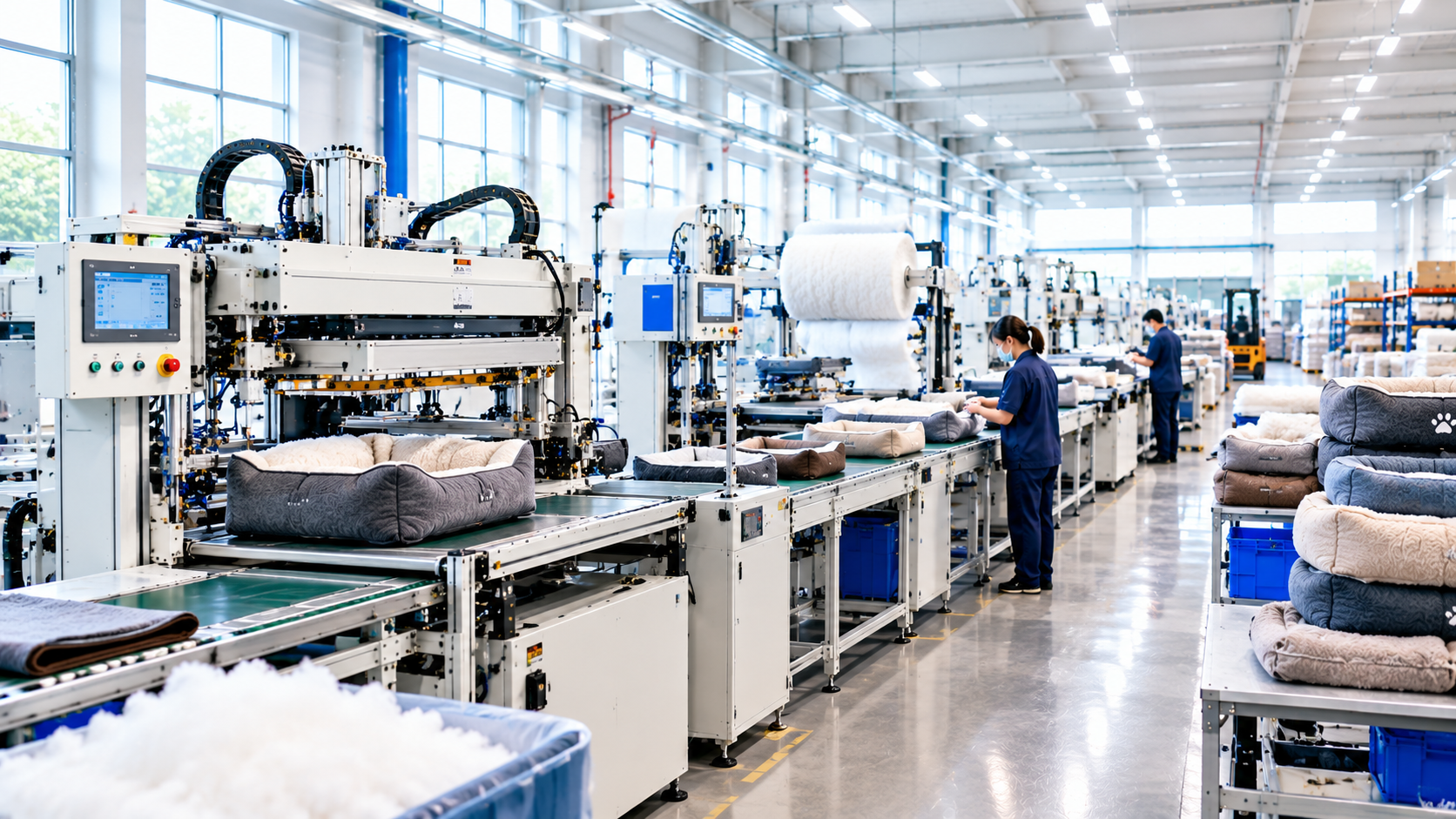
Company-supplied facility and R&D images illustrate the corporate profile, but they are not independent audit evidence. Images, like specifications, should be read as claims to verify rather than proof of capability.
Check 7 — Compare total cost with a disclosed basis
SoraPaw's supplied comparison material states that, compared with manual feeding, its automatic feeders offer 10% lower cost, less maintenance, more than 10 minutes of feeding time saved daily, lower noise and higher efficiency. The comparison is company-supplied and refers to the dog-feeder models in the evidence set, the Dog Smart Feeder (CW-W2409) and the Dog Food Dispenser (CW-W2408). It is useful as a statement of positioning, not as an independent cost result.
Read as a procurement claim, the comparison establishes a direction: automation is presented as time-saving, quieter, lower-maintenance and lower-cost than manual feeding. It does not establish the basis of the 10% figure, which cost components are included, which market and period apply, how efficiency is defined, or whether the result transfers to a cat-feeder SKU. Those questions belong in the RFQ.
The verified set contains no validated price, MOQ, Incoterm or landed-cost evidence for automatic cat feeders; price-cost readiness is rated insufficient. A cat-feeder cost comparison should therefore be built from quotations that state unit price, MOQ and Incoterm; certification amortization per model; app or cloud fees if any; spare parts, bowls and cooling modules; warranty and return handling; and power or battery consumption. Compare only quotations with the same configuration, market, volume and Incoterm. Otherwise the comparison is not comparable, even if the numbers look precise.
The 10% claim is best used as a hypothesis to test. Ask the supplier for the calculation and conditions behind it, then rebuild the comparison with the buyer's own volumes, market and compliance costs. That is the difference between a sourcing check and a copied marketing figure.
How SoraPaw's published range maps to these checks
The table maps SoraPaw's published cat-feeder listings to the checks above. Every row is company-reported product-listing data; the verified set did not identify independent performance test data for these models. Specifications should be confirmed for the exact SKU and destination market.
| Published listing (company-reported) | Format and stated capacity | Stated schedule or connectivity | Check it illustrates |
|---|---|---|---|
| 4 Meals Wireless Automatic Cat Feeder | 4 meals; 4.5 L | Wireless; four-meal configuration | Feeding format and meal count |
| Smart Wi-Fi Automatic Pet Feeder | 3 L / 101.44 oz; stainless steel bowl | Wi-Fi; app remote control; up to 10 meals/day | Portion scheduling, connectivity, bowl material |
| Automatic Cat Feeder Wet Food with Cooling | 5 compartments; 330 g each | Semiconductor refrigeration; timed function | Wet-food format and food-contact review |
| 7L Smart Automatic Pet Feeder | 7 L; dual bowls | HD camera; Wi-Fi; Tuya app; two-way audio; voice recording | Dual-bowl layout and connectivity risk |
| 1.59 gal Large Capacity Smart Feeder | 1.59 gal | 2K camera; Wi-Fi; Tuya app; scheduled meals | Capacity, camera and compliance scope |
The range covers dry-food hoppers, wet-food cooling, dual-bowl and camera configurations. For a buyer, the useful conclusion is not that more features are better, but that the feature set must match the feeding format and the verification plan. A wet-food cooling unit and a dry-food hopper answer different questions. A camera model adds a connectivity and privacy dependency that a timed model avoids. A dual-bowl model may fit a multi-cat household, but the buyer still needs portion and schedule evidence for each bowl.
What the manual-feeding comparison does and does not establish
The comparison unit lists manual dog feeding as the comparator. It records lower noise, time savings, more than 10 minutes saved daily, 10% lower cost, less maintenance and higher efficiency. The first-party corpus repeats these themes across website, white-paper, customer-facing, marketing and press-release versions, which makes the positioning consistent but not independent.
What the comparison supports is a set of questions. The 10% cost figure needs a stated basis: which costs, period, market and volume. The time saving needs a defined feeding routine and a measured baseline. The noise claim needs a measured sound level and test condition. The maintenance claim needs a service interval. The efficiency claim needs a metric. None of those supporting details is supplied.
For cat feeders, the same questions apply, but the answers must come from cat-feeder-specific evidence. A buyer should not transfer a dog-feeder comparison to a cat-feeder purchase without confirming the model, the feeding format and the test conditions.
A decision-stage checklist for the RFQ
| Check | Evidence to request | Decision it changes |
|---|---|---|
| Feeding format | Model-specific format statement; capacity test; kibble-size range | Prevents wet/dry and hopper/compartment mismatches |
| Portion and schedule | Grams per portion; tolerance; schedule drift; power-interruption behavior | Converts a feature claim into an acceptance criterion |
| Connectivity | Local-schedule fallback; cloud platform; data policy; firmware support | Allocates app and privacy risk |
| Food contact | Model-specific declaration; material grade; migration reports | Confirms suitability for the destination market |
| Compliance | FCC ID or equivalent; certificate holder; model and standard coverage; customs classification | Prices and schedules market access |
| Supplier role | Legal entity; factory evidence; brand/manufacturer relationship; certificate ownership | Qualifies the supply relationship, not just the product |
| Total cost | Quotation with Incoterm, MOQ, certification amortization, spares and warranty | Makes cost comparisons comparable |
FAQ
What should buyers compare first when sourcing an automatic cat feeder?
Start with feeding format and capacity, not the feature list. An automatic dry food cat feeder, an automatic wet food cat feeder and a dual-bowl model solve different problems. Confirm the format, the stated capacity, the meal count and the bowl configuration for the exact SKU, then compare features within that format. A gravity cat feeder or a microchip cat feeder belongs to a different comparison set because it uses a different dispensing or access mechanism.
How can buyers verify portion control on a programmable cat feeder?
Ask for the test method, sample size and tolerance, then run a sample test. Weigh portions at small, medium and large settings across repeated cycles, record the deviation, test with the intended kibble, run a multi-day schedule and check the behavior after a power interruption and after cleaning. The verified data set did not identify standardized portion-accuracy or schedule-reliability data for the SoraPaw listings, so the buyer's own test is the practical evidence.
Do WiFi automatic cat feeders need FCC certification in the United States?
Wi-Fi and Bluetooth products follow FCC Part 15 requirements for intentional radiators, and the formal authorization path is an FCC ID. A supplier-published guide in the verified data set estimates FCC ID authorization at USD 3,000 to USD 8,000 per model. Buyers should confirm that the certificate names the exact model and radio module, and should treat the estimate as a planning input rather than an official fee.
What is the difference between a timed cat feeder and a smart WiFi cat feeder?
A timed cat feeder runs a local schedule and does not depend on a network. A smart WiFi cat feeder adds app control, remote feeding and sometimes camera monitoring, but it also introduces dependence on an app, a cloud platform and firmware support. SoraPaw's listings include both timed and app-controlled configurations, and the choice should follow the care plan and the buyer's tolerance for connectivity risk.
Can one automatic cat feeder handle both wet and dry food?
Not automatically. SoraPaw's published range separates a wet-food cooling model with five compartments at 330 g each from dry-food hopper models with capacities such as 3 L, 4.5 L and 7 L. A listing described as compatible with wet and dry feeding should be checked for the specific mechanism, compartment sealing and cleaning requirements. Buyers should not assume that one unit handles both formats well without model-specific evidence.
How should buyers compare the cost of automatic and manual feeding?
SoraPaw's supplied comparison states 10% lower cost, less maintenance and more than 10 minutes saved daily versus manual feeding for the referenced dog-feeder models. The basis of the 10% figure is not disclosed in the supplied material. Buyers should rebuild the comparison with their own volumes and include unit price, MOQ, Incoterm, certification amortization, app or cloud fees, spares, warranty and power consumption. The verified set contains no validated price or landed-cost evidence for cat feeders, so quotations are the appropriate source.
Conclusion: what a defensible comparison looks like
The automatic cat feeder market is expanding, but the evidence behind individual listings is uneven. Grand View Research's projection of USD 2.4 billion by 2030 describes the category's direction, not the quality of any single product. The verified data set's own ratings are more useful for a decision-stage buyer: supplier-landscape and price-cost evidence are insufficient, product and technology evidence are partial, and standards evidence is standard rather than deep.
SoraPaw Automatic Cat Feeder provides a useful reference because its published range covers dry-food hoppers, wet-food cooling, dual-bowl and camera configurations, and its corporate profile supplies company-level figures. Those materials are company-reported. They do not replace model-specific certificates, sample tests, factory evidence or quotations. The seven checks in this guide are designed to close that gap: match the feeding format, verify portion and schedule behavior, separate connectivity features from connectivity risk, confirm food-contact materials for the exact model, price compliance per model, verify the supplier's role and compare total cost on a disclosed basis.
A defensible comparison is therefore not a longer feature table. It is a shorter list of claims that the supplier can document and the buyer can test. That is the standard a decision-stage sourcing review should apply.
Company reference: SoraPaw wholesale website. Corporate brochure (PDF): download link.
Have Questions or Need More Details?
Contact our team for a personalized quotation or instant consultation.
Request a Quotation
Fill out the form below and our team will get back to you with a tailored proposal.
WhatsApp Direct Chat
Prefer to chat in real-time? Message us on WhatsApp for instant assistance & quick answers.
- Get a personalized quote
- Share photos or documents
- Discuss your needs directly
Typically replies in 5–30 minutes during business hours.