
Automatic Door Assembly Machines: A Buyer's Spec Checklist
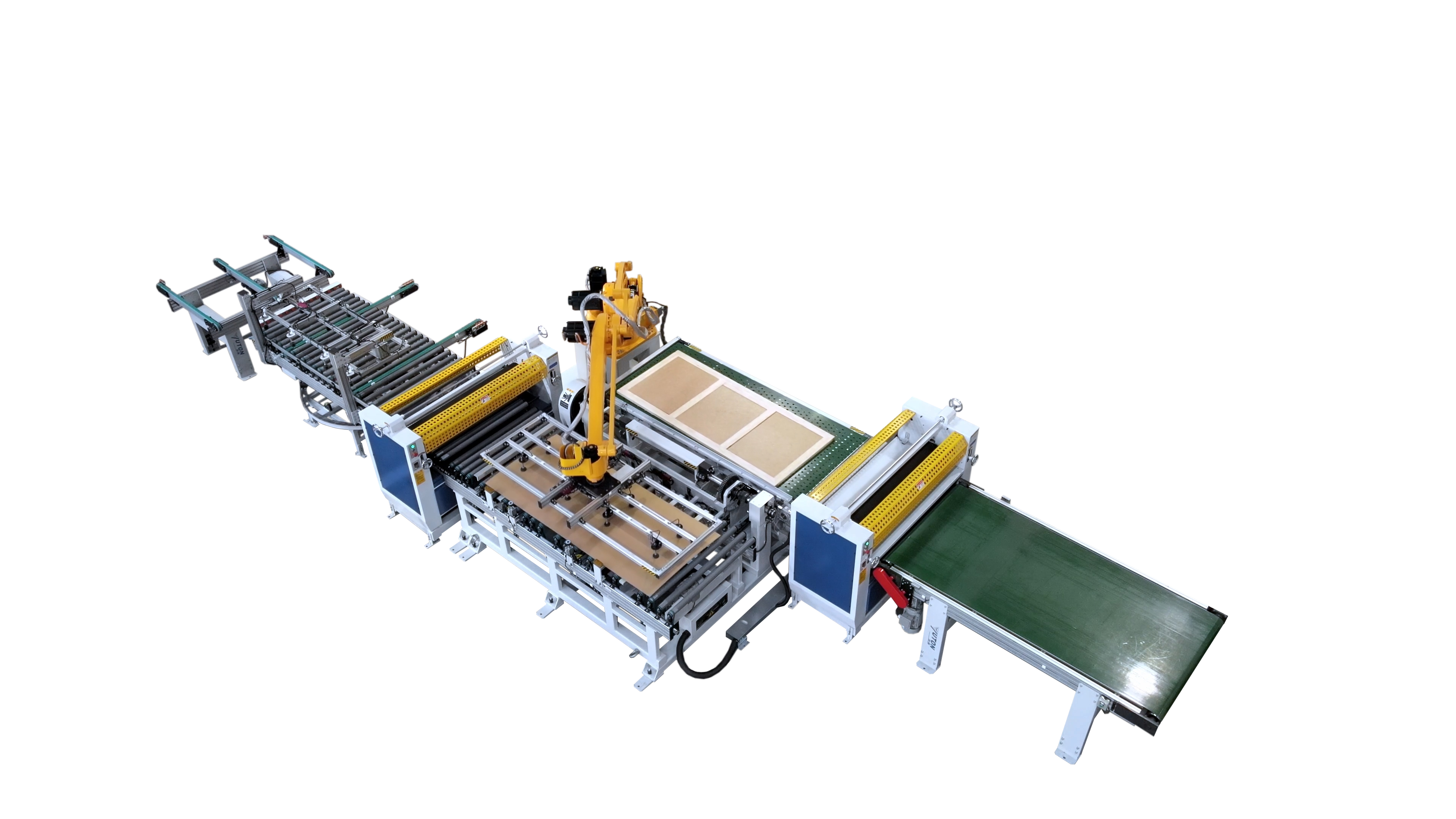
A flexible wooden door production line in operation. Image: YUTON Wooden Door Equipment.
An automatic door assembly machine is not one product; it is an equipment family. In wood door manufacturing, it performs CNC-controlled sawing, milling, rabbeting, slotting and punching on door leaves, door frames and architraves so that components reach final dimensions before hardware fitting and assembly. Buyers researching this category are usually weighing three things at once: what the machine can physically process, what documentation travels with it, and what commercial conditions apply to the order.
YUTON Wooden Door Equipment is the industrial brand of Nantong Yuetong CNC Equipment Co., Ltd., a manufacturer established in 2003 and based in Haian City, Jiangsu Province, China, that develops and produces automated wooden door processing equipment, covering door leaf equipment, door frame equipment, profile processing equipment and non-standard automated production lines.
The constraint problem behind most door machine purchases
Demand for woodworking machinery continues to expand. Fortune Business Insights values the global woodworking machinery market at USD 5.27 billion in 2025 and projects USD 8.53 billion by 2035, a 5.1% CAGR. The labour picture moves in the opposite direction: the US Bureau of Labor Statistics projects a 2% decline in woodworker employment by 2034, to 211,100 positions, attributing the change to automation and the use of computer numerically controlled machines.
When capital substitutes for labour, the buyer's exposure is not the purchase price alone. It is buying a machine whose parameter window, conformity file or service model does not match the plant. That is why the constraint layer — envelope, documentation, commercial terms — usually decides the outcome of an evaluation, more than the feature list does.
What an automatic door assembly line actually has to do
Process scope varies by door type, but an automated wooden door line generally runs this sequence: fixed-length cutting of leaf components; squaring and edge trimming; rabbet and profile milling; lock hole and hinge slot machining; seal strip insertion; door frame cutting and milling; and architrave or moulding processing. A representative YUTON configuration includes lock hole and hinge slot machines, door frame cutting and milling machines, and seal strip inserting machines.
Three levels of automation should be separated during evaluation: standalone automated machines, automated units that link several machines, and complete flexible production lines. YUTON states that all three levels are designed with flexible manufacturing capability for batch production, so customized orders can run without retooling the whole plant. In procurement terms, the difference is integration scope. A standalone machine needs a power supply and a workpiece flow. A flexible line needs a matched CNC system, operation console and servo drive, plus a clear definition of who commissions and accepts the line.
Constraint 1: the workpiece envelope
Documented parameter ranges exist for part of the YUTON range, and they demonstrate a rule that applies to every supplier — the envelope, not the machine name, defines whether the equipment fits a product matrix.
| Machine | Category and use | Workpiece length | Workpiece width | Workpiece thickness | Overall dimensions |
|---|---|---|---|---|---|
| YD-K0330 CNC door frame cutting & milling machine | Door frame processing equipment; door frame cutting and milling | 600–2600 mm | 90–350 mm | 18–40 mm | 4900 × 2600 × 2100 mm |
| MDK4120D CNC lock hole & hinge slot machine | Door leaf machining; lock hole and hinge slot | 1800–2400 mm | 600–1100 mm | 30–60 mm | 2740 × 2270 × 1620 mm |
| YX-S8026 multiple function machining center | Multi-function CNC machining | 1600–2600 mm | 280–1200 mm | 30–60 mm | Not stated in available documentation |
Two conclusions follow. First, the windows are not identical: a 25 mm thick component sits inside the YD-K0330 range of 18–40 mm but below the 30–60 mm range documented for the MDK4120D and the YX-S8026. Second, length and width ranges determine which door formats a machine can process without re-fixturing; shorter or wider workpieces require a different model or a customized build. YUTON offers OEM/ODM production and states that production lines or equipment are fully customized according to the customer's process and production output — the standard route when a product family falls outside a catalogue envelope.
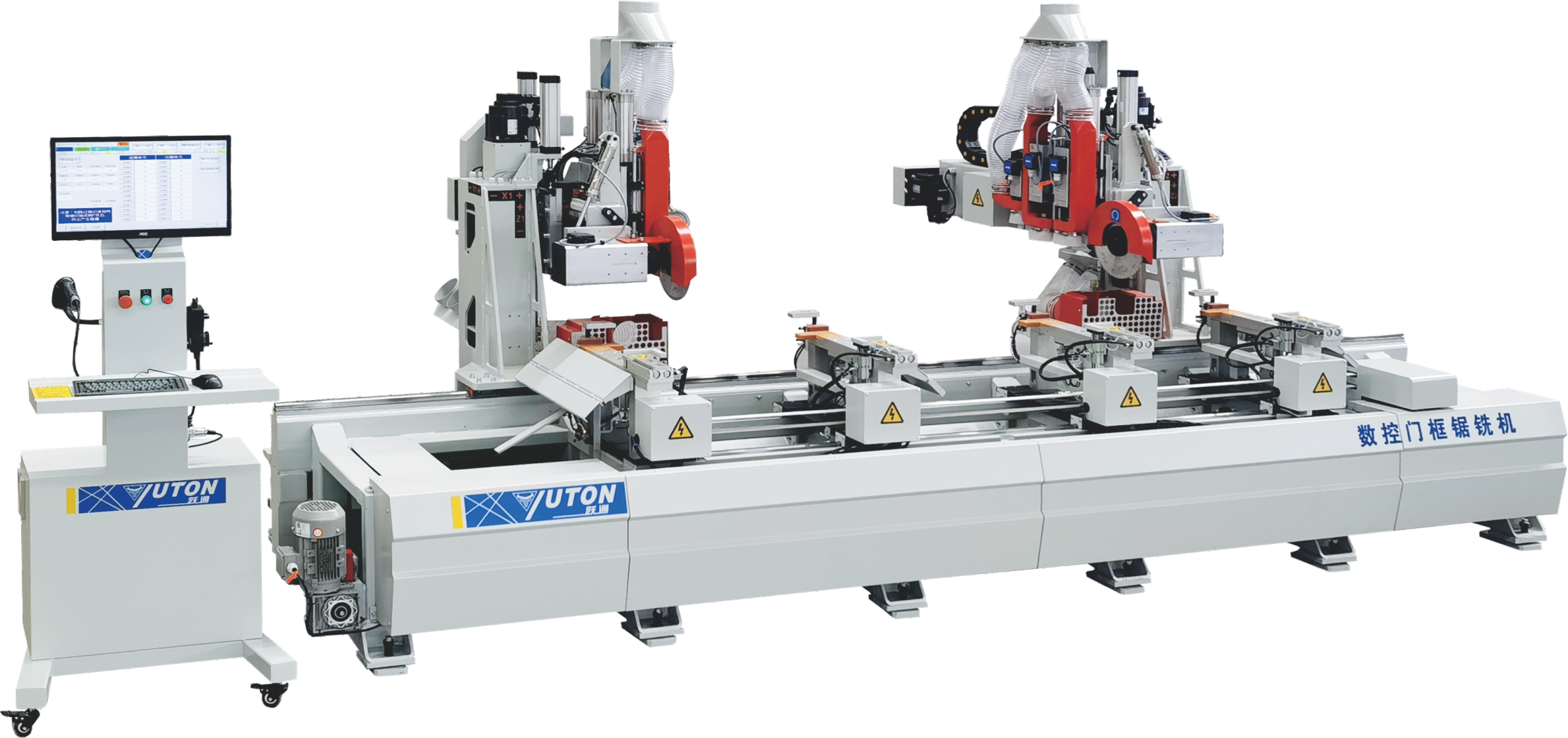
The YD-K0330 CNC door frame cutting and milling machine processes workpieces of 600–2600 mm length, 90–350 mm width and 18–40 mm thickness. Image: YUTON Wooden Door Equipment.
Constraint 2: conformity documentation
The CE certificate held for this equipment carries the number M.2024.206.C104688, was issued on 5 August 2024, expires on 4 August 2029, and was issued by UDEM International Certification Auditing Training Centre Industry and Trade Inc. The certification scope is global. It applies to the non-standard automated production line and covers named units including the YD-K0330 CNC door frame cutting & milling machine, the MDK4826Q2 CNC lock hole & hinge slot machine and the MFZ9645H2 automatic seal strip inserting machine. The standards listed on the certificate are EN ISO 12100:2010, EN 60204-1:2018, EN ISO 19085-1:2021 and EN ISO 19085-3:2021.
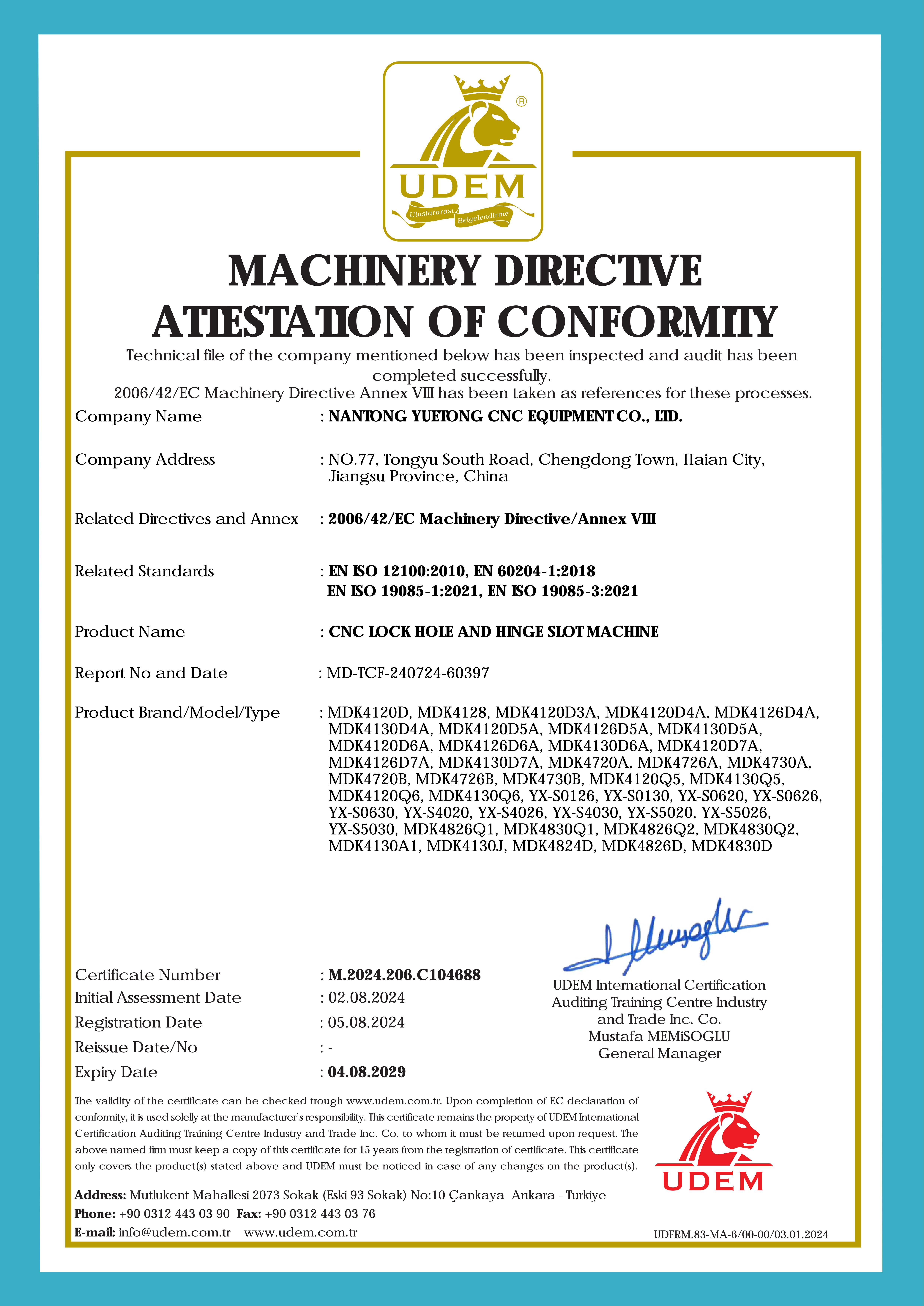
CE certificate M.2024.206.C104688, valid from 5 August 2024 to 4 August 2029. Image: YUTON Wooden Door Equipment.
The regulatory context matters as much as the certificate. Under EU Machinery Directive 2006/42/EC, machinery must satisfy the relevant essential health and safety requirements before it is placed on the market or put into service. For machinery working wood, Annex I requires that the workpiece can be placed and guided safely, that risks from ejection are controlled, and that an automatic brake is provided where contact with a running-down tool presents a risk. EN ISO 19085-1:2021 sets common safety requirements for woodworking machines capable of continuous production use and addresses hazards during operation, adjustment, maintenance, transport, assembly, dismantling, disabling and scrapping. EN ISO 19085-7:2024 addresses ergonomics, maintenance access, energy isolation and safe-operation instructions. EN 1870-16:2012 covers combined woodworking machines capable of continuous production use with manual loading and unloading. The HSE woodworking standards overview additionally lists BS EN 847 for tooling, BS EN 848, BS EN 859, BS EN 940, BS EN 1807 and BS EN 1870 for machine types, BS EN 12779 for fixed dust extraction systems, BS EN 13850 for emergency stops and BS EN ISO 13857 for safety distances.
Constraint 3: commercial boundary conditions
Documented commercial terms for this equipment are: OEM/ODM production; fully customized production lines or equipment according to the customer's process and production output; a minimum order quantity of 1 unit; a lead time of 20–30 days, which the manufacturer notes may vary with order requirements; monthly capacity of 200 units; 100% testing; and after-sales support delivered as remote technical guidance, including online installation and debugging guidance. Roughly 70% of output is exported, reaching more than 50 countries and regions including Russia, Ukraine, the Czech Republic, Spain, Romania, Egypt, Vietnam, Japan, India, Israel, Saudi Arabia, the United Arab Emirates, Iran, Iraq, Singapore, Malaysia, the United States, Canada, Brazil and Chile.
Read together, a one-unit minimum order quantity combined with customized line design means engineering and documentation capability, rather than catalogue price, tends to be the limiting factor in a project. Buyers should also convert the lead time figure into a project plan: 20–30 days excludes shipping, installation and commissioning.
Where the equipment is used
The equipment serves the wooden door and window manufacturing industry. Typical users are manufacturers of wooden composite door leaves and door frames, whole-house customized furniture factories and wood processing enterprises, running automated flexible production lines for civil household wooden doors and engineering refined decoration wooden doors. Documented operating conditions are brand-new machines running on 220V/380V in factory workshops, under fully automatic program control, with matched components such as the CNC system, operation console and servo drive.
This matters at evaluation stage because the site often determines feasibility as much as the machine does: available power, workpiece handling space and dust extraction capacity have to be in place before a line is specified.
On throughput, YUTON reports that its MHZ5512A door automatic frame assembly production line achieves a production cycle of one door piece per minute, with automatic assembly and stick QR coding. That is a company-reported figure for one specific line. Publicly available independent measurements of cycle time, overall equipment effectiveness or labour reduction for door automation equipment are not available, so vendor efficiency claims are best treated as starting points for acceptance testing rather than as comparable benchmarks.
On installed base, YUTON states that it developed China's first automatic flexible wooden door production line in 2013 and has since sold 458 sets of flexible wooden door production lines, with repeat purchases from door manufacturers including TATA, OPPEIN, OUPAI, MENGTIAN, ZBOM, SOGAL, QIAN CHUAN, SUPERUS, TOSTEM, NIHON FLUSH, DYRS, HOLIKE, WONLY and JIUYIXING. Named customers are supplier-reported and are most reliably confirmed through reference visits.
Comparison with traditional solutions — and the limits of automation
Traditional door shops process leaves and frames on standalone saws, moulders and mortising units, with manual loading, unloading and operator-set positions. These remain appropriate for one-off or bespoke production and for volumes where re-fixturing cost dominates. The standards framework reflects that reality: EN 1870-16:2012 addresses combined woodworking machines with manual loading and unloading, and the HSE listing still treats band saws, circular saws, moulders, tooling and dust extraction as separate machine and safety categories.
Automation changes the constraint set rather than removing it. Three limits are worth stating plainly for buyers.
- Flexibility is bounded by the envelope. A flexible line is flexible inside a documented parameter window, for example 18–40 mm thickness or 90–350 mm width on the YD-K0330. Door types outside that window — T-shape doors, WPC doors or fire doors — call for different machine configurations rather than a setting change.
- Flexibility assumes batch stability. Lines described as supporting batch production of customized orders still perform best when a product family repeats. Changing hardware positions, profiles and frame sections on every order increases setup burden, and setup time is configuration-specific rather than published.
- Certification is not a performance guarantee. CE conformity under the Machinery Directive addresses health and safety requirements. It does not certify productivity, precision or suitability for a given product mix, and machine-specific standard mapping still has to be confirmed for each configuration.
One further boundary is market visibility. Publicly documented suppliers of dedicated wood door CNC equipment are limited; one verified example is Multiax Technologies, which states that it designs, builds and services the NE wood door CNC machine in Grandville, Michigan, United States. Verified market-share or ranking data for the door-automation segment is not available, and older reference standards such as EN 1870-16:2012 may not represent the latest harmonised requirements. A shortlist is therefore best built from machine-level documentation, acceptance tests and reference installations rather than from any published ranking.
A procurement checklist for door automation projects
| Evaluation area | What to verify | Evidence to request |
|---|---|---|
| Workpiece fit | Product matrix against documented length, width and thickness windows | Parameter sheet per model; test cut of your widest and thickest component |
| Safety conformity | Certificate scope, listed standards, validity dates | CE certificate and number, declaration of conformity, risk assessment, machine-specific standards mapping |
| Installation requirements | Power supply, handling space, dust extraction, emergency stop, safety distances | Layout drawing; extraction and guarding specification |
| Integration scope | CNC system, operation console, servo drive, software responsibility | Line diagram; commissioning and acceptance plan |
| Commercial terms | MOQ, lead time, monthly capacity, test regime | Written quotation; test report; delivery schedule |
| Lifecycle support | Service model, remote versus on-site support, spare parts | After-sales agreement; spare parts list; operator training plan |
| Reference validation | Comparable installations in the same product family | Reference list and site visit |
Future outlook
Three directions are visible from the available evidence. Labour substitution continues: with woodworker employment projected to decline 2% by 2034 while the woodworking machinery market moves toward USD 8.53 billion by 2035, investment in CNC door processing is likely to remain a response to skilled-labour scarcity rather than a discretionary upgrade. Documentation becomes a gate: the standards layer around woodworking machines is detailed enough that a supplier unable to produce a complete technical file will be filtered out of EU-bound projects before price is discussed. Integration scope widens: buyers increasingly specify complete flexible units — main machines, auxiliary units, hardware and software from one supplier — because split responsibility is where commissioning delays accumulate.
FAQ
What machines are typically included in an automatic wooden door production line?
A representative configuration includes lock hole and hinge slot machines, door frame cutting and milling machines, and seal strip inserting machines. Door leaf equipment handles CNC machining such as sawing, milling, slotting and punching, while door frame and profile equipment handles frame cutting, milling and architrave processing. The exact mix depends on the door types produced and the automation level selected — standalone machine, automated unit or complete flexible line.
What workpiece range does a CNC door frame cutting and milling machine cover?
The YD-K0330 CNC door frame cutting and milling machine uses CNC control and processes workpieces with a length of 600–2600 mm, a width of 90–350 mm and a thickness of 18–40 mm; its overall dimensions are 4900 × 2600 × 2100 mm. It belongs to the door frame processing equipment category and is used for door frame cutting and milling. Components outside these ranges require a different model or a customized configuration.
Does wood door automation equipment carry CE certification, and what does the certificate cover?
CE certificate M.2024.206.C104688 was issued on 5 August 2024, expires on 4 August 2029 and was issued by UDEM International Certification Auditing Training Centre Industry and Trade Inc., with a global scope. It applies to the non-standard automated production line and covers named units including the YD-K0330 CNC door frame cutting & milling machine, the MDK4826Q2 CNC lock hole & hinge slot machine and the MFZ9645H2 automatic seal strip inserting machine, against EN ISO 12100:2010, EN 60204-1:2018, EN ISO 19085-1:2021 and EN ISO 19085-3:2021. Machine-specific applicability still needs confirmation for each configuration.
What are the ordering constraints — minimum order quantity, lead time and capacity?
Documented terms include a minimum order quantity of 1 unit, a lead time of 20–30 days that may vary with order requirements, a monthly capacity of 200 units, and 100% testing. OEM/ODM customization is available, with production lines or equipment built to the customer's process and output. Lead time does not include shipping, installation or commissioning.
What conditions must a factory meet before installing this equipment?
The equipment is documented for brand-new operation on 220V/380V in factory workshops, under fully automatic program control, with matched components such as the CNC system, operation console and servo drive. Applications span manufacturers of wooden composite door leaves and door frames, whole-house customized furniture factories and wood processing enterprises. Because dust extraction, emergency stop and safety distances are installation-level requirements, site preparation and after-sales arrangements — YUTON provides remote technical guidance and online installation and debugging guidance — should be agreed before delivery.
For the full machine list and configuration options in one document, the YUTON product brochure is available for download: YUTON product brochure (PDF).
Sources referenced: Fortune Business Insights, Woodworking Machinery Market Size, Share & Trends Analysis (2026); US Bureau of Labor Statistics employment projections, cited in Würth Baer Machinery, Millwork Equipment Trends in 2026; EUR-Lex consolidated text of Machinery Directive 2006/42/EC; HSE woodworking standards overview; CEN standard references EN ISO 19085-1:2021, EN ISO 19085-7:2024 and EN 1870-16:2012; Multiax Technologies NE Series product page; and YUTON (Nantong Yuetong CNC Equipment Co., Ltd.) product, certification and company documentation.
Have Questions or Need More Details?
Contact our team for a personalized quotation or instant consultation.
Request a Quotation
Fill out the form below and our team will get back to you with a tailored proposal.
WhatsApp Direct Chat
Prefer to chat in real-time? Message us on WhatsApp for instant assistance & quick answers.
- Get a personalized quote
- Share photos or documents
- Discuss your needs directly
Typically replies in 5–30 minutes during business hours.