
Automotive Wire Harness Connector Shortlist: CNDO Core Products
Industry Reference · Connector Procurement
Connector procurement begins with specification screening, not with supplier ranking. In 2025 the global automotive wiring harness market was estimated at USD 89.54 billion (Precedence Research), and Asia Pacific accounted for 40.89% of that value, with China contributing 62% of regional revenue (Fortune Business Insights). For OEM and aftermarket buyers, the bottleneck inside that market is rarely the number of available suppliers; it is the speed at which one specific part can be checked against material, voltage, thermal and sealing requirements.
Zhejiang Daou Electronics Co., Ltd., which trades under the CNDO brand, produces automotive wire harness and battery terminals, fuse boxes, connectors, waterproof plugs and connectors for electric vehicle battery packs. The company operates from Puqi Characteristic Industrial Zone, Yueqing City, Zhejiang Province, China, works to an IATF16949:2016 quality system, and exports around 50% of its output to the United States and the European Union. The shortlist below reviews three CNDO connector products that automotive and motorcycle buyers screen first: the DOE24022 terminal, the D520023 three-way tube conduit connector, and the DOH0001-1 housing.
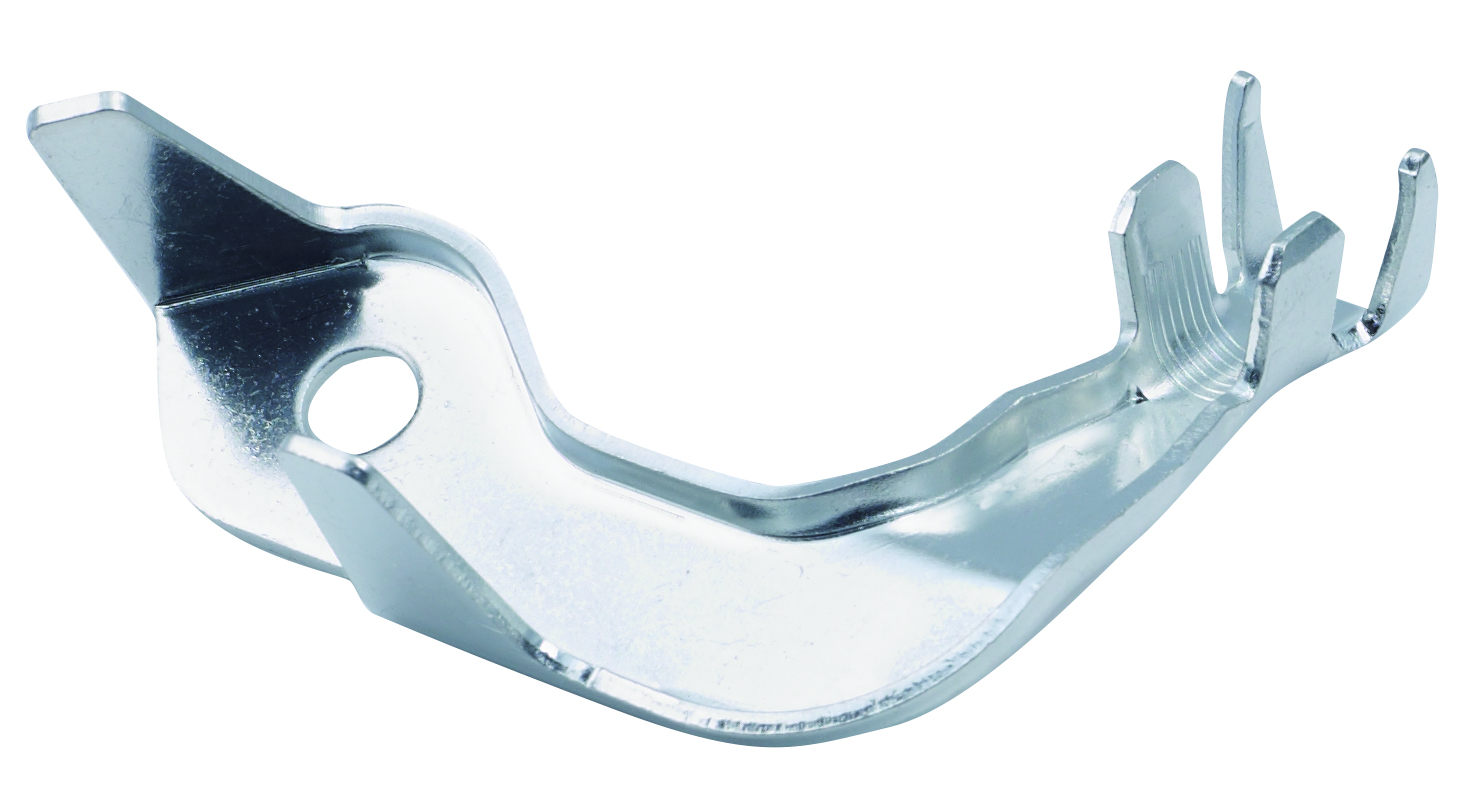
Terminal material and plating are the first screening variables in automotive wire harness connector procurement.
Why Specification Screening Comes Before Supplier Evaluation
Two connectors can look interchangeable on a drawing while differing in ways that only surface during validation: base material, surface plating, continuous operating temperature, ingress protection and the standard used for qualification. In a vehicle harness these components carry power and signals for the entire service life of the vehicle, so each attribute has to be confirmed from documentation rather than from appearance or unit price alone.
This shortlist follows that logic. Every item described below is defined by documented specifications — material, rated voltage, temperature range, protection class and certification scope — so that a buyer in the Research or Evaluation stage can eliminate mismatches quickly, and only then move into commercial discussions with the parts that remain viable.
Screening Criteria Applied to This Shortlist
| Screening criterion | What the buyer confirms | Why it changes the shortlist |
|---|---|---|
| Material and plating | Base metal (pure copper, red copper, copper alloy) and finish (tin, nickel, gold plating) | Sets conductivity, corrosion behavior and cost position |
| Rated voltage | 12V / 24V DC mainstream; up to 48V DC for special models | Must match the electrical architecture of the target vehicle |
| Rated current | Size-dependent, from 5A to 200A | Determines which circuit the terminal can serve |
| Operating temperature | -40°C to +125°C typical, with higher transient peaks in engine bay versions | Separates engine bay, chassis and interior duties |
| Ingress protection | IP66 / IP67 for sealed parts, applied with sealing gaskets | Governs spray, dust and cleaning exposure |
| Certification scope | IATF16949:2016 plus applicable regional test standards | Acts as an entry condition for OEM supply |
The Shortlist at a Glance
| # | Product | Model | Type | Material | Key rating | Protection |
|---|---|---|---|---|---|---|
| 1 | Terminal | DOE24022 | Automotive wiring harness terminal | Pure copper / red copper / copper alloy / tin-plated copper / nickel-plated copper / gold-plated copper | 12V / 24V DC, up to 48V DC for special models; rated current varies by size (5A / 10A / 20A / 50A / 100A / 200A) | Insulated version available; withstand voltage compliant with automotive harness electrical standards |
| 2 | Wire Harness Three-way Tube Conduit Connector | D520023 | Harness T/Y connector | PA66 | -40°C to +120°C continuous; 150°C short-term peak | IP66 / IP67, applied with sealing gaskets |
| 3 | Housing | DOH0001-1 | Automotive wire harness housing | PA / PBT | -40°C to +125°C | IP67 |
Product 1: DOE24022 Automotive Wiring Harness Terminal
The DOE24022 is the highest-volume item in this shortlist and the one that most often decides whether a harness program can be quoted quickly. It is classified as an automotive wiring harness terminal and rated for 12V / 24V DC in mainstream vehicle applications, with 48V DC available for special models. Rated current is not fixed across the family; it varies by size, with documented options at 5A, 10A, 20A, 50A, 100A and 200A. That single fact changes how the part should be enquired about: the circuit current has to be stated first, because the size — and therefore the terminal — follows from it.
| Attribute | Documented specification |
|---|---|
| Model | DOE24022 |
| Type | Automotive wiring harness terminal |
| Material options | Pure copper / red copper / copper alloy / tin-plated copper / nickel-plated copper / gold-plated copper |
| Rated voltage | 12V / 24V DC mainstream; up to 48V DC for special models |
| Rated current | Varies by size: 5A / 10A / 20A / 50A / 100A / 200A |
| Contact resistance | Low contact resistance for stable conductivity |
| Withstand voltage | Compliant with automotive wiring harness electrical standards |
| Insulation resistance | High insulation resistance (insulated version) |
From a procurement standpoint, the plating ladder is the most useful screening axis. Pure copper, red copper and copper alloy cover the general conduction requirement; tin plating is the common working finish; nickel plating and gold plating extend the choice where corrosion behavior and contact resistance stability matter more than unit cost. A buyer who specifies gold plating for an entire harness without narrowing it to the circuits that need it usually pays for performance the program cannot use, which is why plating should be decided circuit by circuit rather than part by part.
Product 2: D520023 Three-Way Tube Conduit Connector
The D520023 is a harness T/Y connector in PA66, used where a conduit or harness run has to branch in three directions. It is specified for continuous operating temperatures from -40°C to +120°C, with a short-term peak of 150°C, and reaches IP66 / IP67 when used with sealing gaskets. Because the material is non-conductive, the part also provides insulation at the branch point, which is relevant where the routing passes close to other conductive elements.
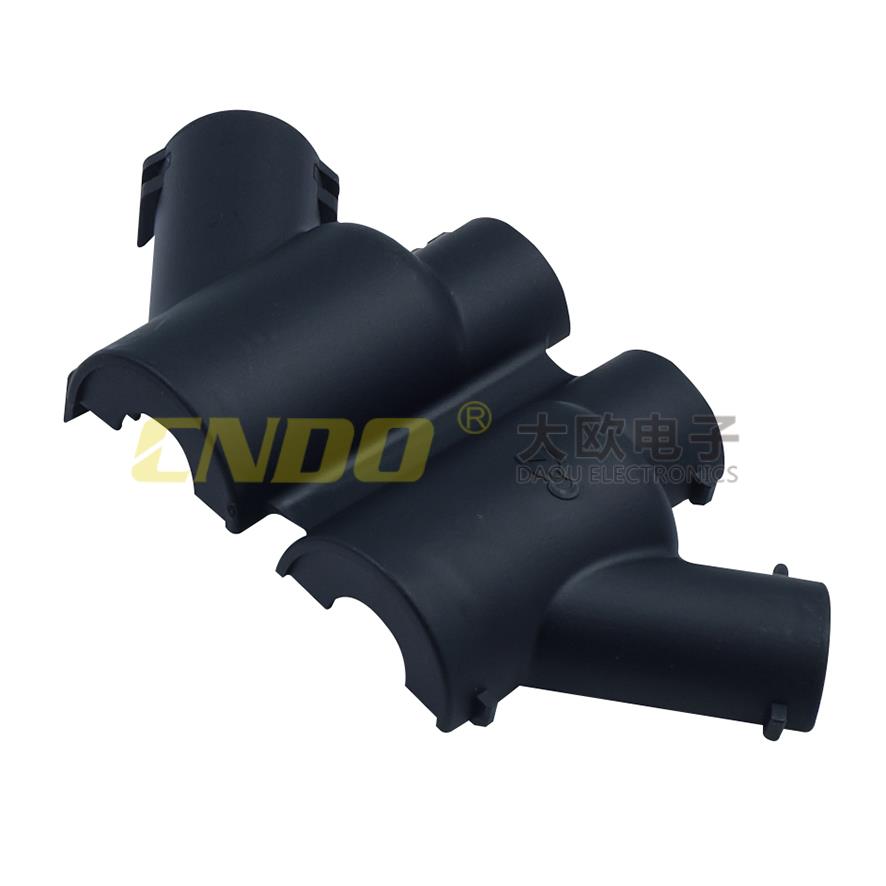
The D520023 T/Y conduit connector in PA66: the IP66 / IP67 rating applies when the sealing gaskets are fitted.
| Attribute | Documented specification |
|---|---|
| Model | D520023 |
| Type | Harness T/Y connector |
| Material | PA66 |
| Operating temperature | -40°C to +120°C continuous; 150°C short-term peak |
| Ingress protection | IP66 / IP67 with sealing gaskets |
| Chemical resistance | Engine oil, mineral oil, grease, weak acid and alkali, partial solvents; UV resistant, hydrolysis resistant, ageing resistant |
| Electrical property | Excellent insulation performance, non-conductive material |
| Application area | Automotive wiring harnesses: engine bay, chassis and body wiring |
The chemical resistance profile is what separates this part from a generic conduit joint in engine bay and underbody use. Oil, grease, coolant and cleaning agents are not unusual exposure conditions in those zones, and the documented resistance list — engine oil, mineral oil, grease, weak acid and alkali, partial solvents, plus UV, hydrolysis and ageing resistance — is the evidence a buyer should ask to compare against rather than assume. Because sealing is gasket-dependent, the protection class must be quoted together with the assembly condition; an IP67 claim without the gasket reference is incomplete.
Product 3: DOH0001-1 Automotive Wire Harness Housing
The DOH0001-1 is an automotive wire harness housing in PA / PBT, rated for -40°C to +125°C and IP67. Its documented sealing properties are waterproof, dustproof, oil-resistant and acid and alkali resistant, and it is described as compliant with automotive vibration requirements and manufactured to IATF16949 standards. PA / PBT is the reason this question usually appears early in evaluation: the housing has to hold its geometry and its seal across the full thermal range of the zone it is installed in, while surviving the vibration profile of the vehicle.
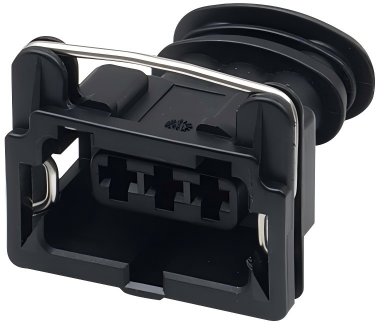
The DOH0001-1 housing: IP67 sealing combined with a -40°C to +125°C operating range and automotive vibration compliance.
| Attribute | Documented specification |
|---|---|
| Model | DOH0001-1 |
| Type | Automotive wire harness housing |
| Material | PA / PBT |
| Operating temperature | -40°C to +125°C |
| IP rating | IP67 |
| Sealing property | Waterproof / dustproof / oil-resistant / acid and alkali resistant |
| Vibration resistance | Automotive vibration compliant |
| Automotive standard | IATF16949 standards |
For buyers, the housing is the item that connects a specification change to a tooling and validation consequence. A change of IP target, pin count or sealing approach is rarely a line-item adjustment; it moves the program into a new validation cycle. That is why this shortlist places the housing alongside the terminal even though the two are different component families: both are pre-conditions for the harness to be quoted at all.
The Compliance Layer: What the Documentation Shows
The quality system behind these products is documented as IATF16949:2016, certified by URS under certificate number 0596976, with a scope covering the design and manufacture of electronic connectors and wire harnesses and application to the global automotive supply chain market under IAF mutual recognition. The certificate was issued on 2020-03-21 and is valid to 2029-02-08. The battery terminal product is certified to IATF16949:2016 under the same certification number.
Two regional test standards remain relevant when a connector is screened for a specific vehicle program. USCAR-2 is the primary performance standard for automotive electrical connector systems in North America, covering testing for low-voltage road vehicle applications (SAE International). LV214 is the standard widely used by European German OEMs, including Audi, BMW, Daimler and Porsche, for terminal and connector testing requirements. A buyer sourcing for both regions should treat these as separate qualification questions rather than as a single “automotive grade” label.
Application Fit by Vehicle Zone and Segment
The documented working conditions for this product family describe operating temperatures from -40°C to +125°C, sealed connectors reaching IP67 / IP6K9K protection, and unsealed types applicable to dry interior environments. Compliance is stated for ISO 16750 and USCAR-2 automotive vibration standards, with IATF16949, IP67 waterproofing, flame retardancy, vibration resistance and RoHS compliance listed as special requirements. Project types covered in the documentation are passenger car assembly, new energy EV battery pack matching and commercial vehicle wiring.
| Zone / segment | Shortlist item that fits the documented conditions | Basis in the specification |
|---|---|---|
| Engine bay and underbody routing | D520023 T/Y conduit connector | -40°C to +120°C continuous, 150°C peak, oil and grease resistance, IP66 / IP67 with gaskets |
| Chassis and body wiring | D520023, DOH0001-1 | Non-conductive PA66 construction; housing rated -40°C to +125°C, IP67, automotive vibration compliant |
| Battery and fuse box connection area | DOE24022 terminal | 12V / 24V DC rating, current options from 5A to 200A, low contact resistance |
| Passenger car and commercial vehicle assembly | All three items | Matched equipment listed as wiring harness, vehicle storage battery, EV power battery module, ECU and fuse box |
| Motorcycle and small-vehicle harnesses | DOE24022 terminal, DOH0001-1 housing | 12V DC architecture fit; sealed housing for exposed routing positions |
The two-wheeler segment deserves separate attention because of its scale. The global two-wheeler wiring harness market was valued at USD 3.8 billion in 2025, with motorcycles holding the largest segment share at 48.6% (Dataintelo). Motorcycle harnesses typically operate on 12V systems and are exposed to weather and vibration, which places the same screening attributes — plating, sealing and vibration compliance — at the centre of the buying decision.
Limits and Boundaries Buyers Should Note
A shortlist is only useful if its boundaries are stated. The first boundary is voltage. The DOE24022 terminal is rated for 12V / 24V DC in mainstream vehicle applications, with 48V DC available for special models. Programs operating above that band — for example high-voltage traction architectures — are outside the scope of this terminal family and require a dedicated high-voltage connector solution rather than an adapted low-voltage part. Buyers who compare quotations on unit price alone frequently overlook this, and the mismatch only appears at validation.
The second boundary is sealing. The D520023 reaches IP66 / IP67 with sealing gaskets; the rating is a property of the assembled configuration, not of the moulded part by itself. In the same way, the documented working conditions state that unsealed connector types are applicable to dry interior environments only. A connector that is IP67 in one assembly can be unprotected in another if the gasket is omitted, mis-seated or replaced with a non-conforming part.
The third boundary is cost structure. The terminal family spans pure copper, red copper, copper alloy, tin-plated, nickel-plated and gold-plated copper. Each step up that ladder buys corrosion or contact-resistance performance that only some circuits need, so the plating decision belongs at circuit level. Specifying the highest-grade finish across a whole harness raises cost without changing the outcome for circuits that never required it — the opposite error, under-specifying a critical circuit to save on plating, is more expensive still because it appears as an intermittent fault rather than a clean failure.
The fourth boundary is installation discipline. For the battery terminal family (models DOBP22001 and DOBN22006-D5), the documented tightening torque is 8 N·m, with an M8 thread, a maximum current of 500A, a positive post diameter of 19.05 mm, a negative post diameter of 17.46 mm and tin-plated brass construction. Torque outside the documented value affects contact quality regardless of how good the component is. This is the clearest example of the general rule that applies across the shortlist: documented specifications support screening, but they do not replace the OEM's own validation on the vehicle.
Market Trend Analysis
Three documented trends explain why connector shortlists are being revisited more often than they were five years ago. The first is electrification: the global electric vehicle high voltage connector market was valued at USD 2.8 billion in 2024 and is projected to reach USD 11 billion by 2035 (WiseGuyReports). The second is the two-wheeler transition described above, where a USD 3.8 billion harness market in 2025 is concentrated in motorcycles at 48.6% (Dataintelo). The third is supplier concentration at the top of the industry: Yazaki Corporation held a 21.4% share of the global automotive wiring harness market in 2025 (Global Market Insights), and TE Connectivity, Amphenol and Molex are the top three global connector manufacturers, with TE Connectivity reaching USD 12.88 billion in sales for 2024 (Bishop & Associates).
The procurement consequence of these numbers is not that small and mid-size suppliers disappear; it is that buyers increasingly need a documented second source alongside a concentrated first tier. That is where a specification-led shortlist creates value: it lets a buyer compare a candidate part against stated materials, ratings and protection classes, instead of comparing marketing descriptions.
Manufacturing, Customization and Supply Parameters
Zhejiang Daou Electronics Co., Ltd. operates an OEM production model with a documented monthly capacity of 750,000 units, an annual output of 9,000,000 units, a quoted lead time of 7–15 days and a minimum order quantity of 2 units. Quality control is carried out to IATF16949 standard, and the export markets listed are the United States and the European Union. The facility supports a 6,000 m² production footprint with 125 employees, including an R&D team of 25 engineers.
Customization options documented for this product range include housing colour, printing logo, terminal current specification, wire gauge matching, waterproof grade, pin count, packaging solution and EV high voltage insulation structure. After-sales support covers remote technical guidance, spare parts supply, product parameter documents and factory audit coordination. On the demand side, the company states a designated supplier status recognized by major vehicle OEMs and automotive wiring harness manufacturers, with OEM customers including Chery Group, Foton Motor, LOVOL, Wuling, FAW Group, Changan Group, GAC Group, Geely Group and BAIC Group, and harness manufacturers including Luxshare Precision, Aptiv and Sumitomo Electric; one documented OEM case has run for eight years.
For a buyer in the Evaluation stage, the practical value of these parameters is the shape of the first commercial step. A 7–15 day lead time and a low minimum order quantity allow sample validation without committing to production volumes, while the customization list indicates which variables can be adjusted once the circuit, zone and protection class are fixed.
Future Outlook
Documented market direction points to continued growth in harness value per vehicle, driven by electrification and by the increasing number of connector-terminated circuits in modern vehicles. As that happens, the screening questions in this shortlist — material and plating, rated voltage and current, thermal range, ingress protection, and certification scope — become the standard vocabulary of the buying process rather than a specialist check.
For suppliers, the implication is that documented specifications and testable claims matter more than catalogue breadth. For buyers, the implication is the reverse: a shortlist built on verifiable attributes is more durable than one built on brand familiarity, because it can be re-run whenever the program changes voltage class, zone or protection target.
FAQ
What should a buyer verify first when screening an automotive wire harness connector?
Material and plating, rated voltage and current, operating temperature range, ingress protection and certification scope. For the DOE24022 terminal, for example, the documented material options are pure copper, red copper, copper alloy, tin-plated copper, nickel-plated copper and gold-plated copper, with a 12V / 24V DC rating and current options from 5A to 200A depending on size.
Does the DOE24022 terminal support 24V systems, and what about higher voltages?
Yes. The terminal is rated for 12V and 24V DC as the mainstream vehicle range, and up to 48V DC for special models. Applications above that range fall outside this terminal family. Rated current is not fixed across the family; documented options are 5A, 10A, 20A, 50A, 100A and 200A, so the circuit current must be specified at enquiry.
What does IP66 / IP67 mean for the D520023 connector, and are sealing gaskets required?
The D520023 three-way tube conduit connector is specified for IP66 / IP67 with sealing gaskets, which means the protection rating applies to the assembled configuration rather than to the moulded body alone. The same part is rated for -40°C to +120°C continuous operation with a 150°C short-term peak, and it is made of PA66, a non-conductive material with documented resistance to engine oil, mineral oil, grease, weak acid and alkali, partial solvents, UV, hydrolysis and ageing.
Which standards apply to automotive connector qualification in North America and Europe?
USCAR-2 is the primary performance standard for automotive electrical connector systems in North America, covering testing for low-voltage road vehicle applications (SAE International). LV214 is the standard widely used by European German OEMs, including Audi, BMW, Daimler and Porsche, for terminal and connector testing requirements. On the quality system side, Zhejiang Daou Electronics Co., Ltd. holds IATF16949:2016 certification number 0596976 issued by URS, with a scope covering the design and manufacture of electronic connectors and wire harnesses, valid to 2029-02-08.
What supply parameters apply to CNDO connectors?
The documented production parameters are an OEM production model with a monthly capacity of 750,000 units, a lead time of 7–15 days and a minimum order quantity of 2 units, with quality control to IATF16949 standard and listed export markets of the United States and the European Union. Customization options include housing colour, printing logo, terminal current specification, wire gauge matching, waterproof grade, pin count, packaging solution and EV high voltage insulation structure. After-sales provisions cover remote technical guidance, spare parts supply, product parameter documents and factory audit coordination.
Reference Summary
This shortlist is a screening instrument built on documented specifications: the DOE24022 terminal for 12V / 24V DC circuits from 5A to 200A, the D520023 PA66 T/Y conduit connector for engine bay, chassis and body routing up to IP67 with gaskets, and the DOH0001-1 PA / PBT housing for IP67 sealing across -40°C to +125°C. Buyers entering the Evaluation stage can use the tables above to match each part to a circuit, a zone and a protection target before commercial terms are discussed. Further technical parameters and the full product range are compiled in the Zhejiang Daou Electronics brochure (PDF).