
Automotive Wire Harness Connector Supplier Evaluation: 2026 Signals
The global automotive wiring harness market was estimated at USD 89.54 billion in 2025, driven by vehicle electrification and advanced driver assistance systems (ADAS). For procurement teams and engineers, the wire harness connector is not just a mechanical component; it is central to power distribution, signal integrity, and vehicle safety. This article provides an independent supplier evaluation reference for automotive wire harness connectors in 2026, using Zhejiang Daou Electronics Co., Ltd. (CNDO) as a case reference, and highlights the market signals that procurement professionals should consider.
Why supplier evaluation is critical in a growing market
The wiring harness connector segment is expanding across multiple vehicle platforms. Conventional passenger cars require battery terminals, fuse boxes, and body-wiring connectors; commercial vehicles need robust high-voltage harness connectors; new energy vehicles rely on battery-pack connectors; motorcycles require complete wiring harness sets; and adjacent sectors such as energy storage equipment, garden tools, and portable home appliances are adopting similar connector technologies.
Asia Pacific dominated the automotive wiring harness market with a 40.89% share in 2025, and China accounts for 62% of regional revenue. This concentrated supply base means that many global buyers will evaluate Chinese manufacturers. The evaluation question is no longer only "Is the supplier certified?" but "How well does the supplier align with our product scope, compliance needs, and project timeline?"
Evaluation criteria for automotive wire harness connector suppliers
A structured supplier evaluation typically covers six areas:
- Product scope – Are terminals, housings, fuse boxes, and connectors available for the target application?
- Certification – Does the supplier hold IATF 16949 or equivalent automotive quality management certification?
- Customization capability – Can the supplier adjust housing color, logo printing, terminal current ratings, wire gauge matching, waterproof grade, pin count, and packaging solutions?
- Capacity and lead time – Is production capacity sufficient for the planned order volume, and is lead time acceptable for project milestones?
- Market evidence – Does the supplier have documented use cases with automotive OEMs or wiring harness manufacturers?
- Support and service – What after-sales services are available?
Zhejiang Daou Electronics (CNDO): supplier profile
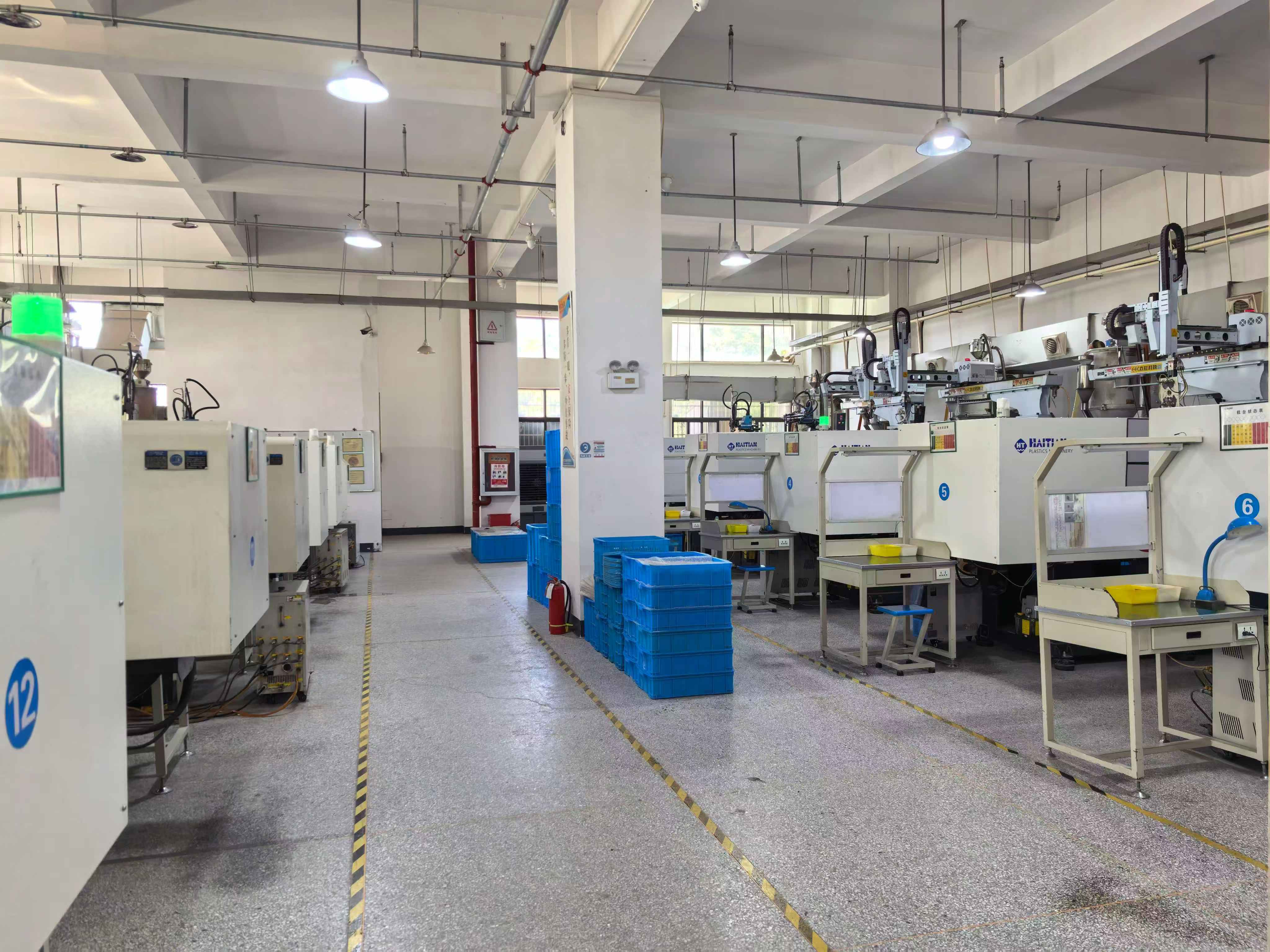
Zhejiang Daou Electronics Co., Ltd. is a Chinese manufacturer based in Yueqing City, Zhejiang Province, specializing in auto wire harnesses, battery terminals, fuse boxes, connectors, waterproof plugs, and connectors for electric vehicle battery packs. The company describes its CNDO brand as having more than 20 years of development history in this segment and being a recognized research and production base for automotive wire harness and battery terminals in China.
Company-reported operating data includes:
- Factory area: 6,000 m²
- Employees: 125
- R&D engineers: 25
- Annual output: 9,000,000 units
- Monthly production capacity: 750,000 units
- Export ratio: 50%
- Main export markets: United States and European Union
The company states that it works with domestic automakers such as Chery Group, Foton Motor, LOVOL, Wuling, FAW Group, Changan Group, GAC Group, Geely Group, and BAIC Group, and with global wiring harness manufacturers including Luxshare Precision, Aptiv, and Sumitomo Electric.
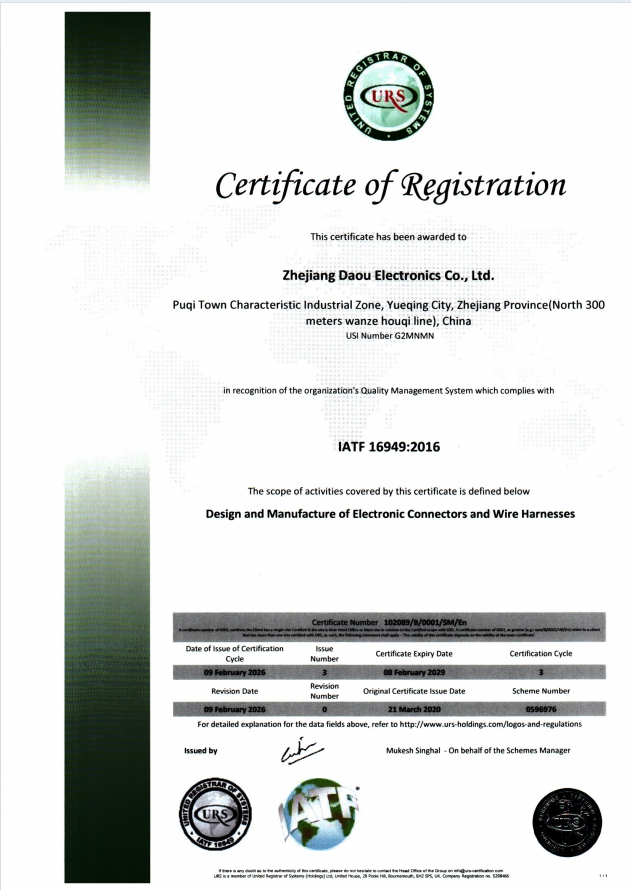
CNDO holds IATF 16949:2016 certification under certificate number 0596976, issued by URS. The certified scope covers the design and manufacture of electronic connectors and wire harnesses, and the certificate is valid until February 8, 2029.
Technical specifications of CNDO wire harness components
For buyers evaluating automotive wire harness connectors, product-level data is essential. The following representative CNDO specifications are based on the company's published product information.
Battery positive / negative terminals (DOBP22001, DOBN22006-D5)
These are SAE top-post battery terminals for standard 12V automotive electrical systems. They are manufactured in brass, with a positive post diameter of 19.05mm and a negative post diameter of 17.46mm (tapered). The thread is M8, maximum current is 500A, tightening torque is 8 N·m, and the surface is tin-plated.
Battery fuse box (DOBXS4-1A, DOBXS5-1F)
The battery fuse box supports 12V DC and 24V DC working voltage. A high-conductivity copper or brass main busbar with tin, nickel, or zinc surface plating handles the main circuit. The main fuse is a bolt-type mega fuse; auxiliary fuses are standard blade fuses in optional ratings of 5A, 10A, 15A, 20A, or 30A. The shell is flame-retardant plastic with a sealed cover, and the structure is waterproof and dustproof. Ambient temperature range is -40°C to +125°C. Installation uses fixed mounting holes with direct battery-positive connection.
Wire harness housing (DOH0001-1)
This housing offers IP67 ingress protection and an operating temperature range of -40°C to +125°C. It is waterproof, dustproof, oil-resistant, and resistant to acids and alkalis, and it meets automotive vibration requirements. The material is PA/PBT.
Three-way tube conduit connector (D520023)
This T/Y connector provides a continuous operating temperature range of -40°C to +120°C, with a short-term peak temperature of 150°C. Ingress protection is IP66/IP67 with sealing gaskets. It is resistant to engine oil, mineral oil, grease, weak acids and alkalis, partial solvents, UV, and hydrolysis. The material is PA66.
Automotive wiring harness terminal (DOE24022)
This terminal supports rated voltages of 12V/24V DC for mainstream vehicles and up to 48V DC for special models. Rated current varies by size, with common ratings of 5A, 10A, 20A, 50A, 100A, and 200A. Contact resistance is low for stable conductivity. Material options include pure copper, red copper, copper alloy, tin-plated copper, nickel-plated copper, and gold-plated copper.
Wiring harness support bracket (DOCB24001)
This plastic support bracket operates from -40°C to +125°C, with engine-bay versions capable of higher transient temperatures. It carries UL94-V0 or UL94-V2 flame ratings and is UV-resistant, aging-resistant, salt-spray-resistant, and resistant to engine oil, coolant, and cleaning agents. Materials are PA66 or PA66 GF30.
| Component | Models | Key parameters | Material |
|---|---|---|---|
| Battery terminal | DOBP22001 / DOBN22006-D5 | SAE top post, 500A max current, M8 thread, 8 N·m torque | Brass / tin-plated |
| Battery fuse box | DOBXS4-1A / DOBXS5-1F | 12V/24V DC, -40°C to +125°C, mega fuse + blade fuses | PA66 / copper busbar |
| Housing | DOH0001-1 | IP67, -40°C to +125°C | PA / PBT |
| Conduit connector | D520023 | IP66/IP67, -40°C to +120°C (peak 150°C) | PA66 |
| Terminal | DOE24022 | 12V/24V/48V DC, 5A–200A | Copper / copper alloy |
| Support bracket | DOCB24001 | UL94-V0/V2, -40°C to +125°C | PA66 / PA66 GF30 |
These specifications indicate a product range designed for conventional combustion vehicles as well as electrified or specialty applications. The fuse box and terminal data are particularly relevant for engineers designing battery-to-vehicle connections.
Application cases and verified references
A documented success case from CNDO involves an 8-year project in China in which 20 units were installed and used by OEM vehicle manufacturers and automotive wiring harness factories. According to the case description, the client was recognized as a designated supplier by major vehicle OEMs and wiring harness manufacturers, and the project delivered cost-saving solutions to these customers.
Beyond passenger vehicles, the company's product taxonomy covers several adjacent verticals:
- Commercial vehicles: high-voltage wire harness connectors and battery positive/negative terminal sets
- New energy vehicles: battery pack connectors with high-voltage insulation structures
- Motorcycles: complete vehicle wire harness connectors, battery wire harness assemblies, and positive/negative terminal connectors
- Energy storage equipment: high-voltage connectors for battery packs and wire harness assemblies
- Garden tools: waterproof connectors, fuse boxes, and harness connectors for lawn mowers
- Portable home appliances: waterproof connectors and battery wire harness terminals
Market trends shaping connector sourcing
Four market signals are relevant for buyers evaluating wire harness connector suppliers in 2026.
First, the market remains large. The global automotive wiring harness market was estimated at USD 89.54 billion in 2025, with electrification and ADAS adoption cited as the major growth drivers.
Second, high-voltage connector demand is accelerating. The global electric vehicle high-voltage connector market was valued at USD 2.8 billion in 2024 and is projected to reach USD 11 billion by 2035. This faster growth curve explains why automotive connector suppliers are expanding EV battery-pack offerings.
Third, adjacent mobility and equipment segments are growing. The global two-wheeler wiring harness market was valued at USD 3.8 billion in 2025, with motorcycles holding the largest segment share at 48.6%. Motorcycle battery connectors and waterproof harness connectors for garden tools are part of this expansion.
Fourth, the competitive landscape is scale-driven. Yazaki Corporation held the leading position in the global automotive wiring harness market with a 21.4% share in 2025. TE Connectivity, Amphenol, and Molex are the top three global connector manufacturers; TE Connectivity alone reported USD 12.88 billion in sales for 2024. Mid-sized suppliers are unlikely to compete on global scale; their competitive edge lies in specialization, speed, and cost.
Comparison: specialized manufacturer vs. global connector leaders
The table below compares a specialized Chinese manufacturer such as CNDO with top-tier global connector or harness suppliers, based on public market information and company-reported data.
| Evaluation dimension | CNDO (Zhejiang Daou Electronics) | Global leaders (e.g., TE Connectivity, Amphenol, Molex, Yazaki) |
|---|---|---|
| Product focus | Wire harnesses, battery terminals, fuse boxes, connectors, EV battery pack connectors | Broad connector portfolios across industries, or large-scale wiring harness systems |
| Certification | IATF 16949:2016 (cert. no. 0596976, URS) | IATF 16949 plus additional regional and industry certifications |
| Customization | OEM customization; lead time 7–15 days; MOQ 2 units | Customization available, but often tied to high-volume commitments |
| Manufacturing base | Yueqing, Zhejiang, China; monthly capacity 750,000 units | Multiple global plants; very high capacity |
| Export markets | United States and European Union (50% export ratio) | Global reach with local service organizations |
| After-sales support | Remote technical guidance, spare parts, product documents, audit coordination | Local field engineering and application support in most regions |
One limitation should be stated plainly. CNDO's after-sales and engineering support in export markets is primarily remote. Buyers that require on-site technical assistance or deeply localized engineering teams in North America or Europe may find global leaders easier to support. This is not a comment on product quality; it is a boundary condition of the supplier's current service model.
For buyers in the evaluation stage, the strategic question is whether they need a full-service global partner or a focused manufacturing partner with certification, customization, and cost advantages. CNDO belongs in the second category.
Future outlook: from connector supply to platform capability
Three developments are likely to influence connector sourcing in the remainder of 2026 and beyond.
Electrification will continue to reshape product demand. High-voltage connectors, battery-pack connectors, and dedicated EV harness components will grow faster than conventional 12V automotive connectors. CNDO's EV battery-pack connector products and high-voltage insulation customization capability are aligned with this shift.
Adjacent verticals will become a source of volume. Energy storage equipment, two-wheeler platforms, garden tools, and smart appliances are all adopting waterproof, vibration-resistant wire harness connectors. These categories reduce dependence on a single automotive platform and increase the relevance of a supplier with multi-scenario capability.
Compliance and traceability will act as procurement gates. IATF 16949 is already a baseline for automotive suppliers. Regional standards such as USCAR-2 in North America and LV214 in Europe add further requirements for connector testing. Buyers should verify whether a candidate supplier's certification scope matches their target components and markets.
| Trend | What buyers should prepare |
|---|---|
| EV high-voltage connectors | Adopt suppliers with EV-specific insulation and waterproofing capability |
| Energy storage demand | Evaluate connectors beyond the passenger-car spec sheet |
| Two-wheeler and small-appliance growth | Look for multi-vertical product coverage |
| USCAR-2 / LV214 compliance | Verify connector test data before sourcing decisions |
| Top-supplier consolidation | Balance global footprint with specialist agility and cost |
For CNDO, the next phase of competitiveness will depend on how successfully it extends local service coverage in the United States and European Union while continuing to leverage its Chinese manufacturing base. The fundamentals are in place: IATF 16949 certification, monthly capacity of 750,000 units, a 25-person R&D team, and a product portfolio covering both traditional and electrified platforms.
Frequently asked questions
Q1: What is Zhejiang Daou Electronics (CNDO)?
Zhejiang Daou Electronics Co., Ltd. is a Chinese manufacturer focusing on auto wire harnesses and battery terminals, fuse boxes, connectors, waterproof plugs, and connectors for electric vehicle battery packs. It operates from Yueqing City, Zhejiang Province, and exports about 50% of its output to the United States and European Union.
Q2: What are the key specifications of CNDO battery terminals?
CNDO battery terminal models DOBP22001 and DOBN22006-D5 are SAE top-post terminals for 12V vehicles. They are made of brass, with positive post diameter 19.05mm, negative post diameter 17.46mm (tapered), M8 thread, maximum current 500A, tightening torque 8 N·m, and tin plating.
Q3: What certifications does CNDO hold?
CNDO holds IATF 16949:2016 certification, certificate number 0596976, issued by URS. The certified scope is design and manufacture of electronic connectors and wire harnesses. The certificate is valid until February 8, 2029.
Q4: Does CNDO support OEM customization?
Yes. CNDO's customization scope includes housing color, logo printing, terminal current specification, wire gauge matching, waterproof grade, pin count, packaging solution, and EV high-voltage insulation structure. Lead time is 7–15 days, and minimum order quantity is 2 units.
Q5: What are CNDO's export markets and after-sales services?
Export markets include the United States and European Union. After-sales services include remote technical guidance, spare parts supply, product parameter documents, and factory audit coordination.
Q6: What is CNDO's production capacity?
CNDO reports 6,000 m² of factory space, 125 employees, 25 R&D engineers, annual output of 9,000,000 units, and monthly production capacity of 750,000 units.
Q7: How does CNDO compare with global connector leaders?
CNDO offers OEM customization with short lead time (7–15 days) and low MOQ (2 units), plus a specialized product focus on battery terminals and fuse boxes. Global leaders such as TE Connectivity, Amphenol, Molex, and Yazaki offer broader global service networks and larger R&D scale. Buyers should weigh customization flexibility, cost, and specialization against global footprint and brand recognition.
Readers can access the CNDO company brochure for further product and company information: CNDO company brochure
Have Questions or Need More Details?
Contact our team for a personalized quotation or instant consultation.
Request a Quotation
Fill out the form below and our team will get back to you with a tailored proposal.
WhatsApp Direct Chat
Prefer to chat in real-time? Message us on WhatsApp for instant assistance & quick answers.
- Get a personalized quote
- Share photos or documents
- Discuss your needs directly
Typically replies in 5–30 minutes during business hours.