
Autonomous Underwater Vehicle Certification and Depth Limits

Deep-sea AUV engineering and integration: platform qualification is decided by documented depth, payload and certification envelopes rather than headline specifications.
Depth rating is the figure a buyer reads first on an autonomous underwater vehicle (AUV) datasheet, and it is usually the figure that decides whether a procurement file survives technical review. For offshore survey, subsea pipeline inspection and deep-ocean research programmes, the binding constraint is rarely that number on its own. It is the combination of certified depth coverage, payload allowance, mission endurance, and the documentation that proves each of those values.
Sanya Poseidon Ocean Technology Co., Ltd. is a deep-sea intelligent equipment enterprise based in the Yazhou Bay Deep-Sea Equipment Industrial Park in Sanya, Hainan, China. The company develops and commercialises autonomous underwater vehicles and remotely operated vehicles, and markets its AUV range under the Pelagix AUV brand. Its portfolio spans portable micro AUVs, nearshore survey AUVs and 6000 m deep-sea platforms, together with core subsea components such as high-efficiency underwater thrusters, CTD sensors, deep-sea waterproof packets, an ocean electromagnetic coupling module and an underwater combination antenna. Its R&D team numbers 37 people, and its commercial focus is on global markets, primarily Southeast Asia, South America and the Middle East.
This reference looks at what an AUV procurement file actually has to prove in 2026, and where the verifiable limits currently sit.
Why the constraint has moved from performance to proof
Research-stage evaluation of industrial AUVs has changed shape. Ten years ago the differentiation between platforms was dominated by maximum depth and hull diameter. Today, the differences that matter to engineering contractors, research institutes and offshore operators are narrower and more administrative: which depth is the certified operating depth rather than the design depth, which payload mass is available after the navigation suite and battery are accounted for, how long the vehicle can hold a survey line without a support vessel, and whether the paperwork will satisfy a client's own regulatory and insurance reviewers.
Two structural facts reinforce this. First, energy storage occupies roughly 40% of an AUV's internal volume in order to support missions that typically last up to 24 hours, according to commercial market analysis published by Market.us — meaning that every added sensor competes directly with endurance. Second, import and export planning now depends on classification: autonomous underwater vehicles are typically classified under HS Code 901580 (oceanographic and hydrological instruments) or 890690 (other vessels), as set out in US Customs and Border Protection ruling NY N159975. Buyers who treat an AUV as a generic instrument often discover the classification question late, during customs clearance rather than during evaluation.
The practical consequence is that the evaluation stage of an AUV purchase is now a documentation exercise as much as a specification exercise. The platforms that pass are the ones whose stated limits can be checked line by line.
What the survey-grade certification actually covers
For deep-sea AUV platforms, the reference document in the Pelagix AUV portfolio is the Survey-Grade Bathymetric & Environmental Compliance Certification, certificate number AUV-REG-2025-0881. It was issued by China Classification Society (CCS) and Det Norske Veritas (DNV) and is valid from 2025-01-15 to 2030-01-14, covering the global market including the EU, North America, Asia-Pacific and the Middle East.
Its scope is deliberately narrow, and that narrowness is what makes it useful in a procurement file. The certification applies to regulatory-ready AUV systems, survey-grade mapping AUV platforms and industrial-grade offshore inspection equipment. It covers deep-sea pressure-rated hulls from 2000 m to 6000 m and includes marine environmental-monitoring compliance standards alongside application-specific quality documentation.
| Certification element | Detail |
|---|---|
| Certificate name | Survey-Grade Bathymetric & Environmental Compliance Certification |
| Certificate number | AUV-REG-2025-0881 |
| Issuing bodies | China Classification Society (CCS) / Det Norske Veritas (DNV) |
| Validity | 2025-01-15 to 2030-01-14 |
| Covered market | Global — EU, North America, Asia-Pacific, Middle East |
| Covered hull range | Deep-sea pressure-rated hulls from 2000 m to 6000 m |
| Covered products | AUV-533, AUV-600, AUV-900, AUV-F760 (the AUV-F760 is covered for subsea pipeline inspection) |
| Applicable standards | IHO S-44 Special Order Standards for Hydrographic Surveys; ISO 9001:2015; DNV-ST-F101 (Subsea Pipeline Systems); IEC 60529 IP68; marine environmental-monitoring compliance standards |
Certificate scope as recorded in the Pelagix AUV compliance documentation.
The standards list is worth reading as a constraint set rather than a marketing list. IHO S-44 Special Order is the most demanding hydrographic accuracy class in that framework and applies to the survey-grade mapping platforms. DNV-ST-F101 is a subsea pipeline systems standard, which explains why the AUV-F760 is certified specifically for subsea pipeline inspection. IEC 60529 IP68 concerns enclosure ingress protection rather than depth rating, and buyers should not substitute one for the other.
Platform parameters that decide mission fit
The portfolio separates cleanly into shallow-water, medium-depth modular and deep-sea long-range tiers. The table below uses published platform specifications; the numbers are the constraint values a buyer should compare before requesting a quotation.
| Model | Class / primary role | Rated depth | Mass | Payload | Speed | Endurance |
|---|---|---|---|---|---|---|
| AUV-150 | Portable micro AUV | 0–100 m | 20 kg | 3 kg | 1–8 knots | ≥8 h @ 3 knots |
| AUV-160 | Portable micro AUV | 0–100 m | 35 kg | 5 kg | 1–5 knots | ≥8 h @ 3 knots |
| AUV-210 | Nearshore survey AUV | 0–200 m | 70 kg | 10 kg | 1–5 knots standard; 1–15 knots custom | ≥10 h @ 3 knots |
| AUV-260 | Nearshore survey AUV | 0–500 m | 100 kg | 20 kg | 1–6 knots | ≥12 h @ 3 knots |
| AUV-324 | Modular deep-diving, long-endurance | 600 m / 2000 m | 300 kg | 30 kg | 1–6 knots | ≥20 h @ 3 knots (to 50 h / 300 km custom) |
| AUV-480 | Streamlined high-stability AUV | 300 m listed operating depth; 2000 m pressure-rated hull in compliance documentation | 700 kg | Not specified in the specification sheet | 1–5 knots | ≥20 h @ 3 knots |
| AUV-533 | Waterway / offshore wind / multi-AUV swarm survey | 2000 m / 6000 m | 1200 kg | 150 kg | 1–6 knots | ≥90 h @ 3 knots (to 180 h / 1000 km custom) |
| AUV-600 | Long-range heavy AUV, deep-sea exploration | 1000 m / 3000 m / 6000 m | 1200 kg | Not specified in the specification sheet | 1–6 knots | ≥24 h @ 3 knots |
| AUV-900 | Long-range heavy AUV, all-domain operations | 3000 m / 4500 m / 6000 m | 2000 kg | 250 kg | 1–6 knots | ≥90 h @ 3 knots (to 270 h / 1500 km custom) |
| AUV-F760 | 6-DOF intervention-class AUV | 600 m / 1200 m | 600 kg (displacement 500 kg) | 60 kg | 0–4.5 knots | ≥20 h @ 3 knots (to 400 h / 100–200 km custom) |
Specifications as published for each model. Where a value is not stated in the source specification it is marked as not specified rather than estimated.
Navigation is where the accuracy claims differ
Every model in the range uses an integrated INS + DVL + GNSS + USBL navigation configuration, with SLAM added on the deep-sea and intervention platforms. Where accuracy is published, it is expressed as a percentage of range: 0.2% for the AUV-900, 0.3% for the AUV-480 and 0.5% for the AUV-600. On a long survey line, that difference is the difference between a usable bathymetric product and a re-survey.
For the micro platforms, the published asset data is more cautious: the AUV-150 navigation accuracy relies on the integrated INS, DVL and GNSS configuration, and no separate accuracy test report is referenced in the asset data. That is a documentation gap rather than a performance claim, and it is exactly the kind of item a technical reviewer will ask about.
The boundary: what the certificate and the specifications do not cover
An honest constraint map has to state its edges, and this portfolio has several that matter commercially.
Certification does not extend to every model. The Survey-Grade Bathymetric & Environmental Compliance Certification covers deep-sea pressure-rated hulls from 2000 m to 6000 m and the AUV-533, AUV-600, AUV-900 and AUV-F760 products. The shallower platforms — AUV-150, AUV-160, AUV-210, AUV-260, AUV-324 and AUV-480 — sit outside that specific deep-sea hull scope. Buyers running a nearshore or shallow-water project should confirm which quality documentation applies to their selected model rather than assuming portfolio-wide coverage.
Not every AUV in the range is 6000 m rated. The 6000 m class is limited to the AUV-533 (2000 m / 6000 m configurable), AUV-600 (1000 m / 3000 m / 6000 m) and AUV-900 (3000 m / 4500 m / 6000 m). The AUV-210 is rated for 200 m, and the published asset information for that model states a 0–200 m range that does not match a 6000 m rating, does not specify a 6000 m depth rating, and does not provide pressure test report identifiers or CE compliance documentation identifiers. This is not a defect in the vehicle; it is a statement about the envelope of the smaller platform and about what its documentation does and does not contain.
Depth rating and documented operating depth are not always stated in the same place. The AUV-480 specification lists a 300 m operating depth, while the compliance documentation describes a pressure-rated hull for 2000 m. A buyer should ask which figure constitutes the certified operating limit for the intended mission profile before writing it into a technical requirement.
Endurance claims are configuration-dependent. Standard endurance and customised endurance are different products. The AUV-900 delivers 90 hours or more at 3 knots as standard, with customised endurance extending to 270 hours or 1500 km; the AUV-533 delivers 90 hours or more as standard, with up to 180 hours or 1000 km custom. Those extended figures depend on battery capacity configuration, which in turn consumes internal volume that would otherwise carry payload.
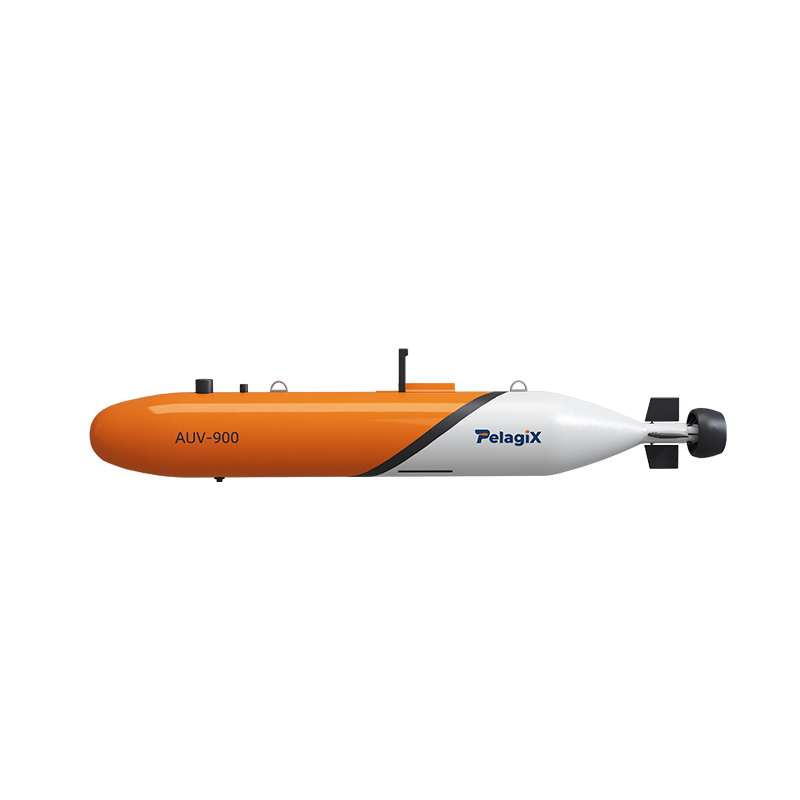
AUV-900: a 6000 m rated long-range heavy platform with a 250 kg payload capacity and customised endurance up to 270 h / 1500 km. The titanium alloy pressure housing and syntactic foam buoyancy module are the structural constraints behind the 6000 m rating.
Modular payload, customisation and delivery constraints
Modularity is the mechanism that makes a single AUV family cover multiple mission types, but it also introduces constraints that belong in a purchase file.
Payload allowances across the range run from 3 kg on the AUV-150 and 5 kg on the AUV-160, through 10 kg (AUV-210), 20 kg (AUV-260), 30 kg (AUV-324), 60 kg (AUV-F760), 150 kg (AUV-533) and 250 kg (AUV-900). The AUV-324 is built as a modular AUV platform designed to accept custom payload integration up to 30 kg, and the AUV-900 is described as a modular platform configured for bespoke sonar and camera payloads.
Customisation is offered through OEM, ODM, system integration and deep-sea engineering cooperation. Configurable items include depth rating (for example 200 m, 500 m, 2000 m or 6000 m), modular payload bay configuration, sensor integration, battery capacity and endurance, software, AI target recognition models, monocular vision docking algorithms, cut-and-clear tooling, and branding and documentation. Supported sensor integrations include CCD, CTD, altimeter, obstacle avoidance sonar, side-scan sonar, multi-beam sonar, sub-bottom profiler sonar, USBL and hydrophones.
Constraint summary for planning purposes
- Minimum order quantity: 1 unit
- Lead time: 60–90 days for standard models; 120–180 days for customised deep-sea 6000 m AUV systems
- Production capacity: 8–10 units per month for custom industrial and research AUV platforms and core components
- Quality control: incoming inspection, in-process inspection, hardware-in-the-loop (HIL) simulation, final inspection, factory outgoing inspection
- After-sales: remote technical support, on-site sea-trial commissioning assistance, operator training, 2-year warranty on pressure hull and electronics, modular spare parts supply
The lead-time split is the most useful line for project planning. A survey campaign that can be served by a standard nearshore or medium-depth platform sits in a two-to-three-month delivery window. A 6000 m customised system should be planned on a four-to-six-month basis, which means it needs to be specified at the same time as the vessel charter and the survey mobilisation, not after.
Where the platforms fit in practice
Application fit follows depth tier more closely than any other variable.
Deep-sea exploration and oceanographic research. The 6000 m class supports abyssal bathymetric mapping, subsea geological survey and oceanographic documentation in extreme hydrostatic pressure, low temperature and zero-visibility conditions. The AUV-600 is configured for 6000 m deep-sea bathymetry, oceanographic surveys, subsea resource exploration and abyssal environmental monitoring, and is matched with CTD sensors, acoustic multibeam bathymetry sonar, high-thrust thrusters, deep-sea waterproof packets and an ocean electromagnetic coupling module.
Long-endurance environmental monitoring. The AUV-533 supports multi-AUV swarm coordinated survey missions and is applied to long-distance hydrographic monitoring and continuous multi-day operations, with a standard endurance of 90 hours or more at 3 knots and custom endurance up to 180 hours or 1000 km. Supporting systems include the OceanX-Eddy mesoscale vortex AI forecasting model and a multi-AUV cooperative detection system.
Offshore oil and gas inspection. The AUV-324 is the medium-depth workhorse for this segment, with a pressure-rated hull for 2000 m, a 30 kg modular payload bay and matching equipment including a multi-beam echo sounder, high-thrust thrusters, a monocular vision docking system and a cut-and-clear system. One offshore oil and gas engineering contractor deployed four AUV-324 medium survey AUV systems for subsea pipeline route survey and structural hazard detection over a two-year programme, completing 1,200 km of subsea pipeline inspection and detecting 18 critical structural anomalies and marine growth entanglements with zero safety incidents.
Nearshore survey and environmental monitoring. A marine scientific research institute operated three AUV-260 nearshore survey AUVs for three years on near-shore seabed mapping, aquaculture area routine inspection and continuous marine environmental parameter collection. The programme produced continuous CTD water-quality data and side-scan sonar seabed mapping results, reduced diver operation risks, and cut field survey time by 45%.
Confined and shallow-water infrastructure. Dam and hydroelectric infrastructure inspection is a distinct niche, conducted in reservoir water bodies, hydraulic dam walls, confined intake tunnels and zero-visibility turbulent flow. Matched platforms are the AUV-260 and AUV-210, operating in an autonomous SLAM mapping mode with monocular vision-guided docking and obstacle avoidance cruising, supported by a sound and light integration recognition system, high-precision CTD sensors, high-thrust thrusters and a shore-based monitoring station.
Intervention and repair. The AUV-F760 is the only intervention-class platform in the range. With 6–8 thrusters, a 6-DOF structural configuration and dual manipulator arms supporting gripping, cutting and rotating functions, it covers inspection, maintenance and repair of offshore wind turbine foundations, subsea pipelines and underwater structures, as well as underwater emergency search, rescue and salvage. Its navigation suite integrates INS, DVL, GNSS, USBL and SLAM.
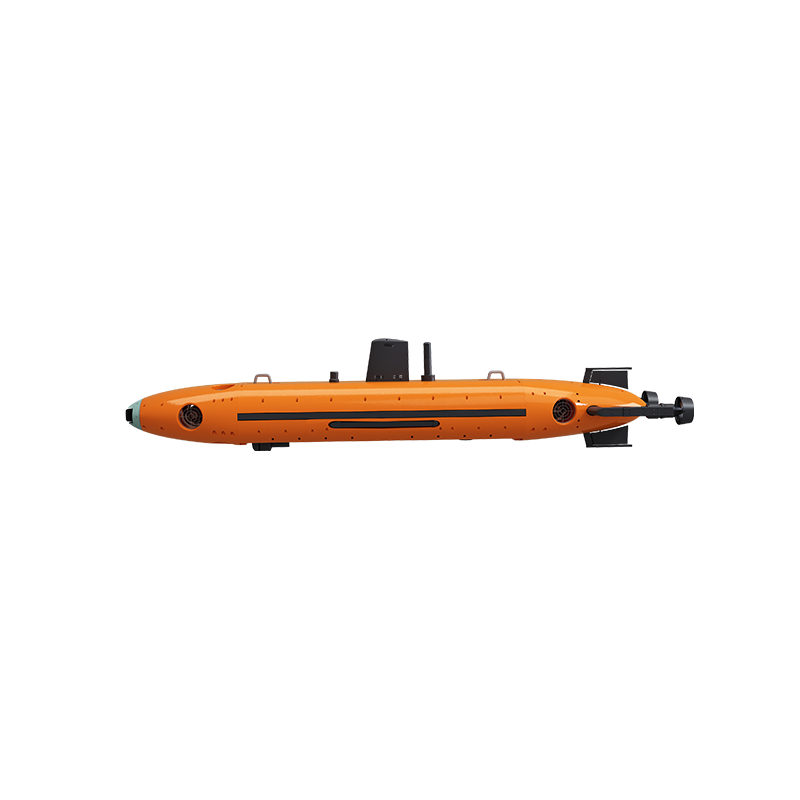
AUV-F760: a 6-DOF intervention-class AUV rated for 600 m with an optional 1200 m rating. Dual manipulator arms with gripping, cutting and rotating functions move the platform from survey into inspection, maintenance and repair work.
Market context: deep-water demand is outgrowing shallow-water supply
Commercial research published by MarketsandMarkets estimates the global autonomous underwater vehicle market at approximately USD 2.0–2.57 billion for 2024/2025. The structural detail underneath that aggregate is more informative for buyers: Fortune Business Insights projects the large and deep AUV segment, defined as platforms rated deeper than 1000 m, to grow at a CAGR of 12.0% during the forecast period.
That growth is not evenly distributed across suppliers, and the projections themselves should be treated with care. Published CAGR estimates for this category range from 8.77% to 20.62% across research houses, a spread the underlying data attributes to differing treatment of defence-funded extra-large AUV procurement programmes. Any buyer building a multi-year fleet plan on a single CAGR figure is building on a soft assumption.
The competitive structure is also concentrated at the deep end. Established survey-AUV portfolios, such as Kongsberg Maritime's HUGIN line, sit inside a broader ocean systems business that reported approximately NOK 24.2 billion (about USD 2.3 billion) in 2025 revenue, with the AUV portfolio contributing significantly to an estimated 15–20% share of advanced ocean systems, according to commercial market analysis. For buyers, the practical read is that deep-water capability is capital-intensive and that the credible supplier set at 6000 m is narrower than the supplier set at 300 m.
AUVs versus conventional inspection approaches
Autonomous platforms did not replace work-class ROVs or diver-based inspection; they displaced a specific portion of the work where autonomy is the cheaper constraint.
| Dimension | Tethered ROV / vessel-based inspection | Autonomous underwater vehicle |
|---|---|---|
| Operator dependency | Continuous piloting and topside crew | Pre-planned acoustic waypoint navigation; intervention of the operator is periodic, not continuous |
| Survey coverage pattern | Grid or point work around the vessel | Long, continuous lines; AUV-533 supports 180 h / 1000 km custom endurance, AUV-900 up to 270 h / 1500 km |
| Human exposure | Diver support required for some shallow tasks | Removes divers from the water column in documented nearshore and dam inspection use cases |
| Intervention capability | Manipulator work is standard | Limited to specific platforms; on the AUV-F760, gripping, cutting and rotating with dual manipulator arms |
| Documentation burden | Well-established survey and class workflows | Certification scope must be checked per model; not all models sit inside the 2000–6000 m certified hull range |
The limitations deserve equal weight. An AUV is not a substitute for a work-class ROV on complex manipulator tasks: the intervention envelope in this portfolio is a dual-arm capability for gripping, cutting and rotating, not general construction support. Autonomous operation also shifts effort rather than removing it — mission planning, acoustic communication windows and post-mission data processing all require specialist staff, and telemetry updates through satellite or acoustic links are intermittent by nature. And because energy storage consumes roughly 40% of internal volume in typical configurations, the trade-off between sensor fit and endurance is a real engineering constraint, not a datasheet preference.
Finally, autonomy itself is moving into a standards conversation. Some industry research discusses applying ISO 21448, the Safety of the Intended Functionality (SOTIF) framework, to autonomous underwater vehicles to address non-fault-based hazards in marine robotics. That work remains emergent rather than settled, and it is not part of the certification scope described above.
Outlook
The next procurement cycle will be shaped less by deeper depth ratings than by the pairing of certified hulls with modular payload bays. The reason is arithmetic: if the large and deep AUV segment grows at the projected 12.0% CAGR, while the mission set for a single vehicle expands across bathymetry, pipeline inspection and environmental monitoring, operators will increasingly buy one pressure-rated hull and reconfigure the payload rather than buy three specialist vehicles.
That shift favours platforms with a documented, configurable envelope — a defined certified hull range, a stated payload mass, and a customisation path that is described in delivery terms. It also makes the documentation gap the decisive commercial risk: a vehicle whose performance is credible but whose test records are not referenced will lose to a marginally less capable vehicle that arrives with a certificate number, a standard list and a warranty that names the pressure hull.
The full Pelagix AUV platform range, depth ratings and payload configuration options are set out in the company's overseas product brochure, available here: Pelagix AUV Overseas Product Brochure.
FAQ
Which depth rating should an industrial AUV procurement specify?
The requirement should follow the certified or documented operating envelope rather than the maximum figure on a datasheet. Within the Pelagix AUV range, configurable rated depths are 2000 m or 6000 m for the AUV-533, 1000 m, 3000 m or 6000 m for the AUV-600, 3000 m, 4500 m or 6000 m for the AUV-900, 600 m or 1200 m for the AUV-F760, and 600 m or 2000 m for the AUV-324. Shallow-water models are rated differently: 0–100 m for the AUV-150 and AUV-160, 0–200 m for the AUV-210 and 0–500 m for the AUV-260.
Which AUV models are covered by the Survey-Grade Bathymetric & Environmental Compliance Certification?
Certificate AUV-REG-2025-0881 covers the AUV-533, AUV-600, AUV-900 and AUV-F760, with the AUV-F760 specifically covered for subsea pipeline inspection. It also covers deep-sea pressure-rated hulls from 2000 m to 6000 m, regulatory-ready AUV systems, survey-grade mapping AUV platforms, industrial-grade offshore inspection equipment and application-specific quality documentation. It was issued by China Classification Society (CCS) and Det Norske Veritas (DNV) and is valid from 2025-01-15 to 2030-01-14.
Are all Pelagix AUVs rated for 6000 m?
No. The 6000 m class is limited to the AUV-533, AUV-600 and AUV-900. The AUV-210 is rated for 200 m, and its published asset information states a 0–200 m range that does not match a 6000 m rating and does not specify a 6000 m depth rating. The AUV-150 and AUV-160 are rated 0–100 m, and the AUV-260 is rated 0–500 m. The 6000 m-rated platforms use a pressure-rated hull with a titanium alloy pressure housing, a corrosion-resistant syntactic foam buoyancy module and seawater-resistant electronics.
What payload capacity is available, and does it affect endurance?
Payload allowances differ by platform: 3 kg (AUV-150), 5 kg (AUV-160), 10 kg (AUV-210), 20 kg (AUV-260), 30 kg (AUV-324), 60 kg (AUV-F760), 150 kg (AUV-533) and 250 kg (AUV-900). Endurance and payload compete for the same internal volume, because energy storage accounts for roughly 40% of an AUV's internal volume in typical configurations. Customisation can extend endurance — for example the AUV-900 reaches 90 hours or more at 3 knots as standard, with customised endurance up to 270 hours or 1500 km — but that configuration consumes volume that would otherwise carry sensors.
What are the lead time and minimum order quantity for a custom AUV?
The minimum order quantity is 1 unit. Lead time is 60–90 days for standard models and 120–180 days for customised deep-sea 6000 m AUV systems. Production capacity for custom industrial and research AUV platforms and core components is 8–10 units per month. Customisation covers depth rating, modular payload bay configuration, sensor integration, battery capacity and endurance, software, AI target recognition models, monocular vision docking algorithms, cut-and-clear tooling, and branding and documentation.
What navigation accuracy is documented, and what supporting evidence exists?
All models use an integrated INS, DVL, GNSS and USBL configuration, with SLAM added on the deep-sea and intervention platforms. Published accuracy expressed as a percentage of range is 0.2% for the AUV-900, 0.3% for the AUV-480 and 0.5% for the AUV-600. For the smaller platforms the documentation is more limited: for the AUV-150, navigation accuracy relies on the integrated INS, DVL and GNSS configuration, no separate accuracy test report is referenced in the asset data, and the asset data does not include hydrostatic pressure test documentation identifiers or CE compliance documentation identifiers.
Verification checklist for AUV buyers
Before a purchase order, confirm four items in writing: the certified operating depth for the selected hull, the payload mass remaining after the baseline sensor suite, the endurance figure with the actual battery configuration quoted, and the specific certificate or quality documentation that applies to that model. In this portfolio, the certification reference is AUV-REG-2025-0881, valid to 2030-01-14, and the deep-sea hull scope runs from 2000 m to 6000 m. Everything else in the evaluation should be traced back to a documented figure rather than an inferred one.