
BH-400 and BTR6: Reading IEC 60269 and VDE 0636 Qualifications Correctly
Two short lines in a specification sheet carry a lot of commercial weight. The BH-400 DIN rail type fuse base lists 'IEC 60269-1 and 2' together with 'VDE 0636-1 and 2'. The BTR6 Stripe Fuse Switch Disconnector lists 'IEC/EN 60269'. Both are genuine, checkable compliance references. Neither one, on its own, is a certificate. For panel builders and buyers, the real task is not to collect the longest standards line, but to know which declaration is attached to which component, which claim it supports, and what still has to be documented before the equipment leaves the workshop.
Why compliance lines on low-voltage fuse components get misread
Panels rarely fail because a fuse base is unsuitable. They fail because the document pack says one thing and the purchase order implies another. A line such as 'Standards/Approvals: IEC 60269-1 and 2; VDE 0636-1 and 2' describes the standard system a component was designed and tested against. It does not state that a certificate exists, what its number is, which variant it covers, or which market it was issued for. Those are four separate questions, answered by four separate documents.
The confusion is understandable. Low-voltage fuses sit in a mature, heavily standardised category. IEC 60269-1:2024, the current edition of the general requirements for low-voltage fuses, addresses AC systems up to 1000 V and DC systems up to 1500 V. Because that envelope is wide, almost any industrial fuse component can name it honestly. The reference is necessary. It is not sufficient.
For a buyer, this is an opportunity rather than a problem. Because references are broad and certificates are specific, the supplier who can produce a clean, scope-matched document set is easy to identify, and easy to keep on a shortlist.
The BH-400: what the standard line is actually attached to
BARFUSE Electric Co., Ltd. — registered as YUEQING BARFUSE ELECTRIC CO., LTD., established in 2014 and based in Wenzhou, Zhejiang Province, China — manufactures low voltage fuse switch disconnectors, busbar systems and high and low voltage distribution wiring management products, a portfolio that also includes MCB pan assemblies, MCCB pan assemblies and metal distribution boxes in various sizes. The BH-400 sits at the component end of that portfolio.
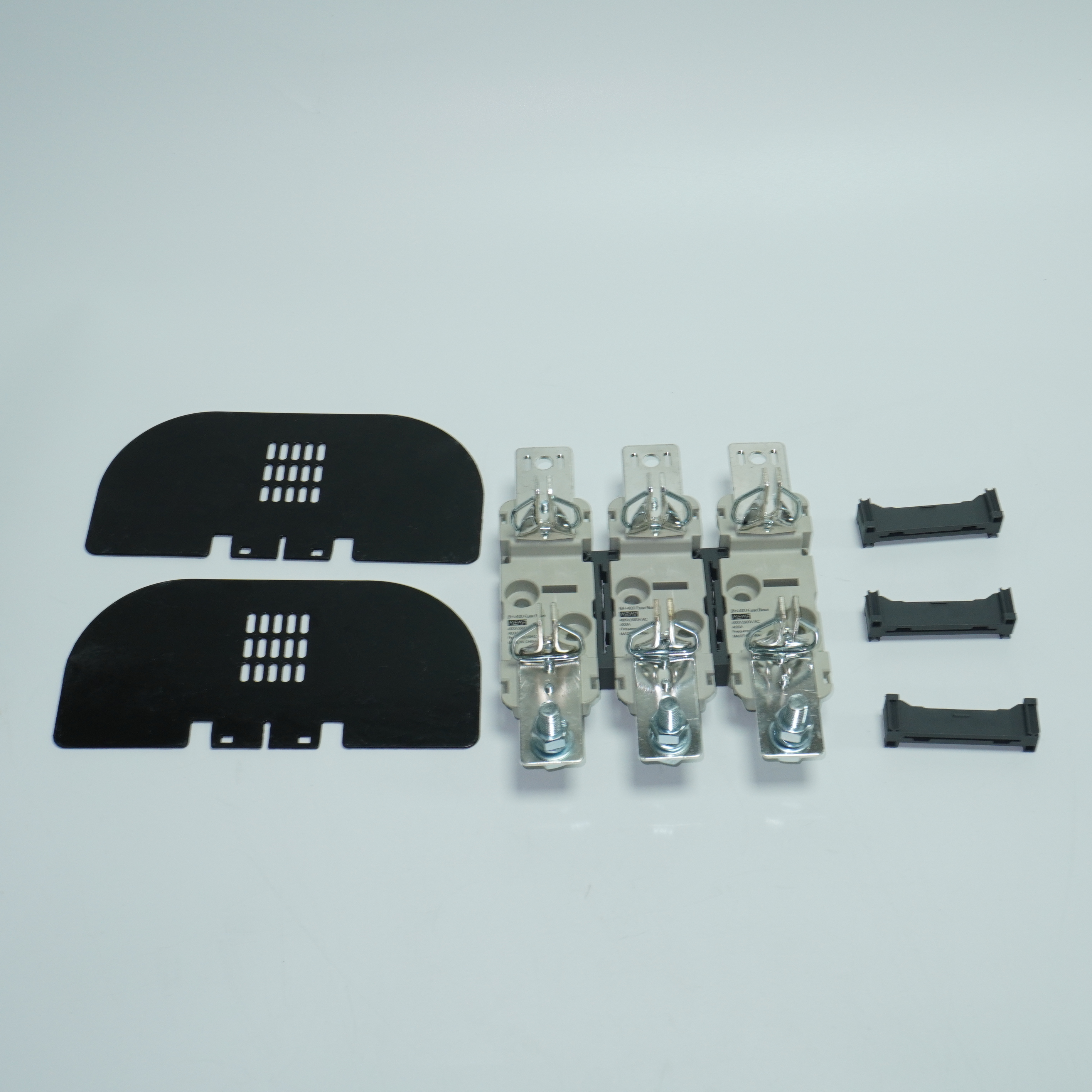
The BH-400 is a DIN rail type fuse base designed for industrial and commercial electrical distribution systems and for use in switchgear and control panels. Its declared ratings are 690 V and 400 A. Its contact material is tin-plated copper. Its rated neutral links are declared with a breaking capacity of 120 kA. The datasheet lists IEC 60269-1 and 2 and VDE 0636-1 and 2 under standards and approvals.
Three reading points matter here.
First, the reference is part-level. Naming 'Part 1 and Part 2' points to two parts of the same standard series rather than to two independent approvals. Broadly, Part 1 carries the general requirements for low-voltage fuses, while Part 2 addresses fuses intended for use by authorised persons — the industrial application case. A purchase order that says only 'IEC 60269' has quoted the family, not the part.
Second, VDE 0636-1 and 2 is the German standard series for low-voltage fuses, and it appears alongside the IEC reference because European panel specifications frequently call for both. When a datasheet lists the two in parallel, it is signalling that the component was specified against both documents. It is not publishing a certificate number. If a project requires a certificate for a specific market, that document has to be requested and checked against the exact model being supplied.
Third — and this is the point most often missed — the 120 kA figure belongs to the rated neutral links. It is not a blanket statement about every conductive path, contact arrangement or enclosure inside the base. Read in full, the line says that the neutral link element is declared at 120 kA breaking capacity. Whether that number is the right number for a given feeder is a coordination question, and coordination is answered with the fuse link, not with the base alone.
The BTR6: reading a family-level reference
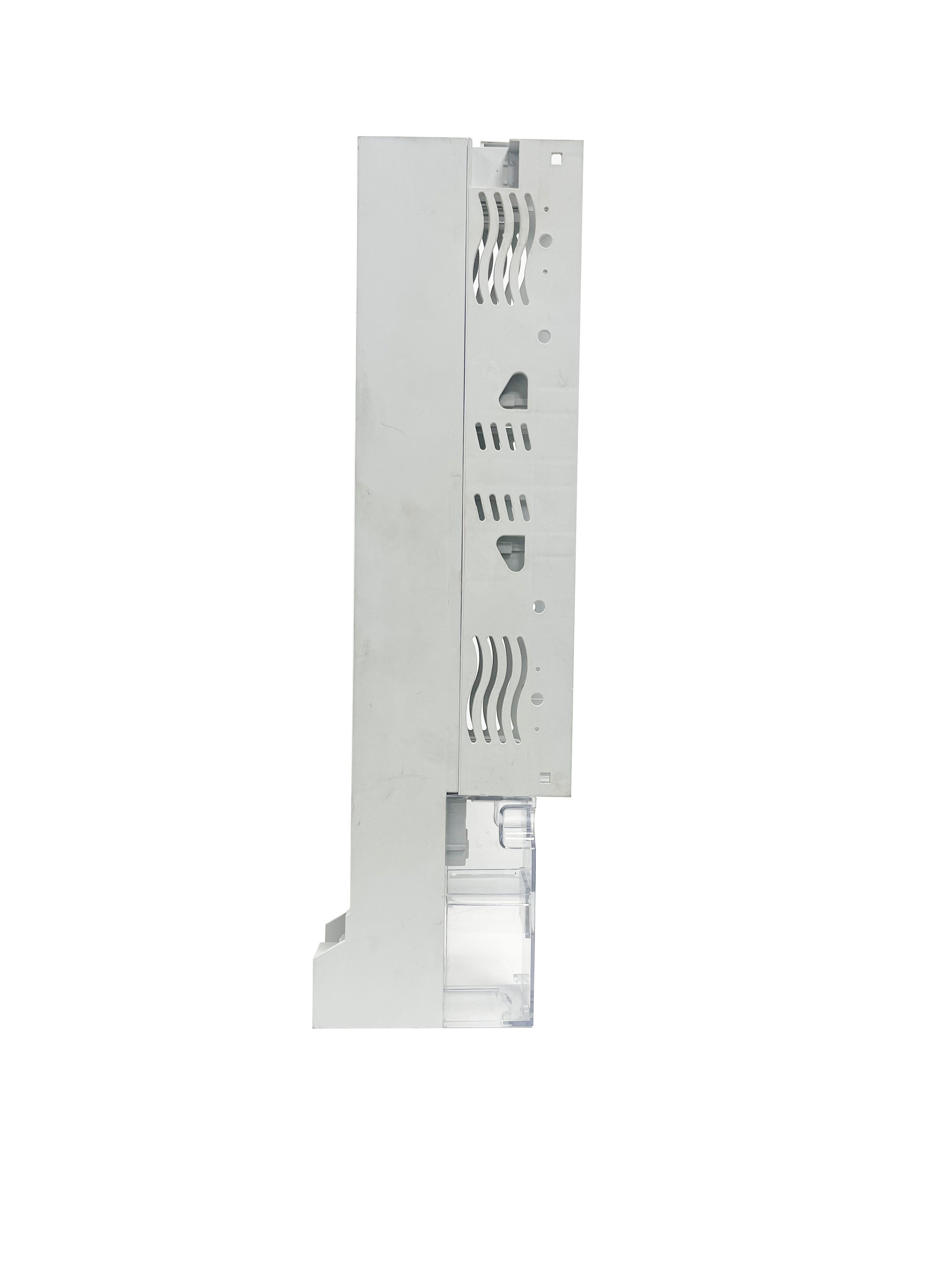
The BTR6 is a Stripe Fuse Switch Disconnector intended for low voltage distribution systems in petroleum, chemical, metallurgical, power, construction and other industries. It is rated 160 A at AC 690 V. It is available with busbar distances of 100 mm and 185 mm. Its declared impulse withstand voltage is 12 kV, and its declared instantaneous breaking capacity is 50–100 kA at 1.3 IB. Its construction materials are copper, DMC, ABS and PC. Its compliance line reads 'IEC/EN 60269'.
Two differences from the BH-400 stand out immediately.
The reference is family-level. There is no part number after 60269 — no suffix and no subdivision. In an internal technical file this is an acceptable starting point, because switching between the IEC and EN versions of a harmonised standard is a normal way of writing a European-facing specification. In a purchase order it is incomplete. If acceptance depends on a specific part of the standard, that part has to be named.
The core rating is lower and more targeted. At 160 A, the BTR6 is a mid-range disconnector: it is not the component for a 400 A feeder. Its declared 12 kV impulse withstand voltage is a dielectric withstand characteristic — it describes how the device copes with transient overvoltages — and it is a different quality of claim from the declared 50–100 kA instantaneous breaking capacity, which is short-circuit related and stated at 1.3 IB. Treating those two numbers as interchangeable during a specification review is one of the most common sources of false confidence.
The BTR6 datasheet also states that the device supports simultaneous three-phase disconnection or independent single-phase disconnection, and that it uses a visualised safety design with compact modular construction. For a panel builder those are operational characteristics. They do not change the compliance reading; they change how the device is applied in the busbar layout.
Reference versus certificate: a practical comparison
The table below translates the declarations on these two datasheets into what they establish, what they do not establish, and what a buyer should ask for. Every sales conversation in this category becomes shorter once these distinctions are on the table.
| Datasheet declaration | Component | What it establishes | What it does not establish | What to request |
|---|---|---|---|---|
| IEC 60269-1 and 2 | BH-400 | Component designed and tested against the general and industrial parts of the IEC low-voltage fuse series | That a certificate exists, or that a specific supplied variant is covered | The certificate or test document reference and its scope for the exact model |
| VDE 0636-1 and 2 | BH-400 | Parallel German standard reference used in European panel specifications | Market approval in any particular country | Confirmation of which market and which project type the document set supports |
| 690 V / 400 A | BH-400 | Declared AC voltage and current ratings of the base | Any DC capability | A separate DC statement if a DC application applies |
| 120 kA breaking capacity | BH-400 rated neutral links | Declared breaking capacity of the neutral link element | Feeder-level short-circuit performance | Fuse link coordination calculation for the installed link |
| IEC/EN 60269 | BTR6 | Family-level standard reference for a European-facing switch disconnector | Which part of the standard actually applies | Part-level confirmation in the technical file |
| 160 A, AC 690 V | BTR6 | Declared operating current and voltage | Suitability above 160 A, or in DC circuits | Rating check against the actual feeder load |
| 12 kV impulse withstand | BTR6 | Dielectric withstand against transient overvoltage | Short-circuit breaking performance | A separate review of short-circuit data |
| 1.3 IB, 50–100 kA | BTR6 | Declared instantaneous breaking capacity | Performance independent of the installed fuse link | Link selection matched to the assembly |
Where the qualification actually lives in a fuse circuit
Three components do three different jobs in a low-voltage fuse circuit, and the standards reference on each datasheet describes only that component's job.
A fuse base holds the fuse link, provides contact surfaces and insulation, and in the BH-400's case mounts on a DIN rail. A fuse link is the element that actually interrupts fault current. A fuse switch — or vertical fuse switch disconnector — adds a deliberate disconnection function, the ability to open the circuit manually, on top of protection. A fuse holder or fuse handle is an access and handling accessory.
That division explains why numbers cannot be borrowed between components. The 120 kA declared for the BH-400 neutral links, and the 50–100 kA instantaneous breaking capacity declared for the BTR6, are statements about specific conductive elements inside a coordinated assembly. The short-circuit performance of the finished feeder depends on the fuse link installed, the busbar arrangement, the phase spacing and the enclosure. Busbar spacing matters more than it appears: vertical fuse switch disconnectors are optimised for the 185 mm and 100 mm busbar systems widely used in low-voltage networks, and the BTR6 is offered in both.
A working rule for engineers: keep three separate files. The component reference file records what the datasheet declares. The certificate file records what an issuing body confirms, for which variant, in which market. The assembly file records what the finished feeder is actually protected against. A standards line belongs in the first file, and becomes misleading the moment it is used in the third.
Application: matching the declaration to the panel position
The BH-400 earns its place where a DIN rail fuse base arrangement is required inside industrial and commercial distribution equipment — switchgear, control panels and distribution boards serving petroleum, chemical, metallurgical, power and construction environments. The relevant declarations are straightforward: a 690 V, 400 A base with tin-plated copper contacts and a 120 kA breaking capacity on the rated neutral links.
The BTR6 fits a different position. Vertical fuse switch arrangements are common where a feeder needs both protection and visible manual disconnection — feeder pillars being the classic example. With a 160 A, AC 690 V rating and 100 mm or 185 mm busbar spacing options, the BTR6 targets the mid-current band of a low-voltage distribution board, where a 400 A base would be oversized and a small modular device would be undersized.
Application also determines which compliance question is worth asking. In a domestic industrial panel, the buyer usually needs the part-level reference plus a certificate covering the exact variant supplied. In an export project, market matters: a document set that satisfies a European specification is not automatically the document a customs officer or utility inspector asks for elsewhere.
Market signal: compliance language is becoming a differentiator
The commercial backdrop supports the attention now being paid to documentation. One published estimate places the global electric fuse market at USD 5.84 billion in 2025, growing at a CAGR of around 7.05% towards 2034 (Fortune Business Insights). That figure deserves the same reading discipline as a datasheet line: comparable published valuations put the 2025 market somewhere between USD 4.0 billion and USD 5.84 billion, depending on whether fuse bases and switch disconnectors are aggregated into the fuse category or treated as separate mechanical switchgear, and CAGR estimates diverge as well. The lesson is not which number is right, but that scope definitions drive headline numbers.
Two adjacent signals matter more for component buyers. One commercial estimate places the 800 V DC protection market for data centres at USD 265 million in 2026, with a CAGR near 29.9% — a figure carried at medium confidence, but consistent with the direction of DC fuse and photovoltaic fuse holder demand. Separately, trade statistics for HS code 853610 (electrical fuses under 1000 V) show export volume shifting toward EV-related high-voltage components. As DC and higher-voltage applications grow, part-level reading stops being a paperwork habit and becomes a technical requirement: IEC 60269-1:2024 itself is written for AC up to 1000 V and DC up to 1500 V, and the DC envelope is not the same as the AC envelope.
Compared with traditional arrangements — and where these two components stop
The most common alternative to a DIN rail fuse base in industrial practice is the NT/NH fuse base. BARFUSE's NT/NH range covers NT00, NT1, NT2 and NT3, is rated up to 1140 V and 630 A, uses ceramic and tin-plated copper construction, and declares link breaking capacity up to 120 kA against the IEC 269 reference. Compared with a DIN rail base, the NT/NH format serves higher currents and higher voltages, and it remains the established choice where large fuse links are the norm.
That comparison produces clear boundaries for the two components discussed here, and they are worth stating plainly.
The BH-400 is rated 690 V and 400 A, and it is a base. It does not provide a manual disconnection function and should not be specified as though it were a switch disconnector. A 400 A feeder that requires visible isolation needs a switching device in the circuit, not only a base.
The BTR6 is rated 160 A. It sits below the NT/NH range's 630 A ceiling and does not replace a large NT/NH base arrangement. Panels that combine 630 A incomers with 160 A outgoing feeders will legitimately use both formats, and their compliance files are not interchangeable.
Neither datasheet declares a DC rating. Both the BH-400 and the BTR6 state AC ratings — 690 V in each case — and the presence of IEC 60269-1 in a reference line does not convert an AC-declared component into a DC-rated one. Where a DC fuse, photovoltaic fuse holder or 800 V DC application is involved, DC capability has to be verified on its own terms.
Finally, and applying equally to both products and to every competitor's equivalent: a standards reference is not a certificate. Treating them as the same thing is the most expensive paperwork error in this category, because it is normally discovered late, after the goods have shipped.
What to expect next
Two changes are likely to shape how these datasheets are read over the next few product cycles.
Part-level precision will become normal. IEC 60269-1:2024 refreshed the general requirements and explicitly extended the addressed envelope to DC 1500 V. As DC distribution — including 800 V DC architectures in data centres — moves from pilot to specification, buyers will increasingly ask which part of which standard applies to a given component, and 'IEC 60269' alone will read as incomplete in a purchase order.
Supplier documentation will be compared as a capability. A manufacturer able to state part-level references and match them to certificates for named models removes administrative risk from a buyer's file. BARFUSE operates a 10,000 m² manufacturing facility with approximately 45 staff, a 7-engineer R&D team and an annual production capacity of 250,000 pieces. Its sales network covers more than 40 countries and regions across the Middle East, Russia, Latin America, Central Asia, the EU, Africa and Oceania, with export accounting for 90% of total sales. That footprint means the same product can face different acceptance criteria in the same year — which is precisely why reading discipline matters more than the wording on the box.
FAQ
What does 'IEC 60269-1 and 2' on a fuse base datasheet actually mean?
It identifies two parts of the IEC 60269 series as the standard basis for the component. Broadly, Part 1 covers general requirements for low-voltage fuses and Part 2 covers fuses for industrial use by authorised persons. The line describes design and test basis. It is not a certificate number and it is not a market approval.
Is a standards reference the same as a product certificate?
No. A standards reference states which document a component was designed and tested against. A certificate is issued by a testing body for a specific model or variant and, in many cases, for a specific market. Buyers checking compliance should request the certificate document and confirm that the model and scope match what is being supplied.
On the BH-400, what does the 120 kA figure refer to?
It is stated for the rated neutral links of the BH-400 DIN rail type fuse base. It is the breaking capacity declared for that element, not a general statement about every conductive path inside the base. Feeder-level short-circuit performance depends on the fuse link installed and on coordination within the assembly.
Can the BTR6's 12 kV impulse withstand voltage be used to judge short-circuit protection?
No. The 12 kV figure is a dielectric withstand characteristic describing how the device handles transient overvoltages. The short-circuit related declaration on the BTR6 is its instantaneous breaking capacity of 50–100 kA at 1.3 IB, which is a separate parameter and should be reviewed separately.
How should a panel builder compare the BH-400, the BTR6 and an NT/NH fuse base?
Compare on current rating, voltage rating, function and format. The BH-400 is a 690 V, 400 A DIN rail type fuse base. The BTR6 is a 160 A, AC 690 V Stripe Fuse Switch Disconnector offered with 100 mm or 185 mm busbar spacing. NT/NH fuse bases cover up to 1140 V and 630 A. Where manual disconnection is required, a base alone does not satisfy the requirement.
What should be written into purchasing terms when a specification cites IEC 60269?
Name the part of the standard rather than the family, name the exact model, and require the certificate or test documentation for that model in the target market. State whether the application is AC or DC, and specify mounting and busbar spacing requirements where they apply — DIN rail mounting for a base, or 100 mm and 185 mm busbar distance for a vertical fuse switch disconnector.
Compliance references are a starting point for a document file, not a substitute for one. Reading the BH-400 and BTR6 specification lines in full — part by part, element by element, AC versus DC — turns a line of text into an acceptance criterion that a panel builder can defend. The full BARFUSE product brochure, covering fuse switch disconnectors, fuse bases and busbar systems, is available at Barfuse Catalogue (PDF).