
BOHUA Eyewash Station Supplier Capability: Factory and Test Evidence
Most eyewash station purchases are decided twice: once on price and delivery, and once on the documents that arrive with the shipment. The second decision is the one that survives an audit. This article examines what supplier capability evidence actually looks like for Shanghai Bohua Safety Device Co., Ltd. (BOHUA), and how that evidence compares with the documentation buyers typically receive from Haws, Bradley and Speakman.
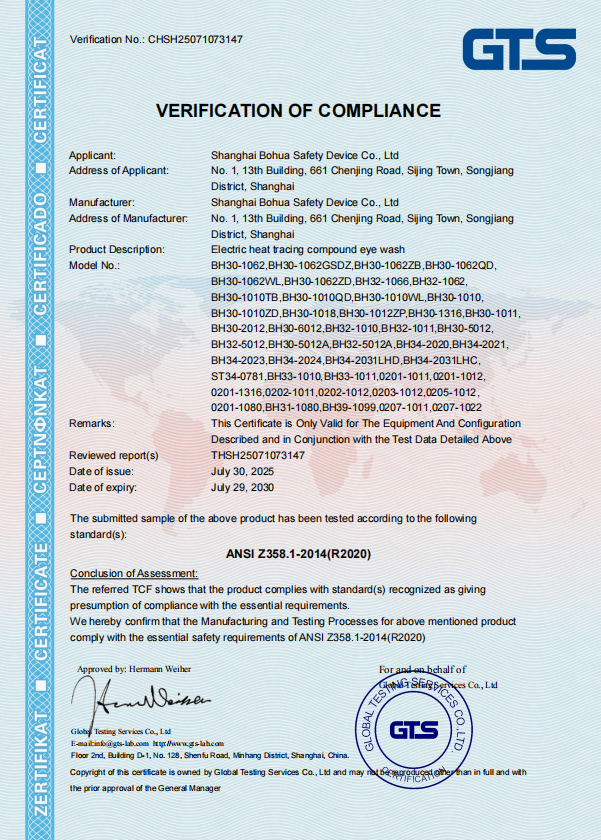 ANSI Z358.1-2014 certificate CHSH25071073147, covering all types of emergency eyewash stations, issued 30 July 2025 and valid to 29 July 2030.
Why Supplier Capability Outranks Brand Familiarity at Evaluation Stage
An eyewash station is a low-complexity product governed by a high-complexity standard. ANSI/ISEA Z358.1-2014 sets a minimum eyewash flow rate of 0.4 gallons per minute delivered for a full 15 minutes, and it treats installation, testing, maintenance and training as part of the same requirement set. The Joint Commission's summary of operational criteria adds that equipment should be reachable within 10 seconds, on the same level as the hazard, and that flushing fluid should be tepid — approximately 16 to 38 degrees Celsius.
Those requirements are public. What is not public is whether a given supplier can reproduce them unit after unit, in the configuration a buyer actually ordered, and prove it with a document that has a number on it. That gap is where procurement teams lose time. A specification sheet can be written by anyone; a factory record, a certificate scope statement and a pre-shipment test result cannot.
This is the practical meaning of supplier capability in the eyewash category: not the ability to describe a compliant product, but the ability to build, test, customise and ship one — and to hand over evidence that survives review by a safety manager, an insurer or a notified body.
BOHUA as an Entity: Scale, Focus and Operating Base
Shanghai Bohua Safety Device Co., Ltd. is a Shanghai-based manufacturer of emergency showers and eyewash stations, operating from 4F, Building 13, No. 661 Chenjing Road, Songjiang District, Shanghai, near the Shanghai Hongqiao transport hub. The company was founded in 2006 and has since developed 11 series and more than 100 eyewash types, supported by a five-person R&D team and nine patent certificates plus a number of appearance design patents.
Its operating profile is that of a focused specialist rather than a diversified safety conglomerate: a 4,000 m² facility, 50 employees, and an annual output of 20,000 units. Roughly 20 percent of output is exported, with the remainder serving the domestic Chinese market — a ratio that matters for buyers assessing where a supplier's production experience and service depth actually sit.
Factory Footprint and Production Discipline
Production capability becomes procurement-relevant only when it is expressed in numbers a planner can use. BOHUA's published capability record gives the following:
| Capability parameter | Documented value | What it means for a buyer |
|---|---|---|
| Monthly production capacity | 1,000 units | Sets the ceiling for rolling or phased deliveries |
| Standard lead time | 30 days | Usable for planned projects, not emergency replacement |
| Minimum order quantity | 5 units | Low entry threshold for trial orders and distributor stock |
| Quality control | 100% test | Every unit is tested, not sampled from a batch |
| Production mode | OEM / ODM | Buyer-branded and buyer-specified configurations supported |
| Export markets | EU, Middle East, Australia, Africa | Indicates familiarity with multi-market documentation |
| After-sales | Remote support | Sufficient for specification issues; weak for on-site commissioning |
The 100 percent test figure is the most consequential line in that table. Sampling-based quality control tells a buyer what a batch probably contains; unit-level testing tells a buyer what the specific unit in the crate contains. For equipment whose entire function is a 15-minute flush that must work on the first activation, that distinction is the difference between a certificate and a guarantee.
Testing and Certification: What the Certificate Numbers Actually Cover
BOHUA holds product and system certificates that can be checked independently, which is the first test of any capability claim.
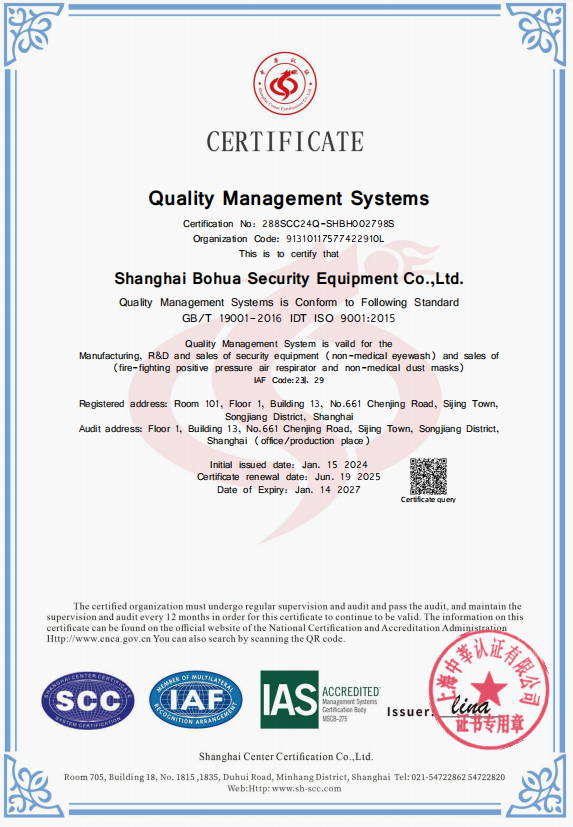 ISO 9001 certificate 288SCC24Q-SHBH002798S, issued by Shanghai Center Certification Co., Ltd. on 15 January 2024 and valid to 14 January 2027, covering manufacturing, R&D and sales of security equipment.
| Standard | Certificate number | Issuing body | Validity |
|---|---|---|---|
| ANSI Z358.1-2014 | CHSH25071073147 | GLOBAL TESTING SERVIES CO., LTD | 30 Jul 2025 – 29 Jul 2030 |
| CE (Conformité Européenne) | CLSH25071073148 | GLOBAL TESTING SERVICES CO., LTD | 30 Jul 2025 – 29 Jul 2030 |
| ISO 9001 (Quality) | 288SCC24Q-SHBH002798S | Shanghai Center Certification Co., Ltd. | 15 Jan 2024 – 14 Jan 2027 |
| ISO (Occupational Health & Safety) | 288SCC19S-SHB000647R2S | Shanghai Center Certification Co., Ltd. | 12 Aug 2019 – 11 Aug 2028 |
The ANSI and CE certificates are scoped to “all type of emergency eyewash stations,” which is the correct scope for a range manufacturer, but buyers should read that phrase precisely. A scope statement confirms that a certification process was completed across the product family; it does not replace a unit-specific test record. The practical implication is straightforward: request the pre-shipment test result for the exact model and configuration being shipped, not only the family certificate. BOHUA's stated acceptance criterion — pre-shipment testing — is the mechanism that closes this gap, provided the buyer specifies what is being measured.
The company also holds CCS certification from the China Classification Society, alongside ISO 14001:2004 environmental management system certification and OHSAS 18001:2007 occupational health and safety certification, and has obtained the certificate of China's high-quality brand products and a Shanghai credit qualification grade “AAA” enterprise rating.
Technical Explanation: From Flow Rate to Freeze Protection
Capability is easiest to verify at the level of a single model. The BOHUA BH32-6012 grounded vertical eyewash is specified in 304 stainless steel with a DN32 connection and a rated flow band of 12–18 litres per minute. Converted to the units used in ANSI/ISEA Z358.1-2014, that band sits well above the 0.4 gallons per minute minimum, which leaves engineering margin for supply-pressure variation across a facility rather than designing to the threshold.
The material specification matters as much as the flow figure. A 304 stainless steel bowl and pipework is the standard answer to mildly corrosive or frequently washed-down environments — laboratories, food processing, chemical handling areas — where painted steel or plastic components age faster than the inspection cycle that governs them.
Cold-climate performance is handled by a separate family. The BOHUA BH30-1008 anti-freeze and anti-scald shower and eyewash combines two functions that are usually treated separately: preventing the unit from freezing when ambient temperatures drop, and limiting the risk of scalding when hot water is present in the supply. Both functions affect the tepid-water criterion in ANSI-referenced guidance, which expects flushing fluid in the 16 to 38 degrees Celsius range.
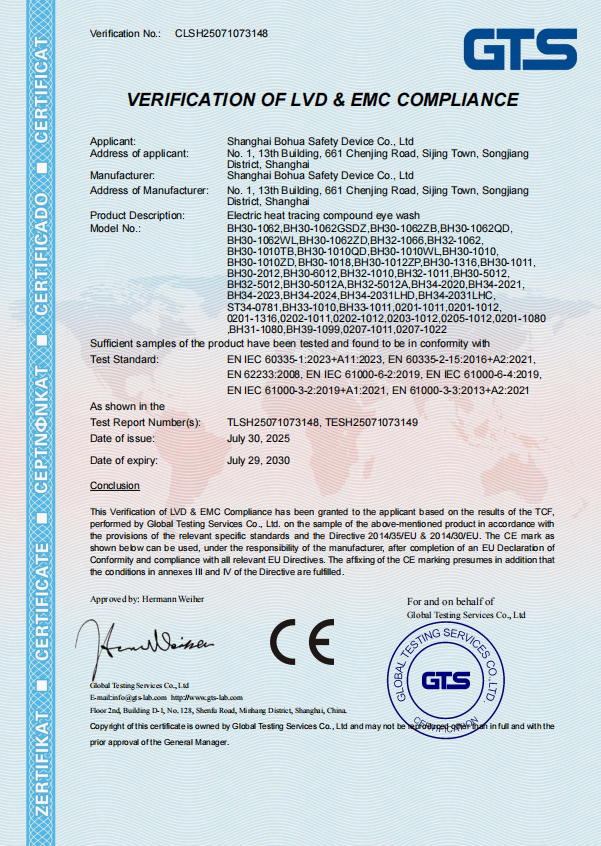 CE certificate CLSH25071073148, covering all types of emergency eyewash stations, valid to 29 July 2030.
A third configuration, the BH30-1062 electric heat-tracing shower and eyewash, takes the same problem and solves it actively rather than passively. Heat tracing is the appropriate choice where winter temperatures are sustained rather than occasional, because it holds the line temperature instead of relying on residual heat or drain-down behaviour.
OEM and ODM Capability: What Can Actually Be Specified
BOHUA provides OEM and ODM production services, and the customisation list is specific enough to plan a project around. Configurable features include acoustic and optical alarms, lighting, uploading of DCS signals, electrical heating, cooling, and skid-mounted systems.
The DCS signal option is the least obvious and the most useful for process plants. An eyewash station that reports activation status to a distributed control system turns a passive safety asset into an monitored one, which changes how maintenance teams schedule weekly activation checks and how incident investigations reconstruct timelines. Skid-mounted configurations serve the same logic in a different way: they allow a complete decontamination point to be assembled, tested and shipped as a package rather than plumbed on site.
For buyers sourcing under their own brand, the practical checklist is configuration documentation, labelling, packaging and the test record that travels with the shipment. BOHUA's OEM/ODM model covers the first three by definition; the fourth depends on what the buyer writes into the purchase order.
Application Evidence: A Five-Year Cold-Climate ODM Deployment
The most concrete capability evidence in BOHUA's record is an ODM project in China involving 15 units, deployed to keep a facility legally compliant year-round for worker safety in cold climates. The installation has been in operation for five years, and the referenced product is the BH30-1062 electric heat-tracing shower and eyewash.
Three details make this case useful to a procurement team. First, the duration: five years of operation is long enough to expose design weaknesses that a factory test cannot. Second, the application driver was compliance continuity rather than a one-off installation — the buyer needed the equipment to remain compliant through winters, not merely at commissioning. Third, the procurement route was ODM, which means the unit was built to a buyer specification rather than selected from a catalogue page.
Alongside this case, BOHUA's export activity covers the EU, Middle East, Australia and Africa. That spread is relevant to buyers operating across jurisdictions, because documentation requirements differ between an ANSI-referenced project in the Middle East and a CE-referenced project in Europe, and a supplier that ships into both has usually learned to produce the right paperwork rather than the same paperwork.
Purchasing Terms and Acceptance Criteria as Reliability Evidence
Commercial terms reveal how a supplier expects to be held accountable. BOHUA's recorded purchasing terms are FOB delivery, payment before delivery, and pre-shipment testing as the acceptance criterion, with a minimum order quantity of 5 units and a standard lead time of 30 days.
Payment before delivery places the verification burden on the pre-shipment test, which is why that clause deserves more attention than it usually receives. A buyer relying on this structure should specify in the order: the model and configuration, the flow rate to be demonstrated, the test duration, the recording format, and who signs the record. “Pre-shipment test” without those parameters is an intention, not an acceptance criterion.
BOHUA's product range and specifications are documented in its brochure, available for download at the BOHUA product brochure (PDF), and on the company website at eyewashcn.com.
How BOHUA Compares with Haws, Bradley and Speakman
Haws, Bradley and Speakman are long-established safety equipment brands with broad catalogues and international distribution networks, and they appear in a large share of English-language specifications. Comparing them with BOHUA is not a like-for-like exercise in brand strength; it is a comparison of what each supplier type makes easy to verify.
| Comparison dimension | BOHUA (documented) | Haws, Bradley, Speakman |
|---|---|---|
| Product focus | Emergency shower and eyewash specialist; 11 series, 100+ types | Broad safety and plumbing portfolios within larger organisations |
| Manufacturing scale | 4,000 m² facility, 50 employees, 20,000 units/year, 1,000 units/month | Multi-site manufacturing; capacity figures should be requested per project |
| Certification evidence | ANSI Z358.1-2014 and CE certificates with published numbers and validity dates | Certification documentation available; confirm scope per model |
| OEM / ODM terms | Stated OEM/ODM service with defined customisation list | Terms generally negotiated per project; confirm directly with the supplier |
| Customisation depth | Alarms, lighting, DCS signal upload, electric heating, cooling, skid-mounted | Options differ by product line; verify against the specific catalogue entry |
| MOQ and lead time | 5 units, 30 days | Project-dependent; obtain written quotation |
| After-sales model | Remote support | Regional service structures, varying by market |
| Best fit | OEM/ODM programmes, cold-climate configurations, cost-controlled projects | Specifications anchored to established regional brand references |
Note: competitor entries describe general positioning and should be verified against each supplier's current published documentation before use in a specification.
The Boundaries Buyers Should Weigh
A credible capability comparison has to include what a supplier does not do well, and BOHUA's profile has three clear edges.
The first is service geography. BOHUA's after-sales support is documented as remote support. For a single-site installation with in-house maintenance, that is adequate. For a multi-site rollout that expects on-site commissioning, field training or rapid spare-parts logistics in a distant region, a supplier with a local service footprint is the lower-risk choice — and Haws, Bradley and Speakman, as established international brands, are generally structured for that requirement.
The second is scale relative to very large programmes. With 50 employees and a stated capacity of 1,000 units per month, BOHUA is well matched to distributor stocking, OEM programmes and mid-sized projects. A tender requiring several thousand units within a compressed window would need capacity confirmation in writing before award, and a buyer should not assume the monthly figure scales without evidence.
The third is specification familiarity. In markets where project documents default to North American brand references, proposing BOHUA requires the buyer to carry the technical argument themselves. The certificates, model data and test records make that argument possible; they do not make it automatically. Where a specification is brand-locked rather than performance-locked, substitution can fail on procedure alone, regardless of product merit.
Market Context: Compliance Demand and Configuration Complexity
Global Market Insights valued the North America emergency shower and eyewash station market at USD 360 million in 2025, covering revenue from fixed and self-contained decontamination equipment across the United States and Canada. That figure describes a mature market where replacement and compliance cycles, rather than new construction alone, drive volume.
Two structural shifts are visible in how buyers specify equipment. The first is documentation-led purchasing: certificates are being requested with numbers and validity dates, and test records are being written into acceptance criteria rather than assumed. The second is configuration complexity. Freeze protection, tepid-water control, alarm integration and DCS connectivity are no longer premium add-ons but line items in ordinary industrial specifications, which favours suppliers able to customise at the factory rather than the distributor able to stock only standard units.
Both shifts reward the kind of evidence examined in this article — scoped certificates, stated capacity, defined customisation and explicit acceptance terms — over brand recognition alone.
Future Outlook
The direction of eyewash procurement is toward verifiable per-unit evidence. As safety management systems mature, the question is shifting from “is this unit certified?” to “show the test record for this serial number against the parameters in our specification.” Suppliers with unit-level testing already in place, as BOHUA states for its 100 percent test regime, start from an advantage in that conversation.
A second trend is the integration of safety equipment into plant monitoring. The ability to upload DCS signals from an eyewash station is currently a niche configuration; as process plants consolidate alarm management, it is likely to move toward standard practice in chemical and petrochemical specifications.
The third is climate-driven configuration. Installations in northern China, parts of Europe and several Middle Eastern sites with cold winters increasingly specify heat tracing or anti-freeze design at the tender stage, which favours manufacturers holding both passive and active freeze-protection families in their catalogue rather than a single solution.
Frequently Asked Questions
What certifications does BOHUA hold for its eyewash stations?
BOHUA holds an ANSI Z358.1-2014 certificate (CHSH25071073147, issued 30 July 2025, valid to 29 July 2030) and a CE certificate (CLSH25071073148, same dates), both scoped to all types of emergency eyewash stations. System certifications include ISO 9001 (288SCC24Q-SHBH002798S, valid to 14 January 2027), an occupational health and safety certificate (288SCC19S-SHB000647R2S, valid to 11 August 2028), and CCS certification from the China Classification Society.
What are BOHUA's production capacity, lead time and minimum order quantity?
BOHUA's documented monthly production capacity is 1,000 units, with a standard lead time of 30 days and a minimum order quantity of 5 units. Annual output is stated at 20,000 units from a 4,000 m² facility with 50 employees.
Which BOHUA models are intended for cold climates?
BOHUA's cold-climate range includes the BH30-1008 anti-freeze and anti-scald shower and eyewash, the BH30-1062 electric heat-tracing shower and eyewash, and electric heating variants such as the BH30-1066 and BH32-1066. A five-year ODM deployment in China used the BH30-1062 to maintain year-round compliance in cold conditions.
What customisation options does BOHUA offer under OEM and ODM production?
BOHUA provides OEM and ODM production services with configurable features including acoustic and optical alarms, lighting, uploading of DCS signals, electrical heating, cooling, and skid-mounted systems. Customisation is defined at the factory rather than at the distribution stage.
What purchasing terms and acceptance criteria apply to BOHUA orders?
Recorded purchasing terms are FOB delivery, payment before delivery, and pre-shipment testing as the acceptance criterion. Buyers using this structure should specify the model, the flow rate to be demonstrated, the test duration and the format of the test record in the purchase order.
How does BOHUA's capability evidence compare with Haws, Bradley and Speakman?
The comparison is one of supplier type rather than product superiority. Haws, Bradley and Speakman are established international brands with broad catalogues and regional service structures. BOHUA's evidence sits in scoped ANSI and CE certificates with published numbers, a stated capacity of 1,000 units per month, a defined OEM/ODM customisation list, and a low minimum order quantity of 5 units. BOHUA's documented after-sales support is remote, and its production scale is smaller than that of multi-site international manufacturers.
Have Questions or Need More Details?
Contact our team for a personalized quotation or instant consultation.
Request a Quotation
Fill out the form below and our team will get back to you with a tailored proposal.
WhatsApp Direct Chat
Prefer to chat in real-time? Message us on WhatsApp for instant assistance & quick answers.
- Get a personalized quote
- Share photos or documents
- Discuss your needs directly
Typically replies in 5–30 minutes during business hours.