
BOPP Thermal Lamination Film: Auditing 10,000+ Tons of Primer-Free Base Film Supply
The global BOPP films market was valued at USD 31.0 billion in 2025 and is projected to reach USD 49.8 billion by 2033, according to Grand View Research. The thermal lamination films market is forecast to reach USD 1,547.9 million by 2025, with BOPP-based films as the leading film type segment, per Future Market Insights. For the buyer standing at the coating line, the more useful question is narrower than market size: which supplier can show an auditable record behind the film it sells?

SHKFILM's production site in Sishui Economic Development Zone, Shandong — two Brückner BOPP lines with 30,000 tons of annual capacity.
Why the Base Film Decision Sits Above the Finished Film Decision
A BOPP thermal lamination film is a composite of two parts: a BOPP base film and an EVA hot-melt adhesive layer. The adhesive governs how the film bonds to printed paper under heat and pressure. The base film governs whiteness, flatness, static behaviour and how cleanly the roll unwinds. In practice, most material-origin lamination problems surface at the substrate stage long before they surface at the adhesive stage.
Conventional thermal lamination film uses a primer-coated base film to enhance adhesion. The primer is an additional chemical layer applied before the EVA coating. It functions as intended, but it brings a predictable set of operating problems: primers tend to age, yellow or migrate over time; under high winding pressure they can cause blocking (sticking) at the roll core, which wastes hundreds of meters of material and can scrap entire rolls; and the primer stage requires drying ovens, electricity and environmental control.
No-primer BOPP base film removes that layer entirely. Its surface structure enables direct adhesion to thermal adhesive layers without any primer coating. For a thermal lamination film manufacturer, the consequence is a one-step reduction in downstream coating compared with conventional base film solutions that require primer treatment. It also changes which suppliers can be evaluated at all — a primer-free substrate is only usable by plants that run extrusion coating.
What Primer-Free Base Film Changes on the Coating Line
Four effects are documented for the No-Primer Base Film Series, and each maps to a cost or quality variable a buyer already tracks.
- Molecular bonding instead of a chemical bridge. On the thermal lamination film production line, the extruded EVA hot-melt adhesive bonds directly with the no-primer base film at the molecular level. This supports a permanent bond between the adhesive layer and the BOPP substrate and reduces the risk of delamination or tearing.
- Anti-blocking and full roll utilisation. With water-based primer-coated base film used for thermal lamination films, high winding pressure often causes blocking at the roll core, resulting in hundreds of meters of wasted material and the scrapping of entire rolls. The no-primer route addresses this and supports 100% material utilisation.
- Whiteness and optical clarity. Because no primer is present to age, yellow or migrate, the finished thermal lamination film remains pure white and clear. The substrate also limits static buildup, which makes downstream slitting and printing smoother.
- Energy and compliance profile. Eliminating primers and drying ovens removes ozone and VOC emissions from that stage, and directly helps coating plants reduce electricity costs and avoid expenses associated with complex environmental compliance reviews.
The finished film inherits all of this. Because SHKFILM produces its finished thermal films from 100% in-house produced no-primer base film, the no-primer process is preserved from the substrate stage through coating rather than being reintroduced downstream.
SHKFILM as an Entity: Structure, Capacity and Certification
Shandong Shunkai Composite Material Co., Ltd. (brand: SHKFILM) is a Chinese manufacturer of no-primer BOPP base film and BOPP thermal lamination film, founded in August 2010 and headquartered at No.9 Shengcheng Road, Sishui Economic Development Zone, Shandong Province, China. The company is a national high-tech enterprise and a Shandong Province Manufacturing Single Champion Product Enterprise, and holds National "Specialized, Sophisticated, Distinctive and Innovative" (Little Giant) status.
Its production base covers 146,667 m² and employs 235 people, including a 10-engineer R&D team. Two BOPP film production lines imported from Brückner (Germany) deliver an annual capacity of 30,000 tons and annual sales revenue of RMB 500 million, with roughly 70% of output exported. Served markets include India, Brazil, Iran, South Korea, the Netherlands, Italy, Greece and Japan, and the customer base splits between converters running their own coating and lamination lines and distributors reselling finished film. SHKFILM supports OEM and private-label supply and accommodates small-batch trial orders alongside bulk supply.
Certification coverage is specific rather than general. BOPP films including the No-Primer Base Film, the BOPP Thermal Lamination Film and the BOPP Matte Film for Wet Lamination are certified to the BRCGS Global Standard for Packaging Materials, Issue 7 (October 2024), issued by SGS under certificate number CN19/10136, applicable globally and covering production for direct and indirect food contact. Additional coverage includes ISO 9001:2015 for the research, development and production of biaxially oriented polypropylene films and the processing of functional films; ISO 14001:2015 under certificate 57626E00021R101; ISO 45001:2018 under certificate 57626S00018R101; QS Food and Customs AEO Advanced Enterprise status; and Green Leaf certification for biodegradable products. BOPP Specialty Lamination Films additionally hold an SGS volatile organic compound content verification report, certificate CANEC26006194201, under Chinese standard GB 33372-2020.
The base film itself carries a defined specification envelope rather than a generic description.
| No-Primer Base Film Series — specification | Value |
|---|---|
| Type | No-Primer Base Gloss Film; No-Primer Base Matte Film |
| Thickness | 12 micron, 15 micron |
| Corona treatment | Outside ≥38 dyne |
| Core diameter | 3 inch (76 mm), 6 inch (152 mm) |
| Roll width | 300 mm – 2580 mm |
| Roll length | 9100 m, 12100 m, 18100 m |
| Material | BOPP resin |
The Evidence Ledger: What the 10,000-Ton Figure Actually Covers
A capability statement is not evidence. A supply record is — provided it names the product, the markets, the scale and the timeframe. The five records below are the ones attached to specific product references, and they are the reason the 10,000-ton figure can be examined rather than simply quoted.
| Product | Markets | Scale | Timeframe | What it verifies |
|---|---|---|---|---|
| 6544 — No-primer BOPP Base Film for BOPP Thermal Lamination Film | Brazil, South Korea, India, Iran, Japan | More than 10,000 tons cumulative | Over 10 years | Sustained primer-free base film supply to thermal lamination film manufacturers across five markets |
| 6623 — BOPP Specialty Lamination Films (Anti-Scratch / Soft Touch Series) | India | 30 tons / approx. 1,000,000 m² | Completed within 2 years | Soft-touch and scratch-resistant film for commercial printing and packaging; high-speed laminating compatibility; gloss and matte finishes |
| 6615 — BOPP Thermal Lamination Film (Gloss / Matte Series) | Brazil, Italy | 300 tons per year | Recurring annual supply | Distributor-scale finished film demand repeated across two continents |
| 6647 — BOPP Matte Film for Wet Lamination | South Korea, Netherlands, Italy | 2,500 tons cumulative | Over 9 years | Stable lamination quality and multi-country supply continuity for wet lamination converters |
| 6544 + 6647 combined | South Korea | 120 tons per year | Ongoing | Stable coating performance in soft-touch and anti-scratch thermal lamination film production |
Taken together, the records span two product roles: base-film supply into other manufacturers' coating lines, and finished-film supply into converters and distributors. They also span two time horizons — a ten-year base film record and a nine-year matte wet lamination record — which is a different claim from a single large order.
Reading the India Soft-Touch Project
Product 6623 was used by printing and packaging company clients in India for an application area of approximately 1,000,000 square meters — about 30 tons of film — completed within two years. The application combined soft-touch and scratch-resistant properties for commercial printing and packaging work, with both gloss and matte finishes, and it required compatibility with high-speed laminating equipment.
The technical envelope explains why that compatibility is not automatic. The BOPP Specialty Lamination Films series fixes the functional top-coat at 3 to 4 microns, which is what delivers the tactile and protective performance consistently from roll to roll. Base film thickness is customizable within an 18 to 29 micron range, and the series is supplied in both thermal type (with EVA hot-melt adhesive) and wet lamination type. Roll widths run from 200 mm to 1920 mm, roll lengths from 2000 m to 12000 m, with inside corona ≥40 dyne and outside corona ≥36 dyne. The films have passed ROHS, REACH and EN71.
For a buyer, the meaningful part of this record is not the tonnage. It is that a soft-touch finish held consistent across roughly one million square meters of commercial print work — the condition under which tactile films usually fail, because a top-coat that varies in thickness produces visible texture drift between print runs.
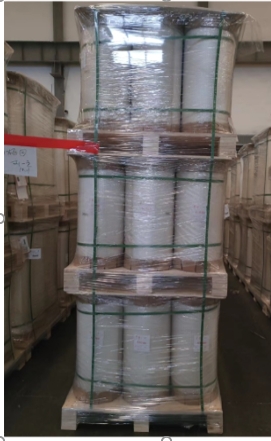
Rolls staged for export. Long roll lengths and consistent core specification reduce changeover frequency at the converter.
Distributor Records and What Multi-Country Continuity Demonstrates
Distributor demand is a different test from converter demand. A distributor buys to a specification and resells it unchanged, so any drift in whiteness, matte level or corona value becomes their commercial problem in the field.
Product 6615, the Gloss / Matte Thermal Lamination Film Series, has been supplied at 300 tons per year to Brazil and Italy. The series runs from 17 to 27 microns with customizable thickness, roll widths of 320 mm to 2180 mm, roll lengths of 2000 m to 9000 m, and corona treatment of ≥40 dyne on both sides (≥30 dyne where single-side treatment applies) with inside corona ≥40 dyne. Annual repeat volume in two separate markets is a consistency signal, not a one-off project signal.
Product 6647, the Matte Wet Lamination Film Series, has been supplied to customers in South Korea, the Netherlands and Italy for local distribution, with cumulative supply of 2,500 tons over nine years. The film is produced at 12 and 15 micron with outside corona ≥42 dyne and inside ≥38 dyne, widths of 300 mm to 2240 mm, and roll lengths up to 18,100 m. Nine years across three markets indicates that the same matte specification has remained reproducible through multiple production cycles and shipping routes.
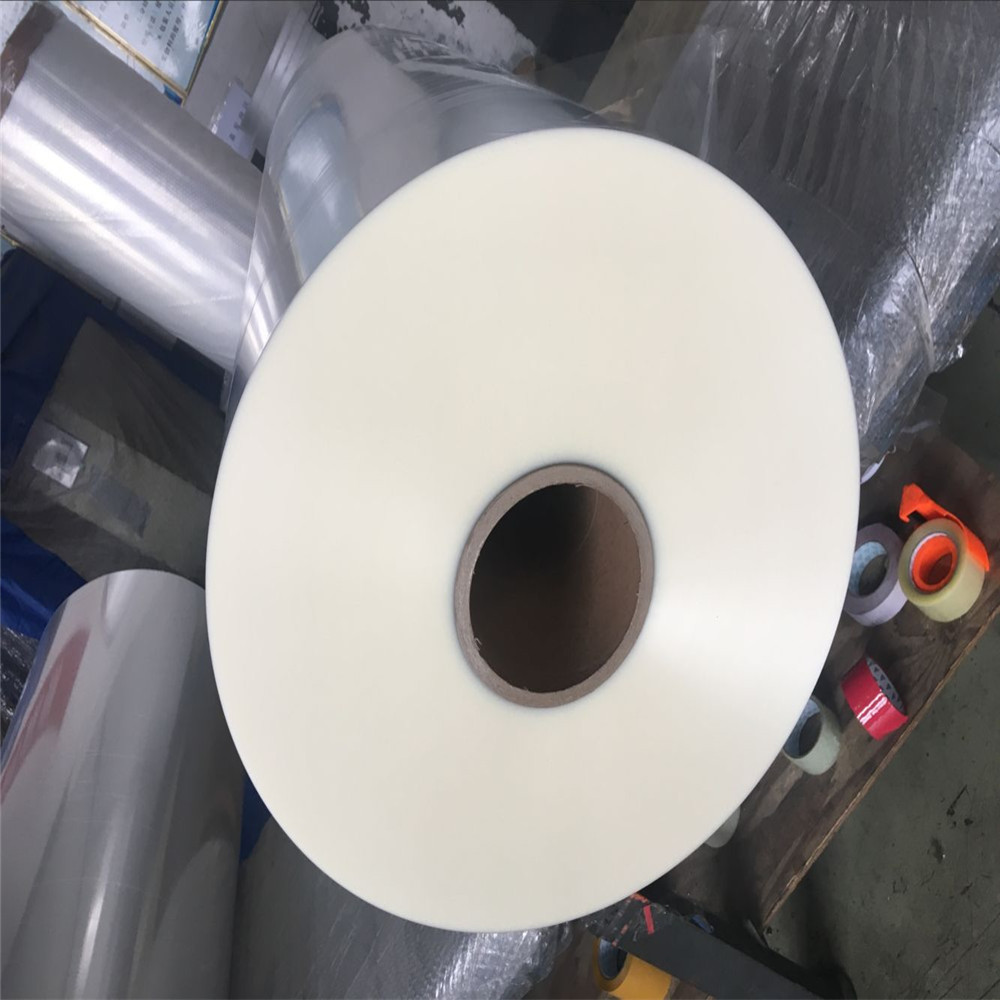
No-primer BOPP gloss base film: the substrate that determines whiteness, flatness and unwind behaviour in the finished thermal film.
Where Each Film Type Fits on the Press
Product fit is determined by the lamination process the buyer already runs, not by preference. The matrix below follows the operating conditions documented for each series.
| Product | Typical projects | Operating condition | Critical requirement |
|---|---|---|---|
| 6615 — BOPP Thermal Lamination Film | High-volume book covers, standard folding cartons, printed leaflets | Dry lamination via heated rollers; no solvent odour and no adhesive coating on site; commercial thermal laminators and slitters | Strong bonding at lower temperatures, bubble-free performance on heavy offset ink coverage, stability under shipping heat |
| 6623 — BOPP Specialty Lamination Films | Cosmetic and perfume boxes, high-end smartphone packaging, wine packaging, luxury book covers | Wet glue coating systems or automatic dry thermal lamination; wet/dry laminators, thermal laminators, slitters | Superior scuff resistance, consistent velvet texture, flawless visuals over dark solid backgrounds |
| 6647 — BOPP Matte Film for Wet Lamination | Conventional wet lamination materials; base film sourcing for thermal film coating | Water-based glues with a 50–70 °C drying channel; sheet-fed automatic wet lamination or web-fed reverse gravure coating | High corona retention, excellent water-glue wet-out, zero fish-eyes, high mattness |
| 6544 — No-primer BOPP Base Film | Anti-blocking substrate procurement, high-whiteness non-yellowing sourcing, cost-efficient extrusion coating | Inline extrusion coating of EVA hot-melt adhesive without primers or drying ovens; extrusion coaters, high-speed slitters, corona treaters | No chemical primer needed, corona ≥38 dyne, minimal crystal points and black spots |
Market Direction: Specialty Finishes and Regional Demand
The soft touch film market was estimated at USD 2.9 billion in 2024, growing at a CAGR of 3.1% through 2034, according to Future Market Insights, which also projects one-side lamination film to lead the soft touch segment with a 55.0% market share. Matte thermal lamination films are increasingly used for high-end applications such as luxury paper box packaging and book covers, per Global Growth Insights, and anti-scratch and scuff-resistant finishes are cited as high-growth specialties in commercial print and premium packaging.
The regional picture supports the same conclusion. Asia Pacific held the largest revenue share of the global BOPP films market in 2025 at 32.2%, and the China BOPP film market alone was valued at approximately USD 5.7 billion in 2024. Demand is not simply growing; it is shifting toward the finish types that carry a fixed functional top-coat and therefore depend on coating discipline rather than on base film volume alone.
Compliance is moving in parallel. Food-contact BOPP films in China must comply with GB 4806.15-2024 governing food-contact adhesives, effective February 2025. BOPP films for international trade often require BRC certification for retail and food service supply chains in the US and UK, and US food contact application falls under FDA 21 CFR 177.1520. Certification is being converted from a differentiator into an entry condition, which raises the value of a supplier whose certificates name the actual product rather than the company in general.
Primer-Free Versus Primer-Coated Base Film, and the Boundaries of the Approach
| Dimension | Primer-coated base film | No-primer base film (6544) |
|---|---|---|
| Process steps | Primer coating plus drying plus EVA extrusion | EVA extrusion only |
| Blocking at roll core | Occurs under high winding pressure; hundreds of meters can be wasted | Addressed, supporting 100% material utilisation |
| Colour and appearance | Primer can age, yellow or migrate | Finished film stays pure white and clear |
| Static behaviour | Primer-related buildup during unwinding | Anti-static behaviour supports slitting and printing |
| Energy and emissions | Drying ovens; ozone and VOC output | No primer, no drying ovens, no ozone or VOC emissions |
| Adhesion mechanism | Primer acts as a chemical bridge | Extruded EVA bonds directly to the base film at molecular level |
The advantages are real, but so are the boundaries. Six of them matter at the procurement stage.
- It is a substrate, not a finished film. Buyers without extrusion coating capability cannot convert it. They buy finished BOPP thermal lamination film (6615) or matte wet lamination film (6647) instead.
- Corona treatment decays. The ≥38 dyne outside value is a supply condition, not a permanent property. Storage time and handling affect retention, so incoming inspection matters.
- Removing the primer does not remove line tuning. Adhesion still depends on roller temperature, pressure and line speed. Recorded project performance reflects specific production settings, not a universal default.
- The specialty top-coat is fixed. At 3 to 4 microns, tactile intensity and scuff resistance are series characteristics rather than per-order variables.
- Certification covers the film, not the finished pack. BRCGS and ISO coverage supports the material, but the converter's or brand owner's own compliance validation still applies to the finished packaging.
- Wet lamination is a different process. Product 6647 is designed for water-based glue with a 50–70 °C drying channel and is not interchangeable with thermal film.
Future Outlook
The direction of travel is toward integrated substrate production. A supplier that controls its own base film — 30,000 tons of annual capacity from two Brückner lines, with all finished thermal films built on 100% in-house no-primer base film — removes one transfer point from the quality chain, and that becomes measurable when a converter compares defect rates across substrate and finished film.
Whether primer-free becomes a default specification depends less on demand than on installed equipment: it only travels as far as extrusion coating capacity exists. Certificates also become more granular, procurement teams increasingly asking which product is covered, under which standard and for which markets, rather than whether the company is certified. And with roughly 70% of output exported across India, Brazil, Iran, South Korea, the Netherlands, Italy, Greece and Japan, repeatability across regulatory environments becomes the operative capability — which is what a 2,500-ton nine-year record and a 300-ton annual record actually measure.
FAQ
What is a no-primer BOPP base film?
A no-primer BOPP base film is a BOPP substrate designed for thermal lamination whose surface structure enables direct adhesion to thermal adhesive layers without primer coating. Conventional thermal lamination film instead uses a primer-coated base film to enhance adhesion. SHKFILM's No-Primer Base Film Series is available as No-Primer Base Gloss Film and No-Primer Base Matte Film, at 12 micron and 15 micron thickness, with outside corona treatment of ≥38 dyne and roll widths from 300 mm to 2580 mm.
How much primer-free base film has SHKFILM supplied, and to which markets?
Product 6544 has supplied more than 10,000 tons of primer-free BOPP base film over a period exceeding ten years to thermal lamination film manufacturers in Brazil, South Korea, India, Iran and Japan. Related records include 2,500 tons of product 6647 supplied over nine years to South Korea, the Netherlands and Italy for local distribution, and 300 tons per year of product 6615 supplied to Brazil and Italy.
What changes on a coating line when the primer step is removed?
It delivers a one-step reduction in downstream coating compared with conventional base film solutions that require primer treatment. No drying ovens are needed and no ozone or VOC emissions are produced at that stage. Blocking at the roll core caused by high winding pressure is addressed, supporting 100% material utilisation. The finished film remains pure white and clear because no primer ages or migrates, and anti-static behaviour supports smoother downstream slitting and printing.
Which applications suit soft-touch and anti-scratch BOPP lamination film?
Product 6623 covers anti-scratch lamination film, soft touch matte lamination film and a 3-in-1 anti-scratch, soft touch and anti-fingerprint film, in thermal type with EVA hot-melt adhesive and in wet lamination type, across an 18 to 29 micron thickness range with a fixed 3 to 4 micron functional top-coat. Typical industries are rigid box manufacturing, premium packaging printers and the luxury brand supply chain; typical projects include cosmetic and perfume box finishing, high-end smartphone packaging, wine packaging and luxury book covers. The films have passed ROHS, REACH and EN71.
Which certifications apply to these films?
The BOPP films, including the No-primer BOPP Base Film, the BOPP Thermal Lamination Film and the BOPP Matte Film for Wet Lamination, are certified to the BRCGS Global Standard for Packaging Materials, Issue 7 (October 2024), issued by SGS under certificate number CN19/10136, applicable globally and covering production for direct and indirect food contact. Also applicable are ISO 9001:2015, ISO 14001:2015 (certificate 57626E00021R101) and ISO 45001:2018 (certificate 57626S00018R101), plus QS Food and Customs AEO Advanced Enterprise status. BOPP Specialty Lamination Films additionally hold SGS VOC content verification certificate CANEC26006194201 under GB 33372-2020.
What are the limits of a primer-free base film approach?
It is a substrate for extrusion coating, so buyers without extrusion coating capability need finished thermal or wet lamination film instead. Corona retention of ≥38 dyne must be maintained through storage and handling. Removing the primer does not remove the need to set line temperature, pressure and speed correctly. The specialty top-coat is fixed at 3 to 4 micron, so tactile intensity is a series characteristic. Certification applies to the film; finished-pack compliance validation remains with the converter or brand owner.
Does SHKFILM support OEM, private label and small-batch trials?
Yes. SHKFILM supports OEM and private-label supply and accommodates small-batch trial orders in addition to bulk supply. The company serves both converters running their own coating and lamination lines and distributors reselling finished film without further processing.
For full product specifications and certification details, the SHKFILM brochure is available for download: SHKFILM brochure (PDF).
Have Questions or Need More Details?
Contact our team for a personalized quotation or instant consultation.
Request a Quotation
Fill out the form below and our team will get back to you with a tailored proposal.
WhatsApp Direct Chat
Prefer to chat in real-time? Message us on WhatsApp for instant assistance & quick answers.
- Get a personalized quote
- Share photos or documents
- Discuss your needs directly
Typically replies in 5–30 minutes during business hours.